
A branch network can look healthy in the dashboard while its security posture deteriorates. A retailer may connect dozens of locations through SD-WAN, send payment traffic directly to the internet, and rely on one edge appliance at each site. If one appliance remains unpatched, that device can become the attacker's foothold, turning a connectivity project into a business-wide incident.
That's the central challenge with SD-WAN and security. SD-WAN decides how traffic moves, but those decisions also determine where trust begins, where inspection occurs, which devices can communicate, and how quickly a compromise can spread. Secure deployment therefore requires more than encrypted tunnels. It requires a deliberate fabric of identity, segmentation, inspection, visibility, and operational control.
Why SD-WAN Security Is Now the Central Question
A branch can route application traffic efficiently while expanding its exposure. Once SD-WAN sends sessions directly to cloud services or the public internet, routing policy, security inspection, identity, and incident response become part of the same design. SD-WAN is no longer only a way to combine transports or reduce reliance on private WAN circuits.
Applications moved beyond the traditional data center. SaaS, public cloud, remote access, and hybrid work now connect users and devices to destinations outside the corporate perimeter. Traffic no longer has to pass through one central firewall, so the old castle-and-moat model leaves gaps. The controller, each branch edge, and every direct-internet-breakout path create places where trust must be established and enforced.
A Heavy Reading survey from 2019 showed that buyers recognized this shift early. Sixty-nine percent of respondents said security-service support was “extremely important” or “important” for SD-WAN, while about 50% of communications service providers were implementing security services or planned to do so within 12 to 18 months. The SD-WAN Security Survey report places SD-WAN in its proper context: a routing system whose policy decisions affect the security perimeter.
By 2025, purchasing discussions had moved toward integrated services. TeleGeography reported that a majority of surveyed enterprise WAN managers had adopted next-generation firewall-as-a-service. Its pricing data listed a median SSE bundle cost of $7.21 per user per month, or $87 per year, figures reported in its 2025 SSE market research. This change reflects a practical concern: organizations want security controls to follow users, applications, and internet-bound traffic rather than remain tied to one data-center gateway. It also raises a design question about where inspection happens and who operates it.
Every design choice carries a security consequence
Before signing an SD-WAN contract, ask:
- Who controls the overlay: Is the orchestrator operated by your team, a provider, or a vendor-hosted service?
- Where inspection occurs: Does branch traffic receive firewall, IPS, DNS, and web-policy enforcement locally or through a cloud point of presence?
- Which identities are trusted: How do controllers authenticate edges, administrators, users, and APIs?
- What happens during an outage: Can a branch continue enforcing policy if it loses access to the controller?
Security also includes equipment leaving the business. Retired appliances may retain configurations, certificates, or credentials, so network controls should sit alongside documented data security for ITAD programs.
Practical rule: Treat security requirements as acceptance criteria for SD-WAN, not as features to add after deployment.
SD-WAN Architecture and Where Security Fits
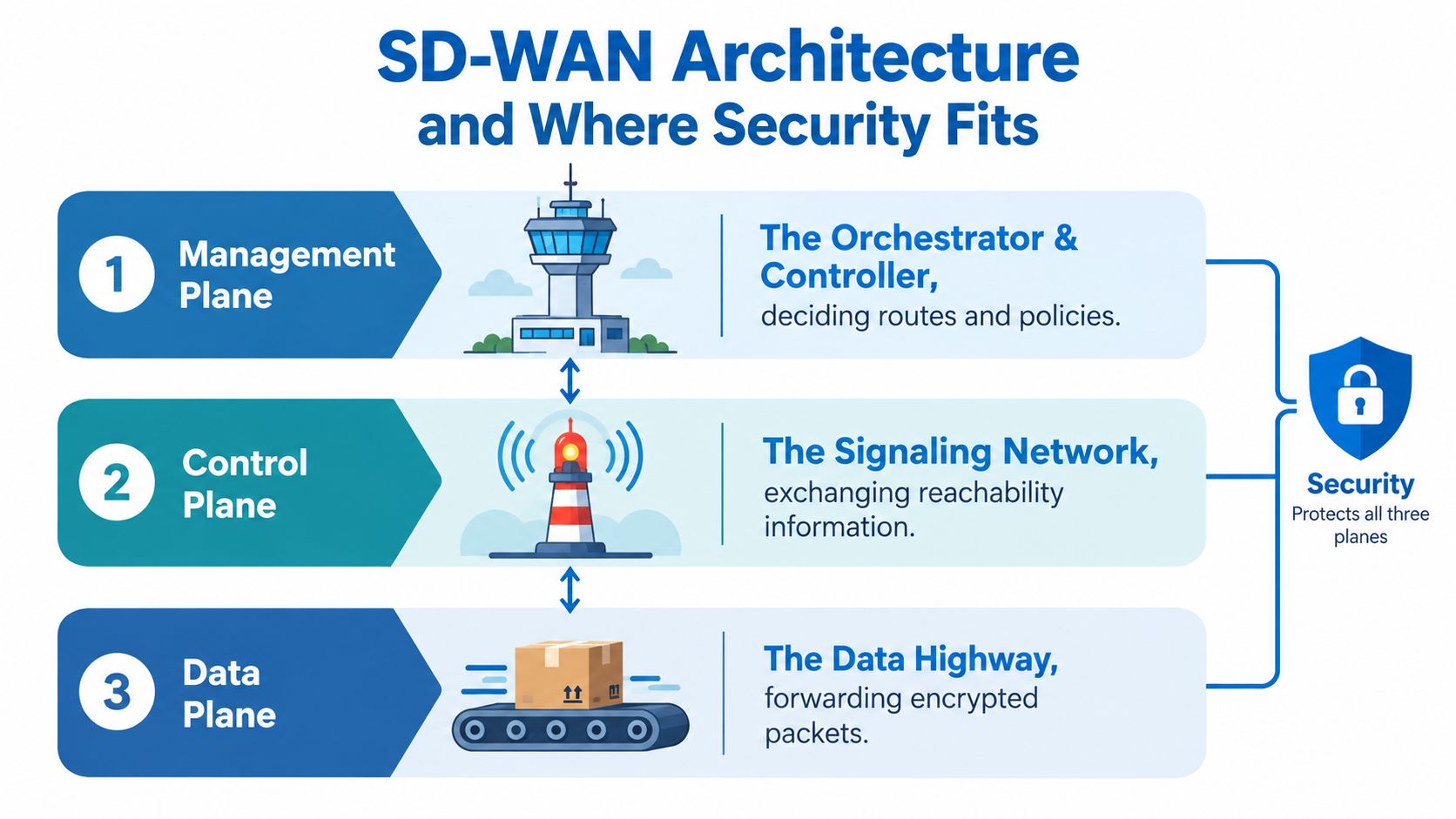
A useful way to understand SD-WAN security is to divide the system into three planes. Think of an airline rather than a collection of routers. One layer decides the schedule, another distributes instructions, and a third moves passengers and cargo.
Management plane
The management plane is the air traffic control tower. Administrators define application policies, security templates, certificates, device roles, and operational workflows here. The orchestrator may also expose dashboards and APIs used by automation systems.
Its security depends on strong administrator identity and careful separation of duties. Enforce multifactor authentication, restrict administrative roles, protect API credentials, and record changes in tamper-resistant logs. A compromised management account is especially dangerous because an attacker may not need to break every branch individually. They could attempt to alter the policy distributed across the overlay.
Control plane
The control plane is the signaling network between the tower and each cockpit. It exchanges reachability information, negotiates relationships, and distributes route or tunnel metadata. This layer doesn't carry the ordinary application payload, but it determines where that payload can go.
Device authentication matters here. The controller must distinguish a legitimate edge from an impostor, and each edge must validate the controller it contacts. Certificate lifecycle, revocation, key rotation, and protection against unauthorized route advertisements belong in this plane.
Data plane
The data plane is the conveyor belt that forwards packets between branches, data centers, cloud environments, and internet services. Encryption protects confidentiality and integrity as packets travel across broadband, LTE, MPLS, or other underlays. Segmentation and firewall policy decide whether traffic should be forwarded at all.
Cisco's design guidance for security-sensitive branch networks describes authenticated devices, encrypted inter-device communication, TLS and DTLS control channels using AES-256, and AES-GCM-256 for data-plane protection in its architecture. The Cisco SD-WAN design guidance illustrates how authentication, encryption, and segmentation work together.
Remote users introduce another boundary. A branch overlay isn't automatically a remote-worker access system, so teams should distinguish site-to-site connectivity from user access and review how a VPN for remote workers fits alongside identity-aware controls.
The New Attack Surfaces SD-WAN Creates
Encryption is necessary, but it isn't a complete answer. IPsec can protect the contents of a tunnel while an attacker targets the controller that creates the tunnel, the appliance that terminates it, or the internet breakout that feeds it.
The first surface is the controller and orchestrator. Stolen administrator credentials, exposed APIs, weak authorization, or a vulnerable portal can let an attacker modify policies centrally. A malicious route advertisement could redirect traffic, while a changed segmentation rule could open communication between zones that were previously isolated.
The second surface is the branch edge appliance. It terminates tunnels, forwards traffic, applies security policies, and often provides administrative access. A vulnerable firmware version, an exposed management interface, weak local credentials, or unsigned software can make the appliance a high-value target. An attacker who controls the edge may see metadata, alter forwarding decisions, or use the branch as a launch point.
The third surface is direct internet breakout. Each branch becomes a local internet gateway rather than just a spoke behind a central firewall. That improves application paths, but it also means every site needs consistent web controls, DNS protection, malware inspection, logging, and incident response.
An arXiv study of internet-exposed SD-WAN systems in August 2018 identified 4,935 unique IP addresses associated with SD-WAN management interfaces across North America, Europe, and Asia. The researchers found outdated software with known vulnerabilities and insecure configurations. The arXiv study of exposed SD-WAN systems demonstrates why visibility and lifecycle management matter as much as tunnel encryption.
| Attack Surface | What Gets Targeted | Common Attack Pattern | Why Encryption Alone Fails |
|---|---|---|---|
| Controller and orchestrator | Credentials, APIs, policy database, certificates | Account takeover, malicious policy push, poisoned route information | Encryption doesn't validate whether an authorized administrator made the change |
| Branch edge | Firmware, local services, tunnel termination, device identity | Exploitation, credential abuse, tampering, tunnel hijack | An encrypted session can still terminate on a compromised appliance |
| Direct internet breakout | Web sessions, DNS, SaaS access, unmanaged devices | Malware callbacks, phishing, command-and-control traffic, exfiltration | The traffic may be encrypted, but the destination and behavior can still be malicious |
Operational teams should also map business integrations that depend on internet reachability, including messaging and customer-service workflows such as a WhatsApp Business API solution. The point isn't to block useful applications. It's to assign each one an owner, an identity policy, a permitted path, and a logging destination.
Native Security Features That Strengthen SD-WAN
A secure SD-WAN fabric works like a building with several doors, locks, guards, and cameras. No single control carries the entire burden. Segmentation limits movement, encryption protects transit, inspection examines behavior, and zero trust decides who receives access.
Start with identity-based segmentation
Traditional VLANs can separate broad network zones, but they often create large trust groups. Microsegmentation makes the policy more precise. A payment terminal, point-of-sale server, guest device, employee laptop, and building-management system shouldn't receive the same access because they share a branch.
Define zones by identity, device type, application, and business purpose. Then apply least-privilege rules between them. A guest device might receive internet access but no path to payment systems. A point-of-sale device might reach only approved transaction services. A support engineer might access a management application without receiving general network visibility.
Encrypt the underlay
IPsec protects traffic across untrusted broadband and LTE connections, and it can also provide consistent protection when multiple underlays coexist. MACsec operates at the data-link layer and can suit controlled Ethernet connections where link-level protection is required. The choice depends on the transport, device support, operational model, and where encryption endpoints must sit.
Encryption should be enabled by default, but teams still need to protect keys, certificates, and the devices that use them. Cisco's security-sensitive design uses mutual authentication and encrypted control and data channels, which reinforces the principle that identity and encryption must operate together.
Inspect traffic where it breaks out
An integrated next-generation firewall can enforce stateful rules, application controls, intrusion prevention, URL filtering, and DNS security at the branch edge. Local inspection avoids sending every internet session through a central data center, but it creates a responsibility to keep policies consistent and logs available across locations.
For unmanaged devices, DNS and URL controls can provide useful protection even when full content decryption isn't practical. Security teams should pair those controls with threat intelligence, flow telemetry, and a clear process for investigating unusual destinations.
Add session-level access
ZTNA verifies the user, device, context, and requested application before creating access. That differs from a broad network tunnel, where a successful login may place a user inside a large address space. ZTNA should complement SD-WAN site connectivity, not replace the need to secure the site-to-site fabric.
Watch the following short explanation before designing the policy model:
The resulting stack is coherent when each layer has a defined job. Segmentation limits reach, encryption protects transit, inspection evaluates traffic, and ZTNA controls application access.
How SASE and ZTNA Are Reshaping SD-WAN Buying
SD-WAN is increasingly evaluated beside secure web gateways, cloud access security brokers, firewall-as-a-service, and ZTNA. Together, these capabilities form SASE, a cloud-delivered approach that places networking and security services closer to users, branches, and applications.
The procurement implication is significant. A recent industry projection says that 60% of new SD-WAN purchases will be part of a single-vendor SASE offering by the end of 2026, compared with 15% in 2022. That projection appears in the State of Network Security 2026 report. It doesn't mean every organization should select one vendor, but it does mean a standalone SD-WAN purchase can create integration work later.
A best-of-breed architecture may offer deeper specialization and more vendor choice. The trade-off is policy duplication, separate consoles, inconsistent identity integration, and more complicated incident investigation. A converged platform may simplify policy and support, but buyers need to examine feature depth, portability, service reliability, and the vendor's ability to treat security as a first-class capability.
| Evaluation Criteria | SASE Converged Platform | SD-WAN Plus Standalone Security |
|---|---|---|
| Policy management | One policy model may cover users, branches, applications, and internet access | Separate policies may require integration and reconciliation |
| Cloud connectivity | Security services are delivered through cloud points of presence | Traffic may pass through separate security gateways |
| Identity integration | Identity providers and ZTNA are usually central to the design | Teams may need to connect several identity-aware products |
| Vendor flexibility | Fewer suppliers can reduce operational friction | More suppliers can provide specialized capabilities |
| Troubleshooting | A unified view can simplify ownership and correlation | Teams may need to correlate logs across platforms |
| Migration risk | Consolidation can create dependence on one roadmap | Integration and lifecycle management remain customer responsibilities |
ZTNA also changes the remote-access question. Instead of granting a user a tunnel into a broad network, it can authorize a specific application session based on identity and device posture. During evaluation, inspect cloud point-of-presence coverage, failover behavior, logging, API access, identity-provider support, and whether networking and security share one operating model.
Best Practices Checklist for Secure SD-WAN Deployment
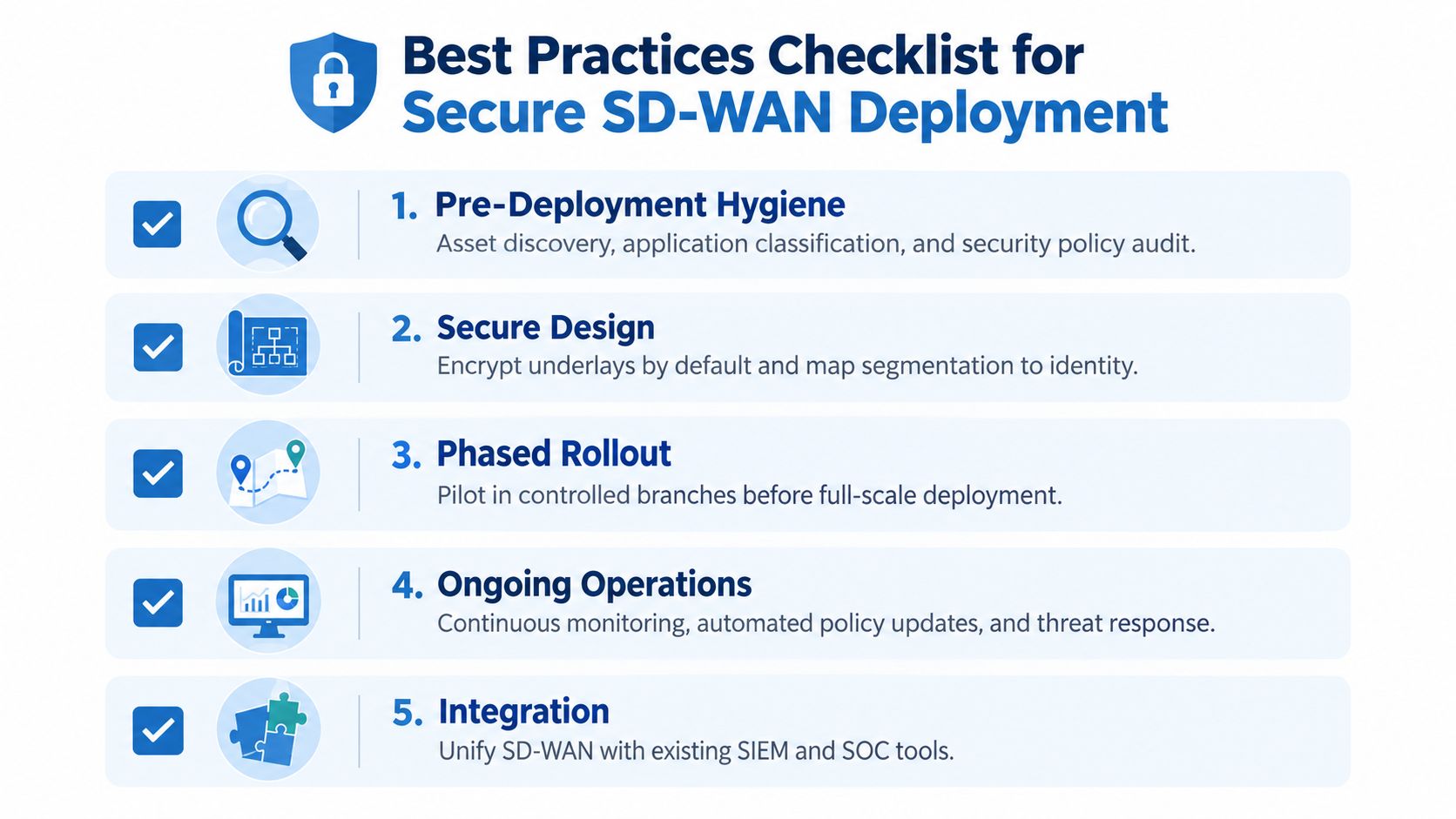
Secure SD-WAN begins before the first appliance arrives. Build an inventory of sites, devices, applications, transports, administrators, and internet breakouts. Classify applications by sensitivity and business dependency, then define security zones before writing forwarding rules.
Design the control surface first
Protect the controller as if it were a security administration system, because it is one. Require MFA for management access, use role-based permissions, restrict administrative paths, rotate API keys, and send immutable audit records to the SIEM. Separate routine operations from policy approval so one compromised account can't change the entire overlay.
At the branch, establish a baseline. Remove unused services, restrict local management interfaces, replace default credentials, verify firmware provenance, and define a supported patch lifecycle. The SMB website security guide offers useful supplementary hygiene for smaller teams that often manage network and web exposure with the same limited staff.
Roll out policies in controlled stages
Use a pilot site with representative applications, users, guest access, and failure conditions. Test:
- Default-deny segmentation: Confirm that zones communicate only through explicitly approved rules.
- Application-aware routing: Verify that path selection doesn't bypass inspection or logging.
- Breakout security: Check firewall, IPS, DNS, URL, and malware controls at every local internet path.
- Controller failure: Confirm that existing sessions and local enforcement behave as designed.
- Configuration consistency: Compare intended templates with the active configuration at each edge.
A staged rollout gives operators time to discover exceptions without distributing them everywhere. Teams can also use controlled experimentation for customer-facing network experiences, including an A/B testing platform, provided its access and data flows receive the same review as other SaaS services.
Operate as though drift is inevitable
Configuration drift, expired certificates, policy exceptions, and untracked devices create risk after deployment. Monitor flow telemetry for unusual east-west communication, repeated beaconing, unexpected destinations, and changes in route behavior. Link alerts to investigation procedures and relevant MITRE ATT&CK techniques rather than sending unstructured noise to a shared inbox.
Maintain runbooks for controller compromise, branch tampering, stolen credentials, and breakout abuse. Include device isolation, certificate revocation, policy rollback, evidence preservation, and communications ownership. Tabletop exercises should test whether the team can make those decisions under pressure.
When Managed Network Edge Beats Going DIY
DIY SD-WAN often looks manageable during procurement. The platform may be centrally configured, and the branch devices may be easy to install. The operational burden appears later, when a small team must patch controllers, rotate certificates, investigate policy drift, tune segmentation, review alerts, and support users across distributed sites.
The deciding question isn't whether the technology can be operated internally. It's whether the organization can sustain the required discipline during vacations, incidents, audits, migrations, and competing projects. A network team without dedicated security engineering may configure the overlay correctly and still struggle to maintain it.
A managed model can provide monitoring, escalation, lifecycle coordination, and security operations integration. That doesn't remove customer responsibility. The customer still owns business requirements, application approvals, identity decisions, compliance obligations, and incident authority. The provider should own the agreed operational tasks, not the customer's risk decisions.
| Capability | DIY SD-WAN | Managed Network Edge |
|---|---|---|
| Device lifecycle | Customer plans inventory, replacement, and retirement | Provider coordinates agreed device lifecycle activities |
| Firmware management | Internal team schedules testing and updates | Provider manages the contracted update process |
| Policy governance | Customer writes, reviews, and distributes policies | Provider administers approved templates and changes |
| Monitoring | Internal staff operate dashboards and alerts | Provider supplies contracted monitoring and escalation |
| Threat intelligence | Customer integrates and tunes feeds | Provider manages agreed feed ingestion and enforcement |
| Posture reviews | Customer schedules assessments | Provider conducts reviews when included in the service |
Premier Broadband's Managed Network Edge brings SD-WAN, routing, remote access, firewalls, and unified threat management into a modular managed service. For organizations evaluating that route, the Managed Network Edge offering should be assessed against the contract's actual SLA, escalation path, logging scope, change-control process, and division of responsibilities.
Bringing It All Together for a Secure SD-WAN Posture
A secure SD-WAN posture in 2026 uses encrypted underlays by default, identity-mapped segmentation, zero-trust application access, inline NGFW inspection, and continuous branch and cloud visibility. SASE can provide a unified policy plane, but only if the organization defines ownership and verifies how the services work together.
Make three decisions this quarter:
- Audit every internet breakout: Assign an owner, policy, inspection point, and logging destination.
- Document the security boundary: Decide which controls belong in SASE, at the branch, or in a hybrid design.
- Choose the operating model: Build the required internal capability or transfer defined responsibilities through a managed network edge contract.
Use a structured approval workflow, such as ApprovePilot, to make ownership and change authorization explicit where it fits your operating model. Secure SD-WAN is a posture decision, not a procurement decision, and the choices made this quarter determine the next three years of exposure.
Premier Broadband offers business connectivity, SD-WAN, managed firewalls, unified threat management, remote access, and Managed Network Edge services for organizations that need a more controlled branch architecture. Visit Premier Broadband to discuss your current internet breakouts, security responsibilities, and the practical path to a secure SD-WAN deployment.