
Low-cost VoIP (Voice over Internet Protocol) is a modern phone service that lets you make and receive calls right over your internet connection, instead of relying on old-school copper phone lines. The main reason it's so much more affordable is simple: it uses the internet service you already pay for.
This approach cuts out the need for a separate, dedicated phone line from the phone company. It’s a smarter way to handle calls that slashes monthly bills while piling on features that traditional landlines just can't match.
Demystifying How Low-Cost VoIP Works
Think about how email works. You type a message, hit send, and the internet breaks it into tiny digital packets. Those packets travel across the web and get put back together on your friend's screen. Low-cost VoIP does the exact same thing, just with your voice.
When you start talking, the VoIP service instantly converts your voice from an analog soundwave into digital data. These little packets of information zip across the internet to the person you're calling. On their end, the process flips, turning that data back into crystal-clear audio.
This whole round trip happens in milliseconds, so your conversation feels just as instant and natural as a regular phone call. The only real difference is the highway your voice is traveling on—the internet instead of the traditional phone network.
The Three Core Components You Need
Getting started with a low-cost VoIP system is surprisingly straightforward. It really only comes down to three things, and you probably have at least one of them already.
- A Stable Internet Connection: This is the bedrock of your VoIP service. A solid, reliable connection like fiber internet ensures your voice data travels smoothly, preventing annoying issues like static, garbled words, or dropped calls.
- A VoIP-Enabled Device: You've got options here. You can use a special IP phone that plugs right into your internet router, an Analog Telephone Adapter (ATA) to connect your current landline phone, or just a simple app (called a softphone) on your computer or smartphone.
- A VoIP Service Provider: This is the company that makes it all happen. They connect your calls, give you a phone number, and manage all the behind-the-scenes tech that routes everything to the right place.
The magic of VoIP is its efficiency. By treating your voice just like any other data on the internet—like a streaming video or a webpage—it sidesteps the expensive, aging infrastructure of the old phone companies.
This digital-first approach isn't just about saving a few bucks. It unlocks a whole world of advanced features that landlines could never easily provide, turning a basic phone line into a powerful communication tool. The term 'low cost VoIP' doesn't mean you're compromising on quality; it just means you've found a smarter, more resourceful way to stay connected.
To see the process in action, you can learn more about how VoIP phone technology works and get a deeper look at the mechanics.
Breaking Down the Real Cost of VoIP Service
When you hear "low-cost VoIP," it’s easy to get fixated on just the monthly price. But to really get the full picture and see where the savings kick in, you have to look at everything involved. The true value of VoIP shines when you understand all the pieces that make up its cost—and see how they stack up against your old landline bill.
The main cost you'll see is a straightforward monthly subscription. This single, predictable fee usually takes the place of that confusing mix of line rental charges, local calling fees, and pricey add-ons that come with traditional phone services.
H3: Unpacking Common Pricing Models
Figuring out how providers charge is the first step to finding a plan that fits your wallet. Most services fall into one of two camps, and each has its perks depending on what you need.
- Per-User Pricing: This is a popular model for businesses. You pay a flat monthly fee for each person (or "user") on the system. It’s simple, easy to scale up or down, and lets you add or remove employees without a fuss.
- Bundled Packages: Often designed for homes or small offices, these plans bundle a set of features and sometimes a block of calling minutes into one flat-rate price. It's a great way to get everything you need for one predictable cost.
Beyond the monthly bill, you might run into a couple of one-time expenses. Many providers offer free setup, but some might have a small charge for hardware like an Analog Telephone Adapter (ATA), which lets you connect your current phone. Another common one-time cost is number porting—that's the small fee for bringing your existing phone number over to the new service.
The secret to VoIP's low cost is that it treats your voice like any other data online. This graphic shows how your voice gets turned into digital packets and sent over the internet, completely bypassing those expensive old-school phone networks.
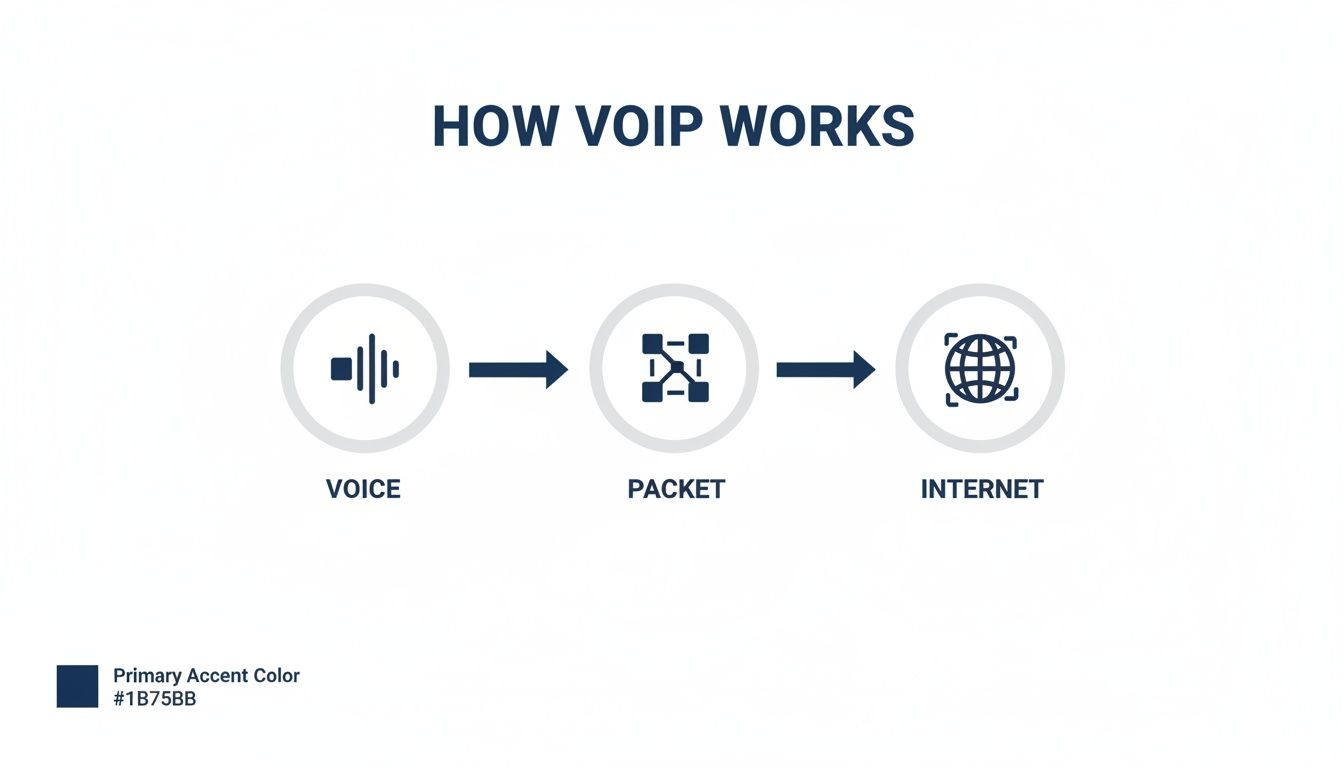
This digital approach is what gets rid of the need for separate, costly phone lines. It just uses the internet connection you're already paying for.
H3: Landline vs. VoIP: A Financial Showdown
The real eye-opener is when you put the costs side-by-side. The global VoIP market is exploding for one simple reason: the savings are huge. The market was valued at around $161.79 billion in 2025 and is expected to hit $415.20 billion by 2034, driven almost entirely by how much money it saves people and businesses. This is especially true for international calls, where VoIP can slash costs down to just pennies a minute.
Let's break down exactly where you'll see those savings.
H3: Cost Comparison: Traditional Landline vs. Low Cost VoIP
Here’s a look at how the typical expenses for a traditional landline compare to a modern low-cost VoIP service.
| Cost Component | Traditional Landline (Estimated Monthly Cost) | Low Cost VoIP (Estimated Monthly Cost) | Key Difference |
|---|---|---|---|
| Monthly Base Fee | $30 – $60 | $10 – $25 | VoIP is often 50-70% cheaper right out of the gate. |
| Long-Distance Calls | Per-minute charges or expensive add-on plans | Usually included for free within the U.S. and Canada | Say goodbye to unpredictable long-distance bills. |
| International Calls | $0.25 – $3.00+ per minute | $0.01 – $0.05 per minute | Savings can be 90% or more on international calls. |
| Feature Add-ons | $5 – $15 per feature (Caller ID, Voicemail, etc.) | Included in most standard plans | Get modern features built-in, not as pricey extras. |
| Setup & Equipment | Professional installation fees | Often free or just a low-cost adapter | VoIP avoids costly technician visits and clunky hardware. |
By getting rid of separate line rental fees and including valuable features from the start, a low-cost VoIP service delivers a modern communication tool that's both powerful and easy on your budget.
For anyone looking to get the most bang for their buck, learning more about flat-rate VoIP can make your monthly expenses even more predictable. Switching from a landline to VoIP isn't just a small upgrade; it’s a total change in how you pay for phone service, leading to big, consistent savings over time.
Must-Have Features in a Modern VoIP Service
When you switch to a low cost VoIP service, you're getting so much more than just a dial tone. The real magic isn't just in the lower monthly bill; it's in the powerful communication tools that come standard. A modern VoIP system becomes the central hub for all your conversations, for your home or your business.
Think about features like Caller ID, Call Waiting, and Voicemail. With old-school landlines, these were often expensive extras. With VoIP, they're just the starting point.
Core Features That Add Real Value
To find the best service, you need to look past the price tag and focus on the features that will actually make a difference in your day-to-day. These are the tools that turn a good deal into a genuinely great one.
Voicemail-to-Email: Forget dialing into your voicemail ever again. This handy feature transcribes your voicemails and sends them straight to your email. You can read messages on the fly, forward them to your team, or save them for your records without ever picking up the phone.
Mobile App Integration: This is a total game-changer for staying connected. A good mobile app turns your smartphone into an extension of your office phone. You can make and take calls from your VoIP number anywhere you have internet, keeping your personal cell number private and maintaining a professional image.
Auto-Attendant (Virtual Receptionist): For a small business, an auto-attendant instantly makes you look bigger and more professional. It greets callers with a custom message and gives them menu options ("Press 1 for sales…"). This gets calls to the right person quickly and efficiently, no receptionist needed.
Advanced Tools for Power Users
Beyond the basics, many VoIP plans include features that give you even more control and can seriously boost productivity.
Data shows that 74% of employees use a mobile app for work-related calls. It’s clear that flexible, work-from-anywhere communication isn't just a trend—it's essential. This is why mobile integration is no longer a luxury but a must-have for any modern phone service.
One of the most powerful tools is Call Forwarding. This lets you automatically send calls to another number—like your cell—if you can't answer or if the internet goes down. It's a simple fail-safe that ensures you never miss that important call.
Another key feature is Simultaneous Ring. It makes multiple phones ring at once—your desk phone, your mobile app, maybe even a colleague's line. The first person available can grab the call, which is a huge help for reducing missed opportunities and keeping customers happy. And if you need to keep records, many services offer call recording. You can learn more about the benefits of VoIP call recording to see how it helps with training and quality control.
Building Your Feature Checklist
As you compare low cost VoIP providers, don’t just look at the price. Make a checklist of the features that you actually need. Are you running a business from home and need that auto-attendant? Are you always on the go and need a rock-solid mobile app?
By figuring out your "must-haves," you can find a provider that delivers more than just savings. You get a communication experience that truly fits your life or your business. That focus on real-world value is what makes switching to VoIP such a smart move.
Navigating the Quality and Cost Tradeoff
Does "low cost" automatically mean you're in for a bad time with call quality? It's a huge worry for anyone thinking about switching to VoIP, but the answer is a clear no. A low-cost VoIP service doesn't mean you have to put up with static and dropped calls; it just means you need to know what really matters for a great calling experience.
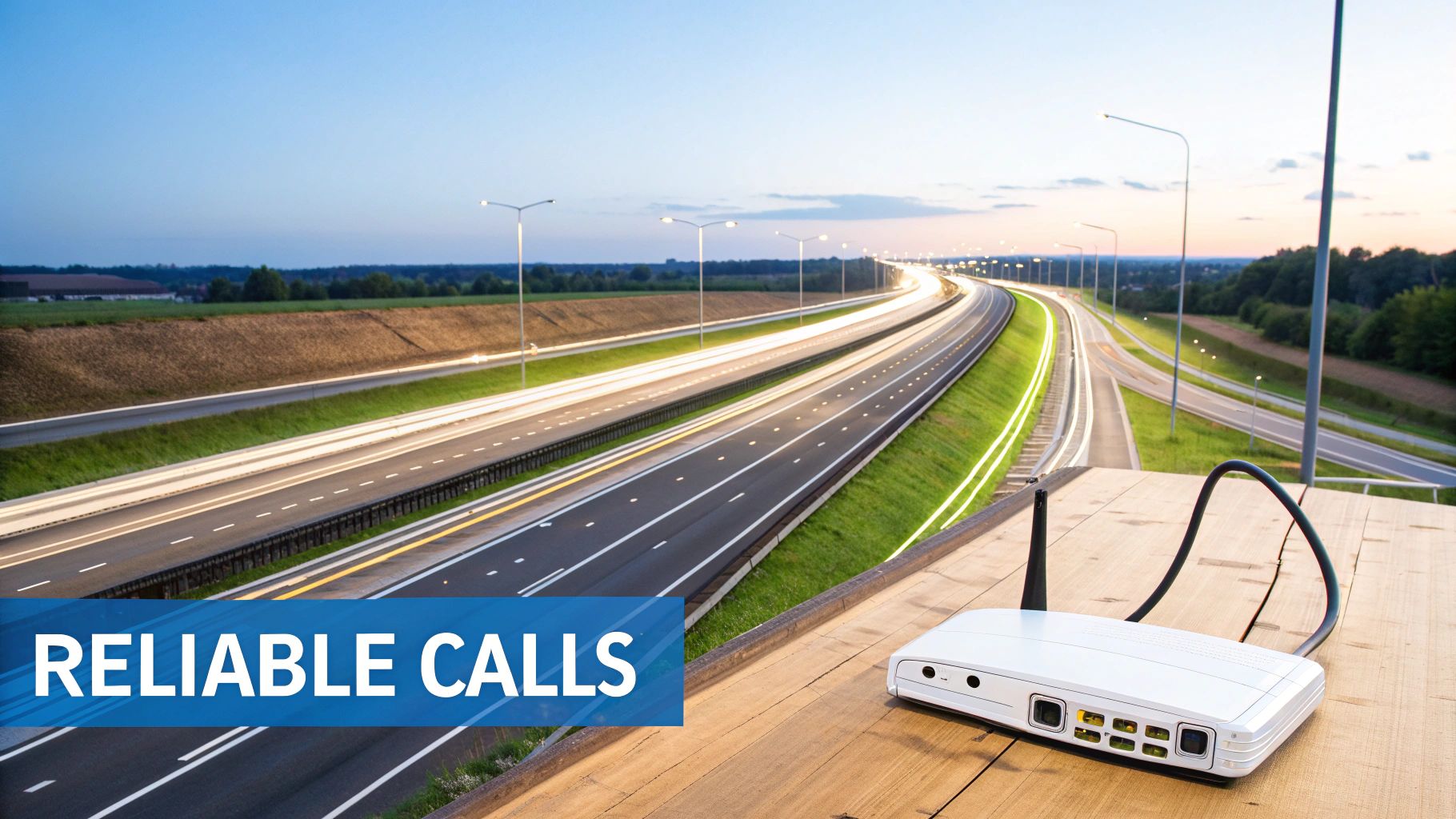
The quality of a VoIP call has very little to do with the price tag on your plan. It has almost everything to do with your internet connection. Think of your internet as a big, multi-lane highway. Your voice, which gets turned into tiny digital packets of data, is like a fleet of cars trying to get to its destination fast and in the right order.
Your Internet Is the Superhighway for Calls
A solid, stable connection like fiber internet is like giving your voice packets their own five-lane expressway. They can zoom along without hitting any traffic, arriving at their destination almost instantly. This is what gives you those crystal-clear, lag-free conversations you're looking for.
On the flip side, a slow or congested internet connection is like a single-lane country road during rush hour. When other people in your house are streaming movies or downloading huge files, it creates a traffic jam. Your voice packets get stuck, delayed, or even show up out of order. That’s what causes those all-too-common call problems.
Jitter: This happens when data packets arrive all mixed up, making voices sound garbled or robotic. It’s the digital version of cars getting scrambled in a traffic jam.
Latency (or Lag): This is that annoying delay between when you say something and when the other person hears it, causing you to talk over each other. It’s like a long red light holding up your conversation.
These headaches aren't caused by your affordable VoIP plan; they're symptoms of a bottleneck on your internet highway. Even the best phone service can only work as well as the connection it's running on.
Asking the Right Questions for Dependable Service
When you're shopping for a low-cost VoIP provider, your real focus should be on their network quality and the stability of your own internet. Nailing this combination gets you the best of both worlds—great prices and solid dependability.
Here’s what you should be looking for and asking about:
- Uptime Guarantees: Ask providers about their service level agreement (SLA) for uptime. Any company worth its salt should be guaranteeing 99.9% uptime or higher. This means their network is always on and ready when you need it.
- Network Infrastructure: Find out what kind of network they use. Providers who manage their own infrastructure or partner with top-tier carriers can deliver much better performance because they have more control over the call quality from start to finish.
- Quality of Service (QoS) Features: QoS is a tech feature that basically creates a VIP express lane on your internet highway just for your phone calls. It prioritizes your voice data over everything else, ensuring your calls always get through loud and clear.
- Customer Support: What happens when things go wrong? A provider with quick, helpful support can get you back online fast, helping you troubleshoot connection issues before they become a real problem.
Once you understand these factors, you can pick a low cost VoIP provider with confidence, knowing you won't have to sacrifice quality. You can dive deeper into checking your connection and finding the right plan by learning about the required bandwidth for VoIP. The key is to match an efficient service with a strong internet connection—that's the recipe for clear, professional calls every time.
How to Choose the Right Low Cost VoIP Provider
Making the jump to a low cost VoIP provider is a smart move, but picking the right one from a crowded field can feel like a real chore. The secret is to have a simple, step-by-step process. If you take the time to figure out what you need and compare your options, you'll land a service that gives you great value and reliable performance.
This isn't just about chasing the lowest price tag. It's about finding the right fit for how you communicate, whether for your family at home or your small business. A little bit of homework upfront saves you a lot of headaches down the road.
Check Your Internet Connection First
Before you start shopping for providers, let's talk about your internet. VoIP runs completely over your internet connection, so a stable, high-speed line is non-negotiable for clear, drop-free calls. Think of it like making sure the road is paved and smooth before you try to drive on it.
Run a quick speed test to see your upload and download numbers. VoIP doesn't hog a ton of data, but it needs a consistent connection to work well. A fast connection, especially a fiber one like we offer at Premier Broadband, cuts down the risk of choppy audio and lag, making every call sound professional.
A common mistake is signing up for a VoIP plan without checking if the internet can handle it. Even the best VoIP service will sound terrible on a weak connection. Always start by checking your network's health.
Next, think about your phones. Do you want to keep using the landline phones you already have? You’ll need a provider that offers an Analog Telephone Adapter (ATA) to make them work. Or maybe you'd prefer new IP phones or just using an app on your smartphone. Knowing what you want to use will help you narrow down the list fast.
Make Your "Must-Have" Feature List
Not all low cost VoIP plans are built the same. Features can vary a lot, so it’s key to write down your must-haves before you start comparing. That way, you only pay for what you’ll actually use.
Just jot down the core functions you can't live without.
- For Your Home: Your list might be simple: number porting (to keep your current phone number), voicemail-to-email for when you're on the go, and caller ID.
- For Your Business: A business checklist will probably be a bit longer. Think about an auto-attendant to route calls, a mobile app for working from anywhere, and call forwarding so you never miss a customer call, even if the internet goes down.
With your list in hand, you can treat it like a scorecard when looking at different providers. It helps you cut through the marketing fluff and focus on what really matters. The residential VoIP market is booming for this very reason, with its value expected to hit $27.68 billion in 2025 and grow by 11.4% through 2035 as more people ditch old landlines. You can find more details on the growth of residential VoIP on Sheerbit.com.
Vet the Providers and Read Real Reviews
Now that you know what you need technically and feature-wise, it's time to research some providers. Look past the monthly price and get into the nitty-gritty. How do they charge—per person or in a bundle? Are there any hidden setup or equipment fees?
Finally, check out what other customers are saying. Pay close attention to reviews about call quality, reliability, and how good their customer support is. A provider known for being dependable and helpful is worth its weight in gold. By following these simple steps, you'll find a low cost VoIP provider that's the perfect match for you.
Got Questions About Low Cost VoIP?
It’s smart to have a few questions before you switch up your phone service. Changing how you connect with family, friends, or customers is a big deal, and you want to get the details right. We’ve put together quick, clear answers to the most common things people ask.
Think of this as your final check-in. We'll cover everything from keeping your phone number to what happens if the internet goes out.
Can I Keep My Current Phone Number?
Yes, you absolutely can. For most people, this is a huge relief. You can almost always bring your existing phone number with you to a new VoIP provider. The process is called number porting, and it’s a standard practice.
Your new provider does all the heavy lifting, working with your old phone company to move the number over smoothly. You might see a small, one-time fee, but it's well worth it to avoid the headache of updating your contact info everywhere.
Important: Do not cancel your old phone service until the porting process is 100% complete. If you cancel too early, you could lose your number for good. Your new VoIP provider will give you the green light when it’s safe to part ways with your old carrier.
What Happens to My VoIP Phone If the Internet Goes Down?
That’s a fair question, since VoIP runs on your internet connection. If you lose power or internet, your VoIP phone won't work directly. But don't worry—any good VoIP provider has a plan for exactly this situation.
It's a feature called call forwarding or failover routing. When you set up your service, you can pick a backup number, like your cell phone. If your system goes offline, all incoming calls are automatically sent to that backup number. You won’t miss an important call, keeping you connected even during an outage.
Do I Need to Buy Special Equipment?
Not usually, which is a big part of what keeps VoIP affordable and easy to start. You’ve got a few options, and you can often use phones you already have.
Here are the most common setups:
- Analog Telephone Adapter (ATA): This is the go-to for homes and small offices. It’s a small box that connects your regular landline phone to your internet router. Just plug your old phone in, and you’re good to go.
- IP Phones: These look like standard office phones but plug right into your internet with an Ethernet cable. They often come with extra features and HD audio, making them a great pick for businesses.
- Softphone or Mobile App: Most providers offer an app for your computer or smartphone. This turns your device into a phone, letting you make and receive calls on your VoIP number from anywhere you have an internet connection.
Is Low Cost VoIP Secure Enough for Business?
Yes. Today’s VoIP services are built with strong security to keep your conversations private. Good providers know how important this is, especially when you’re discussing sensitive business information.
They use powerful encryption, just like online banking or credit card sites. The key things to look for are Transport Layer Security (TLS) and Secure Real-Time Transport Protocol (SRTP). Together, they lock down your call from start to finish. TLS secures the call setup, and SRTP encrypts the audio itself.
When choosing a low cost VoIP provider for your business, just ask if they offer end-to-end encryption. That way, you know your confidential calls stay confidential.
Ready for crystal-clear calls, powerful features, and real savings? Premier Broadband delivers reliable VoIP service backed by our 100% fiber network, giving you the speed and stability you need for a flawless connection every time.
Discover how Premier Broadband can upgrade your communications today