

The secret to making low-cost VoIP calls is simple: you're using the internet connection you already pay for to handle your calls. This completely sidesteps the need for traditional, expensive phone lines. By going digital, you can dramatically cut your communication costs—especially for long-distance and international calls—and turn a fluctuating phone bill into a predictable, small expense.
This is all thanks to a technology called Voice over Internet Protocol (VoIP), which has totally changed how we connect.
How VoIP Slashes Your Phone Bill
Think about it—your internet is probably always on. VoIP just uses a tiny slice of that connection for your phone calls. Instead of renting a physical copper wire from the phone company, your calls travel as digital data right alongside your Netflix stream and emails. That fundamental shift is why VoIP costs so much less than a regular landline.

The savings are immediate and obvious. Most VoIP plans give you unlimited local and long-distance calling for one flat monthly fee, so you can stop watching the clock on calls to other states. And if you have family or business contacts overseas, the difference is just staggering. International calls can drop to just pennies per minute instead of several dollars.
More Than Just Savings
Beyond the money you'll save, VoIP brings a ton of flexibility and modern features that old-school phone systems just can't touch. Your phone number is no longer tied to a physical location, because it's all internet-based.
This unlocks a whole suite of powerful tools to make communication easier:
- Voicemail-to-Email: Get your voicemails sent as audio files right to your inbox. You can save them, forward them, and manage them just like any other email.
- Call Forwarding: Easily send calls from your home phone to your cell when you're out, so you never miss anything important.
- Caller ID and Call Waiting: These are standard features, included without the nickel-and-dime fees the old phone companies love to add.
- Portability: You can take your phone number with you anywhere you have an internet connection, whether you're moving across town or traveling for the holidays.
The global VoIP market is exploding as more people look for flexibility and real savings. A 2023 analysis valued the market at a massive $112.9 billion, and it's projected to hit $179.6 billion by 2026. This shows a clear trend: people are moving away from expensive, outdated landlines for good.
The Foundation of a Great VoIP Experience
For crystal-clear, reliable calls, everything depends on the quality of your internet connection. A stable, high-speed connection makes sure your voice data travels smoothly, getting rid of those annoying issues like robotic-sounding audio or dropped calls. This is where a solid fiber internet connection really proves its worth.
Providers like Premier Broadband offer symmetrical fiber speeds, which means your upload speed is just as fast as your download speed. This is a game-changer for VoIP, since a conversation involves sending and receiving voice data at the same time.
When you pair a dependable fiber network with a straightforward VoIP service, you create the perfect setup for flawless communication. You can see how a flat rate VoIP plan can simplify your billing and help you save even more.
Finding the Right VoIP Provider for Your Business
Picking the right provider is hands-down the most critical step to unlocking real savings with VoIP. The market is packed with options, but the best choice really boils down to how you'll use the service day-to-day. Don't get bogged down by endless feature lists—zero in on what actually matters for your specific needs.
Think about it this way: a consultant working from a home office needs a professional business line, probably with an auto-attendant to route calls. On the flip side, a family wanting to keep in touch with relatives overseas should be hunting for the absolute best international calling rates. These are two completely different needs, requiring completely different plans.
VoIP is exploding because it tears down geographic walls, fueling a global industry valued at a staggering $145.70 billion in 2024. Projections show it could hit $415.20 billion by 2034, driven by both families and businesses. The appeal is obvious, with some unlimited calling plans costing 60-80% less than your old-school phone company.
Residential vs. Business Plans
First things first, you need to know the difference between a residential plan and one built for business. Residential plans are all about simplicity and keeping costs low, making them a great replacement for a home landline. Business plans, however, are built for rock-solid reliability and come packed with features to support a professional operation.
- Residential Plans: These typically focus on unlimited domestic calls, cheap international rates, and the basics like caller ID and voicemail. Perfect for families.
- Business Plans: Here you’ll find powerful tools like auto-attendants (IVR), call queues, integrations with your CRM, and detailed call analytics. These are non-negotiable for any business, from a one-person shop to a growing team.
Key Takeaway: Whatever you do, don't try to use a residential plan for your business. You'll miss out on essential features and could even violate the provider's terms of service, which might lead to your service getting cut off at the worst possible time.
What to Look for Beyond the Price Tag
While saving money is the goal, the cheapest plan isn't always the smart choice. You have to dig a little deeper to make sure you're getting a service that actually works for you and won't hit you with surprise costs.
VoIP Plan Feature Comparison for Different Users
To get a clearer picture, let's break down what different types of users should be looking for in a VoIP plan. The priorities for a family are vastly different from those of a small business.
| Feature | Residential User (Family) | Home Office User | Small Business (5+ Employees) |
|---|---|---|---|
| Primary Goal | Low-cost landline replacement | Professional image, call management | Scalability, team collaboration, reliability |
| Unlimited Calling | Primarily domestic | Domestic & potentially toll-free | Domestic, toll-free, and inter-office |
| International Rates | A top priority for connecting with family abroad | Important, but depends on client base | Varies; need competitive per-minute rates |
| Auto-Attendant | Not needed | Highly recommended for a professional greeting | Essential for routing calls efficiently |
| Mobile App/Softphone | "Nice to have" feature | Essential for taking business calls on the go | Critical for remote work and team mobility |
| CRM Integration | Not applicable | Could be useful for tracking client calls | A must-have for sales and support teams |
| Call Recording | Rarely needed | Useful for client notes and training | Important for quality assurance & compliance |
This table shows why a one-size-fits-all approach doesn't work. Always match the plan's features to your actual, real-world needs.
Check the Fine Print for Hidden Fees
Some providers lure you in with a super-low monthly rate, but then tack on regulatory fees, taxes, or extra charges to port your existing number. Always ask for the total estimated monthly cost before you sign anything.
Evaluate International Calling Rates
If you regularly call other countries, this is huge. Compare the per-minute rates to the specific countries you dial most. A provider with a slightly higher monthly fee but much lower rates to Europe or Asia could save you a fortune in the long run.
Test Customer Support Quality
When your phones go down, you need help, and you need it fast. Before you commit, check out independent reviews for any provider you're considering. Do they offer 24/7 support? Is it easy to get a real person on the line? Our guide on the top VoIP providers for business is a great place to start your research.
At the end of the day, reliable VoIP starts with a stable fiber internet connection. A service like Premier Broadband provides the consistent, low-latency bandwidth that VoIP absolutely depends on. It's the foundation for crystal-clear calls and prevents the frustration of choppy audio and dropped connections.
Setting Up Your Hardware for Flawless Calls
Once you've landed on the right provider, it's time to get your hardware sorted out so you can start making those first low-cost VoIP calls. Don't worry, this part isn't nearly as technical as it might sound. The whole point is just to connect your phone to the internet, and you’ve got a few simple ways to do it.
For most home users, the most common route is an Analog Telephone Adapter (ATA). Think of this little box as a translator that turns your trusty analog phone—the one you already have—into a VoIP powerhouse. It’s hands-down the easiest and most budget-friendly way to get up and running.
Another popular option is a softphone, which is just an app you install on your computer or smartphone. It turns your device into a full-featured phone, letting you make and receive calls with a headset or your built-in mic. This is a fantastic choice for remote workers or anyone who wants their business line with them on the go.
Finally, if you’re after a more buttoned-up, professional setup, you can go for a dedicated IP Phone. These look just like traditional office phones but plug directly into your internet connection. They often deliver superior audio quality and come packed with advanced business features.
Choosing Your Setup Path
The right hardware really boils down to your specific needs and budget. A family looking to replace their landline is going to have different requirements than a home-based consultant who needs to project a more professional image.
- Analog Telephone Adapter (ATA): This is your best bet if you like your current phone and want things to feel familiar. Setup is a breeze: just plug the ATA into your router and then plug your phone's base into the ATA. You're ready to go in minutes. For a deeper dive, check out our guide on choosing a phone and internet adapter.
- Softphone Application: Perfect for digital nomads, freelancers, or anyone who doesn't want another piece of gear on their desk. All you really need is a solid internet connection and a good headset to keep calls crystal clear.
- Dedicated IP Phone: This is the go-to for small businesses or a dedicated home office. These devices usually have programmable buttons, call transfer capabilities, and high-definition audio that give you a truly professional calling experience.
The visual guide below breaks down the simple process of getting started with VoIP, from figuring out your needs to picking a provider.
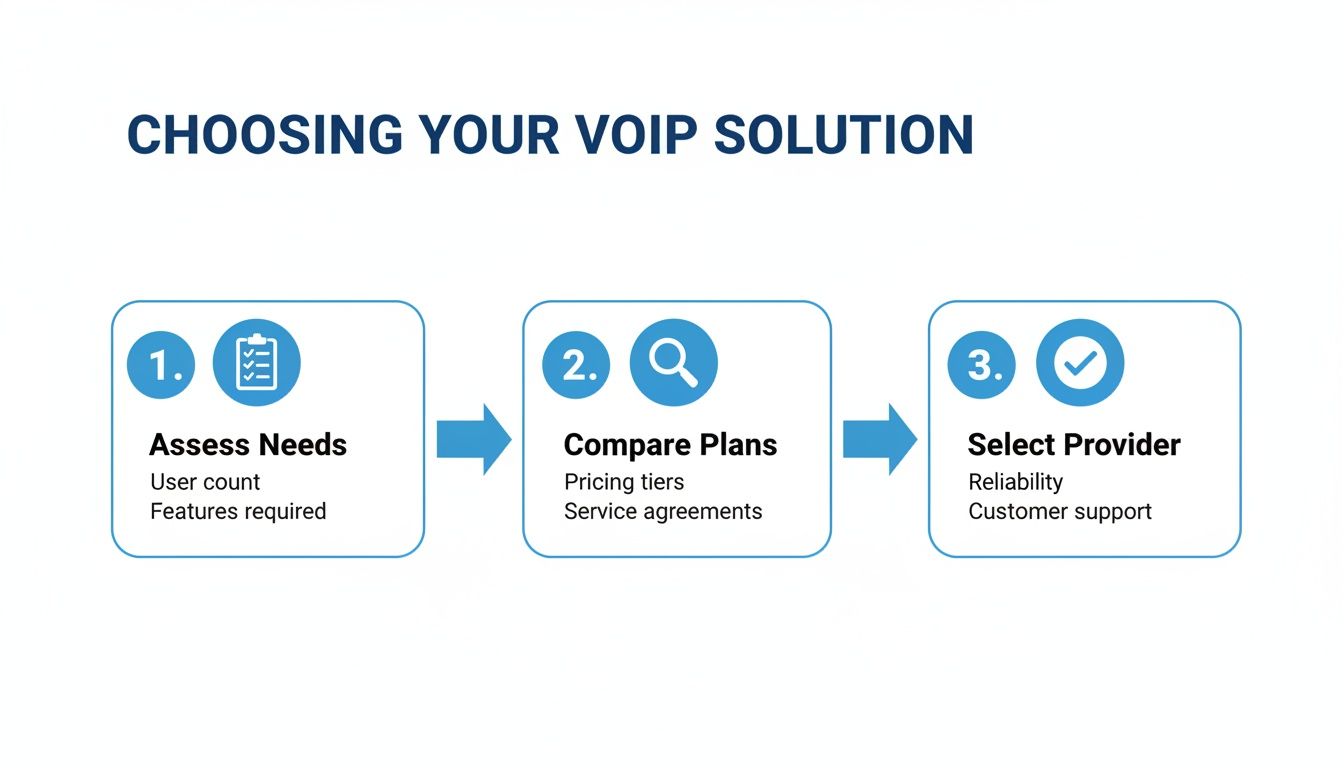
As you can see, choosing your hardware is a direct result of understanding your needs and plan features first.
The Unsung Hero: Your Router
No matter which hardware you choose, your internet router is the heart of the entire operation. An older or underpowered router can cause all sorts of frustrating problems—choppy audio, echoes, or dropped calls—even with a fast internet plan. It’s the traffic cop for all the data in your home, and VoIP calls are extremely sensitive to delays.
Pro Tip: For the best possible call quality, I always recommend a modern router that supports Quality of Service (QoS). This feature lets you prioritize VoIP traffic, essentially telling your router to handle phone calls before it deals with less urgent things like file downloads or video streams.
A high-quality router, especially when paired with a managed Wi-Fi solution, ensures your call data gets the VIP lane it needs. This is the foundation for maintaining crystal-clear conversations and making VoIP a reliable part of your daily routine.
Dialing in Your Network for Peak Call Quality
You can have the best VoIP hardware on the market, but the real secret to consistently flawless calls lives inside your network. Think of a well-tuned network as a dedicated express lane for your voice data. It ensures your conversations are always crystal-clear, without any of that robotic choppiness or frustrating dropped calls.
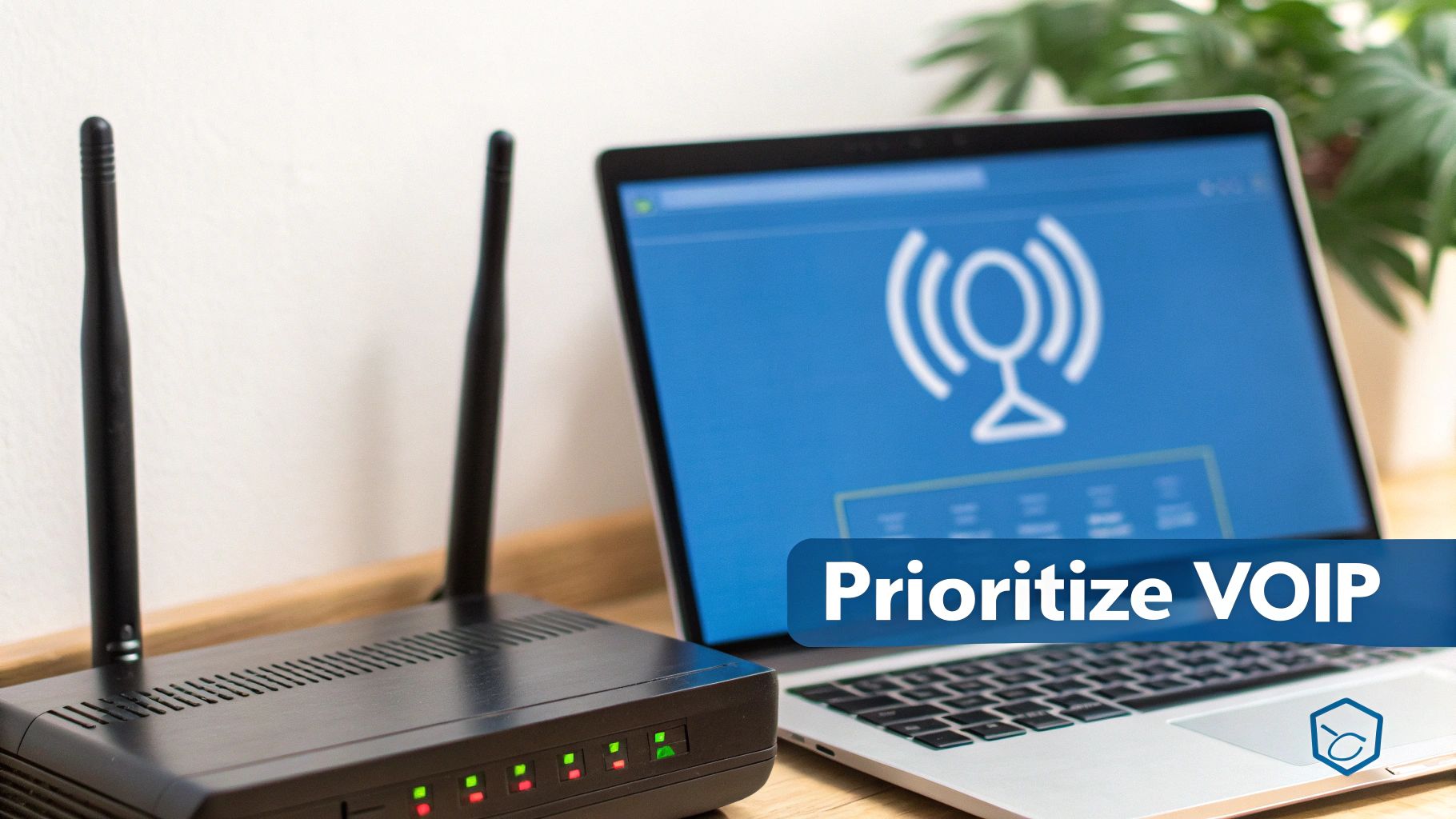
More often than not, the culprit behind poor call quality isn't a slow internet plan—it's network congestion. Picture your internet connection as a highway. When someone in your house starts streaming a 4K movie or downloading a massive game, it creates a digital traffic jam. Your VoIP call, which is incredibly sensitive to delays, gets stuck right in the middle of it, leading to jitter and garbled audio.
This is where a simple network tweak can work wonders.
Put Your Voice Traffic in the Fast Lane with QoS
Most modern routers have a powerful feature called Quality of Service (QoS). In plain English, QoS lets you tell your router which type of internet traffic is the most important. By giving your VoIP traffic top priority, you make sure your calls always get the bandwidth they need, no matter what else is happening on your network.
Enabling QoS is like creating a VIP lane just for your phone calls. Even when the main highway is gridlocked with streaming and gaming traffic, your voice data zips along smoothly.
Setting it up is usually a breeze:
- Log in to your router’s settings page.
- Find the menu for "QoS," "Traffic Management," or "Prioritization."
- Create a new rule to prioritize the device you use for VoIP (like your ATA or IP phone) or the specific network ports your provider uses.
This one adjustment can have a massive impact on your call reliability.
Voice Codecs and Your Bandwidth
Another key piece of the puzzle is the voice codec. A codec is the tech that compresses your voice into digital packets for its trip across the internet. Different codecs offer a trade-off between audio quality and how much bandwidth they gobble up.
- G.711: This is the gold standard for quality, offering uncompressed, high-fidelity audio that sounds just like a landline. It delivers the best sound but also uses the most bandwidth—about 87 Kbps for every call.
- G.729: This codec is all about efficiency. It uses smart compression to provide good quality audio while sipping bandwidth, needing only about 32 Kbps per call.
If you're on a high-speed fiber connection with bandwidth to spare, G.711 is a fantastic choice for the richest audio. But if your internet is on the slower side, or if multiple people will be making calls at once, G.729 is a savvy move to save bandwidth without a major drop in quality.
The Fiber Advantage for Flawless VoIP
At the end of the day, the best way to guarantee amazing call quality is to build your VoIP setup on a rock-solid, low-latency internet connection. This is where a 100% fiber network from an ISP like Premier Broadband really shines.
Fiber optic connections provide symmetrical speeds (your uploads are just as fast as your downloads) and incredibly low latency. This built-in stability often makes complex network tinkering unnecessary. For a deeper dive, our article on the required bandwidth for VoIP is a great resource.
When your internet connection is fast and stable right from the start, VoIP just works—delivering the high-quality, low-cost calling experience you’ve been looking for.
Smart Strategies to Control Your Calling Costs
Getting a great deal on a VoIP plan is a solid start, but the real savings kick in when you start actively managing how you use it. Even with a service built for low-cost VoIP calls, a few simple tweaks can trim your bill down even more. This is about being proactive, not just letting the savings happen.
It all begins with getting to know your own calling patterns. Many providers offer metered plans with rock-bottom per-minute rates that are perfect if you're not on the phone 24/7. Take a look at your call detail records (CDRs) to see exactly how many minutes you’re actually using each month.
That data is pure gold. It helps you find the tipping point where switching to an unlimited plan actually saves you money. For instance, if you find your metered plan averages $15 a month and an unlimited option is $20, you know exactly what to do.
Mastering International and Roaming Charges
For anyone with friends, family, or clients overseas, international calls are where you'll see the biggest, most immediate savings. Traditional phone companies can hit you with rates of dollars per minute, while VoIP often cuts that down to just pennies.
Here's how to make the most of it:
- Compare the Fine Print: Don't get distracted by a low monthly fee. Dig into the per-minute rates for the specific countries you call most. A provider might look cheaper on the surface but have higher rates to a destination you dial every day.
- Use VoIP on the Go: When you're traveling, sidestep those crazy roaming fees by using your provider’s mobile app. Just hop on the hotel or café Wi-Fi, and you can call home at your normal rate, bypassing your mobile carrier entirely.
- Get a Virtual Number: This is a game-changer. You can get a local number in another country, so when people call you from there, it's just a local call for them. The call rings right on your VoIP line, wherever you are.
A classic mistake is thinking all VoIP providers have the same international rates. One might charge $0.02/minute to the UK, while another charges $0.05/minute. If you talk for 500 minutes a month, that tiny difference adds up to $15 in extra costs.
To illustrate just how dramatic these savings can be, take a look at the difference in typical rates.
Sample International Calling Rate Comparison
This table shows a side-by-side comparison of what you might pay with a traditional carrier versus a typical low-cost VoIP service for international calls.
| Destination Country | Average Traditional Rate (per minute) | Average VoIP Rate (per minute) | Potential Savings |
|---|---|---|---|
| United Kingdom | $1.50 | $0.02 | 98.7% |
| Mexico | $0.99 | $0.03 | 97.0% |
| India | $2.25 | $0.02 | 99.1% |
| China | $2.10 | $0.02 | 99.0% |
| Canada | $0.49 | $0.01 | 98.0% |
As you can see, the difference isn't just a few cents—it's often more than 95%. These are the kinds of numbers that can make a real impact on your monthly budget.
Smart Call Management for Ultimate Savings
Beyond the rates themselves, how you handle your calls can unlock even more value. Many features that look like simple conveniences are actually powerful tools for controlling costs.
For example, using call forwarding to send your business line to your mobile after hours means you don’t need a separate, pricey cell plan for work. Likewise, having your voicemails transcribed and sent to your email saves you the time (and potential call charges) of dialing in, especially when you're on the move.
The goal is to build a setup that isn't just cheap, but incredibly efficient. By keeping an eye on your usage and being smart about your features, you can make sure your communication costs stay as low as they can possibly be.
Making the Switch to a Better Phone Service
You now have the complete playbook for smarter, more affordable phone service. We’ve covered all the bases, from picking a provider to tweaking your network settings. The goal? Making high-quality, low-cost VoIP calls a reality for your home or business.
The biggest takeaway is this: VoIP delivers incredible savings and flexibility that old-school landlines just can't match.
And here’s the good news—this switch doesn’t have to be a headache. At Premier Broadband, we make it simple by pairing our crystal-clear VoIP phone service with our 100% fiber network. That combination is key. Fiber gives you the symmetrical speeds and rock-solid stability VoIP needs to perform perfectly, so you can say goodbye to dropped calls and robotic audio for good.
Your All-in-One Solution
Forget the hassle of dealing with multiple bills from different companies. We offer a single, reliable solution for both your internet and phone service. This integrated approach means every piece of the puzzle is designed to work together flawlessly from day one.
With Premier Broadband, you get more than just a dial tone. You get a communication platform built on a foundation of speed and reliability, ensuring every call is as clear as the last.
Ready to see how much you could save? Take a look at our home phone plans and see just how easy it is to make the change. Ditch that outdated landline and start enjoying a better, more affordable phone service today.
Got Questions About Low Cost VoIP?
Thinking about making the switch to a modern, low cost VoIP phone service? You're not alone, and it's smart to have a few questions before you jump in. Let's tackle some of the most common ones we hear from businesses.
Can I Keep My Current Phone Number?
Yes, you absolutely can. We use a standard process called number porting to bring your existing phone number over to your new VoIP service.
It’s a simple way to guarantee a smooth transition without having to notify all your customers and update your marketing materials. Any provider worth their salt, including us here at Premier Broadband, will handle the entire porting process for you. It usually just takes a few business days to complete, and we'll keep you updated along the way.
How Much Internet Speed Do I Really Need?
This is a great question, and the answer usually surprises people. A single VoIP call only needs about 100 Kbps of bandwidth. It’s incredibly efficient.
What's far more important than raw download speed is having a stable connection without a lot of lag or jitter. That’s why a 100% fiber internet connection is the gold standard for VoIP. It provides the rock-solid foundation needed to prevent those annoying audio dropouts and garbled calls.
The secret to great VoIP call quality isn't massive speed—it's connection stability. A reliable fiber network eliminates the jitter and lag that cause poor audio, ensuring your calls are consistently clear.
Is VoIP Secure Enough for My Business?
Modern VoIP is built with security in mind. Most services come standard with robust security protocols like call encryption (SRTP/TLS) to protect your conversations from being intercepted.
For businesses that handle sensitive information or just want extra peace of mind, you can add advanced solutions like Managed Network Edge services. These act as a digital security guard, creating an extra layer of protection around all your business communications and data.
Ready to see how crystal-clear calls and significant savings can benefit your business? Premier Broadband pairs our ultra-reliable 100% fiber network with a feature-rich VoIP phone service designed for modern companies.