

If you've ever seen a phone number beginning with +86, you're looking at the 86 country code—the international dialing prefix for China. It's the first thing you need to know to connect with anyone in the country.
Your Digital Key to Connecting with China
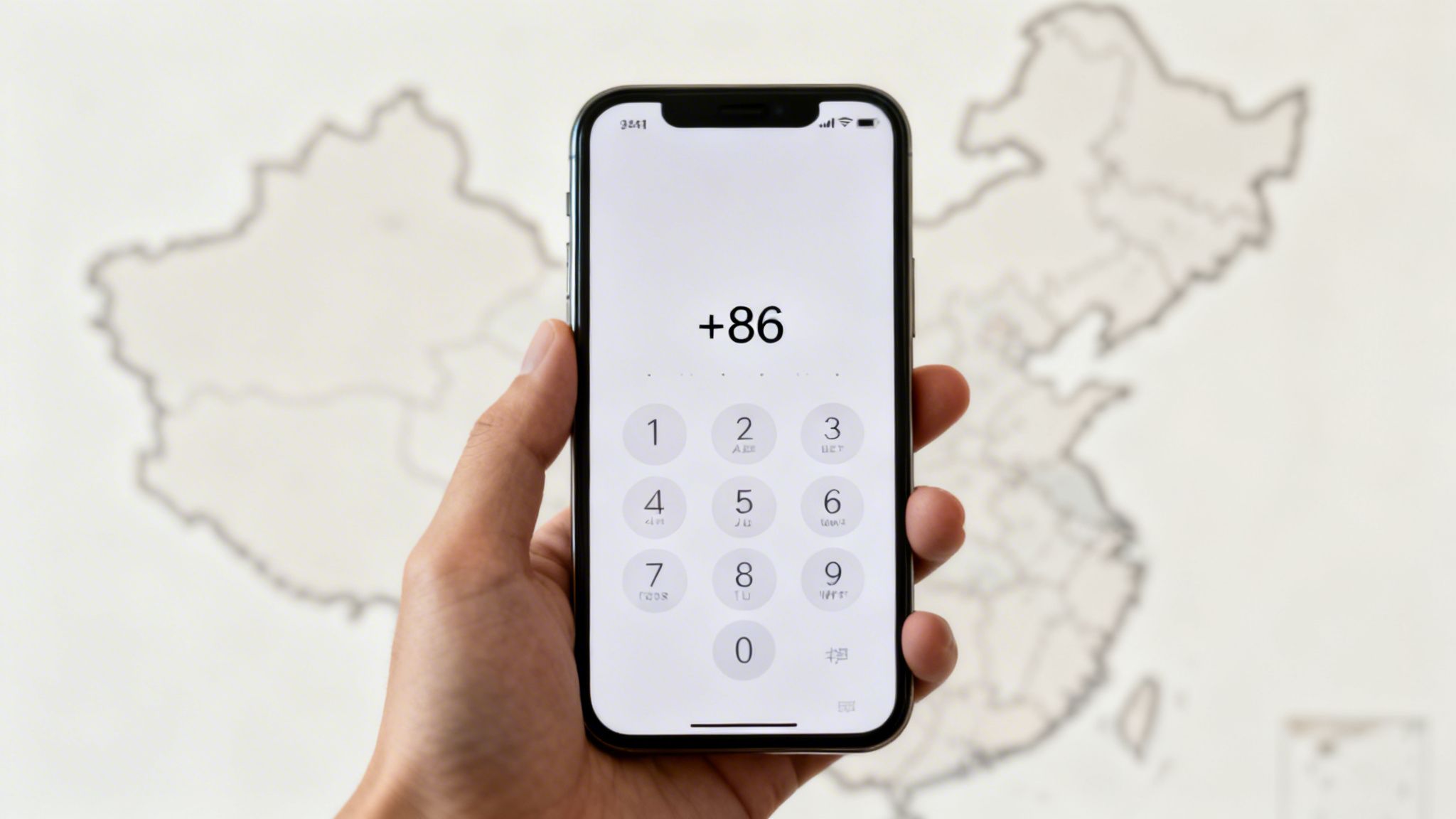
Think of a country code like a digital address for a nation’s phone system. Just like a postal code gets a letter to the right city, the +86 country code tells the global network your call is headed for China.
This simple two-digit number is your gateway to one of the largest and most active telecommunications markets on the planet.
Why the +86 Country Code Matters
Knowing how to use the +86 code isn't just about dialing—it's your entry point to a massive digital economy. This prefix connects you to a true telecom powerhouse.
The 86 country code opens the door to a nation with over 1.30 billion internet users and a digital penetration rate of 91.6%. For businesses, mastering calls to China can unlock new collaborations and markets. For individuals, it ensures you can reliably reach family and friends.
In international calling, the country code acts like a global switchboard operator. Dialing +86 sends your call straight to the right national network, eliminating any confusion.
Here's a quick look at the essential details for dialing +86.
| Attribute | Detail |
|---|---|
| Country | China |
| Country Code | +86 |
| International Dialing Format | +86 [Area Code] [Local Number] |
| Time Zone | China Standard Time (UTC+8) |
| Capital | Beijing |
| Top-Level Domain (TLD) | .cn |
Understanding these basics is the first step, whether you're using a traditional phone or exploring modern VoIP solutions.
For those making frequent or business-critical calls, services like Premier Broadband's global phone services offer dependable VoIP systems that make connecting easier and more affordable than ever. This guide will walk you through everything you need to know to dial with confidence.
How to Call China Step by Step
Calling China might seem tricky at first, but it’s really just a simple, three-part formula. Once you know the sequence, you can reliably dial any number with the +86 country code.
Let's walk through exactly how it’s done.
The Three Parts of a Chinese Phone Number
To make a successful call, you just need to dial three pieces of information in the right order.
- Your Country's Exit Code: This is the short code that tells your phone provider you're making an international call. For the U.S. and Canada, it's 011. If you're calling from the UK, Australia, or most of Europe, it's 00.
- China's Country Code: Right after the exit code, you'll dial 86. This is what routes your call specifically to China's phone network.
- The Local Number: Finally, you dial the local Chinese number. This will be an 11-digit number for a mobile phone or an area code followed by a 7 or 8-digit number for a landline.
Pro Tip: Calling from a mobile phone? You can skip the exit code. Just press and hold the '0' key until the plus sign (+) appears. Then, simply dial 86 and the local number. The + symbol automatically handles the international part for you.
Examples from Around the World
Let's put it all together. Say you're calling a landline in Beijing with the number (10) 1234-5678.
- From the United States: Dial
011-86-10-12345678 - From the United Kingdom: Dial
00-86-10-12345678 - From Australia: Dial
00-86-10-12345678
Getting this sequence right connects you to a massive market. In 2026, China’s 1.30 billion internet users generated over $1.2 trillion in its digital economy. With more than 1.83 billion mobile lines in use, a clear VoIP connection is a must-have for families and businesses. That’s why we offer reliable VoIP solutions over our high-speed fiber network, so your calls always go through clearly.
For a deeper dive into how this market works, check out this great breakdown of QR code usage in China at wavecnct.com.
Decoding Chinese Phone Number Formats
When you're dialing a number with the +86 country code, it really helps to know if you're calling a cell phone or a landline.
Chinese phone numbers have unique patterns for each. Once you know what to look for, telling them apart is simple and can save you from the frustration of a call that just won't connect.
This visual guide breaks down the three basic steps for any international call to China.
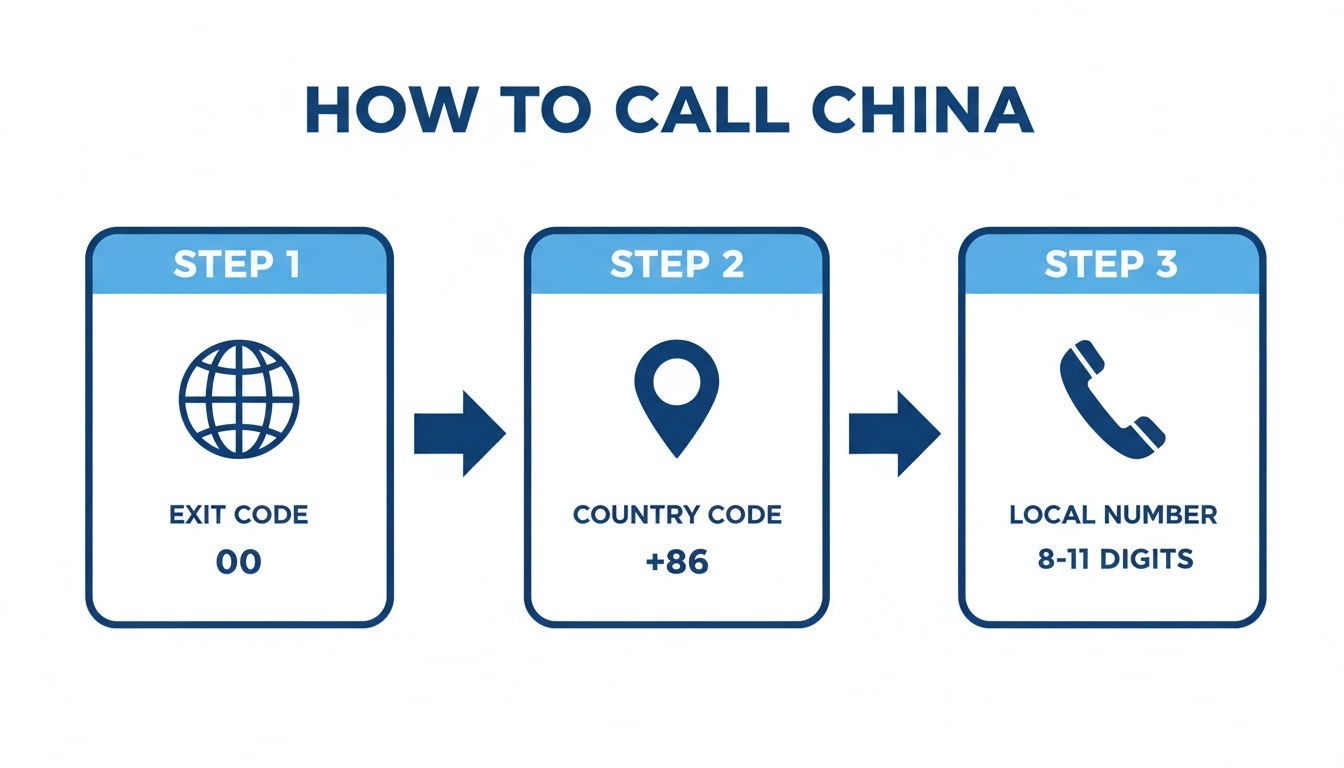
As you can see, the process is straightforward. You start with your country's exit code, punch in China's country code (86), and then dial the local number.
Landline Versus Mobile Numbers
Landline numbers in China are always tied to a specific city and include an area code. For instance, a number in Beijing will start with the area code 10. A call to Shanghai will start with 21.
Mobile numbers, on the other hand, are standard across the whole country. They are always 11 digits long and begin with a three-digit prefix like 13x or 18x. These prefixes identify the mobile carrier (like China Mobile or China Unicom), not a city or province.
Knowing the difference is the key to making sure your call actually goes through. A landline number won't work without its area code, and a mobile number with the wrong digits is just a dead end.
Comparing China's Landline and Mobile Number Formats
Here’s a quick table to show you the structural differences at a glance.
| Feature | Landline Number | Mobile Number |
|---|---|---|
| Total Length | 9-11 digits (Area Code + Local) | 11 digits |
| Identifier | 2-4 digit area code (e.g., 10, 21) | 3-digit prefix (e.g., 139, 186) |
| Geographic Link | Tied to a specific city | Not tied to a location |
As you can see, the area code is the biggest giveaway for a landline, while all mobile numbers have that standard 11-digit length.
No matter which type of number you're calling, using modern tech can make a world of difference in call quality. To learn more about how internet-based calling works, check out our guide on what VoIP phone numbers are.
Making Cheaper and Clearer Calls with VoIP
If you’re regularly dialing the 86 country code, you already know how quickly those traditional international phone bills can pile up. Fortunately, there's a much better way. Voice over Internet Protocol (VoIP) isn't just a techy acronym—it’s your secret weapon for slashing those costs.
Think of it this way: instead of relying on old-school copper phone lines, VoIP uses your internet connection to make calls. This simple switch can dramatically lower your expenses, especially for international calls to places like China. It’s the modern, cost-effective alternative to outdated phone plans.
The Foundation of a Great VoIP Call
The magic behind a perfect VoIP call isn't complicated. It all comes down to one thing: a stable, high-speed internet connection. A quality fiber internet connection provides the rock-solid foundation you need for conversations that are not just cheaper, but often clearer than a traditional phone line.
This stability is a game-changer, whether you're:
- Catching up with family in Shanghai.
- Collaborating with your remote team in Beijing.
- Coordinating with your gaming squad across the globe.
A strong internet connection means your calls are consistently crystal clear, without the annoying lag, dropped words, or echoes you get with older networks.
VoIP turns your internet connection into a superhighway for your voice. It’s the difference between a bumpy country road and a smooth, fast-moving expressway, ensuring your conversations arrive instantly and without a single hiccup.
This technology is a core part of modern communication, and it's especially vital in a digitally-first nation like China. Today, with 90.3% of China's population active on social media—that's 1.28 billion user identities—reliable digital communication is non-negotiable. Premier’s crystal-clear Hosted VoIP ensures your Home Office Hero plan keeps you connected during those long Zoom calls with partners using the +86 country code. For a deeper look at China's digital landscape, check out the full 2026 report on datareportal.com.
Want to peek under the hood? You can learn more about how VoIP phones work in our detailed guide. It's the most effective way to take control of your calls.
Avoiding Common Problems and Scams
Making a call to China should be straightforward, but a few common slip-ups can trip you up. A failed call often comes down to a simple mistake, like forgetting your country's exit code or dialing an incomplete number.
Always take a moment to double-check the full dialing sequence before you hit call. It’s a small step that ensures your call connects without a hitch.
But dialing mistakes aren't the only thing to watch out for. It's just as important to stay aware of scams that exploit international calling codes like +86. Scammers have gotten clever, and knowing what to look for is your best line of defense.
Spotting and Avoiding Common Scams
Have you ever gotten a call from an unknown international number that rings just once and then hangs up? That’s likely the ‘Wangiri’ (one-ring) scam in action. The scammer's entire goal is to make you curious enough to call them back.
Don't fall for it. Calling back almost always connects you to a premium-rate number, which is designed to drain your wallet with sky-high charges on your next phone bill. As a rule of thumb, never return a call to an unknown international number.
Here are a few more tips to keep you safe:
- Verify, Then Trust: If you get a call or text from a +86 number claiming to be someone you know, hang up and contact them through a different, verified channel before responding.
- Watch for Urgency: Scammers love to create panic. Be skeptical of any message that pressures you to act immediately, especially if it involves money or personal data.
- Guard Your Information: Never give out passwords, financial details, or other sensitive information over the phone. If you're worried your number has been compromised, our guide on what to do if someone is using my phone number can help.
The +86 code isn't just for phone calls; it's a gateway to a massive digital economy. In China, over 102 million+ QR scans happen every year, powering a payment network worth trillions. As more businesses adopt QR technology, secure connections like those from Premier Broadband become essential to protect every transaction. You can see more of these QR code statistics on wavecnct.com.
Key Cultural Insights for Calling China
Getting a call through to China is about more than just dialing the +86 country code. To really connect, whether for business or just to catch up, you need to understand a few key details about how communication works there.
First up, timing is everything. China is a massive country, but it runs on a single time zone: China Standard Time (UTC+8). Before you pick up the phone, always double-check the local time. A quick calculation can save you from calling someone in the middle of the night.
Navigating the Digital Ecosystem
You also have to remember that China’s digital world is completely different from what you might be used to. Many of the apps we use daily for messaging and social media aren't the go-to choices there.
The undisputed king of communication is WeChat (or Wēixìn, as it's known locally). It's an all-in-one powerhouse for messaging, payments, social updates, and more. For most people, a WeChat call is far more common than a traditional phone call.
Here's a neat cultural fact for you. While dialing the +86 country code, it’s interesting to know that the number 8 in Chinese culture means good fortune, which adds a nice bit of positive context to the country’s dialing prefix.
This preference for specific platforms even shapes how people work and play. For the country’s massive gaming community and growing remote workforce, a rock-solid, low-lag connection is non-negotiable. With symmetrical speeds, a service like Premier Broadband’s VoIP is a lifesaver, eliminating frustrating lag in games like Honor of Kings—a title played by over 100 million people every day.
You can get a deeper look at just how huge China's digital scene is in this 2026 data report. When you keep these cultural and tech norms in mind, you’re not just making a call; you’re building a better connection from the start.
Your Questions About the 86 Country Code, Answered
We get it. Even after you have the dialing instructions down, a few questions can pop up when calling China. Let’s tackle some of the most common ones so you can dial with confidence.
Can I Text a +86 Number?
Absolutely. Sending an SMS text to a Chinese mobile number works just like calling. You'll format the number starting with +86, followed by the 11-digit mobile number.
Just be aware that your mobile provider's international SMS rates will apply. These can add up quickly, so check your plan first to avoid any surprises on your bill.
Why Won't My Call to China Go Through?
If you're having trouble connecting, it's usually a simple fix. Start by double-checking these common slip-ups:
- Missing the Exit Code: When calling from a landline, you have to dial your country's exit code (like 011 from the US) before the 86.
- An Incorrect Number: It’s easy to mistype. Confirm you have the right area code for landlines or the full 11-digit number for mobile phones.
- Bad Timing: Remember, China is on a single time zone (UTC+8). You might be calling in the middle of the night or outside of business hours without realizing it.
Sometimes, the issue isn't on your end. The call might fail due to local network congestion or temporary outages. If you know the number is correct, your best bet is to try again later. For a more reliable connection, a VoIP service often cuts through these issues.
Is Calling the 86 Country Code Free?
No, calling a standard Chinese phone number using the 86 country code is an international call and will be billed by your service provider.
If you're looking for a free option, both you and the person you're calling need to use an internet-based app like WeChat or Skype. These calls are free over a Wi-Fi connection.
Ready to make your calls to China clearer and more affordable? Premier Broadband offers crystal-clear VoIP phone service and high-speed fiber internet perfect for connecting globally. Discover our reliable solutions at https://premierbroadband.com.