
Let’s cut right to it. Fiber to the Home (FTTH) means you get an internet connection that’s a pure fiber-optic cable running straight from our network directly into your house.
That’s it. No old-school copper wires, no shared connections slowing you down. Instead of using technology that sends data with electrical signals, FTTH uses tiny, flexible strands of glass to transmit data as literal pulses of light. That’s why it’s blazingly fast and rock-solid reliable.
So, What Exactly Is Fiber to the Home?
Think of it this way: older internet technologies like cable and DSL are like sharing a single road with the rest of your neighborhood. When everyone gets on at 5 PM, you get a traffic jam. Buffering, lag, dropped video calls—sound familiar?
FTTH is completely different. It’s like having your own personal, multi-lane superhighway built directly to your front door. Since that connection isn't shared with your neighbors, you don't have to worry about slowdowns during peak hours.
This "last mile" of pure fiber is what makes all the difference. Some internet providers might talk about their "fiber network," but often they switch to outdated copper cable for the final stretch to your home. This creates a massive bottleneck that chokes your speed. With FTTH, that high-speed signal of light travels uninterrupted all the way to your router.
Why It’s a True Upgrade
The real game-changer is the material itself. Copper wires, the basis for cable and DSL, are prone to problems. The signal gets weaker the farther it travels, and it’s easily disrupted by interference from power lines, appliances, and even bad weather.
Fiber optic cables, on the other hand, are made of glass. Since they transmit data using light, they are completely immune to that kind of electrical interference.
This one core difference delivers a completely new internet experience:
- Real Speed: Fiber offers gigabit speeds that old copper lines simply can't handle. We're talking downloads and uploads that are worlds apart from cable or DSL.
- Symmetrical Speeds: With FTTH, your upload speed is just as fast as your download speed. This is a huge deal for anyone working from home, video conferencing, gaming online, or uploading large files to the cloud.
- Unbeatable Reliability: Those durable glass fibers aren't just faster; they stand up to the elements far better than copper, giving you a stable, consistent connection you can actually count on.
Fiber to the Home isn't just a minor speed bump—it's a completely different and better way of delivering the internet. It gets rid of the roadblocks from older tech and gives you a powerful, future-ready foundation for everything you do online.
And people are catching on. The FTTH market in the U.S. is growing fast, with fiber now available to 56.5% of U.S. households. Experts even predict the market will more than double to USD 21.5 billion by 2030 as more and more families make the switch. If you're interested, you can explore the full scope of this growth and see detailed statistics about the U.S. market. This huge investment points to one clear fact: fiber is the new gold standard for home internet.
How Data Travels at the Speed of Light
To really understand what makes Fiber to the Home so special, it helps to know how your data makes the incredible journey to your devices. The process is a world away from old-school methods that used copper wires and electrical signals. At its heart, it's all about turning digital information into light, sending it over huge distances, and then changing it back again.
Think about sending a message with a powerful flashlight at night. You could use Morse code—short and long flashes of light—to spell things out. Fiber-optic tech works on the exact same idea, but instead of a simple flashlight, it uses powerful lasers to pulse light through impossibly thin glass fibers millions of times per second.
This entire journey kicks off at a central point in your provider's network.
From Network Hub to Your Neighborhood
The starting line for your internet is a piece of gear called an Optical Line Terminal, or OLT. This is the main hub that connects to the wider internet backbone. The OLT’s job is to take all the electrical data signals from the internet and convert them into pulses of light.
From there, those light signals are shot out from the OLT into a massive network of fiber-optic cables. This is where the magic really begins. The pulses zip through these thin glass strands, carrying everything from your next movie night marathon to that important video call.
The core idea is simple but incredibly effective: data becomes light. By turning digital information into light pulses, FTTH gets rid of the electrical resistance and interference that always slowed down copper systems like cable and DSL. This lets data travel farther and faster with almost no loss in signal quality.
Because light is doing all the work, the information travels with unbelievable efficiency. Copper wires lose signal strength the farther they go, but the light pulses in a fiber cable can travel for miles and miles with minimal loss, guaranteeing a rock-solid, strong signal by the time it gets to you.
The Last Mile: A Direct Light Path to Your Home
This final stretch is what puts the "Home" in Fiber to the Home. A dedicated fiber-optic line runs directly from a local hub right to the side of your house. This "last mile" is the most important part of the whole setup, and it's where older technologies stumble by switching back to slow, outdated copper cables.
The diagram below shows how different internet types, like fiber, cable, and DSL, make that final connection to a home.
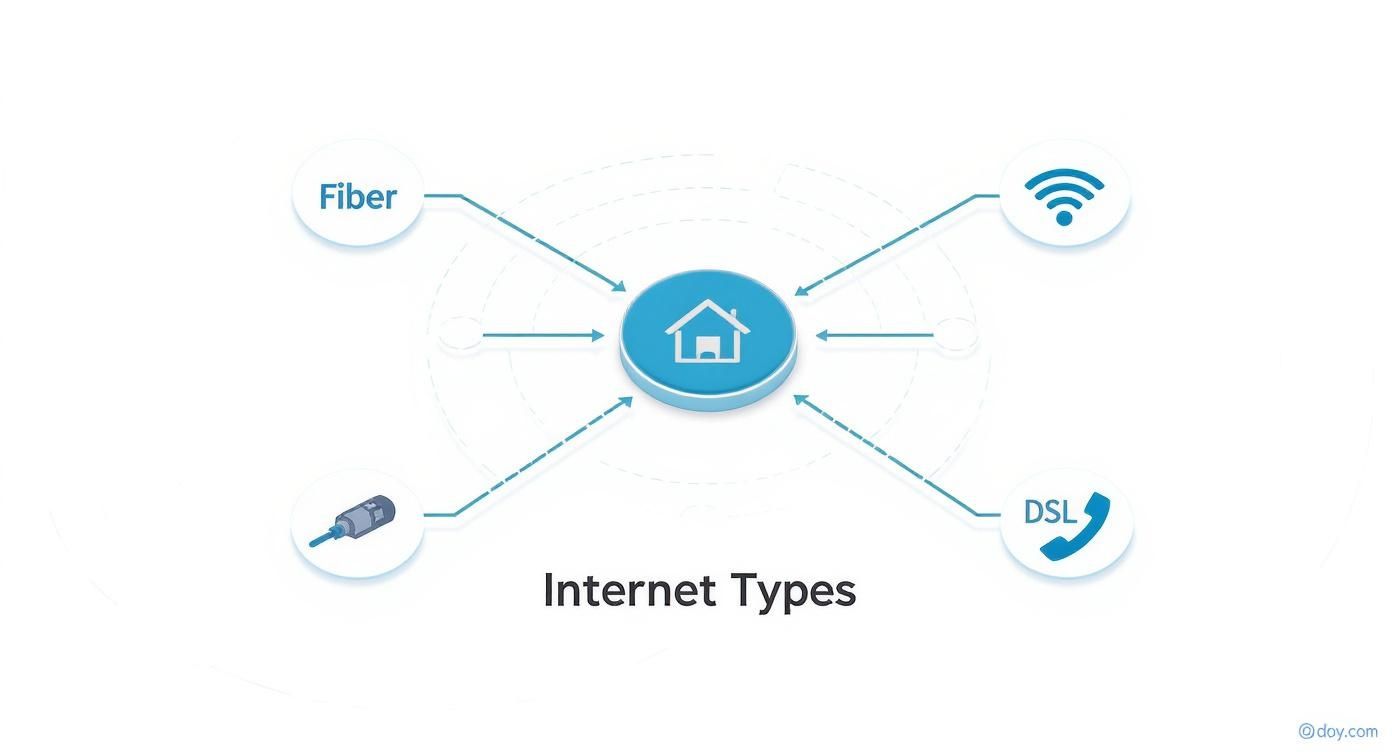
As you can see, only fiber keeps a pure, high-speed path all the way to the finish line, avoiding the bottlenecks you get with older infrastructure.
Once this light signal arrives, there’s just one final step needed to get it ready for your devices.
Translating Light Back into Data
A small box called an Optical Network Terminal (ONT) is installed at your home, usually on an inside or outside wall. The ONT's role is simple but crucial: it’s a translator.
The ONT takes the incoming light pulses from the fiber cable and instantly converts them back into a standard electrical ethernet signal. From there, you just plug your Wi-Fi router into the ONT, and it beams that blazing-fast connection all through your house. This clean, end-to-end system based on light is what makes FTTH such a huge leap forward.
The Real-World Impact of a Pure Fiber Connection

Knowing how Fiber to the Home (FTTH) works is one thing, but feeling the difference it makes every day is something else entirely. The technical stuff—using light to move data—translates into real-world upgrades you’ll notice every single time you go online. These aren't just small tweaks; they’re game-changers for how you work, play, and connect with others.
Let's cut through the jargon and get straight to the good stuff. Here are three major benefits you'll get with a 100% fiber connection.
Symmetrical Speeds: Finally, Your Uploads Can Keep Up
With old-school internet like cable or DSL, you get way faster download speeds than upload speeds. That made sense back when we mostly just browsed websites and downloaded files. But that’s not how we live anymore. We’re constantly sending data out—jumping on video calls, backing up files to the cloud, and live-streaming.
This is where fiber blows everything else out of the water with symmetrical speeds. In plain English, your upload speed is just as fast as your download speed.
- Flawless Video Calls: Ever had your video freeze up during an important meeting? Slow upload speed is almost always the culprit. Symmetrical fiber keeps your calls crystal-clear and stable.
- Instant File Uploads: Trying to send a big work file or a folder of family photos can feel like it takes forever on cable. With fiber, those hours turn into minutes. Sometimes even seconds.
- Seamless Online Gaming: To compete online, you need to send data to the game server just as fast as you receive it. Symmetrical speeds give you a huge advantage by cutting down lag.
We live in a two-way digital world now. Symmetrical speeds aren't just a nice-to-have; they’re essential for anyone working from home, learning online, or just trying to stay connected without the frustration.
Unmatched Reliability and Zero Neighborhood Slowdowns
Older internet tech relies on copper cables, and frankly, they’re prone to all sorts of issues. They can get interference from power lines or even your microwave, leading to random slowdowns. Plus, they don’t hold up well against bad weather, whether it’s extreme heat, cold, or rain.
Because Fiber to the Home uses hair-thin strands of glass, it's a completely different ballgame. Fiber-optic lines are immune to electrical interference, which means you get a cleaner, more stable connection. They're also tougher and more weather-resistant, giving you rock-solid reliability day in and day out. You can dive deeper into the complete list of advantages in our guide on the benefits of fiber optic internet.
Even better, a pure fiber connection gets rid of the single biggest headache of cable internet: neighborhood traffic jams. With cable, you and all your neighbors are sharing the same main connection. When everyone gets online after work to stream movies, the whole network slows to a crawl.
FTTH gives you a dedicated line straight to your home. Your bandwidth isn't shared, so your speed stays consistently fast, no matter what your neighbors are doing.
To see what this really means for your day-to-day use, let’s compare how different internet technologies handle common tasks.
Impact of Internet Technology on Daily Activities
| Activity | Fiber to the Home (FTTH) | Cable Internet | DSL |
|---|---|---|---|
| 4K Streaming | Flawless, multiple streams at once without buffering. | Generally smooth, but can buffer during peak hours. | Struggles with a single stream, especially at higher quality. |
| Video Conferencing | Crystal-clear video and audio, no lag or freezing. | Prone to freezing or audio cutouts, especially on your end. | Significant lag, often forcing audio-only calls. |
| Online Gaming | Ultra-low latency for a competitive, lag-free experience. | Inconsistent performance, with lag spikes during peak times. | High latency, making competitive gaming nearly impossible. |
| Uploading Large Files | Extremely fast. A 5 GB file can upload in just a few minutes. | Very slow. A 5 GB file can take an hour or more. | Painfully slow. Uploads of this size are impractical. |
| Multiple Users | The whole family can stream, game, and work simultaneously. | Performance degrades noticeably with each additional user. | Barely supports two or three light users at once. |
The difference is clear. While older technologies struggle to keep up with just one or two demanding tasks, fiber handles everything effortlessly, all at the same time.
Future-Proofing Your Home for What's Next
The need for fast, reliable internet isn't going away—it's only getting bigger. As things like 8K streaming, virtual reality, and truly smart homes become mainstream, they'll demand more bandwidth than today’s copper connections can ever hope to deliver.
Getting fiber isn't just about a better connection today; it’s an investment in your home’s future. It’s why the global FTTH market, valued at USD 56.03 billion, is expected to skyrocket to USD 110.44 billion by 2030. The fastest-growing part of that market is for speeds over 1 Gbps, which shows you exactly where things are headed. By choosing fiber, you’re making sure your home is ready for whatever comes next.
The Fiber Installation Process Demystified
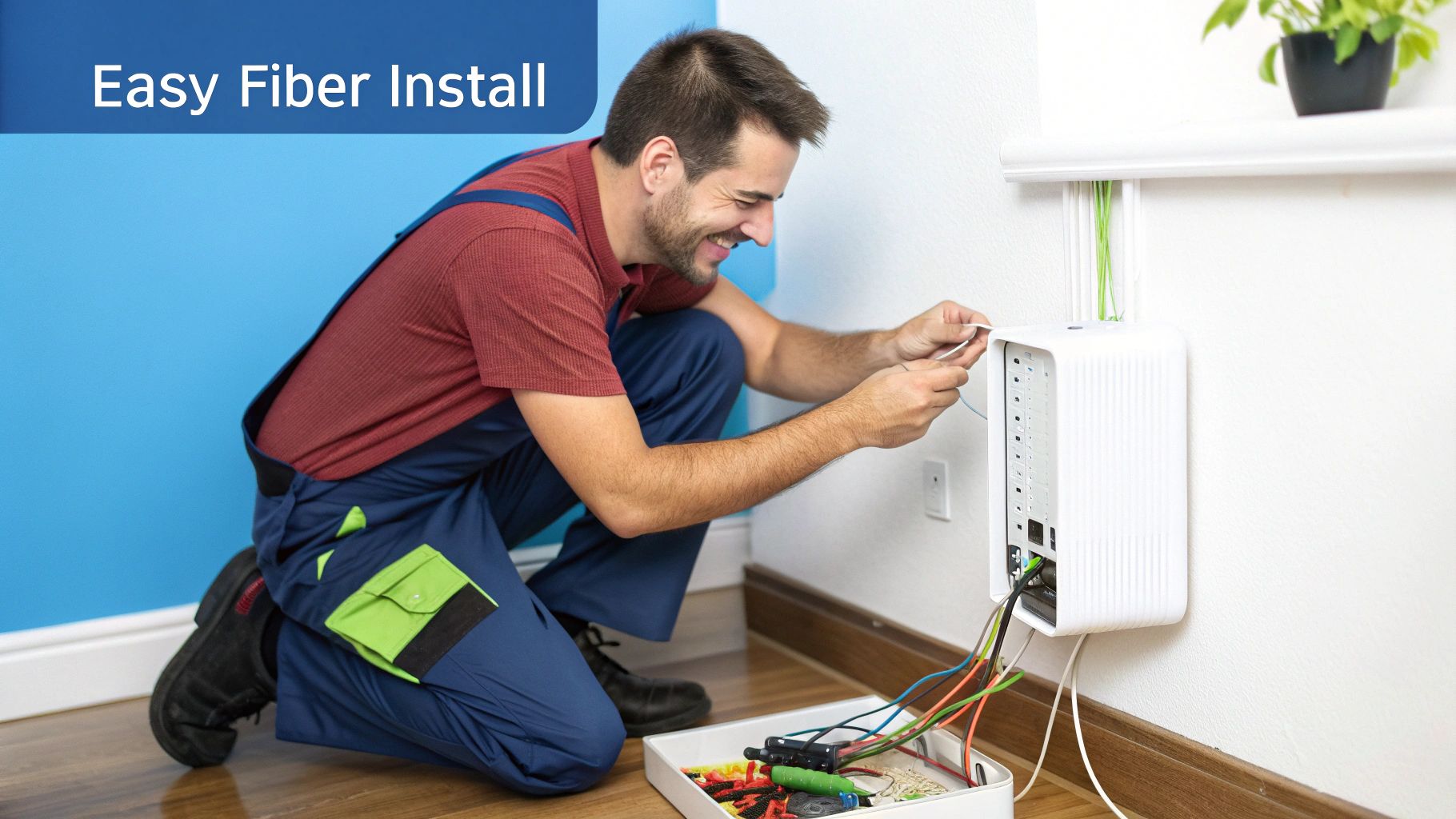
Getting set up with a brand-new fiber connection might sound like a huge undertaking, but it’s actually a pretty straightforward process. Knowing what to expect on installation day makes everything go smoothly and takes the guesswork out of upgrading. The whole thing really just boils down to three simple stages.
It all starts with scheduling a time that works for you. After you sign up, a technician will usually do a quick site survey—sometimes in person, sometimes remotely—to figure out the cleanest path for running the fiber line to your house. This prep work ensures the final installation is quick and tidy.
Running the Line to Your Home
The first real step is what we call the "drop." This is where our technicians run a tough, weather-proof fiber-optic cable from a nearby connection point right to the outside of your house, bridging you to the main network. This is all part of a much larger system, and if you're curious about the bigger picture, you can learn more about understanding underground utility services.
How this happens depends on your neighborhood's setup:
- Aerial Installation: If you see other utility lines (like power and cable) on overhead poles, your fiber line will likely take the same route. A technician simply strings the new cable from the pole to a small attachment point on your home.
- Underground Installation: When utilities are buried, the fiber line is run through an existing conduit, or a new, very small trench is made. This method keeps the cable completely hidden and out of sight.
Our technicians handle this part from start to finish with minimal impact on your property. Once the line is securely attached to your house, we move inside.
Finalizing Your Indoor Connection
The last step is getting that powerful connection inside and getting you online. A technician drills a tiny, neat hole through an exterior wall to bring the fiber line in. They’ll then install a small box called an Optical Network Terminal (ONT) on an inside wall, usually tucked away in a utility room, basement, or garage.
The ONT is the key piece of hardware that acts as a translator. Its job is simple: it converts the light signals from the fiber optic cable into a standard Ethernet signal that your Wi-Fi router can understand and use to blanket your home with a fast, reliable connection.
With the ONT mounted and powered on, the technician connects it to your Wi-Fi router. The final step is to run a few tests to make sure you’re getting the incredible speeds you signed up for. The whole indoor part of the installation usually only takes a couple of hours.
For homeowners who want a more detailed breakdown, our guide to fiber optic home installation provides a simple guide that walks you through everything. With very little fuss, you’ll be plugged into the future of internet.
How to Choose the Right Fiber Internet Provider
With Fiber to the Home (FTTH) popping up in more neighborhoods, you might think all fiber services are the same. But that’s not the case. The rapid expansion means you have more choices, but you need to look closer to make sure you're getting a truly top-tier connection. Picking a provider is about more than just the monthly price; it's about the quality of the service and trusting the company that delivers it.
Making the right choice today sets your home up for the future. A great provider doesn’t just sell you internet—they deliver a powerful, reliable connection with honest pricing and a real commitment to their customers. This ensures your home is ready for anything, from immersive gaming to the ever-growing number of smart home gadgets.
Verify You Are Getting 100 Percent Fiber
This is the most important question you can ask: is the connection 100% pure fiber right to my front door? Some companies advertise "fiber-rich" or "hybrid fiber" networks. This usually means they use fiber for their main network but switch to old, slow copper coaxial cables for that last, critical stretch into your house.
That final switch from fiber to copper creates a massive bottleneck, choking your speed and robbing you of the real benefits of a true fiber network.
- Ask Directly: When talking to a salesperson, be specific: "Will a fiber optic line run directly into my house and connect to an ONT?"
- Check the Terminology: Look for phrases like "FTTH" or "Fiber to the Home." Be cautious if you see vague marketing terms that don't clarify how that "last mile" connection is made.
A true FTTH provider like Premier Broadband is built on a 100% fiber network. That means the light-speed signal travels completely uninterrupted from our core network straight into your living room. It's the only way to guarantee the incredible speed and rock-solid reliability we promise.
Look Beyond the Advertised Price
A cheap introductory offer looks good on a flyer, but it often hides the real cost you'll be paying. Before you sign anything, dig into the contract details to avoid nasty surprises on your bill. A provider you can trust will be upfront about every possible cost.
Choosing the right provider is an investment in your home's digital future. It's about securing a powerful, reliable connection from a partner you can trust, ensuring your household stays seamlessly connected for years to come.
Pay close attention to these key details:
- Data Caps: Does the provider limit how much data you can use each month? Busting through a data cap can lead to shocking overage fees or bring your internet speeds to a crawl. Premier Broadband offers plans with no data caps, so you can stream, work, and game without ever checking a meter.
- Throttling Policies: Some providers will deliberately slow down your connection (this is called "throttling") during busy evening hours or after you've used a certain amount of data—even if you're on a so-called "unlimited" plan.
- Hidden Fees: Keep an eye out for equipment rental fees, installation charges, and other random costs that can jack up your monthly bill. We believe in simple, honest pricing with no hidden fees.
Evaluate Customer Service and Reputation
Your internet is essential. When it goes down, you need help from someone you can actually count on. A provider’s reputation for customer service is just as important as the technology they use. Check online reviews, ask your neighbors about their experience, and see how the company responds to customers.
The global push for fiber is undeniable. Today, twenty-nine countries have FTTH penetration rates over 50%, a big jump from just twenty-one countries the year before. As this technology becomes the new standard, it's the quality of service that will separate the good providers from the great ones. If you're curious about how different nations are adopting fiber, you can review the full 2025 global FTTH rankings to see the worldwide trend.
Choosing a provider is a big decision, and we've put together a detailed guide to help you weigh your options. Check out our breakdown of the best fiber internet providers to see how we stack up and learn what makes for a truly premium internet experience.
Is Fiber Internet the Right Choice for You?
After digging into how Fiber to the Home (FTTH) works, it all boils down to one simple question: is it the right move for your household? The best way to answer that is to look at how you use the internet every single day. The goal is to match your connection to your lifestyle, not just for today, but for years to come.
For many people, the decision becomes obvious the moment their current internet gives out. If you constantly run into issues with an unstable internet connection, fiber is a massive upgrade in both reliability and performance. A pure fiber connection gets rid of the frustrating lag, buffering, and dropped calls that are all too common with older copper-based systems.
Matching Your Needs to Fiber’s Strengths
Think about your daily digital life. Different activities put different demands on your internet, and fiber is built to handle the most intense tasks without breaking a sweat.
- For Remote Workers: Tired of your video freezing up during an important client call? Fiber’s symmetrical speeds mean your outgoing video is just as crisp and clear as the one you’re watching, making every conference call seamless and professional.
- For Competitive Gamers: In online gaming, milliseconds are the difference between winning and losing. Fiber gives you the ultra-low latency you need for the split-second reaction time to stay ahead of the competition.
- For Growing Families: When everyone is online at once—streaming 4K movies, joining virtual classes, and connecting dozens of smart devices—you need serious bandwidth. A dedicated fiber line has more than enough power to keep everyone online without slowdowns.
Choosing fiber isn't just about getting a faster connection today. It's about investing in a future-ready platform that can handle the next wave of technology—from 8K streaming and virtual reality to advanced smart home ecosystems that will demand more robust connectivity.
Securing Your Home’s Digital Future
Ultimately, switching to fiber is about securing a better, forward-looking internet experience. As we rely more and more on powerful, always-on connectivity, the limits of cable and DSL will only become more obvious. They just weren't designed for the demands of a modern home.
Making the change to fiber to the home technology is the best step you can take to leave internet frustrations behind for good. It delivers the speed, stability, and power needed to support your connected life now and ensures you’re ready for whatever amazing new technologies come next.
Frequently Asked Questions About FTTH
To wrap things up, let's go over some of the most common questions people have when they're thinking about switching to Fiber to the Home. Getting clear, straightforward answers can help you feel confident you’re making the right choice for your internet.
Is Fiber Internet Really That Much Faster Than Cable?
Yes, and it's not just about the download numbers. While both can offer fast downloads, cable internet really falls behind on upload speeds. Fiber gives you symmetrical speeds—your upload is just as fast as your download.
This is a huge deal for how we actually use the internet today. With fiber, video calls are crystal-clear without freezing up. You can send huge files in seconds instead of waiting around forever. Online gaming is way more responsive. Cable's slow uploads create a major bottleneck that fiber just gets rid of completely.
How Durable Are the Fiber Optic Cables?
It's a common myth that because fiber optic cables are made of glass, they must be really fragile. The truth is, these cables are incredibly durable and built to last for decades.
The tiny glass core is protected by multiple layers of strong, flexible materials, including a tough outer jacket that shields it from the weather.
Because they use light to send data, fiber optic cables are completely immune to the electromagnetic interference that can cause issues with older copper cables. They also handle temperature changes and moisture much better, making them far more reliable all year long.
This built-in durability means a more stable, consistent internet connection you can actually count on, rain or shine.
Do I Need to Buy a Special Router for Fiber?
Nope, you generally don't need to buy a special router. When your fiber internet is installed, the technician will place a small device called an Optical Network Terminal (ONT) inside your home.
The ONT's job is to convert the light signals from the fiber optic cable into a standard Ethernet signal. From there, you just connect your existing Wi-Fi router to the ONT with a regular Ethernet cable. Most modern Wi-Fi routers work perfectly with a fiber connection, so you can keep using the equipment you already have.
What Is the Difference Between FTTH and FTTN?
This is a really important one to understand when you're shopping for internet service.
- FTTH (Fiber to the Home): This is a 100% pure fiber connection that runs directly from our network all the way into your house. It gives you the fastest possible speeds and best reliability because there are no old copper wires slowing things down.
- FTTN (Fiber to the Node): This is a hybrid connection. A fiber optic line runs to a central cabinet (the "node") somewhere in your neighborhood. From that point on, the connection to your home uses old-school copper phone lines.
FTTN is much slower and less reliable than FTTH because that last critical step relies on outdated technology. You should always confirm you're getting a true FTTH connection to get the full benefits.
Ready to leave buffering and lag behind for good? With Premier Broadband, you get a 100% pure fiber connection straight to your home, delivering the symmetrical speeds and rock-solid reliability you deserve. Explore our powerful fiber internet plans today.