
A low-cost VoIP phone system is a modern way to handle your calls using the internet you already pay for, completely replacing old-school, expensive phone lines. Think of it this way: it’s like streaming a movie on Netflix instead of digging out a physical DVD. It’s just more flexible, packed with useful features, and dramatically more affordable. For businesses of all sizes, this technology has been a complete financial game-changer.
What Exactly Is a VoIP Phone System?
At its heart, Voice over Internet Protocol (VoIP) is a technology that takes your voice, turns it into digital data, and zips it across the internet. A full VoIP phone system bundles this tech into a complete communications hub for your business or home. Unlike the tangled mess of copper wires and clunky hardware from the past, a VoIP system simply runs on your existing internet connection.
This single difference is what makes a low-cost VoIP phone system a reality. By ditching the expensive, outdated infrastructure of the Public Switched Telephone Network (PSTN), providers can offer top-tier features for just a fraction of the cost. The proof is in the numbers: the global VoIP market hit USD 132.47 billion in 2023 and is expected to rocket to USD 326.27 billion by 2032. This explosive growth is fueled by businesses slashing their phone bills by as much as 75% without losing a bit of call quality.
VoIP vs. Traditional Phone Lines at a Glance
To really see the difference, it helps to put the two head-to-head. Here’s a quick comparison that breaks down why so many are making the switch.
| Feature | Low-Cost VoIP System | Traditional Phone Line (PSTN) |
|---|---|---|
| Technology | Runs over your existing internet connection | Requires dedicated copper wire infrastructure |
| Cost | Significantly lower monthly fees, free features | High line rental fees, charges for features & long distance |
| Scalability | Add or remove lines instantly online | Requires a technician visit and physical installation |
| Features | Rich features included (auto-attendant, call recording) | Basic features cost extra or are unavailable |
| Flexibility | Use your number anywhere with an internet connection | Tied to a single physical location |
| Hardware | Minimal; can use IP phones, computers, or mobile apps | Requires bulky, expensive on-site PBX hardware |
As you can see, VoIP isn't just a cheaper alternative—it's a more powerful and flexible one, too.
Unlocking Key Business Benefits
The appeal of VoIP goes way beyond just a smaller monthly bill. This technology lets small businesses punch well above their weight, giving them the same professional tools and efficiency as the big players. The advantages are crystal clear:
- Financial Savings: You can say goodbye to high costs for line rentals, maintenance contracts, and eye-watering long-distance charges.
- Effortless Scalability: Need a new phone line for a new hire? It’s just a few clicks in a web portal, not a week-long wait for a technician. You can scale your system up or down in minutes.
- Powerful Features: Get your hands on tools like auto-attendants (a virtual receptionist), call recording, and voicemail-to-email that were once only for large corporations with deep pockets.
The real magic of VoIP is its ability to level the playing field. A small startup can present a polished, professional image to customers, manage calls efficiently, and support remote team members without a huge upfront investment.
This accessibility is a perfect fit for how we work today. For a deeper dive into the nuts and bolts, this guide on What Is VoIP Technology is an excellent starting point.
Of course, any VoIP system is only as good as the internet connection it runs on. A high-speed fiber network, like the one from Premier Broadband, provides the stable, crystal-clear foundation you need for flawless calls. You can also read: How Does VoIP Phone Work?.
What Does a "Low-Cost" VoIP System Really Cost?
When you hear "low-cost," it's smart to be a little skeptical. A cheap price tag can sometimes be a warning sign for a bunch of hidden fees and surprise expenses down the road. To get the real story on a low-cost VoIP phone system, you have to look past the monthly bill and understand all the pieces of the puzzle.
Think of it like buying a car. The sticker price is just the beginning—you also have to account for gas, insurance, and maintenance to know the true cost of ownership. VoIP pricing works much the same way.
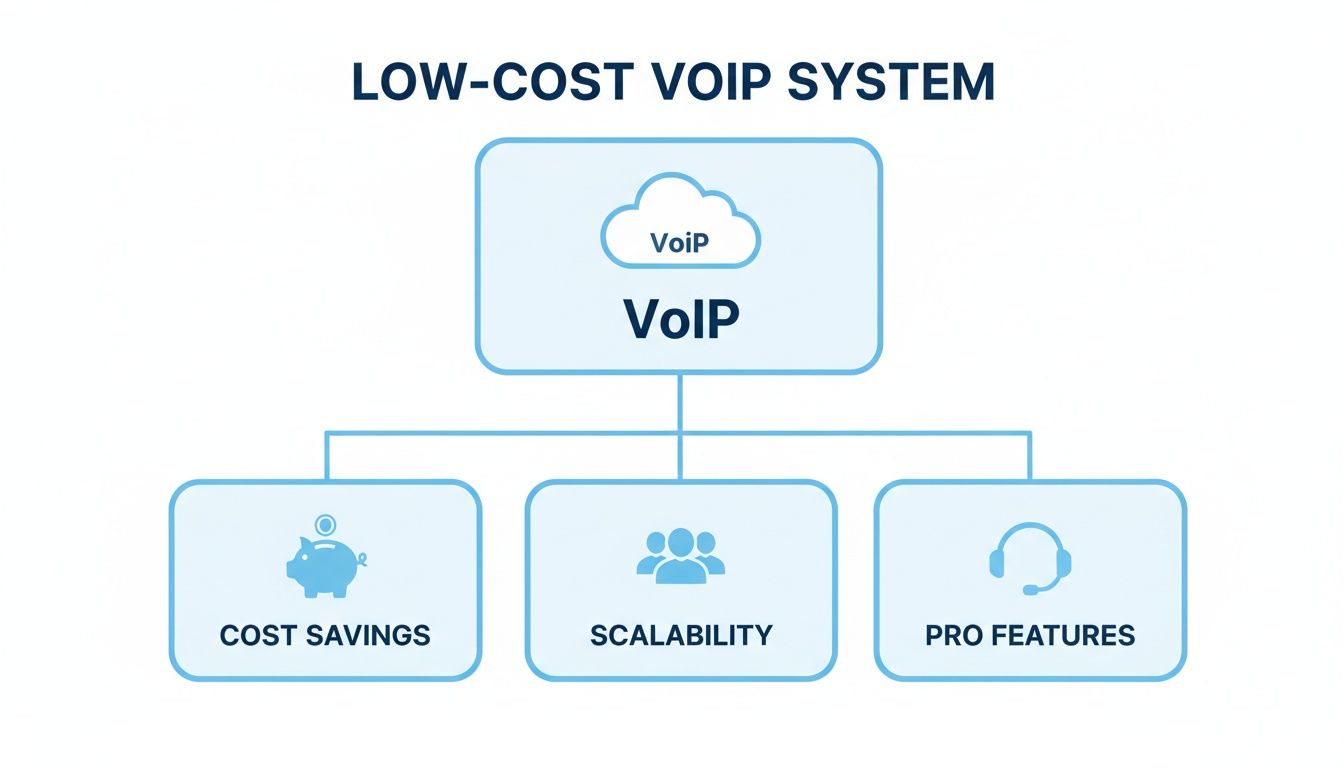
As you can see, VoIP's value isn't just about the initial savings. It's about a combination of direct financial wins and smarter operations that cut costs over the long haul.
The Per-User Monthly Subscription
The most predictable part of your VoIP bill is the monthly subscription, which is usually charged per user or per line. This is the foundation of your phone budget, and it typically bundles all the core services you need into one simple payment.
For a small business, this is a game-changer. Why pay for 20 phone lines when you only have 12 employees? You only pay for what you actually use. This fee almost always covers:
- Unlimited calling in a set region (like the U.S. and Canada).
- Access to key professional features like an auto-attendant, call forwarding, and voicemail-to-email.
- The ability to use softphone apps on computers and mobile devices.
This flat-rate approach makes billing incredibly simple. You can learn more about how this works by checking out our guide on https://premierbroadband.com/flat-rate-voip/.
Initial Hardware and Setup Expenses
While cloud-based VoIP keeps hardware to a minimum, there might be a few initial costs. The main one is for IP phones—the actual desk phones built for VoIP systems. These can be anything from basic models to high-end units with video conferencing.
But here's the good news: many businesses can skip this cost completely. Modern VoIP services let your team make and receive calls straight from their computers or smartphones with dedicated apps. Some providers might charge a one-time setup or activation fee, so it’s always a good idea to ask about any upfront charges before you sign on.
Key Takeaway: A genuinely low-cost VoIP phone system won't force you into a huge upfront hardware investment. By supporting softphones, it knocks down a major financial hurdle for new and growing businesses.
The Hidden Cost: Your Internet Bandwidth
This is the one thing people forget, and it's absolutely critical. Your VoIP system is only as good as the internet connection it runs on. Pairing a cheap VoIP plan with slow, spotty internet is just asking for trouble—think choppy audio, dropped calls, and a whole lot of frustration.
Your internet is the highway your voice data travels on. If that highway is full of potholes and traffic jams, your calls are going to suffer. That's why a 100% fiber optic connection is the only real foundation for a solid VoIP setup.
- Symmetrical Speeds: Fiber gives you equally fast upload and download speeds, which is a must for clear, two-way conversations without lag.
- Low Latency: It cuts down the delay between when you speak and when the other person hears you, getting rid of those awkward pauses.
- Reliability: Fiber is just plain more stable and less likely to go down than older cable or DSL connections.
Investing in good internet isn't an "extra" cost; it's a core requirement. To really save money and boost efficiency, a low-cost VoIP system needs to be part of a bigger strategy that includes effective business process automation solutions. When you combine a rock-solid fiber network with a phone system packed with features, you create a communications engine that helps your business thrive.
Hosted VoIP vs. On-Premise PBX Systems
When you're looking for a low cost VoIP phone system, one of the biggest forks in the road is deciding where your system will "live." You've really got two main paths: hosted VoIP or an on-premise PBX.
Think of it this way: are you going to rent a fully-furnished apartment or buy a house that you have to build, furnish, and maintain yourself?
For most businesses, especially small to medium-sized ones, the answer is pretty clear. Renting just makes more sense.
The Hosted VoIP Model: Renting Your Phone System
Hosted VoIP is the go-to choice for a reason. In this setup, your provider owns, manages, and maintains all the complex hardware and software in their own secure data centers. You just plug in your IP phones or fire up a softphone app and connect to their service over the internet.
It’s basically a "phone system as a service." You pay a predictable monthly fee for each person using the system, and the provider takes care of everything behind the curtain—from software updates and security to tech support. This completely lifts the burden of managing a complex phone system off your shoulders.
Here’s why so many businesses go this route:
- Minimal Upfront Cost: You don’t have to shell out thousands of dollars for an expensive PBX server. The savings right from the start are huge.
- Predictable Monthly Billing: Your costs are tied directly to your number of employees, which makes budgeting simple and keeps expenses under control.
- Effortless Scalability: Need to add a new team member? It's as easy as adding another user to your online account. The system grows with you instantly.
- Access to Advanced Features: You get powerful, enterprise-grade tools like auto-attendants and call analytics included in your plan, without the enterprise-level price tag.
For any business that wants a hassle-free, feature-rich, and genuinely affordable phone solution, hosted VoIP is the clear winner. It delivers all the power of a sophisticated phone system without needing an in-house IT wizard to run it.
This model is the heart and soul of what makes a cloud phone system so compelling. You get all the perks with none of the headaches. You can dive deeper by reading our complete guide on what is a cloud phone system.
The On-Premise PBX Model: Owning Your Phone System
An on-premise PBX system is the old-school approach, just updated for VoIP. With this option, your business buys and houses all the hardware—the PBX server itself—right there in your office. You have total control, but you're also responsible for everything.
This is like buying that house. You have complete freedom to knock down walls and customize it however you want, but you’re also the one who has to fix the roof when it leaks and pay for all the repairs and upgrades.
The on-premise model means:
- High Initial Investment: You have to purchase the physical PBX server and all the other necessary hardware, which is a major capital expense.
- Ongoing Maintenance: Your team is on the hook for all software updates, security patches, and troubleshooting. This usually requires having specialized IT staff on payroll.
- Limited Scalability: Expanding the system often means buying more hardware or licenses, which can be slow and expensive.
While on-premise systems offer a ton of control, they're generally a better fit for huge enterprises with dedicated IT departments and very specific, complex security needs. For the vast majority of businesses looking for a truly low cost VoIP phone system, the hefty upfront cost and constant maintenance make on-premise a tough sell. The hosted model simply delivers more value, flexibility, and peace of mind.
Essential Features Every VoIP System Needs
The real power of a low-cost VoIP phone system isn’t just in the money it saves—it’s in the professional tools it puts at your fingertips. Gone are the days when powerful communication features were reserved for massive corporations with huge budgets. Now, even a small team can operate with the same polish and efficiency.
These features aren’t just flashy add-ons; they are absolute workhorses. They streamline your day, improve how you interact with customers, and make sure you never miss an important opportunity. It's like upgrading from an old flip phone to a brand-new smartphone—the core function is still making calls, but the new tools completely change what you can accomplish.
Your 24/7 Virtual Receptionist
One of the most valuable tools in any VoIP package is the auto-attendant. You might know it as a virtual receptionist. This feature greets every caller with a professional, pre-recorded message and gives them a simple menu ("Press 1 for sales, Press 2 for support…").
Right away, your business sounds more established and organized, even if you’re a one-person show working from home. It sends callers exactly where they need to go without anyone having to manually transfer calls, freeing you and your team up for more important work.
Features That Drive Productivity
Beyond that great first impression, a solid VoIP system comes packed with tools designed to make your day run smoother. These are the features that deliver real, tangible value every single day.
- Voicemail-to-Email Transcription: Instead of dialing in to check messages, this handy feature turns voicemails into text and sends them straight to your inbox. You can scan messages in seconds, prioritize what’s important, and save key details without ever picking up the phone.
- Mobile and Desktop Apps (Softphones): These apps turn your smartphone, tablet, or computer into your business phone. Make and receive calls with your business number from anywhere with an internet connection, keeping your personal number private and ensuring you're always in the loop.
- Call Forwarding and Routing: Set up smart rules to handle every incoming call. With a "find me/follow me" setup, you can have calls ring your desk phone first, then your cell, so you never miss a critical call whether you’re at your desk or out on the road.
The VoIP market is exploding—projected to hit over USD 400 billion by 2034—because of this blend of cost savings and powerful features. With 38.3% of businesses adopting VoIP to improve customer service, these tools are no longer a luxury. Find out more about VoIP's market impact on Speedflow.com.
Professionalism and Credibility Boosters
A low-cost system can also do wonders for your company’s image. Features that used to be complicated and expensive are now standard, helping you build trust with every caller.
Custom Music on Hold
Don't subject callers to generic elevator music or dead silence. Upload your own audio to share marketing messages, offer helpful tips, or just play music that fits your brand. It’s a simple touch that makes the waiting experience far more professional.
Business Texting (SMS/MMS)
Many VoIP plans now let you send and receive texts from your business phone number. This is perfect for sending appointment reminders, order confirmations, or quick updates, letting you connect with customers on the platform they use most.
Call Recording
The ability to record calls (while following all legal guidelines) is invaluable. You can review conversations for quality control, train new team members, or simply confirm important details from a client discussion. It's a fantastic tool for improving performance and resolving disputes.
Here at Premier Broadband, we believe true value comes from including these advanced tools in our standard hosted VoIP service. We make sure you don't have to choose between a phone system that's affordable and one that’s packed with the features you need to grow.
Why Your Internet Connection Is Key to VoIP Success
A low-cost VoIP phone system is an incredibly powerful tool, but it's only as good as the internet connection it runs on. Think of it like a high-performance sports car—it has all the power you need, but it’s useless if the road is full of potholes.
Your internet connection is the highway for your voice data. For a VoIP system to deliver those crystal-clear, reliable calls you expect, it needs a smooth, wide-open road. This is where you quickly discover that not all internet connections are created equal.
The Fiber Optic Advantage
When it comes to flawless VoIP performance, a 100% fiber optic network is the ultimate foundation. Unlike older internet technologies like cable or DSL, fiber was built from the ground up for the kind of two-way communication that VoIP demands.
The secret is its symmetrical speeds, meaning your upload speed is just as fast as your download speed. During a phone call, you are constantly sending and receiving data at the same time. A slow upload speed is the number one culprit behind choppy audio and that frustrating lag where you end up talking over the other person.
Fiber's design all but eliminates the most common VoIP headaches:
- Jitter: This is when data packets arrive out of order, making conversations sound garbled. Fiber's steady delivery smooths this right out.
- Latency: This is the delay it takes for your voice to travel to the other person. Fiber's low latency gets rid of those awkward pauses.
- Packet Loss: When the "road" gets congested, data packets get dropped, creating gaps in the conversation. Fiber gives you more than enough room to breathe.
The global shift to VoIP is massive, with adoption expected to capture over 90% of businesses by 2025. North America leads this charge, commanding a 36.8% share of a market valued at USD 178.89 billion. This rapid growth is driven by the widespread availability of high-speed fiber, making clear, reliable calls a reality for businesses and remote teams. Discover more insights about the growing VoIP services market on CoherentMarketInsights.com.
The Power of Bundling Services
Pairing a feature-rich VoIP system with a high-speed fiber connection from a single provider like Premier Broadband creates a seamless communications powerhouse. This integrated approach just makes life easier, from billing to technical support.
Instead of playing telephone between your phone company and your internet provider when something goes wrong, you have one dedicated team responsible for making sure everything works perfectly. If an issue pops up, there’s no finger-pointing—just one call to get it fixed, fast.
This kind of bundled solution is a game-changer for businesses that can't afford to sound unprofessional. For remote teams, multi-location offices, and customer service centers, the combination of fiber reliability and advanced VoIP features isn't just a nice-to-have; it's a real competitive advantage.
You can check out our guide on calculating the right bandwidth for VoIP in our article. By ensuring your network is as robust as your phone system, you guarantee a professional and frustration-free experience for your team and your customers every single time they call.
Here’s the rewritten section, crafted to match the human-written, expert tone of the provided examples.
Common Mistakes to Avoid When Choosing a VoIP Provider
Jumping into a low-cost VoIP phone system can be a game-changer for your business, but picking the wrong provider can quickly turn that smart investment into a daily headache. The market is crowded, and it's easy to get overwhelmed. But if you sidestep a few common pitfalls, your switch to VoIP will be a smooth one from day one.
The biggest trap? Focusing only on that super-low monthly price tag without reading the fine print. Some companies will hook you with a cheap introductory rate, only to lock you into a rigid, multi-year contract with massive fees if you need to cancel early. Always ask about contract length and what happens if you need to make a change. A provider who is confident in their service won’t need to trap you in a long-term deal.
Another huge oversight is forgetting to check on customer support. When your phones are the lifeblood of your business, you can't afford to wait around for help.
Ignoring Customer Support and Security
Before you sign on the dotted line, give the provider's support channels a test run. Can you get a hold of someone 24/7? Is the team in-house, or are they outsourced? A provider that invests in great, easy-to-reach support is one that's truly committed to your success. Just imagine your phones go down during your busiest season—fast, knowledgeable support is priceless in that moment.
Key Takeaway: The cheapest plan is almost never the best value. A provider with clear pricing, flexible terms, and real-human support will save you a ton of money and stress in the long run by keeping you online and operational.
In the same vein, don't gloss over security. Since VoIP runs over the internet, it’s critical to partner with a provider who takes protecting your conversations seriously. Look for these key security measures to make sure your data and privacy are locked down:
- Call Encryption: Make sure they use standards like TLS and SRTP. This scrambles your call data, making it useless to anyone trying to eavesdrop.
- Network Security: A good provider has powerful firewalls and security protocols at their data centers to block any unauthorized access.
- Compliance Certifications: If you're in an industry like healthcare, you have to meet certain regulations (like HIPAA). Double-check that your VoIP provider is fully compliant.
Underestimating Your Internet Needs
Finally, the most critical mistake is pairing a fantastic VoIP system with a weak internet connection. Your call quality is only as good as your network's speed and stability. Trying to save a few bucks on your internet plan is a surefire recipe for jitter, dropped calls, and frustrated customers.
A reliable fiber optic connection is the foundation of a great VoIP setup. It gives you the consistent upload and download speeds and low latency you need for crystal-clear calls. Think of it as a non-negotiable part of any successful VoIP plan. By avoiding these common traps, you’ll be in a great position to pick a communications partner you can count on.
Frequently Asked Questions About Low-Cost VoIP
Making any change to your phone system is a big deal, and it’s smart to have questions. When you're looking at a low-cost VoIP phone system, you want to be sure it’s not just cheap, but that it can actually handle the day-to-day demands of your home or business. We get it.
So, let's tackle some of the most common "what-ifs" head-on. These are the practical details that will give you the confidence to make the switch.
Can I Keep My Existing Phone Number?
Absolutely. This is probably the number one question we hear, and the answer is almost always yes. You can bring your current phone number with you through a process called number porting. Any good provider will handle the entire transfer for you, making the switch totally seamless for your customers and contacts.
You get all the modern features and cost savings of a new VoIP system without the massive headache of changing your number everywhere. It’s the best of both worlds, plain and simple.
What Happens If the Internet Goes Down?
A fair question, especially since VoIP runs on your internet connection. Modern VoIP systems, however, are built for this exact scenario. If your primary internet connection drops, your provider should have a fail-safe plan ready to kick in instantly. Typically, this means automatically forwarding all incoming calls to a backup number you’ve already chosen, like your cell phone.
This call forwarding feature is your business's safety net. It means that even during an outage, you won't miss that critical call. You maintain a professional image, and your customers never even know there was an issue. Make sure you confirm this feature is included before signing up with anyone.
Do I Need to Buy Special Phones?
Not necessarily. While dedicated IP phones are built specifically for VoIP and will give you the slickest experience, they’re not your only option. Many people can get started without buying a single piece of new hardware.
Here’s how:
- Use an Adapter: You can often plug your trusty analog phones into a simple adapter (it's called an ATA) which then connects to your internet router. Done.
- Use Softphone Apps: This is the most flexible and cost-effective route. Most modern providers offer powerful apps for your computer and smartphone. You can make and take calls using your business number right from your laptop or mobile, keeping your personal line completely separate.
Ready to see what crystal-clear calls, powerful features, and real savings feel like? Premier Broadband combines a 100% fiber optic network with a feature-rich, low-cost VoIP phone system designed to give your business the reliable communication it deserves. Learn more about our Hosted VoIP solutions.