

Choosing the right Ft Worth phone system provider isn't just an IT task—it's a critical business decision that touches everything from your daily operations to your customer's happiness. Get it right, and you’re set up with modern tools that help you grow. Get it wrong, and you're stuck with missed calls, frustrated clients, and a whole lot of operational headaches.
Why Modernizing Your Phone System Is a Smart Move for Fort Worth Businesses

In a place as competitive as Fort Worth, sticking with an old-school landline is like trying to navigate the I-35 mixmaster during rush hour in a horse and buggy. It's just slow, clunky, and it's holding you back.
Those legacy phone systems were never designed for how we work today. They can’t keep up with hybrid teams, remote employees, or customers who expect an answer now.
This old tech creates real problems. If your team is working from home or out on a job site, they can't just grab a call coming into their office line. That means missed opportunities and a communication breakdown between your staff and your customers.
The Strategic Shift to VoIP
This is where modern Voice over Internet Protocol (VoIP) systems come in. They take those problems and turn your communications into a flexible, powerful tool for your business. Instead of being chained to a desk, your phone system lives in the cloud. Anyone can access it from anywhere with an internet connection.
This isn't just a simple IT upgrade; it’s a genuine business improvement. In a fast-growing hub like the Dallas-Fort Worth metroplex, VoIP has become a necessity. It’s no surprise that globally, over 60% of small and medium-sized businesses are making the switch, with a projected 61% planning to move away from their on-premise systems.
Real-World Benefits for Your Business
A modern phone system becomes the central hub for your entire company, connecting every employee to each other and to your customers without a hitch.
Just think about the practical advantages:
- Scale Up (or Down) Instantly: Need to add or remove phone lines? It takes minutes, not weeks. You can scale your operations up or down as your business changes.
- Make Your Team More Productive: Features like getting voicemails sent to your email, forwarding calls to mobile phones, and connecting with your CRM handle the small stuff automatically, so your team stays focused and connected.
- Create a Better Customer Experience: Auto-attendants and smart call routing get every caller to the right person on the first try. That means less frustration for them and better service from you.
When you choose the right Ft Worth phone system provider, you’re not just buying a new phone service. You’re investing in a more efficient, resilient, and customer-focused future. For an even more integrated setup, it's worth learning about what UCaaS can offer your company.
Hosted VoIP vs On-Premise PBX: What Fits Your Business?

Before you can pick the right Ft Worth phone system provider, you have to make a foundational decision. Is your new system going to live in a server rack in your office, or will it be hosted securely in the cloud?
This choice between a traditional on-premise PBX and a modern hosted VoIP solution is the first, and most important, fork in the road. It shapes everything from your upfront budget to how your team works every single day.
The Old School: On-Premise PBX Systems
The traditional route is an on-premise Private Branch Exchange (PBX). This means you buy and own all the physical hardware—the servers, switches, and other gear—and house it right there in your building. Your IT team is responsible for managing, maintaining, and fixing every last piece of it.
For a well-established law firm in downtown Fort Worth with a dedicated IT department and iron-clad data security rules, this can make sense. They get total, granular control over the system and can keep all their call data physically within their own walls.
But that level of control comes with a hefty price tag and a lot of responsibility.
- Big Upfront Investment: You’re on the hook for purchasing all the server hardware, software licenses, and desk phones. This is a major capital expense that can run into the tens of thousands.
- Constant Maintenance: Your IT team has to handle every update, security patch, and late-night troubleshooting session. When a line goes down, the buck stops with them.
- Scaling is Slow and Expensive: Need to add a few new phone lines? That often means buying more hardware and going through a complex configuration process.
This model can work for large enterprises with deep pockets and the in-house tech experts to run the show. For most small and medium-sized Fort Worth businesses, though, the cost and complexity are serious roadblocks.
The New Way: The Agility of Hosted VoIP
Now, picture a fast-growing tech startup over in the Alliance corridor. They need to be nimble. They need flexibility. For them, a Hosted VoIP system is a no-brainer.
Instead of a massive upfront cost, they pay a simple, predictable monthly fee. When they hire three new developers next week, adding them to the phone system is as easy as a few clicks in a web browser. No new hardware, no waiting on an IT ticket.
With Hosted VoIP, you're essentially outsourcing all the complexity. Your provider handles the technology, the security, and all the updates, freeing you up to focus on running your business—not your phone system.
This cloud-based model is built for modern businesses that prioritize growth and efficiency. There's no server closet to maintain and no need to have a phone specialist on your IT staff.
The system is also perfectly designed for today’s work environment, easily connecting your team whether they’re in the office, at home, or on the road. It brings everyone under one seamless communication network.
To see just how powerful this can be, check out our guide on the benefits of a cloud phone system for business.
Hosted VoIP vs On-Premise PBX at a Glance
Making the right call starts with a clear understanding of the trade-offs. This table breaks down the key differences to help you see which model truly fits your Fort Worth business.
| Feature | Hosted VoIP (Cloud-Based) | On-Premise PBX (Self-Hosted) |
|---|---|---|
| Initial Cost | Low. Minimal hardware purchase; monthly subscription model. | High. Requires significant investment in servers, software, and phones. |
| Maintenance | None. Handled entirely by the provider. | High. Requires dedicated in-house IT staff for updates and repairs. |
| Scalability | Easy & Fast. Add or remove users instantly through a web portal. | Complex & Slow. Often requires new hardware and professional configuration. |
| Control | Limited to User Features. Provider manages all backend infrastructure. | Total Control. Full customization and management of hardware and software. |
| Best For | SMBs, startups, businesses with remote teams, and those prioritizing flexibility. | Large enterprises with strict security needs and dedicated IT resources. |
Ultimately, choosing the right Ft Worth phone system provider comes down to knowing which of these models aligns with your budget, your team's needs, and your goals for the future. For the vast majority of businesses today, the scalability, predictable costs, and powerful features of Hosted VoIP make it the clear strategic winner.
Pinpointing the Features Your Business Actually Needs
When you’re looking at a new Ft Worth phone system provider, it’s easy to get lost in a long list of features. But a flashy list is useless if the tools don't solve your actual, day-to-day business problems. The real goal is to find a system that makes your operations smoother, not more complicated.
You have to cut through the noise and figure out your "must-haves" versus your "nice-to-haves." The best way to do that is to think about how your team really works and what your customers expect when they pick up the phone to call you.
Core Features for Any Modern Business
Some features just aren't optional anymore. They’re the foundation of any efficient business phone system, keeping your team connected whether they're in the office, on a job site in Tarrant County, or working from home.
Here's what your baseline checklist should include:
- Mobile App Functionality: This lets your team make and receive calls from their business number on their personal smartphones. It keeps up a professional image and makes sure they're always reachable.
- Voicemail-to-Email (or Text): This feature automatically transcribes voicemails and shoots them straight to an employee's inbox. It's a massive time-saver and makes messages easy to search and forward.
- Auto-Attendant: Think of this as a virtual receptionist that greets every caller professionally and routes them to the right person or department. It ensures no call goes unanswered and frees up your staff from playing operator.
These fundamentals take care of the most common communication headaches. But the real magic happens when you add features that are tailored to your specific business goals.
Game-Changing Features That Drive Growth
Once you’ve got the basics covered, it's time to look for tools that give you a real competitive edge. These are the features that do more than just maintain your business—they actively help it grow by improving sales, customer service, and your own internal workflows.
For instance, a local service business can use call recording to train new technicians and for quality control. A retail business with locations across the metroplex gets a huge benefit from multi-site management, which lets them control the phone system for every single store from one simple dashboard.
The right features should feel less like a new piece of software and more like a solution to a problem you've been trying to solve for years. Think about your biggest operational bottlenecks—chances are, there’s a VoIP feature designed to fix it.
There's a reason the U.S. VoIP market is now worth $49.4 billion. Powerful fiber networks have dramatically improved call quality, making features like video conferencing—used by 75% of employees—a daily reality. For remote teams, basics like call forwarding see 92% adoption, ensuring seamless work no matter where they are. You can read more about the growth of the VoIP market on fortunebusinessinsights.com.
One of the most powerful advanced features is CRM integration. When you link your phone system to your Customer Relationship Management software, it can automatically log calls and pull up customer records when they ring. This small change turns your phone from a simple communication device into a powerhouse for your sales and service teams. Take a look at our guide on finding the right VoIP solutions for small business to see what else is possible.
Alright, you’ve mapped out your needs and you know what kind of phone system will work best for your Fort Worth business. Now for the crucial part: finding the right local partner to make it all happen.
This isn’t just about buying technology. It's about finding a team that understands the Fort Worth business climate and will actually pick up the phone when you need them.
How to Vet and Select Your Local Fort Worth Provider
Your first move is to build a shortlist of providers who are genuinely local. Start with a search for companies that specifically serve the Fort Worth area. A local address and a local support number are non-negotiable. When there’s an issue, you don’t want to be stuck waiting for a technician driving in from Dallas or, worse, dealing with a call center thousands of miles away.
A provider’s own online presence can tell you a lot. A clean, professional website is a good sign they take their business seriously. In fact, knowing a little about how providers optimize their online presence can give you clues about their attention to detail and commitment to being accessible to customers like you.
Looking Beyond the Star Rating
Online reviews are a great resource, but you have to read between the lines. Don’t just look at the 5-star average; dig into the actual comments to see what people are saying.
You're looking for patterns in the feedback.
- The Support Experience: Are customers raving about fast response times from a local Fort Worth team? Or are they complaining about endless ticket queues and unresolved problems?
- The Onboarding Process: Do the reviews talk about a seamless, zero-downtime setup? Or do they sound like a nightmare of dropped calls and chaotic migration?
- Billing Transparency: Keep an eye out for phrases like "hidden fees" or "surprise charges." A good partner is upfront about their pricing.
Reviews that mention technicians by name or detail how the provider solved a specific, tricky problem are pure gold. That’s the kind of insight you can’t get from a simple star rating.
Asking the Right Questions During Consultations
Once you’ve narrowed your list down to two or three solid contenders, it’s time to get them on the phone. This is where you get past the slick sales pitch and find out how they really operate. Don't be shy—ask direct, specific questions.
The goal here is simple: you need to understand their service guarantees, the real expertise of their local team, and what your partnership will actually look like once the ink is dry on the contract. Their answers will tell you everything.
Go into these calls with a prepared list of questions. It’s the only way to make a true apples-to-apples comparison between each Ft Worth phone system provider.
Your Essential Provider Vetting Checklist
Here are the critical questions every Fort Worth business should ask. The way they answer will separate the true partners from the mere vendors.
- What’s your network uptime guarantee? Ask to see their Service Level Agreement (SLA). You’re looking for a guarantee of 99.99% or higher. Crucially, ask what happens if they fail to meet it.
- Where is your support team physically located? You want confirmation that you’ll be talking to a technician right here in the area who gets it, not someone in a generic national call center.
- Can you walk me through your onboarding and migration process? A pro will have a documented, step-by-step plan to port your numbers and switch your system over with absolutely zero downtime.
- Are there any hidden fees? Push for a complete breakdown of every potential charge—taxes, regulatory fees, one-time setup costs, everything.
- Can you provide me with local references? A confident provider will have no problem connecting you with a few other Fort Worth businesses they work with. This is the ultimate proof.
Following this framework helps you cut through the marketing noise and focus on what really matters: reliability, local expertise, and a transparent partnership. It's the best way to choose a provider who will be an asset to your business for years to come.
To get a head start on your search, check out our guide to the best DFW VoIP phone service providers.
Your Guide to a Painless System Migration
Let's be honest: the thought of swapping out your company's entire phone system can be intimidating. It's easy to picture the worst-case scenarios—dropped calls, lost numbers, and a team that has no idea how to use the new phones.
But it doesn't have to be that way. With a solid game plan, moving from an old, clunky system to a modern VoIP solution can be surprisingly seamless. A successful migration isn't about crossing your fingers and hoping for the best; it's all about careful, deliberate preparation.
The whole process comes down to mapping everything out before you flip the switch. That means getting a crystal-clear picture of your current setup and working hand-in-hand with your chosen Ft Worth phone system provider to nail down all the technical details.
This is the fundamental approach we take when helping businesses vet a new partner—it’s the crucial first step in your migration journey.
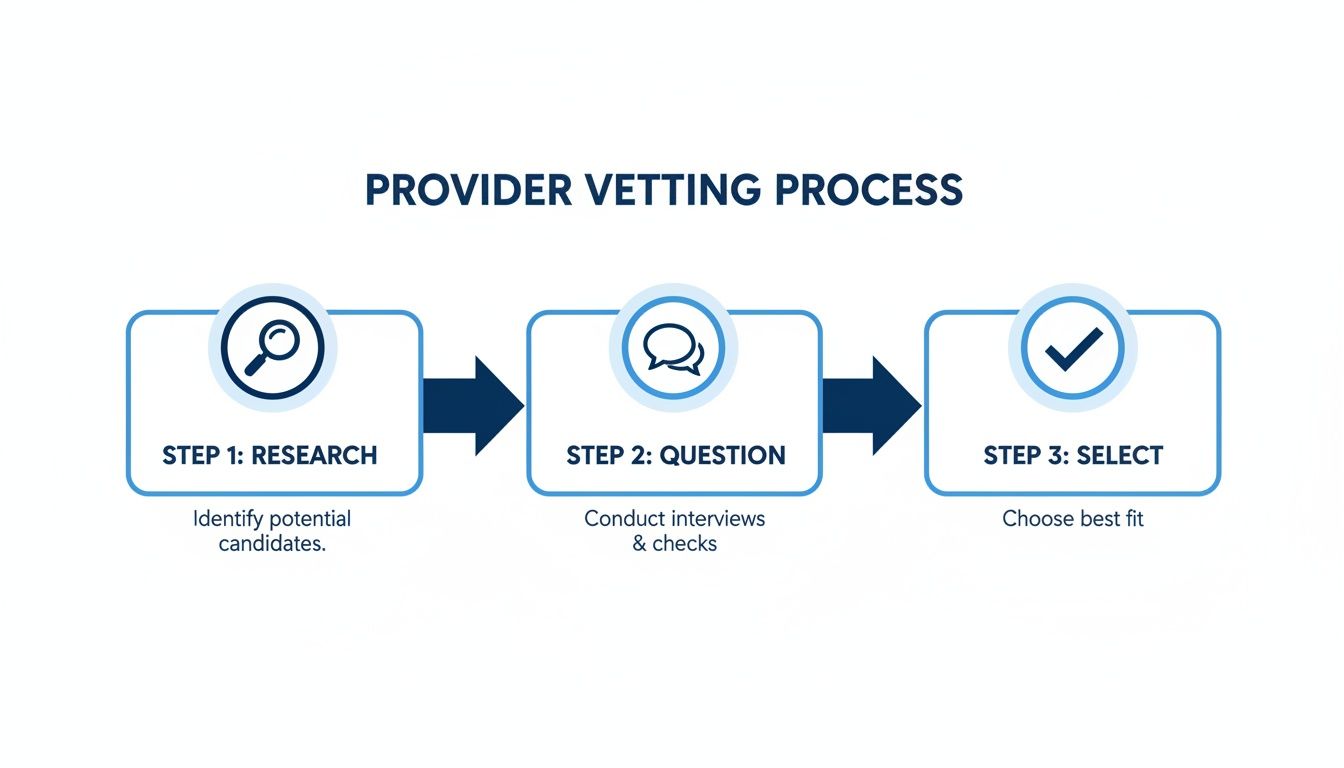
By following a deliberate process like this, you can move from doing your homework to making a final decision with total confidence.
Your Pre-Launch Migration Checklist
A few key steps taken before you go live can save you from massive headaches later. This isn't just a tech checklist; it’s about getting your business operations and your people ready for the change.
- Audit Your Current System: First, take stock of what you have. How many phone numbers are in use? When are your peak call times? Knowing your daily call volume is essential for your new provider to configure the system correctly right out of the gate.
- Get Your Network Ready: Your new VoIP system is only as good as your internet connection. We always recommend working with your provider to test your network's readiness. This ensures you have enough bandwidth for consistently crystal-clear calls.
- Build Your Call Flows: Think through the experience you want for your callers. What happens when someone dials your main number? Who does the auto-attendant greet? Which department gets which calls? Getting this right is the key to a professional customer experience.
A smooth migration is 90% planning and 10% execution. The more you iron out the details beforehand, the less chance you have of hitting a snag during the switch.
Don’t Sweat the Number Porting Process
One of the biggest anxieties we hear from business owners is the fear of losing their main phone number—the one that's on their trucks, website, and business cards.
Thankfully, you don't have to worry. Number porting is a standardized, federally regulated process designed to prevent exactly that from happening.
Your new provider should handle all the heavy lifting. All you'll need to do is provide a copy of your most recent phone bill and sign a Letter of Authorization (LOA). This gives them the legal green light to coordinate the transfer with your old carrier.
Here's the critical part: do not cancel your old service until the port is 100% complete. Your new provider will give you a firm date and time for the switch. This careful coordination ensures there's absolutely zero downtime, so you won't miss a single customer call.
Getting Your Team On Board
Once your new system is up and running, the job isn't quite done. The final piece of the puzzle is making sure your team actually knows how to use it.
A great local provider won't just plug everything in and walk away. They should offer hands-on training for your entire staff.
Make sure to schedule a session to walk everyone through the key features. This could include using the mobile app for calls on the go, setting up voicemail-to-email, or learning the new way to transfer calls. This small investment in training pays off immediately by boosting productivity and ensuring you get every bit of value out of your new system.
Lingering Questions Before You Make the Switch
Even with all the facts laid out, it's completely normal to have a few last-minute questions. I get it. Changing your business phone system is a big deal, and you want to be 100% sure you're making the right move.
Let's walk through some of the most common questions we hear from Fort Worth business owners just like you. My goal here is to give you clear, straight answers so you can feel confident in your decision.
How Long Does This Whole Process Actually Take?
This is usually the first thing people ask, and for good reason—you can't afford to be offline. The good news? With a professional Ft Worth phone system provider, the switch itself is incredibly quick. All the heavy lifting is done in the planning stage.
The process of moving your phone numbers (called "porting") usually takes one to two weeks, but this all happens behind the scenes. You won't notice a thing, and your service will continue as normal.
On the actual "go-live" day, the cutover is nearly instant. A well-planned migration should mean zero downtime. One minute you're on the old system, the next you're on the new one. It's that smooth.
Do I Have to Scrap All My Current Phones?
Maybe not! Many modern VoIP desk phones, especially those using the open SIP standard, work just fine with different providers. A good local provider can take a look at your current hardware and tell you what's reusable.
The key thing here is compatibility. If your phones are locked to your old provider or are just ancient, you'll likely need new ones to get all the features and reliability you're paying for.
But even if you do need new phones, it's not a dealbreaker. Most providers offer them as a low-cost rental or roll the price into your monthly plan. This avoids a big hit to your cash flow and makes getting modern equipment really affordable.
What Happens If My Internet Goes Down?
A totally fair question, since VoIP runs on your internet connection. Any provider worth their salt has a plan for this. It's all about automatic call forwarding.
If your office internet drops, a good system will detect it instantly. From there, it automatically reroutes all incoming calls to wherever you've designated—cell phones, another office location, you name it.
Your customers will have no idea there was an issue. They call your main number, and someone answers. This is a must-have safety net that keeps you in business no matter what's happening at the office.
Ready to modernize your business communications with a reliable, local partner? Premier Broadband offers crystal-clear VoIP phone systems and high-speed fiber internet designed for Fort Worth businesses. Simplify your network and enhance your customer experience today.