

VoIP business phones are simply a modern way to make and receive calls using your internet connection, ditching the need for old-school copper phone lines. Think of it as the difference between sending an email and mailing a letter—it's faster, more flexible, and packed with features that traditional phones just can't match.
What Are VoIP Business Phones and Why Should You Care?
Picture your company's phone system as a tangled mess of physical wires. It's expensive to set up, a headache to expand, and if one line goes down, you're out of luck. That’s the reality for many businesses still relying on a traditional 2-line telephone system or a clunky, on-site PBX box.
VoIP, which stands for Voice over Internet Protocol, throws that entire model out the window. Instead of those restrictive physical wires, it uses the internet—something you already have—to handle all your calls. Your voice is converted into digital packets that zip across your existing network, delivering crystal-clear conversations to anyone, anywhere.
The Shift to Smarter Communication
There's a reason businesses are moving away from legacy phone systems in droves. The global VoIP market was valued at $85.2 billion in 2021 and is expected to climb to $102.5 billion by 2026. This isn't just a fleeting trend; it’s a fundamental change in how modern companies stay connected.
For small and medium-sized businesses, VoIP is a game-changer. It gives you access to powerful communication tools that were once only affordable for massive corporations, leveling the playing field.
The core value of VoIP is agility. It allows a business to scale up or down instantly, connect a remote workforce seamlessly, and present a professional image without the high costs of traditional hardware.
VoIP vs. Traditional Phones: A Clear Comparison
To truly get it, you need to see the differences side-by-side. While both systems let you talk on the phone, how they work and what they deliver are worlds apart. If you want to get into the technical nuts and bolts, you can learn more about how VoIP phones work in our detailed guide.
Let's break down the key contrasts between old-school phone systems and modern VoIP business phones.
Traditional Phone Systems vs. VoIP Business Phones
This table really highlights the advantages you get when you move to a modern, internet-based phone system. The conversation shifts from "How many lines do I need?" to "What can my phone system do for my business?"
| Feature | Traditional PBX System | VoIP Business Phone System |
|---|---|---|
| Infrastructure | Requires physical on-site hardware and dedicated copper wiring. | Runs over your existing internet connection; hardware is in the cloud. |
| Scalability | Complex and expensive; requires technician visits to add new lines. | Effortless; add or remove users instantly through a web portal. |
| Cost | High upfront hardware costs and ongoing maintenance fees. | Low to zero upfront cost with a predictable monthly subscription. |
| Flexibility | Tied to a physical office location; limited remote work capability. | Works anywhere with internet; supports desk phones, laptops, and mobile apps. |
| Features | Basic calling features; advanced tools are costly add-ons. | Includes advanced features like auto-attendant and voicemail-to-email. |
Ultimately, a traditional phone system just makes calls. A VoIP system, on the other hand, becomes a central part of your business operations, helping you work smarter, serve customers better, and grow without limits.
How VoIP Technology Powers Modern Business
To really get why VoIP business phones are such a game-changer, it helps to peek under the hood. Unlike old-school phone lines that need their own physical wires, VoIP turns your voice into digital information that zips across the internet—just like an email.
It's a much smarter, more flexible way to stay connected.
When you talk, your VoIP phone or app instantly chops your voice into tiny digital files called data packets. These packets are tagged with an address and sent over your internet connection. On the other side, they're reassembled back into crystal-clear audio. The whole trip happens in a blink.
Because your calls are just data, you can manage them in ways that are simply impossible with older analog technology. This is where all the powerful features come from.
Your Digital Superhighway for Calls
A core piece of this magic is SIP Trunking. Think of an old phone system like having a few single-lane country roads leading to your business. Only a handful of calls can get in or out at once.
SIP (Session Initiation Protocol) trunking is like paving a multi-lane digital superhighway right to your front door.
Instead of being stuck with a fixed number of physical lines, SIP creates virtual phone lines over your internet connection. This lets you handle tons of calls at the same time and is what makes VoIP so easy to scale. Need more capacity? You just add another lane to your highway, no digging or construction required.
If you want to get into the nitty-gritty, you can learn more about how SIP trunks work and the role they play.
This chart breaks down the differences between the old way and the new way of thinking about business communications.
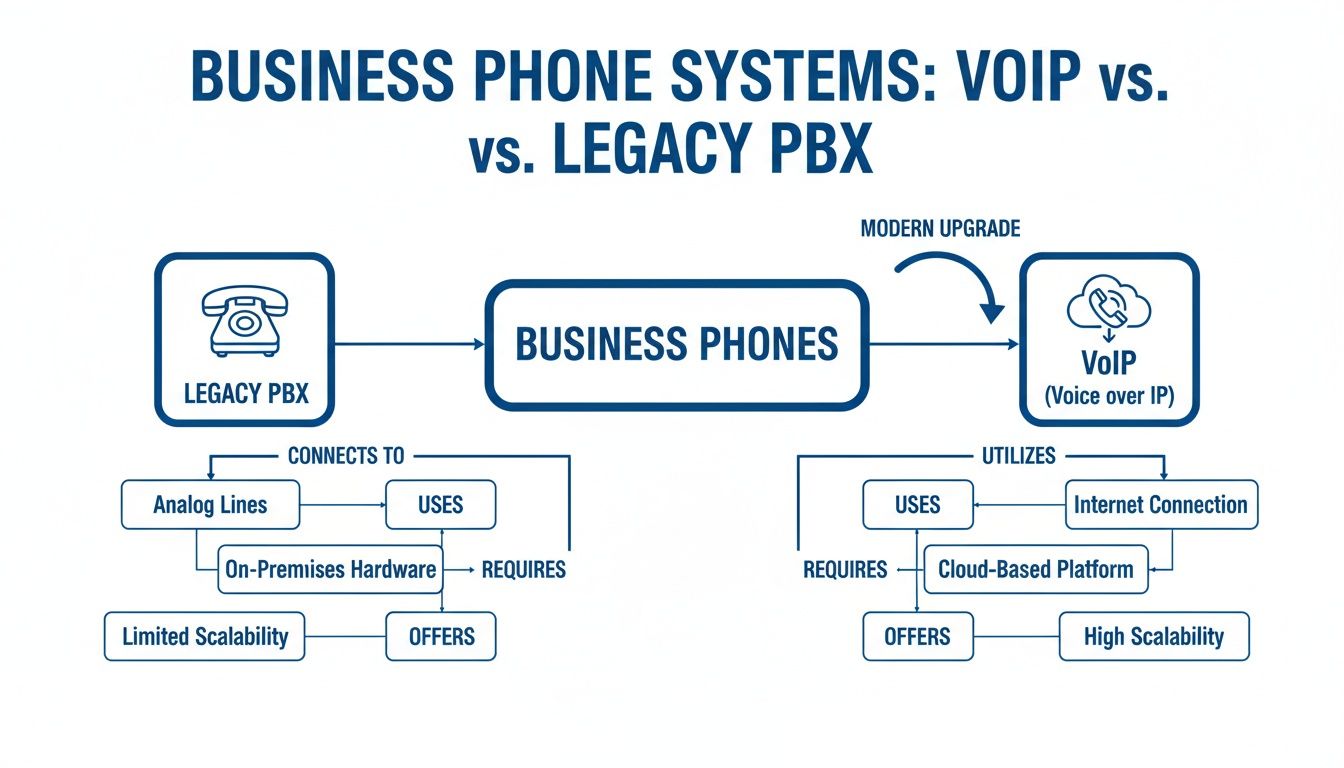
As you can see, VoIP moves your phone system's brain from a clunky box in a closet to the flexible, powerful cloud.
Why Your Internet Connection Is Everything
Since your voice is traveling as internet data, the quality of your connection is the most critical part of the puzzle. A weak or unstable connection means packets can get delayed or lost, which leads to those frustrating echoes, choppy audio (jitter), or dropped calls.
This is where a high-quality fiber network isn't just a "nice-to-have"—it's a must-have.
For a professional VoIP system, a standard home internet connection just won't cut it. You need business-grade connectivity with symmetrical speeds. That means your upload speed is just as fast as your download, ensuring your voice goes out as clearly as the other person's comes in.
Premier Broadband’s 100% fiber network is built for exactly this. It provides the rock-solid, high-speed foundation you need for flawless calls, so your business always sounds its best. You'll never have to worry about a critical conversation getting dropped because of a bad connection.
The Core Features and Benefits of a VoIP Phone System
Switching to a VoIP business phone system isn't just a technical upgrade; it's a complete overhaul of how your company communicates. These systems are packed with smart features that solve real-world business problems, helping your team get more done while giving your customers a far better experience.
Let's skip the dry technical jargon and look at how these tools can make a difference for you right away.
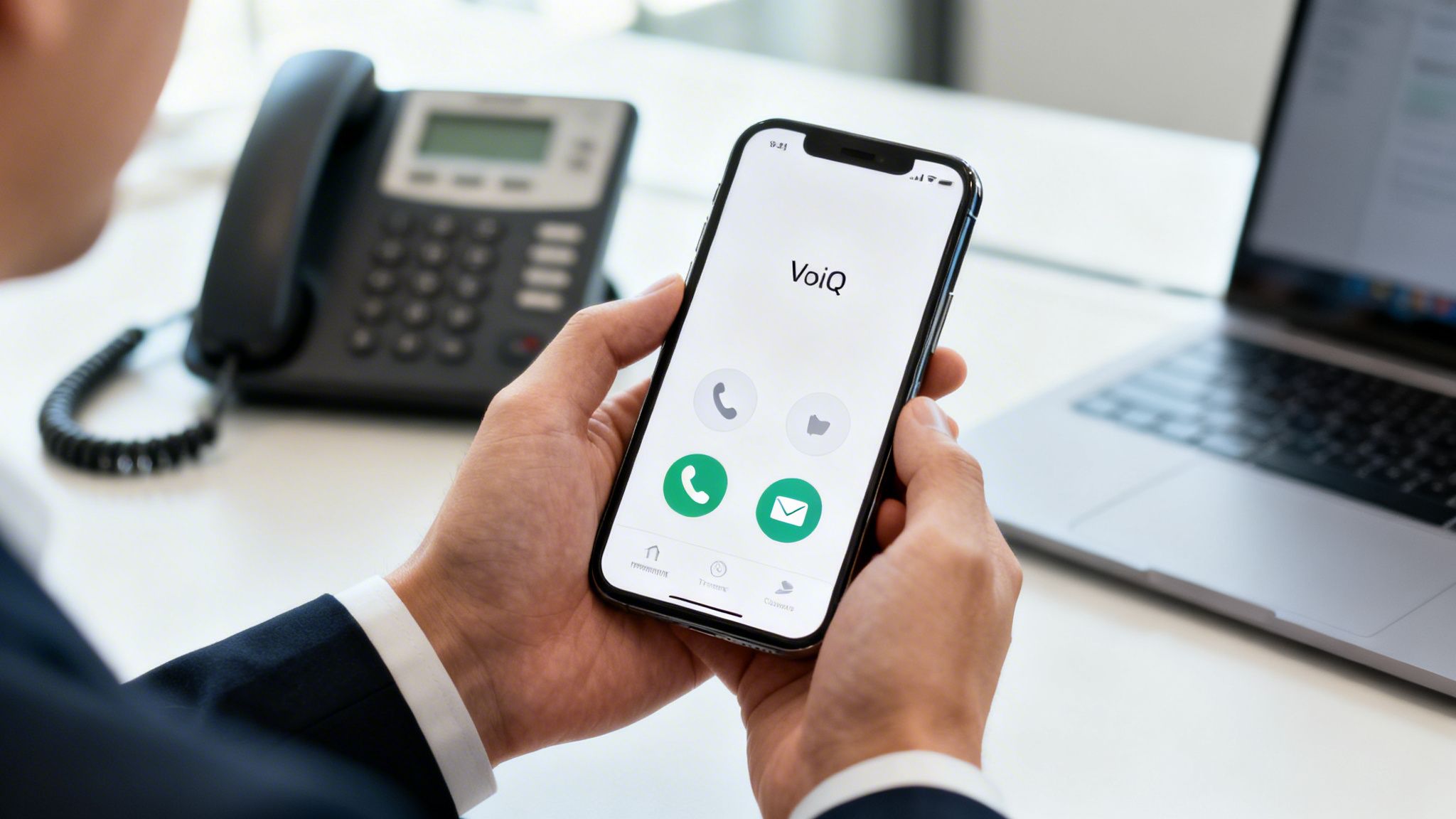
Many of these tools are part of a bigger picture called Unified Communications. You can learn more about UCaaS in our dedicated guide, but for now, we'll focus on the hands-on features that deliver an immediate payoff.
Make a Great First Impression with an Auto Attendant
Worried about missing important calls when you’re busy or after hours? An Auto Attendant is your virtual receptionist, ready to greet every caller professionally, day or night. It gives callers a clear menu of options—"Press 1 for Sales, Press 2 for Support"—and gets them to the right person instantly.
This single feature completely changes how your company is perceived. Instead of a phone ringing off the hook, every caller gets a polished, helpful response. It makes a small business sound just as organized and capable as a major corporation.
Free Your Team from Their Desks with Advanced Mobility
In a world of flexible schedules and remote work, being chained to a desk phone just doesn't cut it anymore. VoIP smashes that limitation with tools built for working from anywhere.
- Mobile and Desktop Apps: These apps turn any smartphone, laptop, or tablet into a business phone. Your team can make and take calls from their business number wherever they are, keeping their personal numbers private and maintaining a professional front.
- Voicemail-to-Email: Stop dialing in to check messages. This feature automatically turns voicemails into text and sends them straight to your email inbox. You can quickly read messages, decide who to call back first, and save important voicemails without ever touching a phone.
- Call Forwarding and Find Me/Follow Me: Make sure you never miss that critical call. Set up rules to have calls ring your desk phone first, then your mobile app, then even a colleague's line, ensuring someone is always there to pick up.
These mobility features give your team the power to be productive whether they’re at home, on the road, or in the office.
One of the biggest wins with modern VoIP business phones is device independence. Your business number isn’t stuck on one piece of hardware. It follows you everywhere, creating a single, professional presence across all your devices.
Build Trust and Work Smarter with Powerful Tools
Beyond just making calls, VoIP gives you features that build customer trust and help your team collaborate more effectively. A huge one is Branded Caller ID. It displays your company’s name and logo on the recipient's phone, even if they don't have you in their contacts. This simple change replaces an "unknown number" with a familiar brand, which can dramatically boost your answer rates.
VoIP systems also bring other vital communication tools into one place. You get:
- Integrated Video Conferencing: Jump on a video call for a team huddle or a client presentation right from your phone app. No more juggling different software or subscriptions.
- Business SMS/Texting: Send and receive text messages from your main business number using the desktop or mobile app. It's perfect for appointment reminders, quick customer updates, and service follow-ups.
- Insightful Analytics: Get your hands on real data. See detailed reports on call volume, wait times, missed calls, and individual team member activity. This helps you make smarter decisions about staffing and track your performance.
These tools give small and mid-sized businesses the operational edge they need to compete. They simplify workflows, keep customers happy, and deliver the insights required for smart, sustainable growth.
Choosing the Right VoIP Solution for Your Company
Choosing a provider for your VoIP business phones is a big deal. This decision will directly affect your budget, how your team works, and the experience your customers have every single day. It’s not about grabbing the cheapest plan you can find; it’s about finding a strategic partner who’s ready to support your company as it grows.
To make the right call, you need to know what to look for. We’ve put together this guide to help you evaluate providers on the things that actually matter, so you can sidestep the common traps and find a solution that gives you a real edge.
What Really Matters in a VoIP Provider
When you start comparing your options, it’s easy to get fixated on price. But the true value of a VoIP system is found in its reliability, how it can grow with you, the support you get, and how secure it is.
Use these points as your checklist to ask the right questions and spot a high-quality partner.
- Scalability for Future Growth: Your business won't stay the same size forever, and your phone system needs to keep up. Can a provider add or remove users on the fly? A great system lets you make these changes instantly through a simple online portal, no waiting on a technician required.
- Reliability and Call Quality: You have to ask potential providers about their network. What kind of uptime do they guarantee? A provider running on a 100% fiber network, like Premier Broadband, will always deliver better call quality and reliability than one using older cable or DSL lines.
- Responsive Customer Support: When something goes wrong, you need help—fast. Is their support team there for you 24/7? Are they local? Many cheap providers cut corners on support, leaving you to fend for yourself with complex issues. Give their support a test run before you commit.
- Robust Security Measures: VoIP calls are just data traveling over the internet, and that data needs to be locked down. Make sure any provider you consider uses strong encryption like TLS and SRTP to protect your conversations from being snooped on. A truly complete solution will also include network security to shield you from other cyber threats.
The cheapest VoIP plan often ends up being the most expensive one. Poor call quality, constant downtime, and support that's nowhere to be found can cost you far more in lost productivity and unhappy customers than you'd ever save on a monthly bill.
DIY vs. A Fully Managed Solution
When you're ready to set up your VoIP business phones, you really have two options: a Do-It-Yourself (DIY) setup or a fully managed solution.
Going the DIY route can look tempting because of the lower upfront cost. You pick a provider, buy your own phones, and get everything configured on your own. The catch? You're now responsible for everything—setup, maintenance, and troubleshooting are all on your plate. When calls start dropping, it’s up to you to figure out why.
A fully managed solution, like our own Managed Network Edge, is a completely different world. We take care of it all, from optimizing your network and setting up the hardware to keeping an eye on it 24/7. This gets rid of the technical headaches and guarantees your phone system works flawlessly with your internet because it's all managed under one roof. It’s the smart play for any business that wants to focus on what it does best, not on IT problems.
The shift toward integrated, mobile-friendly systems is undeniable. Hosted VoIP is changing the game, with the mobile VoIP market valued at $44.99 billion in 2023 and expected to hit over $104 billion by 2030. For small and mid-sized businesses, moving to a cloud system can cut costs by up to 50% compared to an old-school setup. You can dig into what these trends mean for you in this detailed VoIP statistics report.
Understanding the True Total Cost of Ownership
Finally, it’s crucial to look at the Total Cost of Ownership (TCO), not just the monthly price. The sticker price is only one piece of the puzzle.
Think about all the potential costs:
- Upfront Costs: Are there fees for the phones, the setup process, or for moving your existing number over?
- Monthly Fees: Does the per-user price really include all the features you need, or are there add-ons?
- Hidden Costs: Will you get hit with extra charges for going over call limits, using "advanced" features, or calling tech support?
- Indirect Costs: What's the real business cost of potential downtime or garbled call quality?
Thinking through these factors helps you find a partner that delivers genuine value. If you want to see how a fully managed solution stacks up, check out our breakdown of the best business VoIP services to get a clearer picture.
Your Smooth Migration Plan to a VoIP Phone System

Thinking about switching your phone system can feel like a massive project, but with the right partner, it’s a straightforward process. A successful move to VoIP business phones is all about a clear, step-by-step plan.
We break it down into four simple stages. This roadmap cuts through the complexity and ensures your business keeps running without a single hiccup.
Stage 1: Assess Your Current Network
First things first: we need to look at your internet connection. Since VoIP runs over your network, a fast and stable connection is non-negotiable. This is the single most important step for guaranteeing crystal-clear calls.
The goal here is simple. We need to confirm your network can handle the real-time data of voice calls without any lag, jitter, or dropped connections. A business-grade fiber connection is always the best foundation.
When you work with Premier Broadband, this network health check is part of our process. Our team will analyze your setup to spot any potential roadblocks and make sure your network is ready for peak VoIP performance before we install a thing.
Stage 2: Plan Your Deployment and Porting
Once we’ve given your network the green light, it’s time to plan the rollout. This is where we map out all the details of your new phone system. A critical piece of this is number porting—the process of moving your existing phone numbers over to our service.
Number porting is a standard process that lets you keep the business number your customers already know and trust. It’s essential for a seamless transition and saves you from having to update every business card, sign, and website.
This is also when you'll decide on your equipment. Will your team use physical desk phones? Will they use softphone apps on their computers and mobile devices? We’ll help you choose the right mix of hardware and software that fits how your team actually works.
Stage 3: Deploy and Configure the System
This is the hands-on stage where your new VoIP business phones are set up. With our fully managed service, you don’t have to lift a finger. Our technicians take care of everything.
Here’s what that looks like:
- Installing and configuring all new desk phones and hardware.
- Setting up all your user accounts and permissions through a simple online portal.
- Programming your key features, like the auto-attendant, call routing rules, and voicemail-to-email.
- Completing the number porting at a scheduled time to ensure a flawless cutover from your old system.
We provide a true "white glove" installation. Everything is fully tested and working perfectly before we hand it over to your team.
Stage 4: Train Your Team and Go Live
The final step is making sure your team feels confident with their new tools. The best phone system in the world won’t help if no one knows how to use it. Good training is what makes the difference and unlocks all the productivity benefits you’re paying for.
Our training is practical and focuses on the features your team will use every day. We’ll cover making and transferring calls, using the mobile and desktop apps, and accessing features like video conferencing.
Once your team is ready, we flip the switch. With a solid plan in place, the change is instant and smooth. Your phones ring, your customers connect, and your business is officially running on a smarter, more flexible communication platform.
Why Premier Broadband Is Your Ideal Connectivity Partner
Choosing a provider for your VoIP business phones is a huge decision. It's about more than just technology—it's about finding a real partner who's got your back. Think about the headaches of juggling separate vendors for your internet, phones, and network security. When something goes wrong, the finger-pointing begins.
We get it. That’s why we do things differently. Imagine one streamlined solution where every part is designed to work together from day one. That’s the Premier Broadband advantage.
The Power of an Integrated Solution
When your VoIP system and your internet connection come from the same expert team, you get performance you can count on. Our solution is built on three pillars that work together to support your business:
- High-Speed Fiber Internet: Crystal-clear calls start with a rock-solid connection. Our 100% fiber network delivers the symmetrical speeds and reliability you need for professional, jitter-free conversations every single time.
- Enterprise-Grade VoIP: Get a serious competitive edge with features like an auto-attendant, branded caller ID, and mobile apps that let you work from anywhere—all running on a network that prioritizes your voice traffic.
- Managed Network Edge: Stop worrying about security and network upkeep. We provide comprehensive security and proactive management, handling all the heavy lifting so you can focus on what you do best: running your business.
With Premier Broadband, you get more than just a dial tone. You get a fully managed, secure, and high-performance communication ecosystem from a single, accountable partner.
Before you can build a powerful system, you have to start with a solid base. That means thoroughly understanding your network infrastructure, as it forms the very backbone of reliable VoIP communication.
This unified approach means every piece of your communications puzzle fits perfectly. Your fiber connection guarantees top-notch call quality, your VoIP system gives you powerful tools, and our managed services protect it all. It’s a complete solution designed for growth, security, and absolute reliability.
Got Questions About VoIP? We've Got Answers.
Thinking about upgrading your business phones to VoIP? It’s a smart move, but it's normal to have a few questions before you jump in. After all, this is a big step up from old-school phone lines. We’ve put together answers to the most common questions we hear from business owners just like you.
Are VoIP Business Phones as Reliable as Traditional Landlines?
You bet. In fact, they’re often more reliable, especially when you have a rock-solid internet connection powering them.
Unlike a landline that can get knocked out by a storm or a careless backhoe, VoIP has smart backups built right in. If your internet ever goes down, calls can automatically reroute to your cell phone. Business doesn't stop. And when your service is running on a 100% fiber network, you get the kind of stability you can count on, call after call.
Is Switching My Business to VoIP a Huge Hassle?
It really doesn’t have to be. Trying to handle a VoIP migration on your own can get complicated fast, but that’s not how we do things. A full-service provider like Premier Broadband handles the entire switch for you.
We take care of everything—from checking your network and porting your numbers to setting up the new system and training your team. Our goal is to make the transition so smooth you barely notice it happened, so you can start enjoying the benefits without any of the headaches.
Can I Keep My Existing Business Phone Numbers?
Absolutely. You’ve worked hard to build your business, and your phone number is part of your brand. The process is called number porting, and it's a standard part of any professional switch to VoIP. We handle the entire transfer for you.
This is a non-negotiable for us. It means your customers can keep calling the same number they’ve always used. No need to reprint business cards, update your website, or change your marketing materials.
How Secure Are VoIP Business Phone Calls?
VoIP calls are incredibly secure, protected by the same kind of encryption you trust for online banking. Reputable providers use protocols like Transport Layer Security (TLS) and Secure Real-Time Transport Protocol (SRTP) to encrypt both the call information and the audio itself. This ensures your conversations stay private.
For an even stronger defense, pairing your VoIP system with a service like our Managed Network Edge wraps your entire communications setup behind an enterprise-grade firewall. It’s a layered approach that protects not just your calls, but your whole network from threats.
Ready to unlock the power of a modern communication system? Premier Broadband offers a fully managed, enterprise-grade VoIP solution backed by a 100% fiber network. Learn more and get a custom quote today!