

If you've ever dealt with a traditional office phone system, you know the drill: a closet full of blinking, tangled hardware, expensive maintenance calls, and a system that's completely tied to your physical office. Hosted VoIP changes all of that. It’s a modern, cloud-based phone service that runs entirely over the internet, managed for you by a provider like Premier Broadband.
This approach frees you from the burden of buying and maintaining expensive equipment. Instead, you get a powerful, flexible communication system that works wherever your team does.
What Is Hosted VoIP and How Does It Work?

Think about the difference between a clunky, old-school filing cabinet and a cloud storage service like Google Drive. One is a heavy piece of hardware that lives in your office and requires manual upkeep. The other is a service you subscribe to, where all the complex technology is managed for you behind the scenes.
Hosted VoIP is the same concept, but for your phone system.
From Your Voice to the Cloud
With a hosted VoIP setup, the moment you speak, your voice is converted into digital data. Those data packets travel securely over your internet connection to your provider's data centers. From there, your provider handles routing the call to its final destination—whether that’s another VoIP phone down the hall or a traditional landline across the country.
The core idea is simple: your phone system lives on your provider's servers, not in your office closet. This shift from hardware to software liberates your business from the costs and limitations of an on-premises Private Branch Exchange (PBX).
While the process sounds technical, it happens in milliseconds. The magic is all in how Voice over Internet Protocol technology works, and your provider manages everything for you. That includes the servers, software updates, and security, giving you access to enterprise-grade features without needing an enterprise-level IT department.
This model delivers some immediate wins for any business:
- Slash Your Costs: Forget about the huge upfront cost for PBX hardware or paying for technician visits.
- Work from Anywhere: Your team can make and take calls using their business number on a desk phone, laptop, or smartphone—wherever they have internet.
- Scale with Ease: Adding a new user is as simple as a few clicks in an online portal. No more calling someone out to install new phone lines.
On-Premises vs. Hosted VoIP: What's the Difference?
The best way to understand the value of a hosted system is to see how it stacks up against the old way of doing things. The traditional on-premises PBX puts all the responsibility—and cost—on your shoulders.
Here’s a quick breakdown of how the two compare.
Hosted VoIP vs On-Premises PBX at a Glance
| Feature | Hosted VoIP | On-Premises PBX |
|---|---|---|
| Location | In the cloud (provider's data center) | In your office server closet |
| Upfront Cost | Low (usually just phones) | High (hardware, installation, licensing) |
| Maintenance | Handled by your provider | Your responsibility (or a paid contractor) |
| Scalability | Easy; add users via a web portal | Difficult; requires new hardware/lines |
| Remote Work | Built-in; works anywhere with internet | Limited; requires complex, costly add-ons |
| Features | Advanced features included | Basic; advanced features are extra |
| Pricing Model | Predictable monthly subscription | High initial investment + ongoing costs |
As you can see, the hosted model is built for the way we work today. It's flexible, predictable, and removes the technical headaches, letting you focus on your business.
The Clear Shift to Cloud Communications
Businesses are voting with their budgets, and the trend is clear. The market for hosted phone systems—which is the foundation of hosted VoIP—was valued at $13.71 billion in 2023. It’s expected to explode to $42.55 billion by 2030.
This isn't just a fad; it's a fundamental shift in how businesses operate. A hosted system untangles your communications from a physical building, empowering remote and hybrid teams to stay completely connected. It also gives you a predictable, subscription-based cost structure.
Ultimately, this modern approach paves the way for a more agile and efficient business—and it all starts with a reliable internet connection.
Why Your Internet Connection Is the Key to Flawless VoIP Calls

While a hosted VoIP system moves your phone system into the cloud, its performance is still completely tied to one thing on the ground: your internet connection. Think of it like the highway your voice data travels on. If that highway is a congested, single-lane country road, your calls are going to be full of frustrating static and delays.
A great internet connection, on the other hand, is a multi-lane superhighway. It gives your voice data a clear, wide-open path to travel, making sure every conversation you have is crystal-clear and professional. The quality of this digital highway directly impacts the quality of every single call.
Simply put, your network is the unseen engine that powers your entire communications setup.
The Problem with Unstable Connections
Two little technical gremlins are behind almost all bad VoIP calls: latency and jitter. Latency is the delay it takes for your voice to get to the other person's ear, while jitter is when that delay keeps changing.
An unstable, low-quality internet connection is a breeding ground for both. That's what causes those all-too-common VoIP headaches:
- Robotic-sounding audio: When data packets get jumbled and arrive out of order, voices sound garbled and digitized.
- Echoes and delays: High latency creates that awkward lag in a conversation, causing you to talk over each other.
- Dropped calls: If the connection is too weak, data packets get lost completely, and the call just disconnects without warning.
These problems don't just frustrate your team; they give your customers a poor impression of your business. A professional phone system has to start with a connection that stops these issues at the source. For a deeper look, check out our guide on how to figure out the right bandwidth for your VoIP system.
Why Symmetrical Speeds Are Non-Negotiable
Old-school internet plans, especially from cable companies, usually have asymmetrical speeds. That just means your download speed is way faster than your upload speed. This might be fine for streaming movies or browsing websites, but it creates a major bottleneck for business communications.
A phone call isn't a one-way street; it's a two-way conversation. For a natural-sounding call, you need to send data (your voice) just as quickly and reliably as you receive it (the other person's voice).
This is where symmetrical speeds—equal upload and download rates—are an absolute must. A 100% fiber optic connection from a provider like Premier Broadband is built to deliver this balance.
Here’s why it’s so important:
- Crystal-Clear Voice Calls: Symmetrical speeds make sure the data packets carrying your voice are sent with the same high priority and speed as the ones you receive.
- Flawless Video Conferencing: Video calls are even more demanding. You're constantly sending high-definition video and audio, and symmetrical speeds stop your video from freezing or lagging.
- Efficient File Sharing: When you need to share a big presentation during a meeting, a strong upload speed sends it fast without messing up your call quality.
With businesses relying more and more on video meetings and collaboration tools, a fast upload speed isn't a luxury anymore; it’s a core requirement. Fiber internet gives your hosted VoIP service the high-performance foundation it needs to thrive, ensuring your business always sounds its best.
Essential Hosted VoIP Features for Business Growth

Knowing how a hosted VoIP system works is a great start, but the real magic is in what it lets your business do. Forget thinking of it as just a replacement for your old phone lines. Modern VoIP is a powerful toolkit built to drive productivity, elevate customer service, and empower a truly flexible team.
Switching to a hosted platform gives you access to a whole playbook of features that used to be reserved for huge corporations with bottomless budgets. Now, any business can project a bigger image, react in real-time, and give clients and staff the seamless communication they expect. Let's dig into the must-have features that will actually move the needle for your business.
Mobility and Productivity on the Go
One of the first things you'll notice with a hosted system is the freedom. It completely untethers your team from their desks, making it the perfect foundation for remote work, field staff, and hybrid schedules.
- Mobile Apps: A dedicated mobile app instantly turns any employee's smartphone into a secure extension of their office line. They can make and take calls using the company number, which keeps their personal number private and ensures they look professional, whether they're at home or on the road.
- Voicemail-to-Email: This is a game-changer. Your email inbox becomes your command center for voice messages. When someone leaves a voicemail, the system zips an audio file—and often a handy text transcription—right to your email. You can listen, delegate, or save messages without ever touching a phone.
Features like these mean you never have to worry about missing that crucial call just because someone stepped away from their desk. To see how these tools fit into a bigger picture, you can check out how they form the backbone of a Unified Communications as a Service (UCaaS) strategy.
Professional Call Management and Automation
The way you answer the phone speaks volumes about your business. Hosted VoIP gives you sophisticated tools to make sure every caller has a smooth, professional experience, helping you grab every opportunity that comes your way.
Take the Auto-Attendant, for instance. This virtual receptionist greets callers with your custom message and a clear menu of options ("Press 1 for Sales, Press 2 for Support…"). It gets customers to the right person or department instantly, cutting down on wait times and freeing your team from playing switchboard operator.
An Auto-Attendant isn't just about routing calls; it's about making a polished first impression that makes your small business sound like a major enterprise. It ensures no customer ever gets lost in the shuffle.
When you pair an auto-attendant with advanced call routing, you can build some seriously smart rules. Set up a "find me/follow me" sequence that rings an employee's desk phone first, then their mobile app, before finally sending the call to voicemail. This kind of automation makes your key players reachable, no matter what.
Building Trust and Enhancing Security
Beyond the core calling functions, hosted VoIP systems are packed with advanced features that make your team more effective. This can be anything from built-in video conferencing to call recording. For teams that use other platforms like Skype, knowing how to record your Skype calls is a great skill for training and documentation.
Another incredibly useful tool is Branded Caller ID. This service puts your company's name and logo on the recipient's screen, not just a random string of numbers. In a world full of spam calls, this builds immediate trust and can dramatically increase your answer rates, making sure your important calls actually connect.
The proof is in the numbers. The hosted PBX market for small and midsize businesses is set to grow at an 18% CAGR from 2024 to 2030. Why? These businesses are seeing massive returns, often cutting their phone-related costs by 60% compared to traditional lines while gaining all these powerful new features. You can see more on VoIP's impact on business communication on zoom.com. The trend is crystal clear: businesses are moving toward smarter, feature-rich communication.
Understanding Hosted VoIP Pricing and Real ROI
One of the biggest reasons businesses switch to hosted VoIP is the simple, predictable cost. Say goodbye to shelling out thousands for an on-site PBX server, getting hit with surprise maintenance bills, and paying for old-school phone lines that just don’t cut it anymore.
With hosted VoIP, you’re looking at a straightforward financial model. Most providers, including us, operate on a per-user, per-month basis. You pay a flat fee for each employee, which typically covers a full suite of calling features, unlimited domestic calls, and all the behind-the-scenes software updates. It turns a clunky capital expense into a clean, manageable operating cost.
Breaking Down the Per-User, Per-Month Model
This subscription pricing is perfect for businesses of any size, especially if you’re growing or have seasonal staff. Need to add a new team member or remove a temporary one? It’s as easy as a few clicks in an online portal. You only ever pay for what you’re actually using.
As you shop around, you'll see various business service pricing structures, but the goal is to find a plan that bundles everything you need without tacking on hidden fees. A good provider will be upfront about exactly what’s included in that monthly rate.
Calculating the True Return on Investment
The real financial win with hosted VoIP goes way beyond just the monthly bill. To see the true return on investment (ROI), you have to look at both the direct cost savings and the indirect boosts in productivity.
The hard ROI is the easy part to calculate. It comes from ditching all the expenses tied to your old phone system:
- No Hardware Costs: You don’t have to buy a five-figure PBX server.
- Zero Maintenance Contracts: We handle all the maintenance, so you can cancel those expensive support agreements.
- Elimination of POTS Lines: You can finally cut the cord on those costly, outdated traditional phone lines.
When you add it all up, many businesses find the system pays for itself incredibly fast. For a clear idea of what this could look like for your budget, Premier Broadband offers a straightforward flat-rate VoIP plan that makes the math simple.
The most significant ROI often comes from the “soft” gains—the boosts in efficiency and effectiveness that are harder to quantify but deliver immense value.
Think about it. How much time is saved when your team isn’t playing phone tag, thanks to mobile apps and smart call routing? What’s the value of a customer reaching the right person on the first try? These small efficiencies stack up, giving you a real competitive edge.
This shift isn't just a small trend; it's a massive global movement. The VoIP market is projected to skyrocket from $170.22 billion in 2026 to $306.24 billion by 2030. This explosive growth is happening because businesses everywhere are seeing these clear financial and operational benefits. You can read more about these industry-wide VoIP market projections on thebusinessresearchcompany.com.
Ultimately, hosted VoIP puts powerful, enterprise-grade tools within reach for any business. It delivers a serious ROI that strengthens both your bottom line and your day-to-day operations.
How to Seamlessly Migrate to a Hosted VoIP System
Making the move to a modern phone system is a big win for any business, but the idea of a messy, complicated switch can be intimidating. Here's the good news: migrating to a hosted VoIP system doesn't have to cause chaos. With a clear plan and the right partner, it becomes a smooth, organized project—not a technical nightmare.
A successful migration always breaks down into four simple phases: planning, selection, implementation, and training. Following this roadmap minimizes downtime, gets your team up and running from day one, and makes the whole upgrade feel surprisingly easy.
Phase 1: The Planning and Discovery Stage
Before you can build your new system, you need a blueprint. This first step is all about looking at what you have now and, more importantly, defining what you actually need. Don't just think about replacing old phones; think about fixing your communication problems.
Start by asking the right questions:
- What are our biggest communication headaches? Are you missing calls? Is it hard for your team to stay connected when working from home?
- How many people need a phone line? Count everyone—in-office staff, remote employees, and anyone out in the field.
- Which features are non-negotiable? Do you need an auto-attendant to greet callers, mobile apps for on-the-go access, or voicemail-to-email?
- Is our internet connection ready for this? This is critical. You need a stable, high-quality internet connection with symmetrical speeds, just like the 100% fiber optic service we've been talking about.
Phase 2: Selecting the Right Partner and Plan
Once you know what you need, you can start looking at providers. This isn't just about finding the lowest price; it’s about finding a long-term partner who will have your back. They're the ones who will guide your migration and support your team, so choose carefully.
Look for a provider that offers a hands-on migration process. Having a dedicated specialist to handle the technical details makes all the difference, letting you focus on your business. This is also when you'll start the number porting process—transferring your existing phone numbers to the new service.
Number porting is how you keep the phone numbers your customers already know and trust. A good VoIP provider manages this entire process for you, ensuring a seamless transition without you having to update your contact information everywhere.
Phase 3: The Implementation and Go-Live Process
This is where the plan becomes reality. Your provider will configure the entire system based on the needs you laid out in the planning phase. They’ll set up your call routing, record your auto-attendant greetings, and create user accounts.
The migration process is a straightforward, four-step journey.
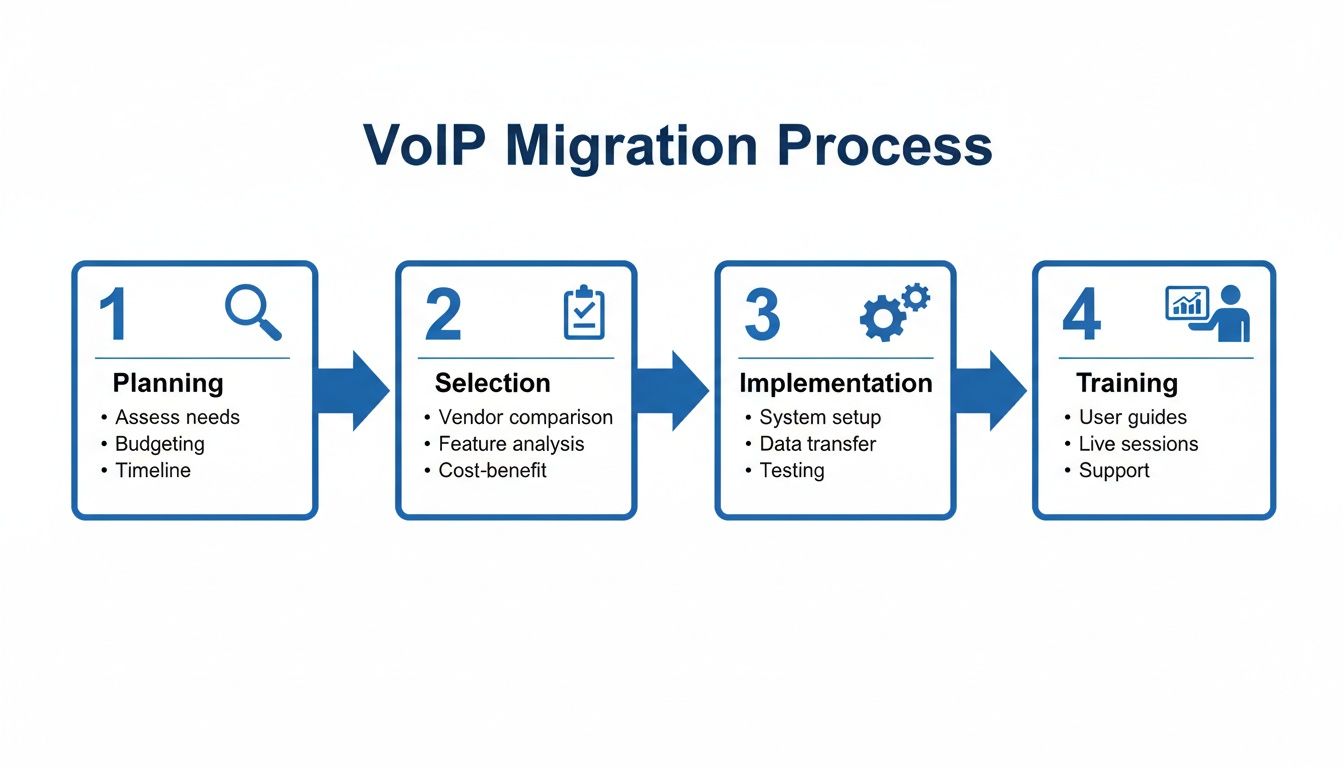
As you can see, a methodical approach means no detail gets missed. After the system is configured, new IP phones are shipped to you. On the scheduled "go-live" day, the number porting finishes, and your new system is officially active. When managed correctly, this happens with minimal to zero downtime.
Phase 4: Training and Ongoing Optimization
Your new hosted VoIP system is live, but the work isn't over just yet. The final piece of the puzzle is making sure your team knows how to use their new tools. Great training is the key to getting the full value out of your new system.
Your provider should give you everything you need to get the team comfortable with the basics:
- Making and Receiving Calls: Getting familiar with the new desk phones or softphone apps.
- Transferring and Parking Calls: Learning the right way to route calls to coworkers without dropping them.
- Using Key Features: Getting hands-on with tools like voicemail-to-email, call forwarding, and the mobile app.
A great partner doesn't disappear after installation. They stick around to provide ongoing support, helping you adjust settings and add features as your business grows. This final step is what turns a technical upgrade into a true business advantage.
Choosing the Right Hosted VoIP and Internet Partner
Picking a hosted VoIP provider isn't just about checking off a list of features. It’s about finding a long-term partner for your business communications. After all, your phone system is how customers reach you, and it’s only as good as the internet connection it runs on.
That’s why bundling your VoIP and internet with one expert provider makes so much sense. When a single company handles both your connection and your calls, everything just works better. If there's ever an issue, you make one call. No finger-pointing between your internet and phone providers—just one team that takes ownership and gets it fixed.
The Power of an Integrated Provider
Think about it this way: you wouldn't hire a foundation crew and a framing crew that refuse to talk to each other to build your business. You'd end up with a mess. The same goes for your phone and internet service. The best hosted VoIP system needs a superior internet connection as its foundation.
An integrated provider like Premier Broadband makes sure that foundation is rock-solid. We deliver both 100% fiber internet with symmetrical speeds and top-tier VoIP, creating a single system built for crystal-clear calls and perfect reliability.
When your internet provider is also your VoIP provider, you get a single point of accountability. Your partner knows exactly how to prioritize voice traffic and can tune your network so every call sounds flawless.
This unified approach just makes life easier. From installation and billing to support, everything is simplified so you can stop worrying about your communications and focus on running your business.
Your Final Checklist for Choosing a Partner
As you look at your options, bring it back to what really matters. The right partner won't just sell you a phone line; they'll deliver a complete solution you can count on.
Look for a provider who nails these four key areas:
- Network Quality: Is the service running on a 100% fiber optic network? For flawless voice and video, symmetrical speeds and low latency aren't just nice to have—they're essential.
- Rich Feature Set: Does the service include the tools you actually need, like mobile apps, an auto-attendant, and branded caller ID, without a bunch of hidden fees?
- Transparent Pricing: Is the cost simple and predictable? A per-user, per-month model is the gold standard. It makes budgeting easy and shows you the real ROI with no surprises.
- Dedicated Support: Can you get expert, U.S.-based support that understands both your internet and phone service inside and out? A true partner helps you migrate and is there for you long after the initial setup.
Choosing an integrated provider like Premier Broadband ticks all these boxes. You're not just buying a phone service—you're getting a unified communications platform from a partner who is 100% accountable for your success.
Frequently Asked Questions About Hosted VoIP
Got a question? We've got the answers. When you're looking at new phone technology, it's natural to have a few things you want to clear up. Here are the most common questions we hear from businesses switching to hosted VoIP.
Can I Keep My Existing Business Phone Number?
Absolutely. You’ve worked hard to make that number familiar to your customers, and you shouldn’t have to give it up.
The process is called “number porting,” and it's a standard part of setting up any VoIP service. We handle the entire transfer from your old phone company, making sure there’s no disruption to your business. Your customers won't notice a thing, and you won't have the headache of updating all your marketing materials.
What Kind of Internet Speed Do I Really Need?
This one surprises a lot of people. It's less about raw speed and much more about the quality of your connection. A single VoIP call only needs about 100 Kbps of bandwidth, which is a tiny fraction of what most business internet plans offer.
The real culprits behind choppy, robotic-sounding calls are latency (delay) and jitter (unstable delay). An unreliable connection, even a fast one, will cause frustrating call quality issues.
That’s exactly why a 100% fiber optic connection is the best foundation for hosted VoIP. Fiber is incredibly stable and provides symmetrical upload and download speeds, ensuring your voice data gets through clearly without lag or dropouts.
Is Hosted VoIP Secure for Sensitive Conversations?
Yes, but you need to make sure your provider takes security seriously. Top-tier VoIP services are built with strong encryption from the ground up to protect your conversations.
We use industry-standard security like Transport Layer Security (TLS) to encrypt the call information (who's calling who) and Secure Real-time Transport Protocol (SRTP) to encrypt the call audio itself. This combination is powerful, preventing eavesdropping and keeping your private business and client discussions secure.
Ready to upgrade your business communications with a system built for modern work? Premier Broadband combines crystal-clear hosted VoIP with a 100% fiber network for unmatched performance and reliability. Discover our business solutions today.