
Trying to call Mexico can feel a little confusing at first, especially with different rules for landlines and mobile phones. I've seen people get tripped up by this countless times. But once you know the formula, it's actually pretty straightforward.
You just need three things: your country's exit code, Mexico's country code (+52), and the local number. If you're calling from the US or Canada, your exit code is almost always 011.
Your Quick Guide to Dialing Mexico Right Now
Let's break it down so you can make your call right now, without the guesswork. Whether you’re trying to reach a hotel in Cancún or a business partner in Mexico City, this is the express lane to getting connected.
The main thing to watch out for is whether you're dialing a fixed landline or a mobile number. This is where most failed calls happen, but the fix is easy once you know the rule.
Calling Landlines vs. Mobile Phones
Here's the key difference: when you dial a mobile number in Mexico, you have to add the number 1 right after the country code. For landlines, you leave that 1 out. It’s that simple.
- Calling a Mexican Landline: Dial 011 + 52 + Area Code + Phone Number.
- Calling a Mexican Mobile Phone: Dial 011 + 52 + 1 + Area Code + Phone Number.
Forgetting that extra 1 for a mobile call is the number one reason I see connections fail. It's a small detail that makes all the difference.
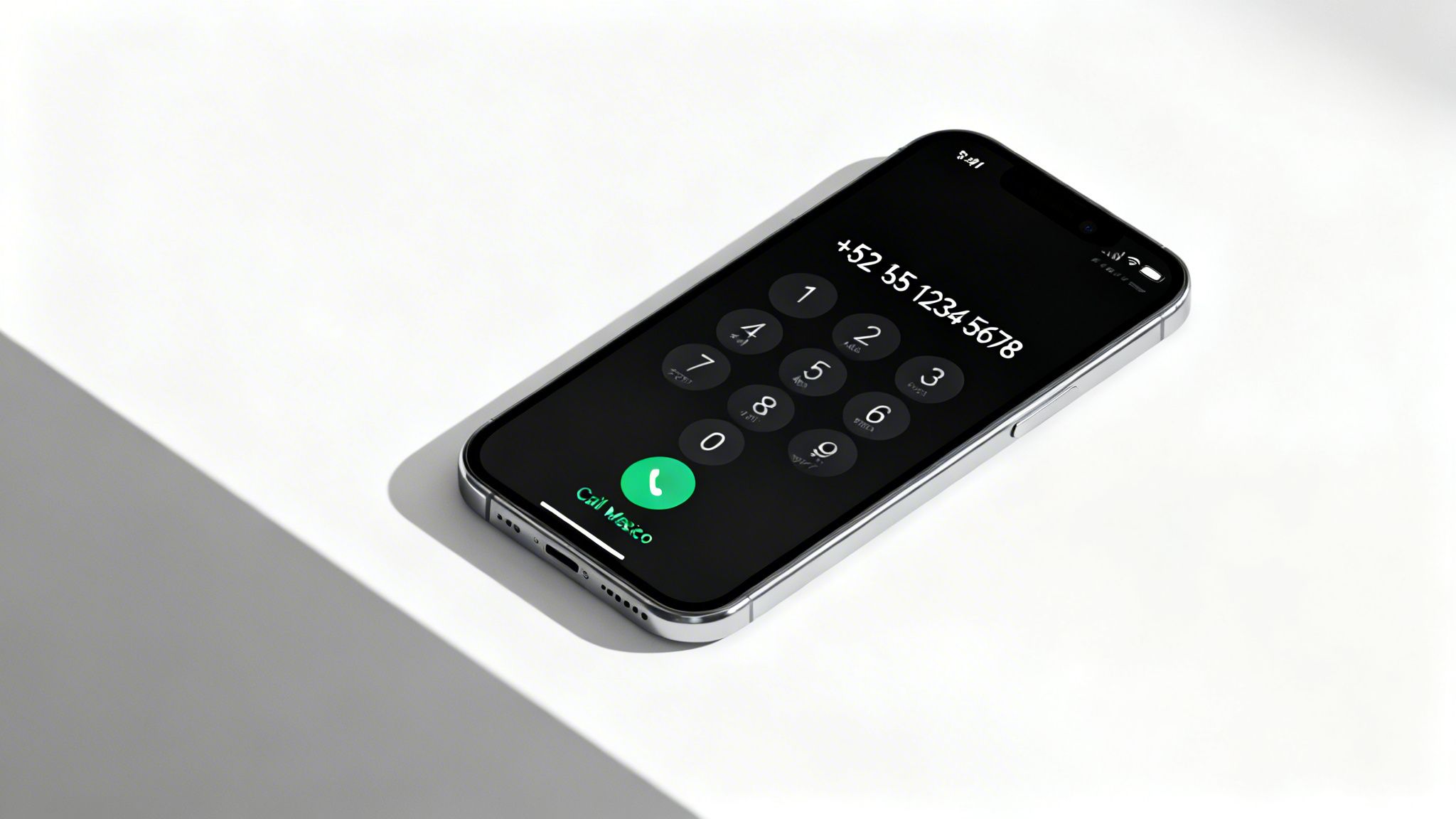
Pro Tip: Save yourself a headache and program Mexican numbers into your phone using the plus symbol (+). For example, use +52 1 55 1234 5678. Your phone will automatically figure out the correct exit code, no matter which country you're calling from.
To make this crystal clear, I've put together a little cheat sheet.
Mexico Dialing Cheat Sheet (From US/Canada)
This table gives you a quick-reference format for the most common dialing scenarios from the United States or Canada.
| Call Type | Dialing Sequence | Example (Calling a Mexico City Number) |
|---|---|---|
| Landline | 011 + 52 + Area Code + Number |
011-52-55-1234-5678 |
| Mobile Phone | 011 + 52 + 1 + Area Code + Number |
011-52-1-55-9876-5432 |
Just follow the sequence for the type of number you're calling, and you'll be set.
A Practical Example
Let's put it all together. Imagine you're in the US trying to call someone in Mexico City, where the area code is 55.
- To reach a landline like (55) 1234-5678, you would dial:
011-52-55-1234-5678 - To call a mobile phone like (55) 9876-5432, you would dial:
011-52-1-55-9876-5432
See how the 1 pops in there just for the mobile call? Once you get the hang of that, you've mastered the most important part of dialing to Mexico.
Decoding Mexico's Phone Numbering System
To get your call to connect to Mexico, you first have to get a handle on its unique phone numbering system. It’s a little different from what you might be used to, but once you know the rules, it's a breeze.
Every international call to Mexico starts with the country code: +52. The easiest way to dial is by using the plus symbol (+) on your smartphone. This automatically handles the international exit code for you, no matter what country you're calling from.
The single biggest trip-up for most people is knowing the difference between calling a landline and a mobile number. This one small detail is where most calls fail.
Here's the key: for Mexican mobile numbers, you must add a 1 right after the country code (+52). If you’re calling a landline, you leave this 1 out. It’s a simple rule, but forgetting it is the number one reason calls don't go through.
Area Codes and Local Numbers
After the country code (and the mobile "1," if you're using it), you'll dial the area code. In Mexico, these are called lada codes, and they get your call to the right city or region.
Mexican area codes can be either two or three digits long.
- Major cities like Mexico City (55), Guadalajara (33), and Monterrey (81) use two-digit codes.
- Smaller cities and towns use three-digit codes, like Cancún (998) or Acapulco (744).
The handy part is that the area code plus the local phone number will always equal 10 digits. So, a 2-digit area code gets an 8-digit local number, and a 3-digit area code is followed by a 7-digit number. This consistency helps you know you’ve got the full number.
Let’s put it all together. To call a mobile phone in Mexico City (area code 55), the full number would look like this: +52 1 55 1234 5678.
Understanding each piece—country code, mobile "1," area code, and local number—is the secret to a successful call every time. This same logic works whether you're using a standard phone or a more advanced setup. If you're curious about how modern systems handle this, you can learn more about how virtual numbers work with our guide on VoIP phone numbers.
Mastering Calls to Landlines vs. Mobile Phones
This is where most people get tripped up when dialing Mexico. Are you calling a business office in Guadalajara or a friend’s cell phone in Tijuana? The process is different, and knowing which number you're dialing is the secret to getting your call to connect the first time, every time.
Let's break it down.
Calling a Mexican Landline
Say you're calling a hotel to confirm your booking. That’s a landline. The format is nice and simple: Exit Code + 52 + Area Code + Phone Number.
That's it. No extra digits, no special tricks.
The All-Important '1' for Mobile Phones
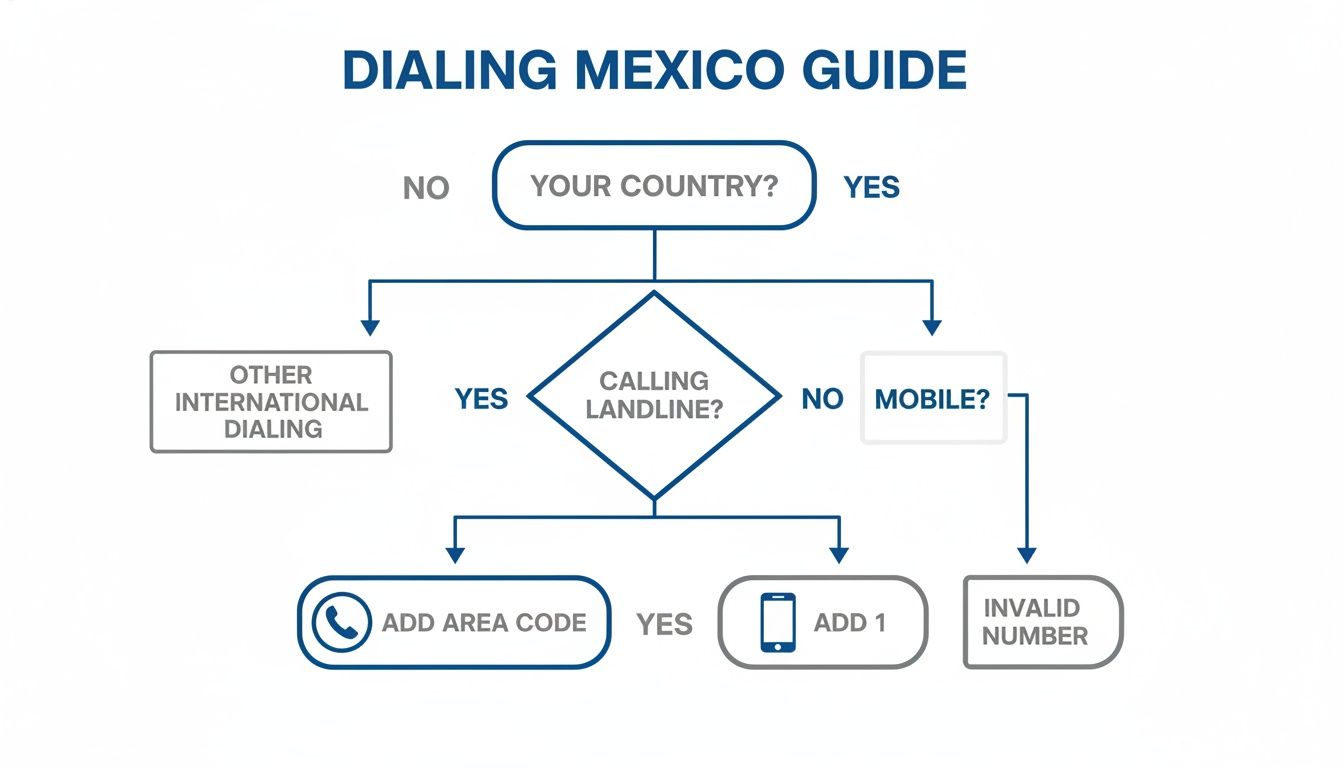
Now, what if you're trying to reach your cousin on their mobile phone? This is where a tiny, but crucial, step comes in. You have to add a 1 right after Mexico's country code.
The format looks like this: Exit Code + 52 + 1 + Area Code + Phone Number.
Forgetting this single digit is the number one reason calls to Mexican mobile numbers fail. If you add it when calling a landline, or forget it for a mobile, you’ll almost certainly get an error message.
This simple flowchart lays out the choice you need to make. It removes all the guesswork.
While everyone seems to have a mobile these days, don't discount the landline. They are still a huge part of Mexico’s communication infrastructure, especially for businesses.
In 2023, Mexico still had 19.8 fixed telephone subscriptions per 100 people. That number is projected to climb to 27.2 million total subscribers by 2026, so knowing how to reach both types of phones remains essential.
These dialing rules apply whether you're on an old-school phone or a modern VoIP system. Even with a high-tech setup using a simple phone internet adapter, you still need to punch in the correct sequence of numbers to make the connection.
Save Money With High-Quality VoIP Calling
We’ve all seen it: a surprisingly high phone bill after making a few international calls. Traditional phone carriers can make staying in touch with contacts in Mexico feel incredibly expensive.
There’s a much better way. By using Voice over IP, or VoIP, you can ditch the old-fashioned phone lines and route your calls directly over your internet connection. This simple switch can slash your international calling costs to a fraction of what you’re used to paying.
But saving money is just the beginning.
Get Crystal-Clear Call Quality
A common myth is that internet-based calls can't match the quality of a landline. In reality, the opposite is often true. When you have a solid internet connection, especially fiber, VoIP calls deliver exceptionally clear, high-definition audio that can be even better than a standard call.
Key Takeaway: Your internet connection is the foundation of a great VoIP call. Fiber internet provides the stable, symmetrical speeds needed for flawless audio without the frustrating drops, lag, or static you get on older networks.
This means you can focus on your conversation with family or colleagues, not on whether the connection will hold up.
More Than Just a Phone Call
Modern VoIP services do more than just connect your call; they give you a full suite of powerful communication tools. You can turn your smartphone, laptop, or tablet into a full-featured phone for connecting with Mexico.
With a quality VoIP service, you get features that traditional phones simply can't offer:
- Voicemail-to-Email: Have your voicemails sent as audio files right to your email inbox. You’ll never miss an important message again.
- App-Based Calling: Make and receive calls from your business number using a simple app on your mobile device or computer, no matter where you are.
- Cost-Effective Plans: Many providers have affordable international calling options. You can see how a service like Premier Broadband's flat-rate VoIP simplifies your billing while cutting costs.
Using VoIP isn't just about finding a cheaper way to dial Mexico—it's about upgrading to a more flexible and feature-rich communication system for your home or business.
Common Dialing Mistakes and How to Fix Them
You've followed the steps, you have the right number, but the call just won't connect. It's a frustrating but surprisingly common problem. Usually, it comes down to one of a few simple mix-ups.
Let's walk through the most frequent issues we see and get your calls connecting smoothly every time.
The Mobile '1' Mix-Up
This is easily the biggest reason calls to Mexico fail. Remember, you only add the '1' after the country code (+52) when you're dialing a mobile number. If you're calling a landline, that '1' will stop the call in its tracks.
If a call doesn't go through, the very first thing you should double-check is whether you're calling a cell phone or a landline and if you've used that '1' correctly.
Forgetting the Exit Code
Dialing from a traditional landline? You absolutely must start with the exit code for the country you're in. For the US and Canada, that code is 011.
This is why we often recommend just using the plus symbol (+) on a smartphone. It automatically finds and applies the correct exit code for you, no matter where you're calling from. It's one less thing to worry about.
VoIP and Internet Issues
Sometimes the problem isn't the number you dialed, but the connection you're using. A spotty Wi-Fi signal can lead to dropped audio or prevent a VoIP call from connecting at all.
A consistently poor VoIP connection might point to a deeper issue on your network. A router setting called SIP ALG is notorious for interfering with VoIP traffic, causing one-way audio or dropped calls. Learning how to check for and disable SIP ALG on your router can be a permanent fix for these headaches.
The good news is that Mexico's communication networks are rapidly improving. Projections show that 5G mobile connections are set to jump from 17 million in 2025 to a staggering 87 million by 2030. You can see more details on Mexico’s evolving mobile landscape on Statista.
Before you hit dial, run through this quick final checklist:
- Correct Exit Code: Are you using
011from a landline or just using the+on a mobile? - Mobile vs. Landline: Did you add or leave out the
1prefix correctly? - Complete Number: Do you have the full 10-digit area code and local number?
Frequently Asked Questions About Calling Mexico
Got a question about calling Mexico? We've got the answers. Even with the right dialing pattern, a few common sticking points can pop up. Let's clear those up so you can dial with confidence.
+52 vs. 0052: Which One Should I Use?
You’ll often see both of these prefixes floating around, but they aren't exactly interchangeable. Here's the simple breakdown.
The +52 format is the modern international standard. When you dial +52 from a smartphone, your phone automatically uses the correct exit code for whatever country you're in. It just works.
The 0052 format is an older method. It only works if you’re dialing from a country that uses
00as its exit code, which is common in Europe but not in the US or Canada.
Our Pro Tip: Always, always save your contacts in Mexico with the +52 prefix. A number saved as +52 1 55 1234 5678, for example, will connect perfectly whether you’re calling from home or traveling abroad. It’s the simplest way to avoid dialing headaches.
Can I Text a Mexican Number the Same Way?
Yes, you can! The exact same dialing format you use to call works for sending SMS messages, too.
Just start your message with the country code +52, add the mobile prefix 1 if it's a cell phone, and then the area code and number. Your text will get there without a problem.
What if My Call Still Won’t Go Through?
It happens. If your call to Mexico isn’t connecting, don't get frustrated. Run through this quick checklist first.
- Did you use the mobile '1'? This is the most common mix-up. Remember to add the 1 right after +52 when calling a cell phone, but leave it out for a landline.
- Is the area code correct? Mexico has a lot of area codes. A quick double-check can save you a lot of trouble.
- Is the number complete? The area code plus the local number should always add up to 10 digits total.
If the number is definitely right, the problem might not be the digits you dialed—it could be your connection, especially if you’re using VoIP and experiencing static or dropped calls.
For crystal-clear, reliable calls to Mexico and anywhere else, your connection is key. Premier Broadband delivers high-speed fiber internet and VoIP phone services built for flawless communication. Find out more about our home and business solutions that keep you connected.