
If you've ever seen a (501) number, you're looking at a call coming straight from the heart of Arkansas. This area code is centered around the state capital, Little Rock, and the bustling communities surrounding it.
Your Quick Guide to the 501 Area Code
So, what exactly is the 501 area code? It's the phone prefix for the most populated region in Arkansas. When you dial or see a 501 number, you're connecting with someone in Little Rock, North Little Rock, Conway, or another key city in the central part of the state.
For any business, having a 501 number is a stamp of local credibility. It instantly tells customers you're a part of their community, which goes a long way in building trust.
Think of it like recognizing a famous city prefix. Just like knowing the 646 area code location places you in the heart of New York City, knowing 501 gives you immediate geographic context for Arkansas.
Here are the must-know facts about area code 501, all in one place.
Area Code 501 at a Glance
We've put together a simple table with the essential details for the 501 area code.
| Attribute | Details |
|---|---|
| State | Arkansas |
| Major Cities | Little Rock, North Little Rock, Conway, Benton, Cabot, Jacksonville |
| Time Zone | Central Time Zone (CT) |
| Overlay | No, 501 is a standalone area code requiring only 7-digit dialing for local calls. |
This quick summary gives you everything you need to know to understand who might be calling from a 501 number.
The Story Behind Arkansas Area Codes
Think an area code is just three random digits? Not quite. The 501 area code has a story that’s woven into the very history of Arkansas.
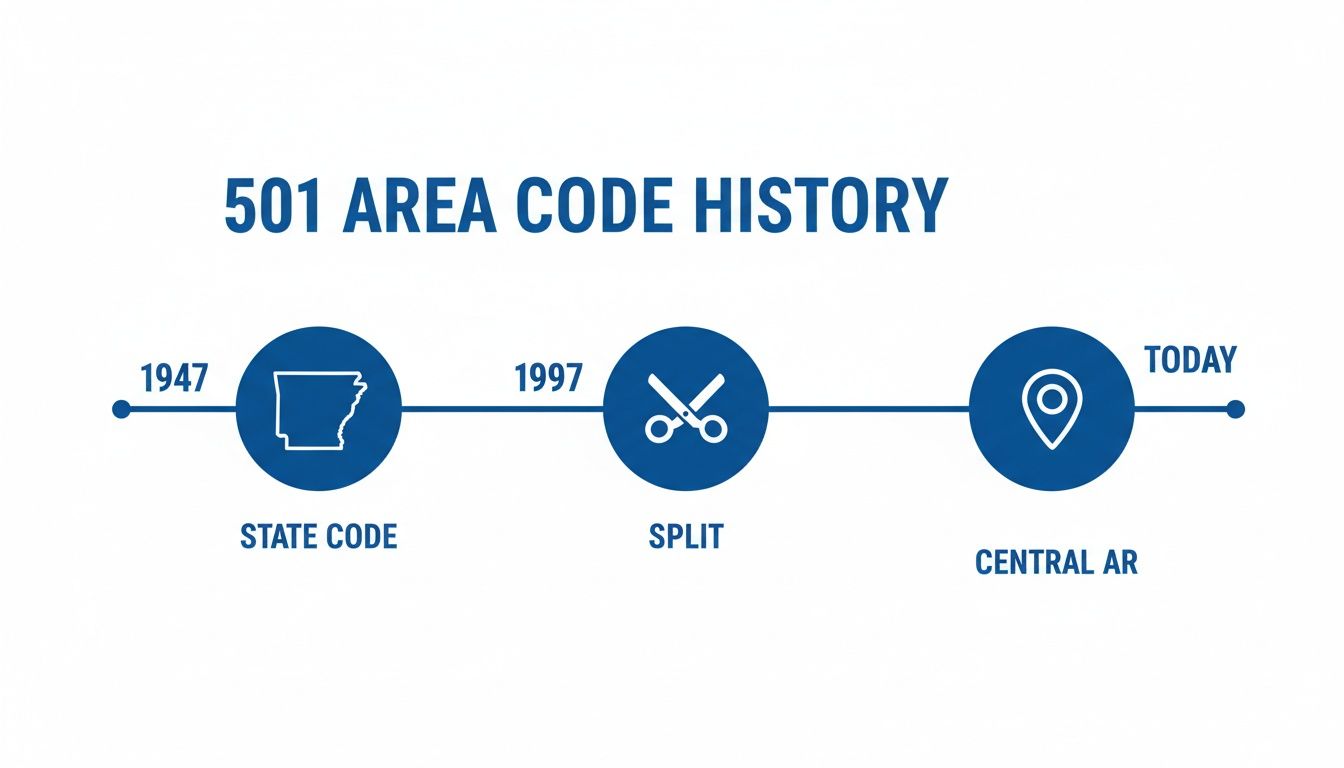
Believe it or not, 501 was one of the original 86 area codes created for North America back in 1947. For decades, it was the only one you needed to call anywhere in the entire state. The '0' in the middle was a special designator used until 1953, marking it as an area code that covered a whole state.
From One to Many: The Evolution of Arkansas Area Codes
Of course, as Arkansas grew, so did the need for more phone numbers. A single area code just couldn't keep up with the state's booming population and businesses. This led to a series of splits to better serve different communities.
The first big change came in 1997 when the northwestern part of the state was given the new 479 area code. A second split followed, creating the 870 area code for the northern, eastern, and southern regions. You can find out more about these changes in this detailed overview of the 501 area code.
This left the 501 area code to represent the central corridor of Arkansas. It became tightly associated with the state capital, Little Rock, and the bustling metro areas around it.
This timeline gives you a great visual of how the 501 area code went from covering the whole state to becoming the heart of central Arkansas.
Today, having a 501 number does more than just route a call. For any business, it signals a deep-rooted, local presence that truly connects with customers in the region.
Where Is the 501 Area Code Located?
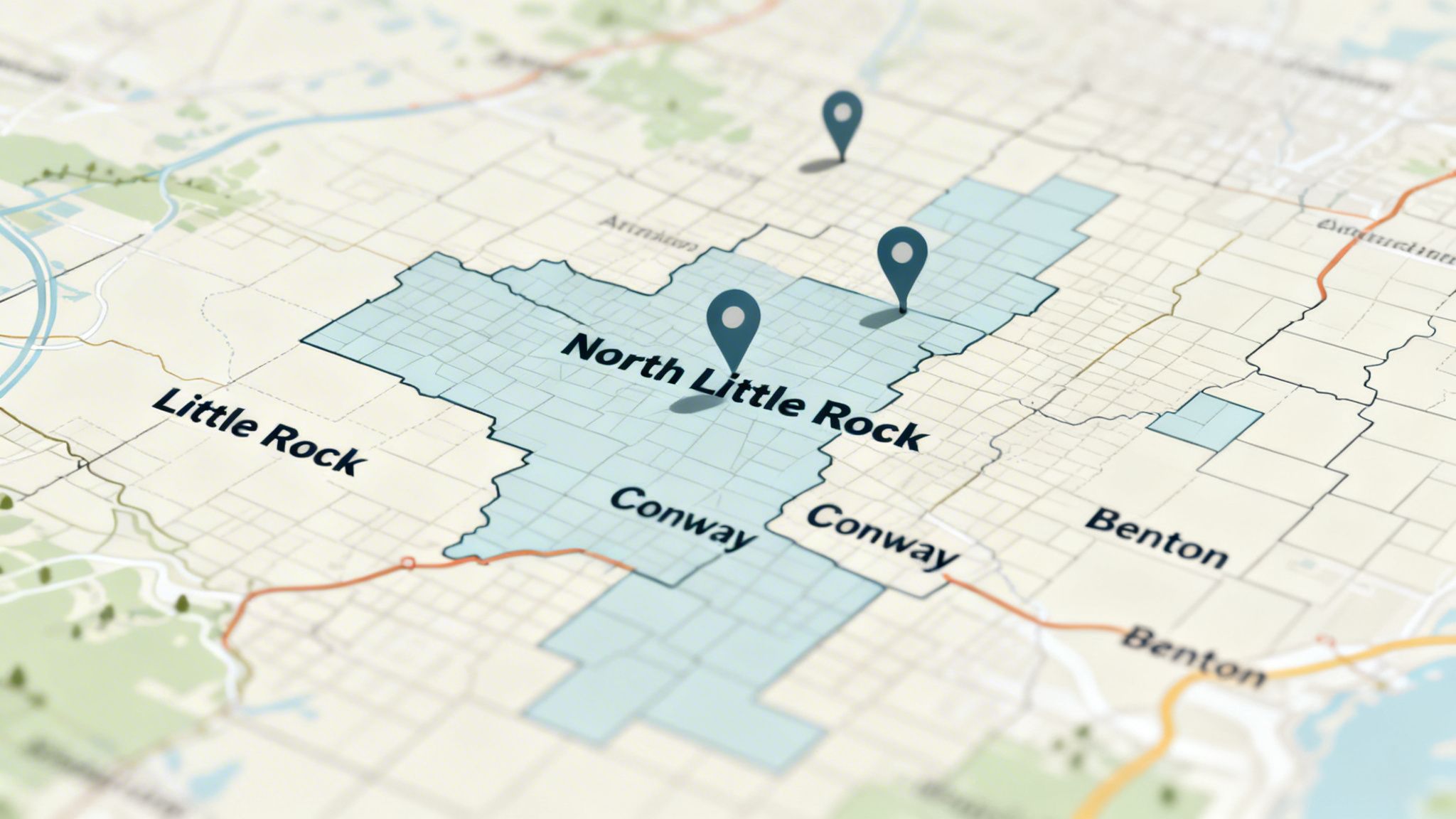
If you've ever gotten a call from a 501 number, you've been in touch with the heart of Arkansas. This area code covers the central part of the state, centered right on its capital.
Think of Little Rock as the bullseye. It’s not just the state capital; it's the biggest city and the main hub for business and culture in the region. Most calls from a 501 number are coming from somewhere in the Greater Little Rock metro.
But it’s more than just one city. The 501 area code connects a whole network of growing communities that work together, creating a bustling corridor right through the middle of the state.
Major Cities and Counties in the 501 Area Code
To really get a feel for the 501 area, it helps to know the key cities and counties it serves. These places make up the core of Central Arkansas, and having a local number here is a big deal for any business.
The table below breaks down the main hubs within the 501 area code.
| Major City | County |
|---|---|
| Little Rock | Pulaski County |
| North Little Rock | Pulaski County |
| Conway | Faulkner County |
| Benton | Saline County |
| Sherwood | Pulaski County |
| Jacksonville | Pulaski County |
| Cabot | Lonoke County |
These cities, along with other communities like Hot Springs, represent the commercial and residential backbone of the 501 area code. If you want to connect with customers here, a local number is the perfect place to start.
The People and Economy of Central Arkansas

When you see the 501 area code, you’re looking at more than just a phone number. You're connecting to the vibrant heart of Central Arkansas—a community filled with families, professionals, and the businesses they run.
This region is a real melting pot. Its diverse population is the engine behind local innovation and a strong, growing economy.
The numbers tell the story. The 501 area is home to a mix of backgrounds, with white or Caucasian residents making up the largest group at about 699,000 people. The community also includes a significant African-American or black population of around 187,000 residents and a growing Hispanic or Latino community of 51,900. This diversity, with deep Irish, English, and German roots, creates the unique character of Central Arkansas.
Powering a Thriving Economy
This community powers an economy built on key industries like government, healthcare, education, and technology. The 501 area is a hub of activity, from the state capitol in Little Rock to its busy medical centers and university campuses.
All this activity depends on modern, reliable communication. Businesses can’t run and families can't connect without high-speed, dependable service.
For any business, having a local 501 number is the fastest way to build trust and feel like a part of the community. For everyone else, from remote workers to students, quality fiber internet isn't a luxury—it's essential for everything from video calls to homework.
That’s why expanding digital infrastructure is so critical. As providers like Premier Broadband win projects to bring more fiber to the area, it ensures Central Arkansas stays connected and continues to be a great place to live and work. You can learn more about these efforts by reading about Premier Broadband’s BEAD projects in Arkansas counties.
How to Get a Local 501 Business Number
Putting down business roots in central Arkansas is simpler than you’d expect. Getting a local 501 business number isn’t the old-school hassle it used to be. Modern communication tech makes it a fast, easy step with immediate payoffs.
Think of a local number as your digital welcome mat. When folks in Little Rock or Conway see a familiar 501 on their caller ID, they're much more likely to pick up. That instant recognition builds trust and makes your business feel like a neighbor, not some faceless company.
Making It Easy with VoIP
The secret to getting a local number fast is a Voice over Internet Protocol (VoIP) phone system. This technology lets you make calls using your internet connection, cutting the cord from traditional landlines. For businesses, this means you can get a 501 number no matter where your office is actually located.
Getting set up is usually as simple as picking a provider and choosing your number from an available list. Companies like Premier Broadband offer VoIP services that can be activated in just a few minutes.
Once you have your number, you get access to a whole suite of powerful tools that go way beyond just making and taking calls. To get a better handle on the tech behind it, you can explore the basics of what VoIP phone numbers are.
A local 501 phone number does more than connect calls; it weaves your business into the local community. It's a key part of your local marketing, telling customers you're invested in and accessible to the central Arkansas market.
Supercharge Your Business Number
A modern VoIP system turns a simple phone number into a full-blown communications hub for your business. The features are built to make you look more professional and work more efficiently.
You can set your caller ID to show your business name, so customers always know it’s you. Plus, with advanced call forwarding, you can send incoming 501 calls straight to your cell phone. You’ll never miss a call, whether you're at your desk or out on a job.
Here are a few other powerful features you can expect:
- Voicemail-to-Email: Get voicemails transcribed and sent right to your inbox. You can read your messages in seconds.
- Auto-Attendant: Set up a professional greeting and menu to automatically guide callers to the right person or department.
- Business Texting: Send and receive texts from your main business number, giving customers an easy way to connect.
After you've locked in your local 501 number, don't forget to use effective local citation building strategies. This ensures your business name, address, and new phone number are consistent everywhere online, helping new customers find you and solidifying your local presence.
Answering Your Questions About the 501 Area Code
So, you know where the 501 area code is, but you probably still have a few practical questions. That's completely normal. Let's walk through some of the most common things people ask, from spotting scams to keeping your number if you switch providers.
Are 501 Area Code Calls a Scam?
This is a question we hear a lot. The short answer is no—a call from a 501 number isn't automatically a scam. It's a legitimate area code for a huge part of central Arkansas, where thousands of real people and businesses make calls every day.
The real problem isn't the area code, but a sneaky tactic called caller ID spoofing. Scammers can disguise their number to look like a local 501 number, hoping you'll be more likely to pick up. The best approach is to be cautious with any call you weren't expecting, no matter what the area code is.
Key Takeaway: Don't be suspicious of the 501 number itself. Instead, watch out for callers who demand personal information or try to create a fake sense of urgency. A real local business won't use pressure tactics.
If you're worried that someone might be misusing a phone number, it's a serious issue. You can learn more by reading our guide on what to do if you find out someone is using your phone number without your consent.
What Time Zone Is the 501 Area Code?
This one is simple but important for making sure you call at a good time. The entire 501 area code operates on the Central Time Zone (CT).
Knowing this helps you avoid waking someone up or calling a Little Rock business after hours. Just for reference, Central Time is:
- One hour behind Eastern Time (ET).
- One hour ahead of Mountain Time (MT).
- Two hours ahead of Pacific Time (PT).
Can I Keep My 501 Number If I Move?
Absolutely. In most situations, your phone number is yours to keep. This is possible because of a federal rule called Local Number Portability (LNP), which gives you the right to take your number with you to a new provider, as long as you're staying in the same general area.
So, if you have a 501 number you love but want to switch from an old landline to a modern VoIP service, you can "port" your number over. It's a standard process that gives you continuity and peace of mind, so friends, family, and clients can always reach you.
Ready to establish your local presence in central Arkansas with a 501 number or upgrade your home internet? Premier Broadband offers reliable, high-speed fiber internet and crystal-clear VoIP phone services to keep you connected. Learn more at https://premierbroadband.com.