
Your phone rings from your business line while you're at the grocery store. You answer on your mobile, finish the conversation, then later return a customer call from your laptop at home. That kind of flexibility feels normal now. Most owners don't want to be chained to a desk phone, and they shouldn't have to be.
That convenience is what draws people to non fixed voip. It promises a business number that travels with you, works across devices, and can help a small team look bigger than it is. For a startup, a remote office, or a solo professional, that sounds like the perfect fit.
But the part many articles skip is this. A phone number isn't just a way to connect calls. It's also part of your identity, your reputation, and your risk profile. The same flexibility that makes non fixed VoIP useful can also make your number harder to trust, harder to verify, and more likely to be treated with suspicion by carriers and platforms.
If you're choosing a phone system for your home office or business, you need more than the sales pitch. You need to know when virtual flexibility helps, when it hurts, and when a more secure fixed option makes more sense.
The Promise of a Phone Number That Goes Anywhere
A lot of business owners start in a messy middle ground. They use a personal cell phone for work, miss calls when they're in meetings, and worry that customers are texting a number the whole family uses. Then the business grows a little, and the problem gets louder.
A local contractor wants a dedicated line but doesn't want to install office hardware. A real estate agent wants calls to ring on both a laptop and an iPhone. A remote employee wants a professional number that doesn't expose a private mobile line. That's where the appeal of virtual calling starts to make sense.
Non fixed voip gives you that "take it anywhere" feeling. The number isn't chained to a single desk or building. It can follow you from a softphone on your computer to an app on your mobile, which is why so many modern teams look at it first. If you want a basic primer on virtual numbers, this guide to what VoIP phone numbers are is a helpful starting point.
Why people want it
The attraction is easy to understand:
- Mobility matters: You can answer business calls while traveling, working from home, or moving between job sites.
- Setup feels light: You usually don't need office wiring or dedicated desk phones to get started.
- Expansion looks easier: A small company can create a local presence in markets where it doesn't have a full office.
Practical rule: If your first requirement is "I need this number to work anywhere," non fixed VoIP will probably land on your shortlist.
That doesn't make it the best default choice for every business line. It just means it solves a real problem. The trick is understanding what you trade away when your number is no longer tied to a verified location.
What Is Non-Fixed VoIP Really
The simplest way to understand non fixed voip is to think about the difference between a P.O. Box and a street address.
A street address tells people exactly where something is anchored. A P.O. Box gives you a valid place to receive mail, but it doesn't prove where you physically are. A non-fixed VoIP number works in a similar way. It's a real phone number for making and receiving calls, but it isn't tied to one physical location in the same way a fixed number is.

What makes it "non-fixed"
With fixed VoIP, the provider associates the number with a real service address. With non-fixed VoIP, the number lives more like a cloud identity than a location identity. That's why it can travel across devices and places so easily.
How VoIP phone service works becomes easier to picture once you know this key fact: OnSIP explains that non-fixed VoIP uses cloud-based SIP addressing, letting users register multiple devices to one virtual number without geographic anchoring. That means the same number can ring on a desktop softphone, a mobile app, and a desk phone without changing the number itself.
How that feels in real life
For a business owner, this usually means:
- You sign up for service online.
- You choose or port a number.
- You install apps on the devices you want to use.
- Incoming calls can ring wherever you've configured them to ring.
That flexibility is excellent for mobile teams. A sales rep can answer from a smartphone in the field, while an office manager can return the same line's missed calls from a laptop later in the day.
Why setup is so easy
Part of the appeal is how little physical proof is required compared with fixed service. Some non-fixed systems can be set up with minimal account information rather than location verification. That's great for speed. It's less great for trust.
A non-fixed number is best understood as a virtual calling identity. Useful, portable, and efficient, but not automatically anchored to a place people can verify.
That distinction is the center of the whole conversation. The technology is not bad in itself. It only plays by different trust rules than a fixed line.
Fixed vs Non-Fixed VoIP A Clear Comparison
People often hear "VoIP" and assume it's one category. It isn't. The practical differences matter because they affect emergency calling, verification, and how customers perceive your business.
One especially important point is adoption versus trust. Voiso notes that nearly 46% of Americans use non-fixed VoIP as primary lines, with smartphones handling 55% of VoIP calls and desktops 30%, but these numbers are often excluded from 2FA verification by platforms like Facebook and Uber because of their anonymity. So yes, these numbers are common. That doesn't mean every system treats them as equally trustworthy.
VoIP Service Type Comparison
| Feature | Fixed VoIP (e.g., Premier Broadband) | Non-Fixed VoIP (e.g., Skype, Google Voice) |
|---|---|---|
| Address requirement | Tied to a physical service address | Not inherently tied to a physical location |
| Portability | More location-centered | Highly portable across devices and places |
| Emergency calling | Better suited to address-based emergency response | More complicated because location isn't built into the number itself |
| Caller trust | Generally stronger because identity is more verifiable | More likely to face trust and verification friction |
| Area code flexibility | Usually aligned with physical presence | Easier to choose numbers from other markets |
| Setup speed | More involved | Faster and lighter to provision |
| 2FA compatibility | More likely to work for verification | Often rejected for account verification on some platforms |
| Best fit | Core business line, front desk, home office primary number | Remote teams, temporary campaigns, flexible routing needs |
Where people get confused
Some readers also hear the term nomadic VoIP and assume it's the same thing as non-fixed. They're related, but not always identical in casual use. A simple way to think about it is this:
- Fixed VoIP is anchored to a known service location.
- Non-fixed VoIP is not anchored in the same way.
- Nomadic behavior means you can move and still use the service from different places.
A system can act nomadically in day-to-day use while still handling verification and address registration more carefully than a casual app-based number.
The practical takeaway
If you're choosing a primary business number, ask a blunt question. Do you need maximum mobility, or do you need maximum credibility?
Bottom line: The more your business depends on customers answering, trusting, and recognizing your calls, the more valuable a fixed and verifiable number becomes.
Technical Behavior and Emergency Call Limitations
Non-fixed VoIP works because the phone number is treated like an account identity in the cloud, not like a line nailed to one wall in one office.
When someone calls your number, the provider's backend checks which devices are registered and where the call should go. It can ring several endpoints at once or follow your routing rules. That design is why a single number can work on a phone, laptop, and desktop app without forcing you to change numbers every time you change devices.
Why emergency calling gets complicated
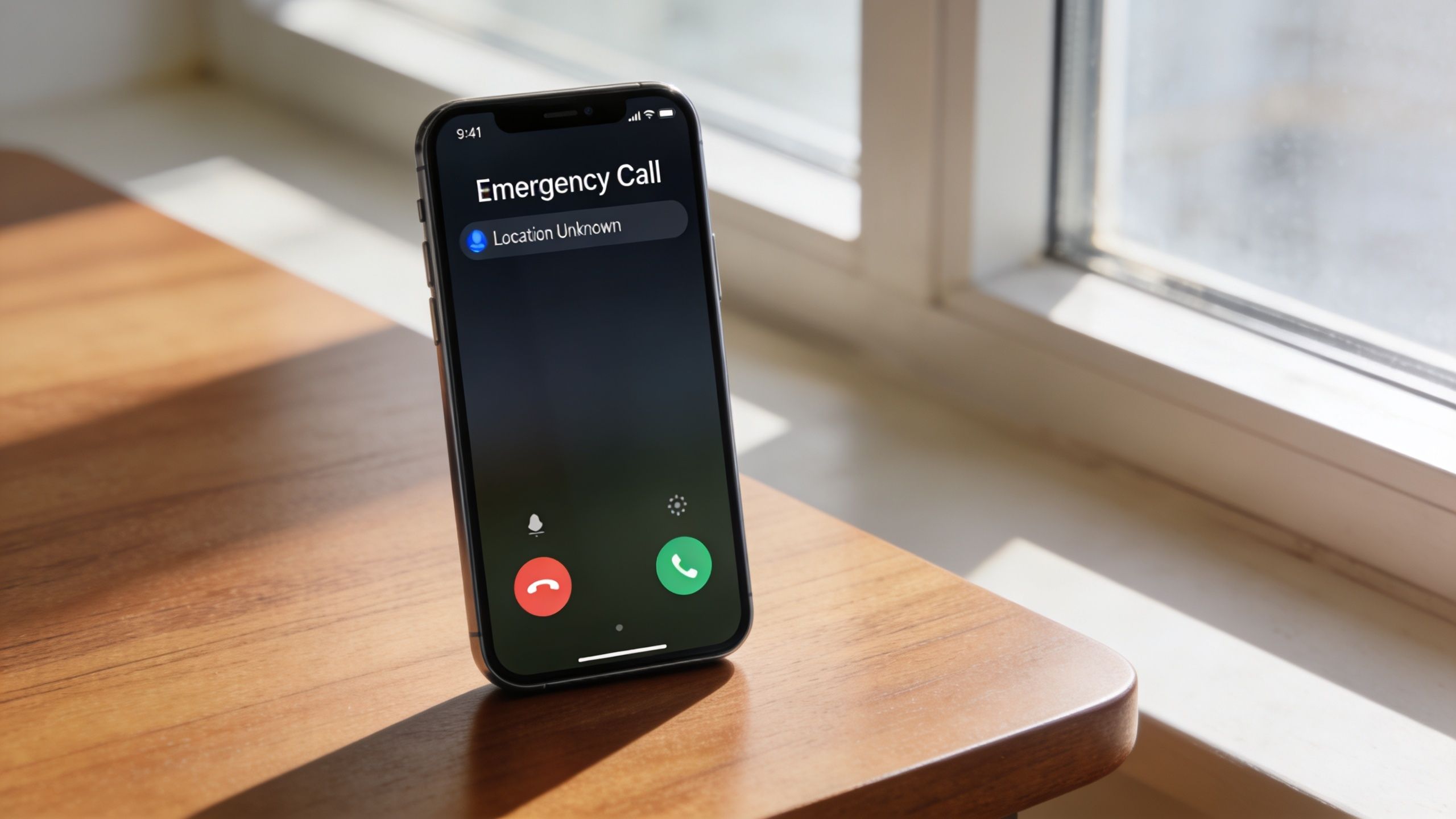
Emergency systems are built around location certainty. Traditional lines and fixed VoIP services fit that model better because the number is associated with a service address. Non-fixed systems can support location registration, but the number itself isn't naturally anchored to where the caller is standing at that moment.
That creates a risk. If the registered emergency address is old, incomplete, or not updated after someone moves, responders may be sent to the wrong place. For a casual secondary line, that may be manageable if the user understands the limitation. For a primary home or business number, it's a serious planning issue.
If you're sorting out how virtual numbers and direct inward dialing relate, this overview of what a DID number is helps connect the pieces.
Local presence and caller identity friction
Another major feature of non-fixed VoIP is flexible area code assignment. That sounds harmless, and often it is. A business can choose a local-looking number for a region where it wants to serve customers, even without opening a local office.
But caller identity systems don't love ambiguity. VoIPstudio explains that the geographic decoupling of non-fixed VoIP supports flexible area code assignment, yet creates challenges for CNAM lookup because numbers without tied physical addresses have higher false-positive rates in caller verification.
That means your perfectly legitimate business call can still look questionable to the systems trying to decide whether your caller ID is trustworthy.
A short explainer can make that easier to visualize:
What this means operationally
For small businesses, these technical details show up in ordinary moments:
- A customer sees an unfamiliar local number and assumes it's spam.
- A staff member dials emergency services and the stored location isn't current.
- A business expands into new markets but discovers local presence doesn't automatically equal local trust.
Technology made the number mobile. It didn't remove the need to prove who owns it and where it belongs.
The Hidden Risks Security Spam and Business Reputation
This is the part many buyers don't hear until after they activate service. Non-fixed VoIP isn't just a technical model. It's also a risk category in the eyes of carriers, fraud systems, and some recipients.
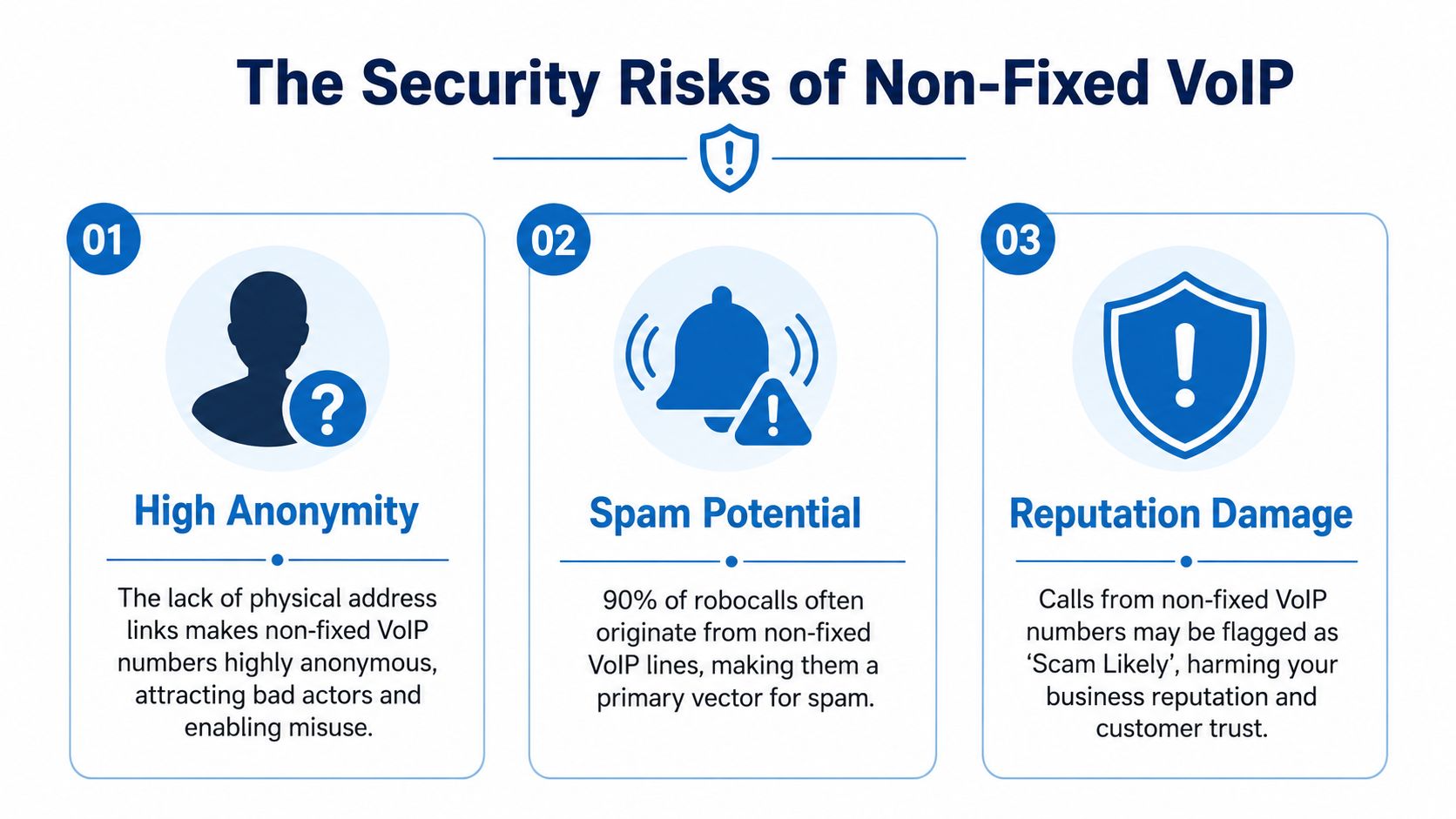
The reason is simple. If a number can be created quickly, moved easily, and isn't strongly tied to a verified address, bad actors will use that flexibility too. Legitimate businesses then inherit the suspicion created by scammers.
The fraud imbalance is real
One statistic captures the issue clearly. In 2023, non-fixed VoIP numbers made up only 3% of call center volume but accounted for 61% of calls flagged as high risk for fraud, according to Brightlio's summary of VoIP statistics.
That doesn't mean every non-fixed number is suspicious. It means the category is disproportionately represented in risky traffic. For a small business owner, that's the distinction that matters. You may be honest, but your number can still be judged by the behavior patterns carriers see across the category.
How that hurts a real business
The damage usually appears in three ways:
- Lower answer rates: Recipients ignore calls that look questionable or arrive with warning labels.
- Brand erosion: Even one "Spam Likely" impression can make a professional business sound shady.
- Verification headaches: Customers, apps, and platforms may treat your number as lower trust before you've said a word.
If you've ever dealt with confusion around caller identity theft, this article on someone using my phone number shows why reputation problems can spread fast.
A business call has to clear two gates now. First, the network must accept it. Then the human being on the other end must trust it enough to answer.
Temporary numbers have their place
There are valid situations where disposable or short-term numbers are useful. For example, teams testing ad response, protecting a personal line during a short campaign, or isolating signups can choose to get temporary phone numbers for narrow use cases. That's very different from making a temporary or loosely verified number the public face of your company.
For outbound sales, support callbacks, or front-desk communication, reputation matters more than convenience. If customers stop answering, the cheaper and faster setup wasn't a savings.
Best Practices for Choosing Your VoIP Service
The right choice depends on what the number is for. That sounds obvious, but many businesses skip this step and choose based on setup speed alone.
If a number is temporary, experimental, or isolated, non fixed voip can make sense. If the number is customer-facing, reputation-sensitive, or safety-critical, you should be much more cautious.
Good uses for non-fixed VoIP
Non-fixed VoIP can work well in a few specific cases:
- Short-lived campaigns: A marketing team may want a separate number to track responses from one ad channel.
- Remote-first internal workflows: A distributed team may need flexible device routing more than public-facing trust.
- Privacy buffers: A consultant may want a secondary number for listings, directories, or temporary projects.
Those are bounded use cases. The business can contain the downside because the number is not carrying the full weight of the brand.
When fixed service is the better call
For a primary office line, support line, or home office number, choose the option that gives you stronger trust signals. Dialpad's discussion of non-fixed VoIP notes that proper E911 registration and branded caller ID can significantly reduce fraud flags, which highlights how important identity methods are when separating legitimate virtual numbers from scams.
That leads to a simple screening checklist:
- Will customers save and reuse this number? If yes, stability matters.
- Could someone call this line in an emergency? If yes, address accuracy matters.
- Will outbound answer rates affect revenue or service quality? If yes, trust matters.
- Do you rely on verification and account security workflows? If yes, compatibility matters.
Decision shortcut: Use non-fixed VoIP for flexibility at the edge of your operation. Use fixed VoIP for the heart of your operation.
What to ask any provider
Before you sign up, ask these practical questions:
- E911 handling: How is emergency location registered and updated?
- Caller identity support: Do they support branded caller ID?
- Call routing: Can calls move cleanly across mobile and desktop apps?
- Porting and continuity: If staff changes, can the number stay with the business?
If your business also needs broader infrastructure planning, local managed services can help connect voice decisions with network decisions. For example, firms comparing communications and infrastructure support may find this guide to business IT support in London useful as a practical reference point.
The goal isn't to avoid flexibility. It's to put flexibility in the right place.
The Premier Broadband Advantage Secure and Reliable VoIP
After you strip away the marketing language, the core choice is about certainty.
Do you want a number that is easy to spin up and easy to move around? Or do you want a number that supports stronger trust, better emergency readiness, and more reliable business identity? For many households and small businesses, the second need is the bigger one.
A fixed VoIP service delivered over a fiber-backed network solves several problems at once. It gives the number a real service foundation. It supports more dependable emergency location handling. It also helps present a more credible identity for routine customer communication.
Why the network matters too
Voice quality isn't just about the phone app. It's also about the connection carrying the call. If your internet service is inconsistent, calls can sound choppy, delayed, or unstable. That problem gets worse when multiple people are video conferencing, uploading files, and taking calls at the same time.
A fiber-backed setup is especially helpful for home offices and small businesses because symmetrical performance supports voice, video meetings, and cloud work without turning every busy afternoon into a bandwidth argument.
What a business actually gains
A more secure fixed VoIP setup is valuable when you need:
- A number customers trust
- Clearer support for address-based services
- Business features like branded caller ID
- One communication identity that stays consistent as your team grows
For home users, the benefit is peace of mind. For businesses, it's operational credibility. In both cases, the number becomes part of a dependable communications system instead of a floating app identity with extra caveats.
Reliability is not only call clarity. Reliability also means people answer, systems recognize your number, and critical services can associate your line with the right place.
That combination is why fixed VoIP remains the better fit for primary lines, front-office numbers, and serious work-from-home setups. Flexibility still matters. But trust is harder to rebuild once a number starts triggering doubt.
If you're weighing convenience against credibility, Premier Broadband is worth a close look. Its fiber-backed fixed VoIP and internet services are built for homes, home offices, and small businesses that need stable calling, clearer identity, and dependable connectivity without the uncertainty that often comes with loosely verified virtual numbers.