
The best VoIP phone system for a small business isn't a one-size-fits-all solution. It’s the one that clicks perfectly with your specific needs, your budget, and where you plan to take your company. While lots of top providers offer flashy features, the right choice usually comes down to a few simple things: flexibility, ease of use, and a rock-solid internet connection to keep those calls crystal-clear.
Your Quick Guide to the Right VoIP System

Trying to find the best VoIP phone system for your small business can feel like a huge task, but it really boils down to a single idea. You’re moving from a basic phone line to a complete communications hub that runs over the internet.
That one change unlocks a world of benefits that old-school landlines just can't match. You’ll see lower monthly bills almost immediately. Your remote and hybrid teams can stay connected from literally anywhere. And you get access to professional tools that make your small shop sound like a Fortune 500 company.
Think of it like swapping a flip phone for a new smartphone. The basic function is the same—making calls—but the capabilities are light-years apart.
Why Small Businesses Are Making the Switch
This shift to VoIP isn’t just a passing trend; it’s a smart business move. By 2025, an estimated 61% of small businesses will be running on VoIP, with SMBs driving over 15% of market growth since 2019 alone. The reasons for this are crystal clear: it's more powerful, more flexible, and more affordable.
This guide will walk you through everything you need to know to make the right call. We'll cover the essential features, different setup options, and what to look for in pricing. But first, let’s get a high-level view of what really matters.
Key Decision Factors for Your VoIP System
When you start comparing VoIP providers, it's easy to get lost in the details. This table cuts through the noise and highlights the five most important things to focus on for your small business.
| Factor | What to Look For | Why It Matters for SMBs |
|---|---|---|
| Scalability | Easy per-user pricing; the ability to add or remove lines on the fly. | Your phone system should fuel your growth, not create a bottleneck. |
| Key Features | Auto-attendant ("press 1 for sales"), call routing, and mobile apps. | These tools project a professional image and ensure you never miss a customer. |
| Reliability | A provider with guaranteed uptime and responsive, human support. | Dropped calls are lost business. Consistent service is non-negotiable. |
| Integration | Compatibility with your CRM and other essential business software. | A connected system saves countless hours of manual data entry and busywork. |
| Cost | Clear, upfront pricing with no surprise fees or ironclad contracts. | Predictable monthly expenses are a must for managing your budget effectively. |
Getting these five areas right is the key to finding a system that works for you today and grows with you tomorrow.
A modern VoIP system is more than just a phone. It's a strategic tool for better customer service, stronger team collaboration, and a more resilient, future-ready business.
Understanding these core ideas will make it much easier to weigh your options. You can dive deeper with our detailed comparison of the top VoIP providers for business. And for a wider look at your options, check out this comprehensive guide on phone systems for small business to help you make a truly informed decision.
How VoIP Actually Works for Your Business
Let's pull back the curtain on how a VoIP phone system really works, without getting lost in a dense technical manual. The main idea is actually pretty straightforward. Think of your voice on a phone call as a stream of tiny digital packages, a lot like the data that makes up an email or a photo you send online.
A traditional landline sends your voice down a single, dedicated copper wire. It’s like a private road built for just one car. VoIP, which stands for Voice over Internet Protocol, takes a completely different route. It breaks your voice into those tiny packages and sends them over the internet superhighway.
This is the very same path your emails, website traffic, and video streams already take. By turning your voice into digital data, VoIP frees your business from the limits of old-school phone lines. It’s more flexible, more powerful, and a whole lot more cost-effective.
The Key Players in Your New Phone System
Figuring out how VoIP operates is a lot easier once you know the main parts involved. You’ll see these terms pop up when comparing the best VoIP phone systems for small business, but they're simpler than they sound.
-
Cloud PBX (Private Branch Exchange): Think of this as your virtual switchboard. In the old days, businesses needed a clunky, expensive box in a server closet to direct calls. A Cloud PBX does all that and more, but it lives securely in your provider's data center. It’s the "brain" that routes your calls, manages your auto-attendant, and handles voicemail, all without you having to maintain any hardware on-site.
-
Softphone: This is your business phone line, just turned into a software app. A softphone lets you make and take calls right from your laptop, desktop, or tablet. It’s a game-changer for remote teams, giving employees their professional business number wherever they have an internet connection.
-
IP Phone (or VoIP Phone): This is the physical desk phone that looks familiar but is built for the internet age. Instead of plugging into a traditional wall jack, it plugs right into your office's internet network. It works just like a classic desk phone but with the power of VoIP technology, giving you crystal-clear HD audio and a ton of advanced calling features.
A VoIP system isn't just a phone service; it's a software-driven communications platform. It uses the internet to deliver not just calls, but a whole suite of tools designed to make your business run more smoothly.
From Analog Voice to Digital Packets
So what actually happens when you pick up your IP phone to make a call? The whole process is seamless and takes just milliseconds.
Your phone or softphone app instantly converts the sound of your voice from an analog signal into compressed digital packets of data. Each packet is then zipped across the internet to its destination. When the packets arrive on the other end, the recipient's phone or app reassembles them in the right order and converts them back into clear audio.
This quick journey is what makes modern business communication so adaptable. To see a more detailed breakdown, you can learn more about how a VoIP phone works and get a closer look at the technology in action. Understanding this helps you see why a stable, fast internet connection is the absolute foundation of a great VoIP experience.
Choosing Between Cloud and On-Premise VoIP
When you're picking a VoIP phone system for your business, one of the first big questions you'll face is where the system actually lives. You really have two main roads you can go down: hosting it in the cloud or building it out right there on-site. The right answer almost always comes down to your budget, your team's technical skills, and how you see your company growing.
Think of it like this. Cloud VoIP is a lot like renting a fully furnished, professionally managed office space. You pay a simple, predictable monthly fee, and everything—the infrastructure, the maintenance, the security, and all the upgrades—is handled for you. You can pretty much move in and start working on day one.
On-premise VoIP, on the other hand, is like buying a plot of land and building your own commercial property from the ground up. You own everything and have total control, but you're also on the hook for every single piece of its construction, upkeep, and security.
Understanding Cloud Hosted VoIP
A cloud-based or hosted VoIP system is the hands-down favorite for the vast majority of small and medium-sized businesses, and for good reason. In this setup, a provider (like us) owns and operates all the complex server hardware and software in their own secure data centers.
You just connect to the service over your internet connection using IP phones or a softphone app on your computer or mobile device. This approach completely removes the need for a dedicated IT team to babysit a phone system, freeing you up to focus on what you do best: running your business. The provider takes care of all software updates, security patches, and network monitoring, which means you get fantastic reliability and uptime without lifting a finger.
For a deeper look into this powerful option, learn more about what a cloud phone system is and see why it’s become such a critical tool for modern companies.
This decision tree gives you a quick visual on which path might be right for your business, depending on the IT resources you have in-house.
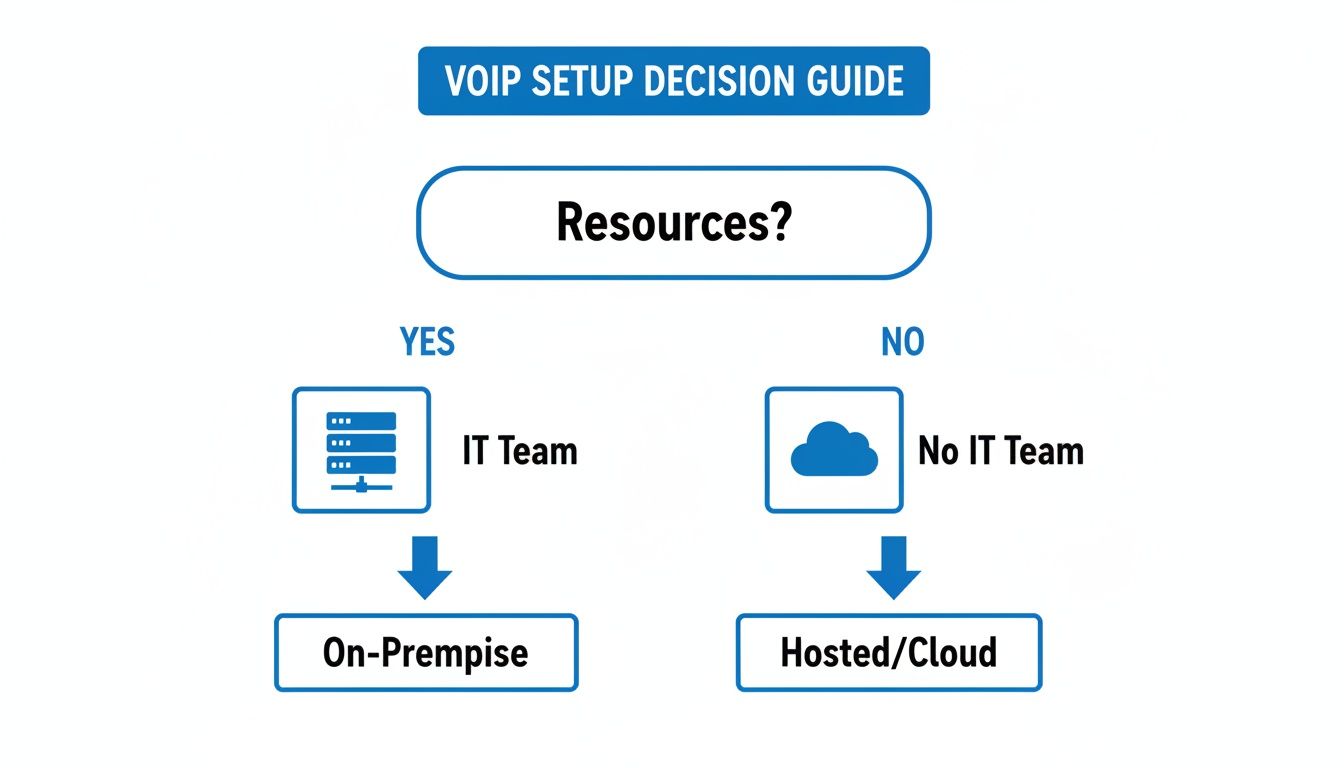
As you can see, the single biggest factor pushing a business toward an on-premise solution is having a dedicated IT department ready to manage it.
Exploring On-Premise VoIP
An on-premise VoIP system means you buy and set up all the necessary PBX hardware and software right at your own business location. This route gives you absolute control over every feature, setting, and security protocol.
But that level of control comes with a ton of responsibility. You’ll need a secure, climate-controlled room for the servers, plus the in-house IT experts who know how to install, configure, and constantly maintain the system. The initial investment in hardware can be massive, and you’re also responsible for paying for any future upgrades or replacements down the line.
While on-premise systems offer the ultimate in customization, they trade the simplicity and low upfront cost of cloud solutions for a much heavier burden of cost, maintenance, and technical expertise.
Hosted VoIP vs On-Premise VoIP A Head-to-Head Comparison
To really spell it out, let’s put these two models side-by-side. This table helps clarify the trade-offs and shows which option aligns best with your business goals.
| Feature | Hosted/Cloud VoIP | On-Premise VoIP |
|---|---|---|
| Initial Cost | Low. Minimal upfront investment, mainly for physical phones if needed. | High. Requires purchasing servers, software licenses, and hardware. |
| Ongoing Costs | Predictable monthly subscription fee per user. | Varies. Includes IT staff salaries, maintenance, and electricity. |
| Maintenance | Handled entirely by the provider. Updates are automatic. | Your responsibility. Requires a dedicated IT team or contractor. |
| Scalability | Excellent. Add or remove users instantly through a web portal. | Limited. Requires purchasing new hardware or licenses to expand. |
| Expertise Needed | Minimal. Basic user-level knowledge is sufficient. | High. Requires specialized IT staff for setup and management. |
| Best For | Small businesses, startups, and companies without a large IT team. | Large enterprises with strict security needs and a full IT department. |
When all is said and done, the financial and operational perks of a hosted VoIP system make it the clear winner for most small businesses. The low barrier to entry, predictable billing, and freedom from technical headaches let you access enterprise-level communication tools without the enterprise-level overhead.
Must-Have Features That Drive Business Growth
A modern VoIP system is so much more than a replacement for your old landline. Think of it as a powerful toolkit, packed with features that make your business sound more professional, run smoother, and give your customers a much better experience. Once you get past the simple dial tone, these are the tools that really unlock the power of internet-based calling.
It’s like the difference between a basic calculator and a spreadsheet. Sure, both can do the math, but one gives you a platform to analyze, automate, and actually grow. The best VoIP phone system for a small business isn’t just about making calls; it's about what those calls can do for you.
The market backs this up. Small and medium-sized businesses (SMBs) are now the main reason the VoIP market is growing so fast. Since 2019, SMBs have jumped on board with an over 15% increase in adoption, ditching pricey traditional phones for flexible, internet-based communications that slash their expenses.
Your 24/7 Digital Receptionist
For any small business, one of the most game-changing features is the auto-attendant. This tool is your virtual receptionist, greeting every caller with a polished, custom message and getting them to the right person or department, every single time.
Imagine a customer calls after hours. Instead of the phone just ringing and ringing, they get a professional greeting. They can be sent to a specific department's voicemail or even hear key info like your business hours. It's a simple feature that makes you look like a bigger, more buttoned-up company and ensures you never miss an opportunity.
Smarter Call Management and Routing
After that first greeting, smart call routing takes over and completely changes how you handle calls. You can set up rules that send calls to different people based on the time of day, what the caller chooses from the menu, or even who’s free on your team right now.
This means you can:
- Create Ring Groups: Make several phones ring at once—like everyone on the sales team—so the first person available can grab the call.
- Use "Find Me/Follow Me": Set up a sequence where a call rings your desk phone, then your cell, then your home office. You're reachable anywhere.
- Set Up Call Queues: If you get busy, callers can wait in a queue with on-hold music instead of getting a frustrating busy signal and hanging up.
These aren't just for massive corporations anymore. They’re essential tools for giving customers the quick, responsive service they expect today.
A well-configured VoIP system automates the tedious work of directing traffic. It frees up your team to focus on having valuable conversations rather than just answering the phone.
Unifying Your Communication Channels
Another huge advantage is Unified Communications (UC). This just means bringing all your communication tools—voice, video, and messaging—together into one simple platform. Your phone app becomes a central hub for your whole team.
This integration delivers some powerful perks:
- Voicemail-to-Email: Get your voicemails as audio files and text transcripts sent right to your email. You can scan messages and prioritize callbacks without ever touching your phone.
- Integrated Video Conferencing: Switch a phone call to a video meeting with one click. It's perfect for sharing your screen or having a more personal chat.
- Business SMS: Send and receive texts from your main business number on your computer or mobile app, keeping your personal number private.
As you look at different VoIP systems, it can be helpful to see what's out there in the wider world of internet calling. For instance, you can compare the best international calling apps to get a feel for the advanced features and competitive rates available for global communication.
Understanding the True Cost of a VoIP System
When you're running a small business, every dollar counts. It’s tempting to just look at the advertised monthly price when shopping for the best VoIP phone system, but that number almost never tells the whole story. To make a truly smart decision, you have to look past the sticker price and understand the total cost of ownership.
This means shifting your mindset from "how much per month?" to "what's the real long-term value?" Sometimes, a slightly higher monthly fee from a provider that includes everything upfront can save you a ton of money and headaches later by getting rid of surprise fees and offering support that’s actually helpful.
The great news is that making this switch pays off. Big time. On average, businesses that move to VoIP see massive cost savings of 30% to 50%. We've seen some small businesses slash their communication bills by up to 68% over two years with the right plan. Even better, new companies can cut their startup costs by a whopping 90% by ditching expensive, old-school hardware. You can check out more of these impressive VoIP savings statistics and trends on Tech.co.
Decoding the Per-User Per-Month Model
Most VoIP providers use a per-user, per-month pricing model. This is actually fantastic for small businesses because it scales perfectly. You only pay for the exact number of employees who need a phone line. As you hire, you just add another user. If your team shrinks, you can usually remove a line just as easily.
But here’s the catch: the features included in each price tier can be wildly different from one provider to the next. They usually offer plans like Basic, Pro, and Enterprise, with each level unlocking more powerful tools like call recording, CRM integrations, or in-depth analytics.
It's so important to match your actual business needs to these tiers. Paying for a top-shelf plan loaded with features you'll never touch is just throwing money away. On the other hand, pinching pennies on a basic plan that lacks a critical tool like an auto-attendant can seriously hold your business back.
Uncovering Potential Hidden Costs
That monthly subscription fee is just the starting point. To get the real cost, you have to be direct and ask providers about all the other expenses that might sneak onto your bill.
Before you even think about signing a contract, make sure you get clear answers on these points:
- Hardware Costs: Are new desk phones included? Are they a rental, or do you have to buy them outright? Some providers will offer free or heavily discounted phones if you sign a contract.
- Setup and Implementation Fees: Is there a one-time charge for setting up the account, porting your existing phone number, or getting everything configured?
- Taxes and Regulatory Fees: These are unavoidable, but they can add a surprising chunk to your monthly bill. Always ask for a full quote that includes them.
- Contract Length and Termination Fees: Are you getting locked into a multi-year deal? What happens if you need to cancel early? Know the penalties.
The best way to compare VoIP providers is to ask for a detailed, all-inclusive quote. This forces them to be transparent and lets you see the full financial picture, not just the shiny price on the homepage.
By asking the right questions and focusing on the total cost of ownership, you can choose a VoIP system that delivers real value and keeps your budget healthy for years to come.
Why Your Internet Connection Is the Secret to Great VoIP Calls
A modern VoIP system brings a ton of powerful features to the table, but it's easy to forget one simple truth: every crystal-clear call you make runs on your internet connection. Think of your internet as the highway for your voice data. If that highway is full of potholes, packed with traffic, or just plain unreliable, your calls are going to suffer—no matter how fancy your phone system is.
This is the single biggest thing businesses overlook when they're looking for the best VoIP phone system for a small business. You can have the greatest phone system on the planet, but if you pair it with a subpar internet connection, you're signing up for a world of frustration. The quality of your calls is directly tied to the health of your network. A stable connection isn't just nice to have; it's a non-negotiable.
Before you jump in, you need to be sure your internet is up to the task. It’s not just about speed; it's about the quality and consistency of that connection.
Cutting Through the Network Jargon
You're going to hear a few technical terms thrown around when talking about getting your network ready for VoIP. Let's break them down into what they actually mean for your calls.
-
Bandwidth: This is simply the size of your internet "pipe," or how much data you can push through it at once. A single VoIP call doesn't use much (around 100 kbps), but you need enough breathing room so calls aren't fighting for space with someone streaming video or downloading huge files.
-
Latency: Ever experience that awkward delay or echo in a conversation? That’s latency. It’s the time it takes for your voice to travel to the other person and for their voice to get back to you. High latency feels like a conversation with a time lag, making it impossible to talk naturally.
-
Jitter: This is all about consistency. High jitter means the little packets of voice data are arriving all jumbled and out of order. It's the reason calls can sound choppy, garbled, or robotic—like the audio is breaking up.
The goal for flawless VoIP is a connection with low latency and almost zero jitter. This combo ensures your voice data travels like a VIP motorcade—smoothly, predictably, and without interruption—for clear conversations every single time.
The Advantage of Having a Single Provider
One of the biggest headaches we see is the "blame game." A call drops, and you call your VoIP provider. They point the finger at your internet service provider (ISP). You call the ISP, and they point right back. You're left stuck in the middle with a problem nobody wants to own.
This is exactly why choosing one provider to manage both your internet and your phone system is such a game-changer. When one company handles everything, they have full visibility into your network. They can set up Quality of Service (QoS) rules, which is like creating a dedicated carpool lane just for your voice traffic, making sure it always gets top priority over everything else.
This all-in-one approach puts an end to the finger-pointing and ensures your network is perfectly tuned for VoIP right from the start. It's also vital to make sure your router isn't secretly sabotaging your calls. Many have a setting called SIP ALG that can cause major headaches, so understanding what SIP ALG is and how to deal with it is key to reliable calls. When you partner with a managed provider like us, you get an expert who handles all these technical details for you, so you can just focus on your business.
Answering Your Questions About Business VoIP
Making the switch to a new phone system is a big decision, and it’s smart to have questions. We get it. You need to be sure you're making the right move for your business.
Let's walk through some of the most common concerns we hear from business owners so you can feel confident about upgrading your communications.
Is VoIP as Reliable as My Old Landline?
This is probably the number one question we get, and the answer might surprise you: modern VoIP is incredibly reliable—often more reliable than a traditional landline, as long as you have a stable internet connection.
Think of it this way: when a storm takes down a physical phone line, you're dead in the water until a truck rolls out to fix it. With a good hosted VoIP system, if your office internet ever blips out, your calls can automatically forward to your cell phone. That kind of built-in backup plan means you never miss a customer call, giving you a level of business continuity that old-school landlines just can't match.
It's a common myth that VoIP is less dependable than traditional phones. The truth is, when it's built on a solid internet foundation with features like automatic call forwarding, a VoIP system keeps you connected when it matters most.
Can I Keep My Current Business Phone Number?
Absolutely. You don't have to worry about reprinting business cards, updating your website, or confusing your customers. Keeping your number is a standard part of the process.
It’s a process called "porting," and it's simply how we transfer your existing number from your old phone company to your new VoIP service. Any good provider will handle all the behind-the-scenes work for you, making sure the switch is completely seamless. Your customers will never know anything changed—except for maybe the improved call quality.
What Kind of Internet Speed Do I Need for VoIP?
While it’s easy to get caught up in high download speeds, for VoIP, the quality and stability of your connection matter far more. A single call only uses about 100 kbps of bandwidth, which is a drop in the bucket for most business internet plans.
The real keys to crystal-clear audio are low latency (no awkward delays) and minimal jitter (no choppy, robotic voices). A stable, consistent connection will deliver perfect calls every time, even if the speed isn't top-tier. On the flip side, a super-fast but unstable connection will cause nothing but headaches. This is exactly why having a managed network is such a game-changer.
Is It a Hassle to Set Up a VoIP System?
Not with a modern hosted solution. The reputation for difficult setups comes from the old days of on-premise systems that required a dedicated IT team and a closet full of complicated hardware.
Today's hosted VoIP systems are pretty much "plug-and-play." We ship you pre-configured phones that are ready to go. You just plug them into your internet connection, and you're in business. We're here to walk you through every step to make sure you get up and running fast, without any of the technical headaches.
Ready to upgrade your business phone system with the backing of a rock-solid fiber network? Premier Broadband brings together crystal-clear VoIP and expertly managed internet service. We take the guesswork out of it so you can focus on your business.