
For many folks, a Cat 7 cable seems like the ultimate upgrade for hitting top network speeds. It promises 10 Gbps performance and has some serious shielding against interference. But while it’s a high-quality option, whether it’s the right choice for you depends on your setup, especially with great alternatives like Cat 6a and Cat 8 out there.
Is a Cat 7 Cable Your Network's Missing Link?
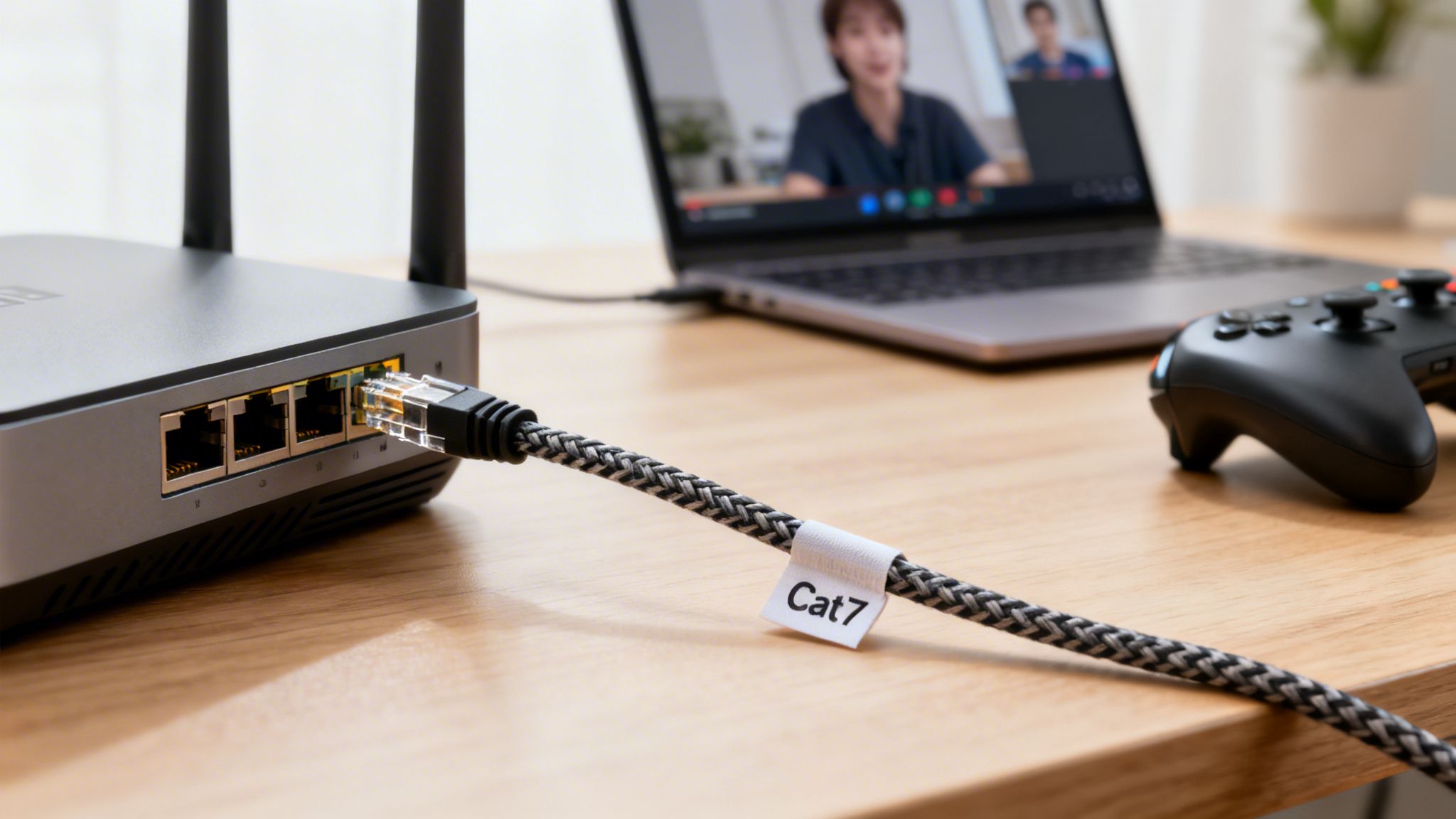
Let's get right to it: is a Cat 7 cable the upgrade your network actually needs? Honestly, it depends. For most people, a good Cat 6a cable will do the job just fine. But if you’re in a space with a lot of electronic noise and you demand the absolute best performance, Cat 7 is hard to beat.
Think of it this way: your fiber internet plan from Premier Broadband is a high-performance engine. The Ethernet cable is the road it drives on. If you're still using an old, beat-up road—like a worn-out Cat 5e cable—you'll never feel your connection's true power. You’ll be stuck in digital traffic, dealing with lag, and wondering why you pay for speeds you can’t seem to get.
Matching the Cable to Your Connection
Upgrading your cable is like paving a smooth, multi-lane superhighway for your data. A Cat 7 cable is built for this exact purpose, with specs that deliver a rock-solid, lightning-fast connection. But what do all those numbers really mean for you?
Here's a quick breakdown of what makes a Cat 7 cable tick, and more importantly, how it can help you.
Cat 7 Cable at a Glance
| Specification | Cat 7 Performance | What This Means For You |
|---|---|---|
| Max Speed | 10 Gigabits per second (Gbps) | Easily handles the fastest internet plans available today, so your cable will never be the bottleneck. |
| Bandwidth | Up to 600 MHz | Creates a huge pipeline for data, perfect for running multiple demanding apps at once without any slowdown. |
| Shielding | S/FTP (Screened/Foiled Twisted Pair) | Provides maximum protection from interference, giving you a more stable and reliable connection with fewer dropouts. |
That heavy-duty shielding is where a Cat 7 cable really shines compared to other options. It’s what gives you that extra peace of mind.
For a home user, this superior shielding means your game won't lag just because someone started the microwave. For a business, it ensures crystal-clear VoIP calls and reliable data for security cameras, even in an office buzzing with electronics.
Who Benefits Most from a Cat 7 Upgrade?
An investment in Cat 7 makes the most sense for people who need to eliminate every possible performance issue.
- Competitive Gamers who need the absolute lowest latency and a connection that won’t stutter from outside interference.
- Remote Workers and Content Creators who rely on flawless video calls and need to upload huge files quickly and without interruption.
- Smart Home Power Users with tons of connected devices, especially those using a wired backhaul for their mesh Wi-Fi system. For more tips, check out our guide on how to improve your home Wi-Fi signal.
- Businesses running data-heavy applications, AI security cameras, or enterprise-grade VoIP phone systems where signal integrity is everything.
At the end of the day, if you're a Premier Broadband customer with a high-speed fiber plan, pairing it with a high-quality cable like Cat 7 ensures you're squeezing every last megabit of performance out of your connection.
What Makes a Cat 7 Cable Different
So, what really separates a Cat 7 cable from all the others? On the outside, it might look just like any other Ethernet cable you've seen. The real magic, though, is what’s going on inside.
Cat 7 cable is engineered from the ground up for one thing: extreme reliability, especially when there’s a lot of electronic "noise" around. Think about trying to have a clear conversation in a packed, noisy room. That's exactly what your data goes through in a lesser cable, surrounded by interference that can cause errors, slow you down, and even drop your connection.
The Power of Superior Shielding
Cat 7 tackles this head-on with a tough design known as S/FTP, which stands for Screened/Foiled Twisted Pair. This isn’t just a single layer of protection; it's a complete defense system for your data.
- Individual Pair Shielding: Inside the cable, each of the four twisted pairs of copper wire is wrapped in its own foil shield. This keeps the pairs from "talking" over each other, a problem called crosstalk.
- Overall Cable Shielding: Then, the entire bundle of four shielded pairs gets wrapped in another layer of protection, usually a braided mesh screen. This outer layer is your frontline defense against outside electromagnetic interference (EMI).
This double-shielding design basically creates a private, soundproof highway for your data to travel on. It aggressively blocks out all the background noise from things like power lines, fluorescent lights, and appliances. The result is a much cleaner, more stable signal that's essential for hitting and maintaining those top-tier speeds. While this physical wiring makes a huge difference, you can see the bigger picture in our comparison of fiber internet vs. traditional cable.
More Lanes for Your Data Superhighway
Beyond its heavy-duty armor, the other big difference with a Cat 7 cable is its frequency, or bandwidth. It’s rated for a frequency of 600 MHz, a massive leap from the 250 MHz you get with standard Cat 6.
It helps to think of bandwidth as the number of lanes on a highway. A 250 MHz cable is like a simple two-lane road—it gets the job done for normal traffic. A 600 MHz cable, on the other hand, is a full-blown superhighway.
This extra bandwidth means a Cat 7 cable can handle a ton of data all at once without creating a digital traffic jam. It’s what lets one person stream in flawless 4K while someone else enjoys a lag-free gaming session, all on the same network.
This combination of advanced construction and high bandwidth has cemented Cat 7's place in the high-frequency data wire market. In fact, that market is projected to grow from USD 3.72 billion in 2026 to USD 5.89 billion by 2034, all driven by the growing need for networks that can handle massive speeds. You can dig into the numbers in the high-frequency data wire market outlook from IntelMarketResearch.com. This forward-thinking design is exactly why it's still such a smart choice for future-proofing your home or business network.
Comparing Cat 7 Performance Against Other Cables
So, how does a Cat 7 cable actually stack up against the other Ethernet cables you might have? Choosing the right cable is a lot like picking the right tool for a job. While a few different ones might work, only one is going to give you the best performance for your specific needs.
Let's put Cat 7 in a head-to-head matchup to see where it really shines and where another cable might be the smarter pick.
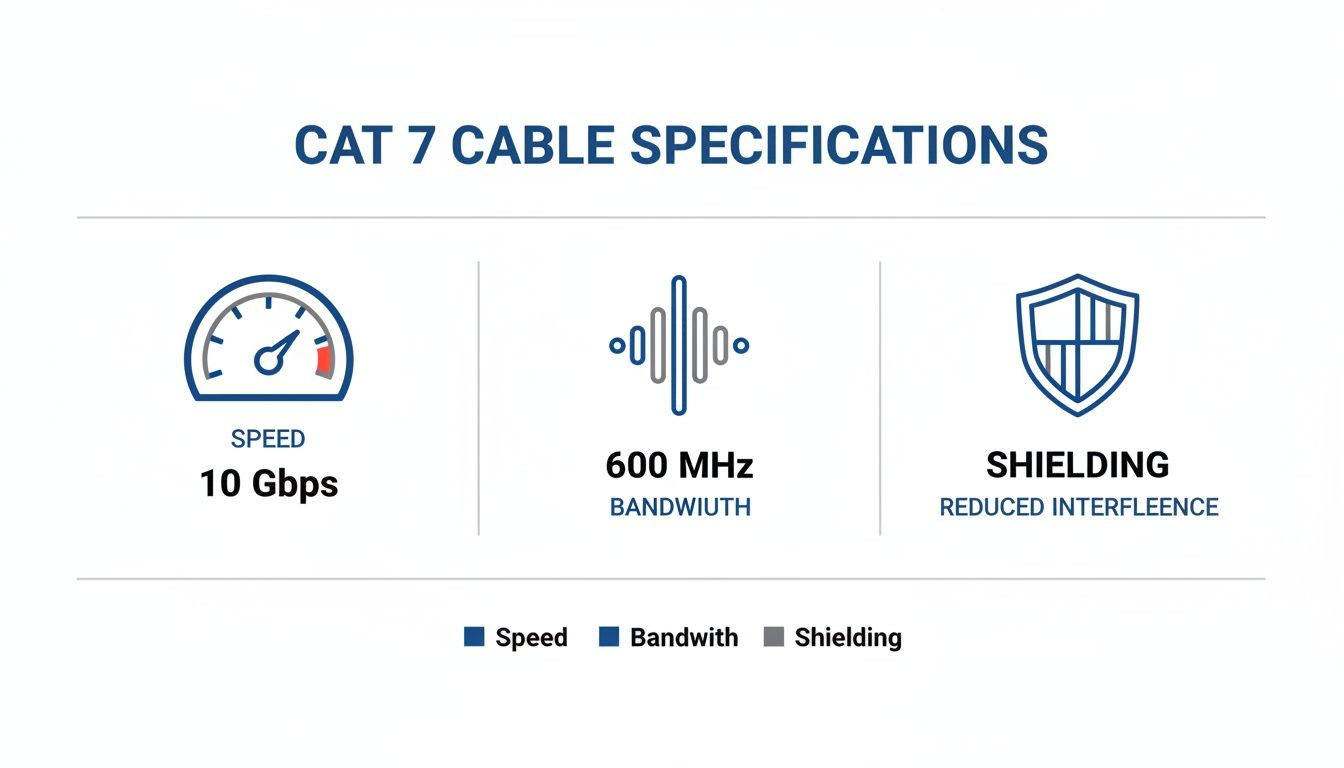
The big takeaways here are its support for 10 Gbps speeds at a high 600 MHz frequency, all wrapped in some seriously tough shielding.
The Old Guard: Cat 5e and Cat 6
For a long time, Cat 5e was the go-to cable for just about everything. It handles speeds up to 1 Gbps, which was plenty for older internet plans. But if you have a modern Premier Broadband fiber connection, that old Cat 5e cable is absolutely a bottleneck holding your network back.
Cat 6 was a nice improvement, boosting the frequency to 250 MHz and providing a more stable 1 Gbps connection over longer runs. It can technically hit 10 Gbps, but only across very short distances (less than 55 meters), making it impractical for wiring a whole home or office for top speed. It’s still a decent cable for basic needs but lacks the muscle for today's high-demand networks.
Think of it like this: Cat 5e is a two-lane country road, and Cat 6 is a four-lane highway. Both get you there, but neither was built for the super-fast, heavy traffic of a multi-gigabit fiber network.
The Modern Standard: Cat 6a
The most common competitor to Cat 7 is Cat 6a. It also delivers full 10 Gbps speeds over the standard 100-meter distance, but it operates at a lower frequency of 500 MHz. For most homes and offices that don't have a ton of electronic interference, Cat 6a is often the sweet spot, balancing great performance with good value.
Cat 7 pulls ahead with its superior shielding and that extra bit of bandwidth at 600 MHz. This makes it the clear winner in environments with a lot of electronic "noise"—think offices with heavy machinery, homes with tons of smart gadgets, or anywhere cables run near power lines. That extra protection guarantees a rock-solid signal when Cat 6a might start to drop packets.
Curious what speeds you're actually getting right now? It's a good idea to how to test your internet speed accurately to see if your current cabling is a weak link.
The Data Center Powerhouse: Cat 8
Finally, you have Cat 8, the heavyweight champion of copper cabling. It’s built for mind-blowing speeds of 25 Gbps or even 40 Gbps. The catch? It can only hold those speeds for about 30 meters.
This limitation makes Cat 8 a highly specialized cable designed for data centers and server rooms to connect switches and servers. For any residential or normal office setting, it's complete overkill.
Ethernet Cable Comparison Cat 5e vs Cat 6 vs Cat 6a vs Cat 7 vs Cat 8
To make it even clearer, here’s a breakdown of how these cables compare side-by-side. This table should help you quickly see which category fits your needs.
| Category | Max Speed | Max Bandwidth | Shielding | Best For |
|---|---|---|---|---|
| Cat 5e | 1 Gbps | 100 MHz | Minimal (UTP) | Basic internet on older, slower plans. |
| Cat 6 | 1 Gbps (10 Gbps <55m) | 250 MHz | Optional (UTP/STP) | Standard home and office networks. |
| Cat 6a | 10 Gbps | 500 MHz | Often Shielded (F/UTP) | High-speed homes and businesses; the modern standard. |
| Cat 7 | 10 Gbps | 600 MHz | Standard (S/FTP) | Future-proofing, gaming, and high-interference areas. |
| Cat 8 | 40 Gbps (at 30m) | 2000 MHz | Standard (S/FTP) | Data centers and server-to-switch connections. |
At the end of the day, Cat 7 sits in a very strategic spot. It gives you a real-world performance boost over the mainstream Cat 6a—especially in signal stability—without jumping to the extreme cost and distance limits of Cat 8.
Understanding Cat7 Connectors and Compatibility
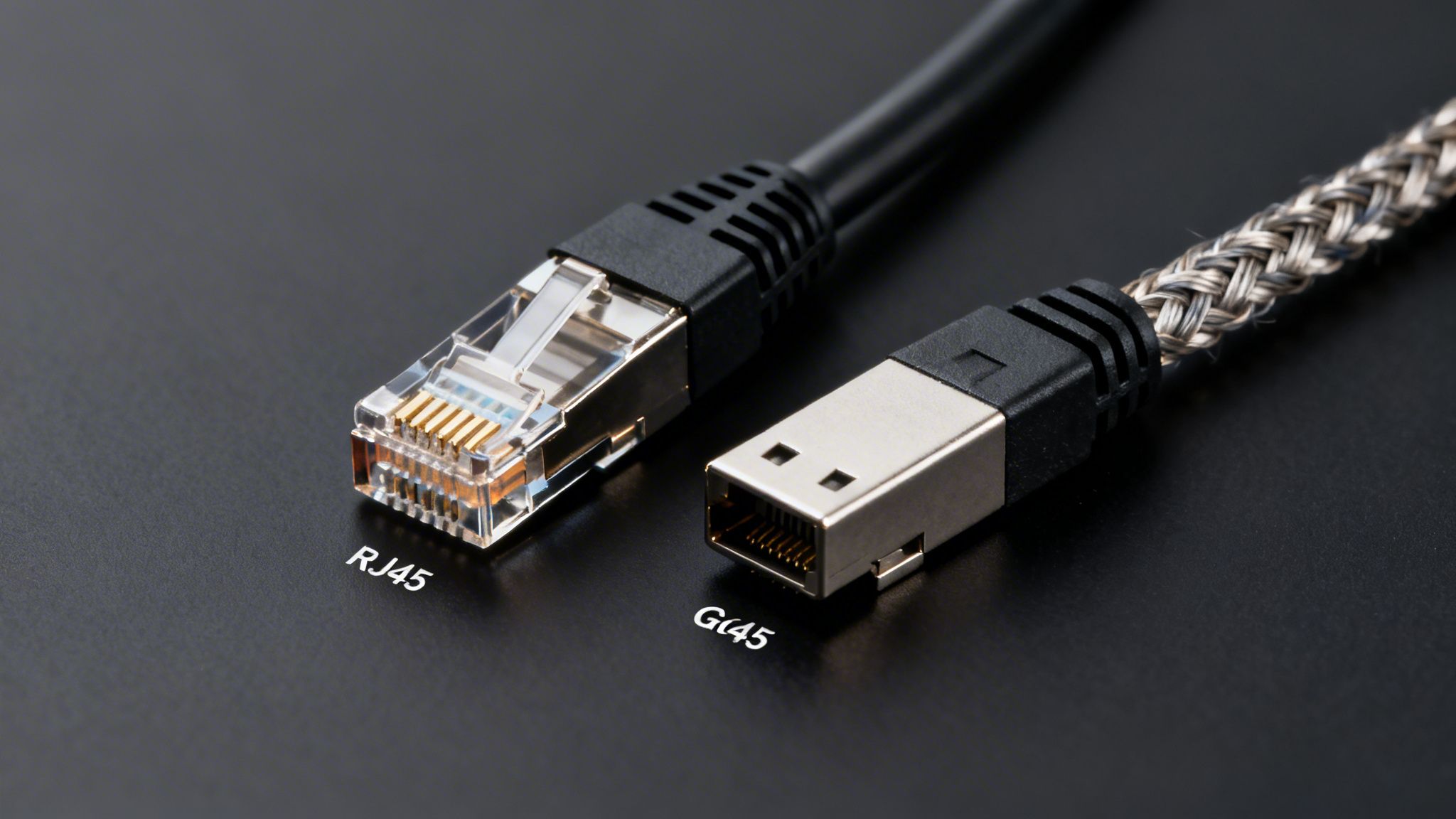
Here’s where the Cat7 story gets a little confusing, but don't worry, we're here to clear it all up. The original, official standard for Cat7 was actually designed for specialized connectors you've probably never even seen, like the GG45 or TERA plug. These were purpose-built to handle the cable's massive performance potential.
The problem? The rest of the world didn't follow suit. Router, switch, and computer manufacturers stuck with what they knew: the classic RJ45 port. It's that familiar rectangular plug you've been using for years. This created a huge compatibility gap for the official Cat7 standard.
The Great Connector Compromise
So, cable makers came up with a practical solution. The vast majority of "Cat7" cables sold today have standard RJ45 connectors on the ends. This was a smart move—it makes them backward compatible and ready to use with all your current gear right out of the box. You can plug them directly into your laptop, gaming console, or Premier Broadband router with zero hassle.
But what does this compromise mean for performance? You get a cable built with the superior internal wiring and heavy-duty S/FTP shielding of a true Cat7. However, because it uses an RJ45 plug, its performance is technically limited to 10 Gbps at 500 MHz—the same specs as a Cat6a cable.
This is a critical point: while the cable itself is built to Cat7 standards, the RJ45 plug limits its performance to Cat6a levels. This is why some experts argue that most consumer "Cat7" cables are essentially premium, super-shielded Cat6a cables.
That's not a bad thing, though. For nearly every home and office setup, this compromise gives you the best of both worlds.
Why This Still Matters for You
Even with an RJ45 connector, a Cat7 cable delivers a major benefit that Cat6a often can't match: incredible resistance to noise and interference. That robust shielding is still doing its job, protecting your data from all the electronic "chatter" in a modern home. This results in a more stable and reliable connection, which is often far more important than raw theoretical speed.
A stable connection means fewer dropped data packets and lower latency. For you, that translates to real-world improvements:
- Flawless Gaming: Say goodbye to frustrating lag spikes in the middle of a match.
- Buffer-Free Streaming: Enjoy your 4K and 8K movies without any interruptions.
- Clearer VoIP Calls: Experience crystal-clear business calls without digital static or dropouts.
- Reliable Backhaul: Create a rock-solid wired connection for your mesh Wi-Fi system.
If you’re experiencing weird connection drops even with a fast internet plan, signal interference might be the hidden culprit. A heavily shielded Cat7 cable can be a surprisingly effective fix. If you're trying to diagnose these kinds of issues, our guide on how to troubleshoot internet connection problems can help.
In short, even though the RJ45 connector is a technicality, the practical benefits of a Cat7 cable's superior construction are very real. You get plug-and-play convenience with maximum protection against the signal interference that plagues modern homes and offices.
When Is a Cat7 Cable the Smartest Choice?
Understanding the technical side of a Cat7 cable is one thing. Knowing when it actually makes a difference in your daily life is what really matters. This is where we go beyond the numbers and look at the real-world situations where choosing Cat7 isn't just an upgrade—it's the smartest move for your network.
It all boils down to your specific needs. While a Cat6a cable handles most jobs just fine, some situations demand the heavy-duty shielding and absolute stability only Cat7 can deliver. For some, it’s about getting a competitive edge. For others, it’s about guaranteeing professional reliability day in and day out.
For the Home User Demanding Peak Performance
For many home users, especially Premier Broadband customers, investing in Cat7 cabling is about eliminating every possible weak link in their network.
Competitive Online Gaming: You're in the final moments of a high-stakes match. A split-second lag spike can mean the difference between winning and losing. A Cat7 cable gives you an incredibly stable, hardwired connection. Its powerful shielding fights off the signal interference that causes those game-ending stutters, keeping your connection to the server clean and consistent.
Rock-Solid Wi-Fi Backhaul: Mesh Wi-Fi systems are great for covering your whole home, but they're only as good as their "backhaul"—the link between your main router and the satellite units. Using Cat7 for a wired backhaul creates an interference-free superhighway for your data, making sure every satellite delivers the fastest speeds possible.
The Flawless Remote Office: When you work from home, a choppy video call or a failed file transfer is more than an annoyance; it's unprofessional. A Cat7 cable ensures your connection stays solid, even in a home office packed with other electronics. Your virtual meetings and data transfers will run smoothly every time.
To see if Cat7 is the right fit, it helps to understand all your options. Getting familiar with choosing the right network LAN cable for your specific home environment is a great place to start.
For the Business Where Reliability Is Non-Negotiable
In a business environment, network stability isn’t a nice-to-have; it’s essential for operations. This is where a Cat7 cable really shines.
As businesses rely more on connected devices and cloud services, the need for better cabling is skyrocketing. The market for network cables, from Cat5 to Cat7, is projected to hit USD 5.3 billion globally by 2033. Cat7's fully shielded design makes it a top choice for businesses that simply cannot afford signal problems. You can explore more market trends in this UTP Cable market analysis from Data-Insights.com.
Here are a few business scenarios where Cat7 excels:
Crystal-Clear VoIP Calls: If your business depends on a VoIP phone system, call quality is everything. The superior shielding in a Cat7 cable blocks the electrical noise that causes static, jitter, and dropped calls. For Premier Broadband clients using our enterprise-grade VoIP, this ensures every conversation is perfectly clear.
Dependable Security and Surveillance: Modern security cameras, especially those using AI, are constantly sending massive high-definition video files. A Cat7 cable provides a secure, high-bandwidth connection, ensuring your footage is captured without dropouts and the system stays online, even in electrically noisy places like warehouses or factory floors.
Ultimately, choosing a Cat7 cable is a strategic investment in stability. It’s about protecting your network’s performance against the ever-growing electronic noise of our modern world and preparing it for what comes next.
The Verdict: Is Cat 7 Worth It in 2026?
So, with all this new network technology on the horizon, where does a Cat 7 cable actually fit in? It’s in a unique spot, somewhere between the go-to standard for most high-speed homes, Cat 6a, and the industrial-grade powerhouse, Cat 8.
For many of our Premier Broadband customers, Cat 7 hits a real sweet spot.
Its main advantage isn't just about chasing the highest possible speed on paper. It’s about building a rock-solid, resilient network. A Cat 7 cable provides a major, noticeable upgrade in shielding and overall durability. This tough construction protects your connection from signal interference, future-proofing your home or business without jumping to the highly specialized, short-distance world of Cat 8.
It's the premium choice for anyone who puts stability and reliability first.
The Cost-Benefit Breakdown
Of course, any upgrade decision comes down to what you're paying versus what you're getting. A Cat 7 cable definitely costs more than its very capable cousin, Cat 6a. The real question is whether that extra investment pays off for your specific needs.
The answer isn't a simple yes or no—it really depends on how you use your internet and the environment you're in.
The market trend is clear: more people are choosing higher-performance cabling. The global demand for Class 7 Ethernet Cable (the official standard for Cat 7) was valued at USD 1.70 billion in 2025. It’s projected to hit USD 2.40 billion by 2030, showing a strong annual growth rate of 6.10%. This growth is fueled by our increasing need for flawless connections for 4K streaming, competitive gaming, and reliable remote work. You can dig into the numbers with these Class 7 Ethernet Cable market insights from Reportprime.com.
This trend tells us that for a growing number of users, the upgrade is making a lot of sense.
A Clear Verdict for Different Users
To help you decide, let's look at who gets the most value from a Cat 7 cable. This should make it clear if it’s a smart investment for you or just overkill.
For the Casual Home User:
If you mostly browse the web, scroll social media, and stream in HD, a Cat 7 cable is probably more than you need. A good Cat 6a cable will handle all that perfectly and save you some money. The extra shielding from Cat 7 just won't make a noticeable difference for this kind of use.
For Gamers and Power Users:
Here’s where the conversation changes. If you’re a competitive gamer, a content creator uploading large files, or a professional working from home, the superior shielding of a Cat 7 cable is a huge win. It’s your best defense against the random lag spikes and signal drops that can cost you a match or disrupt an important video call. For you, the extra cost is an investment in pure consistency.
The stability offered by Cat 7's S/FTP shielding provides a more dependable connection, which is often more critical than a theoretical speed advantage. It's about ensuring your network performs at its peak, all the time.
For Small Business Owners:
For our Premier Broadband business clients, the right choice depends on your workplace. In a typical office, Cat 6a is usually the right call. But if your business operates in an environment with a lot of electronic "noise"—like a manufacturing floor, a mechanic's shop, or a building with crowded wiring—the heavy-duty shielding of Cat 7 is invaluable. It ensures critical systems like VoIP phones and security cameras stay online and reliable.
Ultimately, a Cat 7 cable is absolutely worth it in 2026 for anyone who needs maximum stability in a noisy environment or simply wants to build the most resilient, future-ready network possible. Think of it as performance insurance for your connection.
Your Top Questions About Cat 7 Cables
Let's clear up some of the most common questions people have about Cat 7 cables. We’ve got the straightforward answers to help you decide if it's the right choice for your network.
Can I Plug a Cat 7 Cable into My Regular Router and Computer?
Yes, absolutely. Cat 7 cables sold today come with the standard RJ45 connector, the same one you see on all your network gear.
They are fully backward compatible, so they’ll plug right into your router, PC, game console, or smart TV. You get all the advanced shielding benefits of Cat 7 with the same plug-and-play ease you're used to.
Will a Cat 7 Cable Make My Internet Faster?
A Cat 7 cable can't increase the speed of your internet plan, but it makes sure you get every bit of speed you're paying for. An older cable, like Cat 5e, can be a weak link in your setup, causing a bottleneck that slows you down.
Upgrading to Cat 7 removes that bottleneck. Its heavy-duty shielding is especially good at fighting off electronic interference, letting your devices reach the maximum speeds your internet plan allows.
Key Takeaway: A Cat 7 cable doesn’t boost your plan's speed, but it stops your hardware from holding you back. It protects your connection so you can maximize the performance you already have.
Is Cat 7 Better Than Cat 6a for Home Use?
For many homes, Cat 6a is more than enough since it also handles 10 Gbps speeds.
However, a Cat 7 cable is the clear winner if you need to run wiring near power lines, major appliances, or other sources of electrical "noise." The superior S/FTP shielding gives you a rock-solid signal, making it the best choice for future-proofing your home or for anyone who just wants the most reliable connection possible.
Do I Need a Cat 7 Cable for Gaming?
It’s not a requirement, but if you're a serious gamer, it's a smart upgrade. A Cat 7 cable’s powerful shielding prevents signal drops and random latency spikes that can ruin a competitive match.
For gaming where every millisecond is the difference between winning and losing, that stability is a huge advantage.
Ready to unlock the full potential of your fiber connection? Premier Broadband provides the high-speed, reliable internet that deserves a high-quality network. Explore our residential and business plans today at https://premierbroadband.com.