

When your business needs to connect with the world, traditional phone lines just don't cut it anymore. Global phone services are modern communication systems that use the internet to handle all your calls, offering a level of flexibility and cost savings that old-school landlines simply can't match.
This technology is called Voice over Internet Protocol (VoIP). In simple terms, it lets your phone number travel with you wherever you have an internet connection, effectively erasing geographic boundaries.
What Are Global Phone Services Really?
Let's cut through the jargon. Think of a traditional phone line like a fixed railway track—it's reliable for getting from Point A to Point B, but it's rigid, expensive to build, and stuck on one path. Global phone services are more like a superhighway built on the internet; they can reach any destination that has a web connection, anywhere in the world.
Instead of relying on physical copper wires, this modern approach uses VoIP to turn your voice into digital data and send it online. It works over your existing internet connection, whether that's fiber, cable, or even a mobile network.
The Technology Behind It All
At the core of most business-grade global phone services is a hosted PBX. A PBX (Private Branch Exchange) is essentially the central switchboard for a company's phone system. In the past, this was a bulky, expensive piece of equipment that sat humming away in an office closet.
With a hosted or what a cloud phone system is, that entire switchboard is managed by your provider in a secure data center. You get all the powerful features of an enterprise phone system without the headache and cost of maintaining physical hardware.
This approach gives businesses a level of agility that was impossible with older technology. You get immediate benefits like:
- Work From Anywhere: Your phone number is tied to your account, not a physical line. You can make and receive calls from a desk phone, your computer, or a mobile app.
- Slash Your Phone Bill: International and long-distance calls are significantly cheaper because they travel over the internet instead of legacy phone networks.
- Scale on Demand: Need a new phone line for a new employee? It's as simple as adding a new user in your online portal. No waiting for a technician to install new wiring.
The key takeaway is this: global phone services separate your communication from your physical location. This empowers businesses to establish a local presence anywhere in the world and allows you to stay connected without facing outrageous fees.
Traditional Phone Lines vs Global Phone Services at a Glance
To make the difference crystal clear, let's put the two systems head-to-head. The contrast in flexibility, cost, and features really shows why so many businesses are making the switch.
| Feature | Traditional Phone Lines | Global Phone Services (VoIP) |
|---|---|---|
| Infrastructure | Physical copper wires, on-site hardware | Your existing internet connection, cloud-hosted system |
| Flexibility | Tied to a single physical location | Accessible anywhere you have an internet connection |
| Cost Structure | High setup costs, expensive long-distance & international rates | Low setup, affordable monthly plans, low global call rates |
| Scalability | Slow and costly to add new phone lines | Instantly add or remove users online |
| Features | Basic calling, voicemail | Advanced call routing, auto-attendant, mobile apps, & more |
The comparison speaks for itself. For any modern business that needs to stay connected and grow, a global phone service is no longer a luxury—it's a necessity.
The Essential Features Powering Modern Communication
Global phone services are way more than just a dial tone. They're a collection of powerful tools that make your communication smarter, more flexible, and completely free from the confines of a physical office. When you peel back the layers and look at the core features, you start to see why this technology is such a game-changer.
These aren't just flashy bells and whistles. Each feature is designed to solve a real-world problem, whether that’s setting up a local presence in a new country or making sure you never miss an important message, no matter where you're working from.
Establish a Local Presence Anywhere With International DID Numbers
Let's say your business is based in New York, but you want to break into the UK market. An International Direct Inward Dialing (DID) number is your secret weapon. It gives you a local UK phone number that rings straight to your desk in the US. For your customers in London, it's just a simple, familiar local call.
Think of it like getting a local P.O. box in any city you want. It instantly makes your business feel local and approachable, which can boost your inbound calls by up to 40%. It’s also perfect for families with relatives overseas, giving them a cheap and easy way to stay in touch without dialing complex international codes.
Automate Your Inbound Calls With Advanced Call Routing
Picture an all-star digital receptionist for your company—one that works 24/7 and never calls in sick. That's Advanced Call Routing. It’s a smart system that automatically sends incoming calls to the right person or department based on rules you set.
This goes way beyond simple call forwarding. A modern routing system can direct calls based on all sorts of criteria:
- Time of Day: Route after-hours calls straight to voicemail or an on-call support line.
- Caller ID: A call from a VIP client? Send it directly to the senior account manager's cell.
- Menu Selection: "Press 1 for Sales, Press 2 for Support" gets callers where they need to go, fast.
This kind of efficiency keeps customers happy and stops your team from wasting time manually transferring calls. These powerful features are often bundled into tools like VoIP Call Center Software, giving teams everything they need to respond instantly and grow.
Connect Your System With SIP Trunks
The name sounds technical, but Session Initiation Protocol (SIP) Trunking is just the modern-day version of the old copper phone lines that connected your office to the world. Instead of physical wires, SIP trunks use your internet connection to do the job.
This technology is the bridge between your internal VoIP system and the traditional phone network. It's what allows you to make and receive calls to landlines and mobile phones across the globe.
Using SIP trunks is far more flexible and budget-friendly than juggling a bunch of old-school phone lines. You can add or remove call capacity on the fly, only paying for what you actually need as your business changes.
Never Miss a Message With Voicemail-to-Email
We’ve all been there—endlessly scrubbing through voicemails trying to find that one important callback number. Voicemail-to-Email puts an end to that headache by sending an audio file of every message directly to your email inbox. Many services even transcribe the message into text for you.
Suddenly, your voicemail becomes a searchable, organized archive. You can listen on your laptop, forward a message to a colleague, and save key details without ever touching your desk phone. It's a must-have for staying productive. Curious how these features fit into the bigger picture? Learn more in our article about what UCaaS is.
Take Your Office Number on the Go With Mobile App Integration
Finally, mobile app integration is what truly cuts the cord to your desk. With a dedicated mobile app, your personal smartphone becomes a full-featured extension of your office phone system.
You can make and receive calls from your business line right on your mobile. Your clients see your professional company number, not your personal cell, so you always look polished. For anyone who works remotely or travels often, this is the key to staying connected and professional from anywhere.
Here's the rewritten section, designed to match the specified human-written style and tone.
What Global Phone Services Actually Do for Your Business
Let's move past the technical talk. The real magic of global phone services isn't in the features themselves, but in what they do for your bottom line and your day-to-day operations. This isn't just a new way to make calls; it's a way to build a more professional, flexible, and affordable business.
Think about the first impression you make. When a potential customer calls, do they get endless ringing or a generic voicemail? Or are they greeted by a professional auto-attendant that says, "Press 1 for Sales, Press 2 for Support"? That small touch instantly makes a one-person shop sound like a major player.
But that polish is just scratching the surface. The real benefits are baked right into how your business runs.
Grow Without the Growing Pains
Scalability is one of the biggest wins. With old-school phone systems, adding a new employee was a headache. You had to call a technician, run new wires, and shell out for expensive hardware. The whole process was slow, clunky, and expensive.
Global phone services flip that script. Need to bring on a new team member? Just log into a simple online portal, add them as a user, and their extension is ready to go in minutes. Your communication system grows right alongside your business, without the painful upfront costs.
This turns your phone system from a fixed expense into a flexible asset. As your business expands or scales back, your service adjusts instantly. You only ever pay for what you actually use.
This is a game-changer for seasonal businesses or companies hitting a growth spurt. It gives you a predictable cost model that traditional hardware just can't touch.
Connect Your Team, Wherever They Are
Today, work isn't a place—it's what you do. Keeping your team connected is everything, whether they're at home, on the road, or in the office. Global phone services are the glue that holds a distributed workforce together.
An employee working from a home office in Denver, a manager traveling in Europe, and your main office in Miami can all be on the same unified system. They can transfer calls, jump on conference lines, and use the company directory like they're all sitting side-by-side.
The economic shift here is massive. Mobile tech, the engine behind these services, already accounts for about 5.8 percent of global GDP, adding up to $6.5 trillion in economic value. By 2030, that number is expected to climb to nearly $11 trillion. It’s clear that business runs on mobile connectivity. You can read more about the economic impact of mobile technology from GSMA.
Real-World Example: Unifying a Small Business
Picture a small marketing agency with a main office and a few freelance designers scattered across the country. Before, their communication was a mess. A client would call the office, only to be told the designer would have to call them back from a personal cell phone. It just didn't look professional.
After switching to a global phone system, everything changed:
- One Business Number: Every outbound call, whether from the office phone or a designer's mobile app, showed the main company number. Consistency.
- Easy Call Transfers: The receptionist could instantly transfer a client to the right designer's extension, no matter where they were working.
- Better Teamwork: The team started using internal extensions to call each other, cutting down on wasted time and making project collaboration much smoother.
This simple upgrade unified their brand, made their customers happier, and boosted their internal efficiency. It's the perfect example of how the right features create real business results, making geography irrelevant.
How to Choose the Right Global Phone Service Provider
Picking the right global phone service can feel overwhelming, but it doesn't have to be. When you know what to look for, the process becomes much simpler. You're not just buying a dial tone; you're investing in a communications partner. The goal is to find a service that's reliable, secure, and won't hit you with surprise costs.
Forget just hunting for the cheapest plan. The real win is finding the best value—a service that gives you crystal-clear calls, straightforward pricing, and a support team that actually picks up the phone when you need them. Let's walk through the five critical things you need to check out before making a decision.
Call Quality and Reliability
Let’s be honest: nothing else matters if your calls sound like they’re coming from the bottom of a swimming pool. A cheap service is worthless if calls constantly drop or are filled with static. Because VoIP runs over the internet, it's sensitive to network issues. You need a provider with a seriously stable network to avoid annoying problems like jitter (that choppy, robotic sound) and lag (awkward delays).
A top-tier provider should guarantee excellent uptime, usually in a formal Service Level Agreement (SLA). Don't be shy about asking them how they keep calls clear and connections stable.
Here are a few questions you should definitely ask:
- What percentage of uptime do you guarantee?
- What do you do to minimize things like latency and packet loss on your network?
- Can I get a free trial or a demo to hear the call quality for myself?
Pricing and Transparency
Global phone service pricing can get complicated fast, and some companies love to hide fees in the fine print. A provider you can trust will be completely upfront about all their costs, from the monthly fee per user to what you'll actually pay for international calls. If a plan seems too good to be true, it probably is.
Make sure the pricing model actually fits how you'll use the service. Some offer unlimited calling plans, while others are pay-as-you-go. Get clarity on what "unlimited" really means—which countries are included, and what happens if you go over?
A provider’s willingness to be completely transparent about their pricing says a lot about how they do business. Hidden fees for setup, number porting, or regulatory charges can turn a cheap plan into an expensive headache.
Global Coverage and Number Availability
A "global" phone service better live up to the name. Whether you're running a business with international clients or just have family scattered across the globe, you need a provider with great coverage and the ability to give you local phone numbers where you need them.
Always check their list of available countries for International DID numbers. This is huge for creating a local presence, letting people in other countries call you without racking up a massive international bill. A provider with a big inventory of global numbers gives you the room to grow. You can dive deeper into the tech behind this by reading our guide on how SIP trunks work.
Security and Compliance Measures
Your conversations are private, and they should stay that way. When calls travel over the internet, security is a must. Your provider needs to be serious about protecting your call data from hackers and preventing attacks that could shut down your phone system entirely.
Look for these key security features:
- Call Encryption: They must use modern protocols like TLS and SRTP to encrypt your calls, keeping them private.
- Network Security: Ask about their firewalls, how they detect intrusions, and if they perform regular security audits.
- Compliance: If your business is in an industry like healthcare or finance, make sure they meet standards like HIPAA or PCI-DSS.
The Quality of Customer Support
Finally, think about what happens when something breaks. When your phones are down, you need help now, not tomorrow. The quality of a provider's customer support can be the difference between a minor hiccup and a major business disruption.
Check out their support options. Do they offer 24/7 help via phone, email, and live chat? Do some digging and read user reviews. A provider that invests in a smart, responsive support team is one that's truly committed to its customers.
Provider Evaluation Checklist
Use this checklist to compare global phone service providers on the factors that matter most.
| Evaluation Criterion | Provider A | Provider B | Premier Broadband |
|---|---|---|---|
| Guaranteed Uptime (SLA) | 99.9% | ||
| Free Trial Available? | Yes | ||
| Transparent Pricing (No Hidden Fees) | Yes | ||
| Key Countries Covered? | Extensive Global Network | ||
| Call Encryption (TLS/SRTP) | Yes | ||
| 24/7 Customer Support | Yes |
Doing your homework upfront will save you a ton of headaches later. By focusing on these five areas, you can confidently choose a provider that will not only meet your needs today but also grow with you tomorrow.
Making the Switch a Smooth Transition Plan
The thought of overhauling your phone system can feel like a massive headache. Concerns about downtime, losing your main number, or a tangled setup process are enough to make anyone hesitate. But with a solid plan, moving to a global phone service is a lot smoother than you’d expect.The secret is all in the prep work and partnering with a provider who knows how to walk you through it. A well-planned migration keeps your business running without a single hiccup, so you can jump right into enjoying all the new benefits.
Keep Your Business Number, Ditch the Old System
One of the biggest worries we hear is, "Will I lose my phone number?" The answer is a clear and simple no. Thanks to a process called number porting, we can move your existing phone numbers from your old carrier right over to your new service.
This process is standardized across the industry to make sure you don't experience any service gaps. All you typically need is a recent phone bill and an authorization form. From there, your new provider handles all the technical legwork behind the scenes, keeping your business identity perfectly intact.
The most important takeaway is that you are in complete control of your phone numbers. Porting ensures you can upgrade your technology without confusing customers or losing the brand recognition you’ve worked hard to build.
Get Your Network Ready for Crystal-Clear Calls
Since global phone services use your internet connection, a quick network check-up is a smart first step. Taking a look at your current internet setup ensures it’s ready to handle voice traffic without annoying issues like lag or choppy audio.
A fiber internet connection is the gold standard here. It gives you the equal upload and download speeds needed for seamless, two-way conversations. We can help you test your connection and might suggest a few tweaks to prioritize voice data, guaranteeing a perfect calling experience from day one.
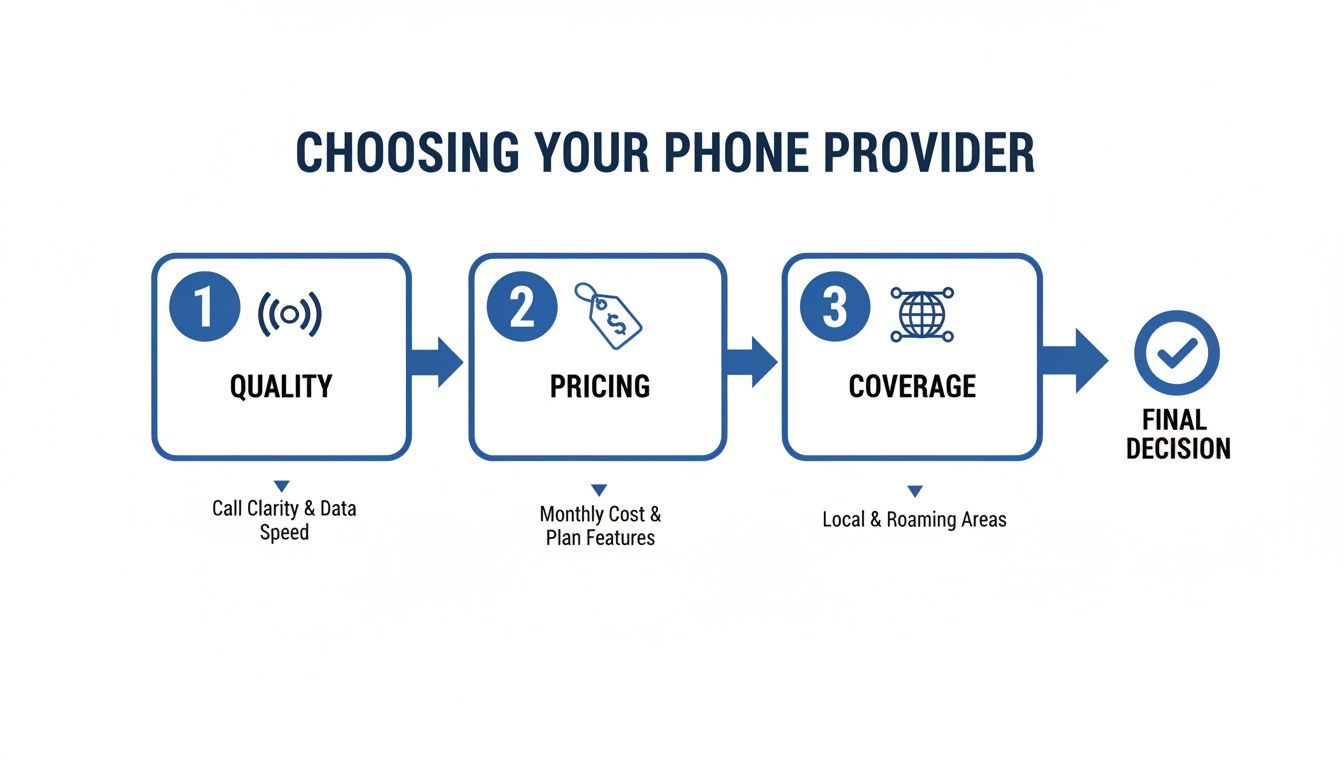
This process really boils down to three core pillars: making sure the call quality is top-notch, the pricing is straightforward, and the coverage meets your needs.
Set Up Your System With Zero Downtime
The last piece of the puzzle is dialing in the features that make the system work for you. This is your chance to set up your auto-attendant, program call forwarding rules, and configure voicemail settings to fit right into your workflow. Any good provider will give you an easy-to-use online portal to manage this.
The best part? You can get all of this customized before your numbers officially switch over. That means the second your service goes live, every call is routed exactly where it needs to go. Your customers and staff won't notice a thing.
Here’s a quick checklist to get you started:
- Map Your Call Flow: Decide how calls should be handled. Should they go to an auto-attendant first, or ring a specific group?
- Record Professional Greetings: Create welcoming messages for your main line and any department voicemails.
- Set Up User Extensions: Assign extensions and set up handy features like voicemail-to-email for everyone on your team.
- Install Mobile and Desktop Apps: Have your team download the apps on their computers and smartphones so they're ready to go.
With a little bit of planning, making the switch isn't something to dread. It’s a straightforward move to a better, more flexible way of communicating.
Why Premier Broadband Is Your Ideal Connectivity Partner
When you're choosing a provider for global phone services, it’s easy to get lost in a long list of features. But the truth is, none of them matter without a rock-solid internet connection underneath. Crystal-clear calls and glitch-free video meetings don't happen by accident—they happen because the network powering them is up to the job.
At Premier Broadband, our entire system is built on a 100% fiber network. This isn’t just a technical detail; it’s the secret to our quality. Unlike old-school cable or copper, fiber gives you symmetrical upload and download speeds, killing the lag, jitter, and dropped calls that can make a business look unprofessional.
A Single Partner for All Your Needs
Juggling different vendors for your internet, phone, and network security is a headache you don't need. We believe in keeping things simple. We act as a single, dedicated partner for all your connectivity, providing a full suite of services designed to work together from day one.
This means you get one point of contact, one straightforward bill, and one team that knows your setup inside and out. Our offerings cover everything:
- High-Speed Business Internet: The reliable fiber backbone your business depends on.
- Enterprise-Grade VoIP: Powerful calling features to connect your team, wherever they are.
- Managed Network Edge: An all-in-one solution that handles deployment, monitoring, and security for you.
Bringing your internet, phone, and network management under one roof isn’t just about convenience—it strengthens your security and simplifies your operations. It’s simply a smarter way to manage the tech that fuels your growth.
Empowering Your Connected Future
Whether you're a remote worker who can’t risk a dropped client call or a growing business trying to unify multiple locations, the right infrastructure is what gives you an edge. Our solutions are built to grow with you, giving you the power you need today and the flexibility to adapt for tomorrow.
Ultimately, our job is to provide the reliable foundation that lets you focus on your business, not your phone system. For companies looking to get the most out of their communication tools, our guide to internet and phone for small business is a great place to start. Let us provide the powerful, secure, and simple platform you need to thrive.
Frequently Asked Questions
Thinking about upgrading to a global phone service? It’s a smart move, but we get that you probably have a few questions before you jump in. We’ve put together answers to the most common things people ask us, so you can feel confident about your decision.
Our goal is simple: give you clear, straight answers.
Can I Keep My Current Phone Number?
Yes, you absolutely can. This is the first thing most people worry about, and the answer is a definite yes. You don't have to start from scratch with a new number.
The process is called number porting, and it’s standard practice. We handle all the technical details of moving your existing number from your old provider to your new service. It’s a smooth, seamless transfer with no downtime, so you keep your business identity and never miss a call.
Do I Need Special Equipment to Use VoIP?
Probably not! One of the best parts about modern phone services is how flexible they are. You have a few options, and most of them work with the equipment you already have.
Here’s how most people get connected:
- VoIP Desk Phones: They look and feel just like a regular office phone, but they plug into your internet router instead of a phone jack.
- Your Computer: Just pop on a headset and use a "softphone" app on your desktop or laptop. Simple as that.
- Your Smartphone: With a mobile app, your personal cell phone can double as your business line, letting you make and take calls from your company number wherever you are.
How Secure Are Phone Calls Made Over the Internet?
That's a great question, and the answer is: very secure, as long as you choose a quality provider.
Reputable providers use powerful encryption, like TLS (Transport Layer Security) and SRTP (Secure Real-time Transport Protocol), to protect every conversation. Think of it like the security that protects your online banking—it scrambles the data so no one can listen in.
You should always ask a provider about their security. A good one will be happy to explain how they keep your calls and your network safe. In today's world, that commitment to keeping your private conversations private is a must-have.
Ready to see what a modern, reliable communication system can do for you? Premier Broadband provides powerful VoIP solutions on our 100% fiber network. Explore our business and residential phone services today!