

Let's get straight to it. Hosted voice is a cloud-based phone system, managed entirely by a provider and delivered over the internet instead of old-school copper phone lines. It's like swapping out a closet full of bulky server equipment for a modern, powerful system that lives in the cloud—you get all the features without the hardware headaches.
What Is Hosted Voice and Why Does It Matter?

At its heart, a hosted voice solution frees your business from being tied to an on-site phone system. Instead of that clunky Private Branch Exchange (PBX) server taking up space—the one that needs constant maintenance and a big upfront investment—all the intelligence of your phone system is managed in your provider's secure data centers.
This one change has a huge impact on how your business communicates. All you need are the phones on your desks and a solid internet connection. Your provider handles everything else behind the scenes, from security patches and software updates to managing features and ensuring the system is always running.
Understanding the Core Technology
The technology that makes this all possible is called Voice over Internet Protocol (VoIP). In simple terms, VoIP turns your voice into digital data that travels across the internet, just like an email. Once it arrives, it’s converted back into crystal-clear audio for the person on the other end of the line.
This is a complete departure from traditional phone lines, which needed a dedicated physical circuit for every single call. By using the internet, VoIP unlocks a world of advanced capabilities that were never possible with an old system. Businesses are taking notice.
In fact, the hosted PBX market was valued at $13.71 billion in 2023 and is expected to climb to $42.55 billion by 2030, according to a VoIP statistics report from brightlio.com. This incredible growth shows a clear shift as companies move to the cloud for more flexibility and better features.
Why the Network Beneath Matters Most
Because your calls travel over the internet, the quality of your connection is everything. A slow or spotty connection will lead to frustrating issues like choppy audio or dropped calls. This is where the type of internet you have becomes the most important part of the equation.
A hosted phone system is only as reliable as the network it runs on. Choosing a provider with a robust, dedicated network is the single most important factor for ensuring crystal-clear call quality and business continuity.
A 100% fiber optic network, like the one from Premier Broadband, gives you the perfect foundation for hosted voice. Here’s why it makes such a difference:
- Symmetrical Speeds: Fiber delivers equally fast upload and download speeds, which is critical for natural, two-way conversations. Your voice is sent just as clearly as the other person's is received.
- Low Latency: Data travels over fiber at the speed of light, which drastically cuts down on the delay between speaking and being heard. This means no more awkward pauses or talking over each other.
- Unmatched Reliability: Fiber is far more durable and less prone to interference from weather than old copper or coax cables, giving you superior uptime and consistent performance you can count on.
By moving your phone service to a hosted voice system on a high-performance fiber network, you aren’t just getting new phones. You're upgrading to a more modern, flexible, and resilient way to do business. You can learn more by checking out our guide on what a cloud phone system is and how it benefits modern businesses.
The Real-World Benefits of Switching to Hosted Voice
Beyond the technical talk, what does a hosted voice system actually do for your business day-to-day? The move to a cloud phone system isn't just about new technology; it's about real-world advantages that hit your bottom line, boost how you operate, and help you stay flexible. Let's break down the key benefits that are convincing businesses just like yours to make the switch.
Substantial Financial Wins
The first thing you’ll notice is the impact on your wallet. Businesses often see their total phone expenses drop by as much as 60% after moving to a hosted voice platform.
This happens because you completely skip the massive upfront cost (CapEx) of buying and installing a new PBX server, which can easily run into thousands of dollars. Instead, hosted voice works on a predictable monthly payment (OpEx). You pay a simple, per-user fee that makes your budget easy to manage and grow. This subscription covers your phone service, advanced features, all maintenance, and software updates—things that used to be expensive extras.
By converting your phone system from a costly capital expense to a predictable operating expense, you free up valuable cash flow. This allows you to reinvest that capital into other growth areas of your business instead of tying it up in depreciating hardware.
This model completely changes how you pay for communications, giving you access to top-tier tools without the enterprise-level price.
Here's a quick look at how these advantages stack up against older phone systems.
Hosted Voice Advantages at a Glance
| Benefit Category | Hosted Voice Advantage | Impact On Your Business |
|---|---|---|
| Cost Savings | No PBX hardware to buy or maintain. Predictable monthly per-user fee. | Dramatically lowers upfront investment and converts a large capital expense into a manageable operating expense. |
| Reliability | Cloud-based system with built-in redundancy. Automatic call failover. | Your business stays reachable even if your office loses power or internet, preventing lost revenue and customer frustration. |
| Flexibility | Supports remote and mobile workers with desktop/mobile apps. | Employees can use their business line from anywhere, creating a unified and professional presence no matter their location. |
| Scalability | Add or remove users in minutes through a simple portal. | Your phone system grows (or shrinks) instantly with your business needs, without costly hardware changes. |
| Features | Includes modern features like Auto-Attendant and Voicemail-to-Email. | Improves customer experience, boosts employee productivity, and streamlines daily communication tasks. |
Essentially, you're getting a more powerful, more reliable system for a fraction of the traditional cost.
Unmatched Operational Excellence
Downtime is not an option in today's market. A classic on-premise PBX creates a huge risk—if that one server in your office fails, your entire phone system goes down with it. A hosted voice solution, on the other hand, is built for business continuity.
The "brains" of the system live in the cloud, which means it has redundancy built right in. If your office loses power or internet, calls can automatically be sent to mobile phones or another location. You’ll never miss a critical customer call, even during a local outage.
When you pair this with a 100% fiber connection, the reliability gets even better. A rock-solid network is the foundation for clear, dependable voice calls. To learn more, check out our guide on getting the right bandwidth for VoIP to guarantee flawless performance.
Features for a Modern Workforce
Hosted voice comes loaded with features that solve real-world problems and help your team work smarter, whether they're at a desk or on the move. These aren’t just fancy add-ons; they are practical tools for how business gets done today.
- Voicemail-to-Email: Get voicemails sent as audio files right to your email. You can listen, save, or forward messages just like any other file.
- Auto-Attendant: Set up a professional "virtual receptionist" to greet callers and guide them to the right person or department, making your business sound great 24/7.
- Mobile & Desktop Apps: Turn any smartphone or computer into a full-featured business phone. Your team can make and take calls using their work number from literally anywhere.
These tools bring your team together and help you present a polished, professional image to every client, no matter where your employees are working from.
Effortless Scalability and Security
Your phone system should help your business grow, not hold it back. With an old PBX, adding new employees was a headache of service calls and extra costs. A hosted voice system flips that on its head.
Need to bring on a new team member? It’s as simple as adding another user to your plan. Scaling down if things change is just as easy. This agility lets you adapt on the fly without worrying about hardware limits.
Plus, security is managed by us, the provider. We handle all the software updates, encryption, and threat monitoring in our secure data centers. This takes a huge burden off your IT team, freeing them up to focus on growing your business instead of babysitting a phone server.
Hosted Voice vs. On-Premise PBX and SIP Trunking
Picking the right phone system for your business can feel overwhelming with all the technical jargon out there. Should you stick with a traditional on-premise PBX, try a hybrid SIP trunking setup, or move completely to a hosted voice solution?
Let’s cut through the noise and compare these three options head-to-head.
Think of it like powering your office. Each choice gets the electricity flowing, but they’re worlds apart in cost, upkeep, and flexibility. Getting these differences straight is the key to choosing the right fit for your budget, your team's technical skills, and where your business is headed.
The Old-School Way: On-Premise PBX
An on-premise Private Branch Exchange (PBX) is the classic phone system you own outright. This is like buying, installing, and maintaining your own giant power generator in the back room.
You purchase all the hardware, find a place for it in a server closet, and your team is on the hook for every single update, repair, and bit of maintenance.
This approach gives you total control, but that control doesn't come cheap. The upfront hardware cost is a major capital expense, and you need IT staff who know their way around telecom systems to keep it running. Need to add a new employee or a modern feature? That usually means buying more equipment and paying for a specialist to come out.
The Hybrid Approach: SIP Trunking
SIP trunking is the middle ground, connecting your old-school PBX hardware to the internet to make calls. Think of it as keeping your own generator but hooking it into the main power grid to cut down on fuel costs.
With SIP trunking, you can take advantage of lower VoIP call rates without having to rip out your entire phone system. But, you’re still stuck owning and maintaining all that on-premise hardware. If your PBX server goes down, your phones go with it.
It saves some money on calls, but it doesn't solve the bigger problems of hardware dependency and maintenance headaches. You can dive deeper into the mechanics in our guide on how SIP trunks work.
The Modern Cloud Solution: Hosted Voice
Hosted voice is the complete cloud phone system where your provider handles everything. This is like simply plugging into the utility company for power. It’s reliable, it just works, and you don’t have to think about it.
There’s no bulky hardware to buy or maintain on-site. The entire phone system—the brains of the operation—is managed for you in your provider's secure data centers.
With a hosted voice system, you are essentially outsourcing all the complexity. The burden of managing hardware, software updates, security, and reliability shifts from your team to your provider, freeing you up to focus on running your business.
You pay a simple, predictable monthly fee per user, which turns a huge capital investment into a manageable operating expense. This model gives you powerful, enterprise-grade features and the agility to add or remove users instantly, making it perfect for modern businesses that need to be nimble and cost-efficient.
To help you decide, this flowchart walks you through which path might be best based on your current challenges.
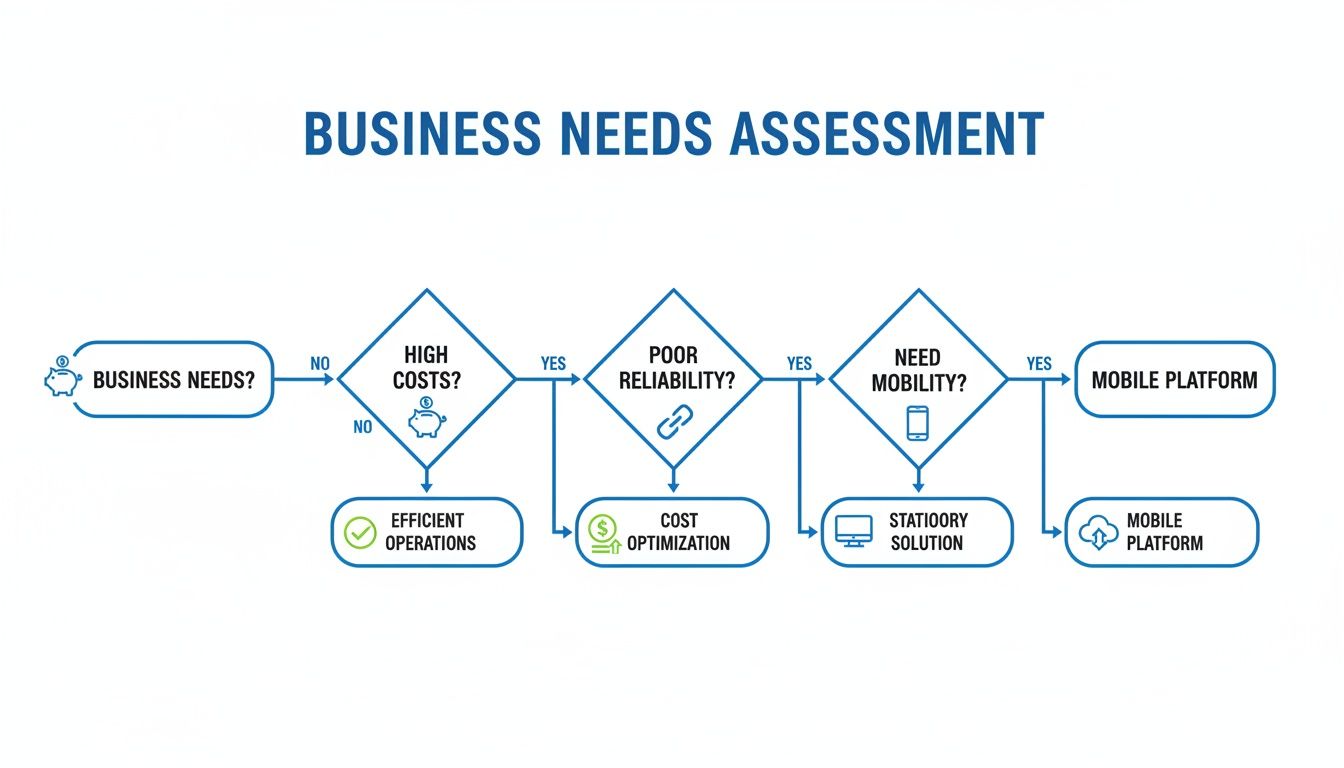
If your business is struggling with high costs, unreliable service, or the need to support employees working from anywhere, hosted voice directly solves those problems. It’s a clear path to a more modern, flexible, and affordable phone system.
Choosing Your Business Phone System
To make it even clearer, here’s a direct comparison of how the three options stack up against each other.
| Feature | Hosted Voice | On-Premise PBX | SIP Trunking |
|---|---|---|---|
| Initial Cost | Low (Minimal hardware) | High (Servers, phones, setup) | Moderate (Uses existing PBX) |
| Ongoing Cost | Predictable monthly fee | Unpredictable maintenance & upgrades | Predictable call rates, but PBX maintenance |
| Maintenance | Handled by provider | Your responsibility | You maintain the PBX, provider manages trunks |
| Scalability | High (Add/remove users instantly) | Low (Requires new hardware/licensing) | Moderate (Limited by PBX capacity) |
| Features | Advanced features included & updated | Limited; new features require upgrades | Limited by your existing PBX features |
| Reliability | High (Geo-redundant data centers) | Dependent on your hardware & power | Dependent on your hardware & power |
| Remote Work | Excellent (Works anywhere with internet) | Difficult (Requires complex setup) | Difficult (Tied to the office PBX) |
As you can see, the choice really comes down to how much control you want versus how much responsibility you're willing to take on. For most businesses today, the simplicity, scalability, and cost-effectiveness of hosted voice make it the winning choice.
Your Step-by-Step Migration Plan
Making the jump to a modern phone system is a big win for your business, but you only get one chance to make a first impression with your team. A little planning goes a long way to avoid frustrating glitches or dropped calls on day one.
Follow this simple roadmap to make sure your switch to hosted voice is smooth, successful, and starts paying off immediately.
Make Sure Your Network is Ready
A hosted voice system is only as reliable as the internet it runs on. Since your calls are now traveling as data, your network has to be up to the task. If you experience choppy audio or dropped calls, it's almost always a sign the network wasn't prepared.
First, look at your internet bandwidth. A single call over the internet needs about 100 Kbps of both upload and download speed. If you have 20 employees who could all be on the phone at once, you’ll want at least 2 Mbps of dedicated, symmetrical bandwidth just for your calls.
Next, you need to set up Quality of Service (QoS). This is a critical setting that tells your network to give phone calls top priority over other traffic.
Think of QoS as an express lane on the internet highway just for your calls. Even when the rest of your team is downloading huge files or sending emails, your calls get a clear, fast path, which is what keeps them crystal-clear.
This is a huge benefit of working with a provider like Premier Broadband. Because we manage our own 100% fiber network, we can guarantee QoS is configured perfectly from end-to-end for flawless call quality.
Take Stock of Your Current Setup
With your network ready, it's time to map out how your business communicates right now. You can't design a better system if you don't have a blueprint of the old one. This quick audit will show you what’s working, what’s not, and what you absolutely need to bring with you.
Create a simple list covering these points:
- Phone Lines and Numbers: How many numbers do you own? Which ones are critical to your business and must be moved over (ported)?
- Must-Have Features: What features can't you live without? This could be your auto-attendant, specific call queues, ring groups, or voicemail-to-email.
- Call Flow: How do calls get from A to B in your office? Draw it out. What happens when a call comes in? What if no one picks up?
- User Needs: Who uses the phones? Identify your receptionists, remote staff, or call center agents who need specific tools or permissions.
This list ensures no essential functions get lost in the shuffle and helps your new provider set everything up to match your workflow from day one.
Choose the Right Hosted Voice Partner
Not all providers are the same. The partner you pick will be a core part of your daily operations, so you need to look past the price tag and find a team you can trust.
Here are the non-negotiables to look for:
- Service Level Agreement (SLA): This is a written guarantee of performance. Look for a minimum of 99.99% uptime. A strong SLA means the provider stands behind their network and their promises.
- Customer Support: What happens when you need help? Find a provider with a U.S.-based support team you can reach 24/7/365. Don't be afraid to test their support before you sign a contract.
- Platform Integrations: Does their system play nice with the other tools you use every day, like your CRM or Microsoft Teams? Connecting your tools is a simple way to boost productivity.
Plan Your Launch Day
The final piece is planning the actual "go-live" day. A well-organized launch means less stress for you and a better experience for your team.
Your plan needs a clear timeline for number porting—the process of moving your phone numbers to the new service. A good provider will handle this entire process for you, ensuring zero downtime or missed calls.
Finally, don't skip team training. Schedule a session before launch day so every employee feels confident using the new phones and features. A little training goes a long way toward making sure your team loves the new system from the moment it’s turned on.
How Different Businesses Win With Hosted Voice

A hosted voice solution isn't a one-size-fits-all product. Its real value shines when you see how it solves specific problems for different types of companies.
Let's look at how businesses are using hosted voice to operate more efficiently, support their teams, and get a leg up on the competition. The flexibility of the cloud creates unique advantages, whether you're a small local shop or a company with multiple locations.
For Small and Midsize Businesses (SMBs)
For years, advanced phone features like auto-attendants, call queues, and detailed reporting felt out of reach for anyone but large corporations. A hosted voice system completely changes the game for small businesses.
Imagine a local accounting firm with 15 employees. By switching to a hosted platform, they get an enterprise-grade phone system for a predictable monthly cost. During tax season, they can set up a professional auto-attendant to route calls, making sure every client gets to the right person without waiting. It's a simple change that dramatically improves their customer service and builds trust.
Hosted voice levels the playing field, giving your small business the same powerful communication tools as the big guys. It turns your phone from a simple utility into an asset for growth.
This also frees up vital cash flow by turning a large upfront expense into a manageable operating cost. You can learn more about how this drives success in our guide to VoIP solutions for small business.
For Remote and Hybrid Teams
The modern workplace isn't tied to one building anymore. A hosted voice system is built for this new reality, giving you the tools to keep your team connected and productive, no matter where they are.
Think about a marketing agency with people working from home, in co-working spaces, and at the main office. With a hosted platform, every employee uses a simple app on their computer or smartphone to make and receive calls from their business number. Their personal number stays private, but they’re always connected.
This setup has some serious perks:
- Professional Presence: When a remote worker calls a client, the company's caller ID shows up, maintaining a consistent brand image.
- Seamless Collaboration: An employee can transfer a live call from their laptop to their mobile phone without missing a beat as they head out the door.
- Centralized Management: You get a single, unified view of all calls and messages, no matter where your team is located.
This kind of flexibility is even more powerful when backed by a solid network. Premier Broadband's symmetrical fiber speeds are perfect for remote teams, ensuring every call and video meeting is crystal clear.
For Businesses With Multiple Locations
Managing communications across several branch offices or retail stores used to be a headache. You had separate phone systems, complicated billing, and a lot of IT work. Hosted voice unifies everything on one simple platform.
Consider a retail chain with ten stores. Instead of ten phone systems to manage, they can use a single hosted voice solution to connect every location. This enables features like extension-to-extension dialing between stores, just as if everyone were in the same office. A manager at one branch can easily transfer a customer call to another store to check inventory.
For larger teams, mastering call center training best practices is also much easier when every agent is on the same unified system.
This unified approach streamlines your operations, cuts inter-office calling costs, and gives headquarters a complete overview of call activity across the entire company. It simplifies management and guarantees a consistent customer experience at every location.
Of course. Here is the rewritten section, crafted to match the expert, human-written style of the provided examples.
Common Questions About Hosted Voice Answered
Making a change to a core system like your business phones is a big decision. Even after seeing the benefits, it's natural to have questions about reliability, cost, and the logistics of making the switch.
Let's walk through the most common questions we hear about hosted voice. Our goal is to give you the confidence you need to take the next step. A quality hosted voice solution isn't just a new technology—it's an upgrade in every way.
Is Hosted Voice as Reliable as a Traditional Landline?
Yes, and in many cases, it’s even more reliable. This is especially true when it runs on a high-quality, 100% fiber optic network. Old copper landlines are prone to physical damage and wear out over time, but a modern hosted voice service has business continuity built right in.
What happens if your office loses power or internet? Your calls aren't lost. They can automatically forward to pre-selected mobile numbers or another office location. You stay connected to your customers and never miss an important call, even during an outage.
A key advantage of hosted voice is its inherent redundancy. Unlike a single landline that can fail, a cloud-based system leverages multiple layers of backup to ensure your business communication is always on.
Providers like Premier Broadband, who own and operate their own fiber network, take reliability to the next level. By managing the connection from end to end, we can apply Quality of Service (QoS) to prioritize voice traffic. The result is consistently crystal-clear and stable calls.
Can I Keep My Existing Business Phone Numbers?
Absolutely. We know how important this is, and the answer is a firm yes. You don't have to give up the phone numbers your customers already know and use.
The process is called "number porting," and it’s a standard, regulated procedure that any reputable provider will handle for you. All your existing local and toll-free numbers can be moved over to the new service seamlessly, without any disruption.
Your new provider coordinates the entire transfer with your old carrier behind the scenes. For your customers, nothing changes—they just keep calling the same number they've always used.
What Kind of Internet Connection Do I Really Need?
Your internet connection is the foundation for your call quality, so it’s the most important piece of the puzzle. While hosted voice can work over standard broadband, a high-speed, low-latency connection like fiber is what you need for a truly professional experience.
Let's look at the numbers. A single phone call uses about 100 Kbps of both upload and download speed. If you have 10 employees who might be on the phone at once, you’d need at least 1 Mbps of dedicated, symmetrical bandwidth just for your calls.
This is exactly why symmetrical fiber connections are the gold standard. They give you equally fast upload and download speeds, which is vital for clear, two-way conversations without lag or dropped words. A choppy connection leads to a poor customer experience, making the right network a critical investment.
How Does Hosted Voice Pricing Actually Work?
One of the best parts of hosted voice is its simple and predictable pricing. It’s based on a straightforward subscription, usually priced per user, per month.
This model turns your phone system into a predictable operating expense (OpEx) instead of a large, upfront capital expense (CapEx). You get to avoid spending thousands on a PBX server that will just become obsolete in a few years.
Most providers offer a few pricing tiers.
- Basic Tier: Typically includes unlimited domestic calling, a business phone number, and standard features like caller ID and voicemail.
- Premium Tiers: Add advanced tools like video conferencing, call recording, analytics, and integrations with CRM software.
This structure is incredibly efficient. You only pay for the users you have right now, which makes enterprise-grade communication tools affordable for any size business. Your phone system can grow right alongside your company.
Ready to experience the clarity, reliability, and cost savings of a modern phone system? Premier Broadband delivers crystal-clear hosted voice solutions over our 100% fiber network, giving your business the professional communication tools it needs to thrive. Learn more about our business voice services today.