
Calling Australia from the USA is simple once you know the right sequence of numbers. Whether you're using a landline or your mobile, the process is straightforward.
From a landline, the key is to dial 011, then 61, and finally the local Australian number (just be sure to drop its leading zero).
If you're on a mobile phone, it's even easier. Just use +61 followed by the local number.
Your Quick Guide to Calling Australia
Connecting with friends, family, or business partners down under just takes a few key codes. The most important parts are the US exit code, which tells your network you're calling internationally, and Australia's country code, which routes the call to the right place.
This visual guide breaks down the dialing steps for you.
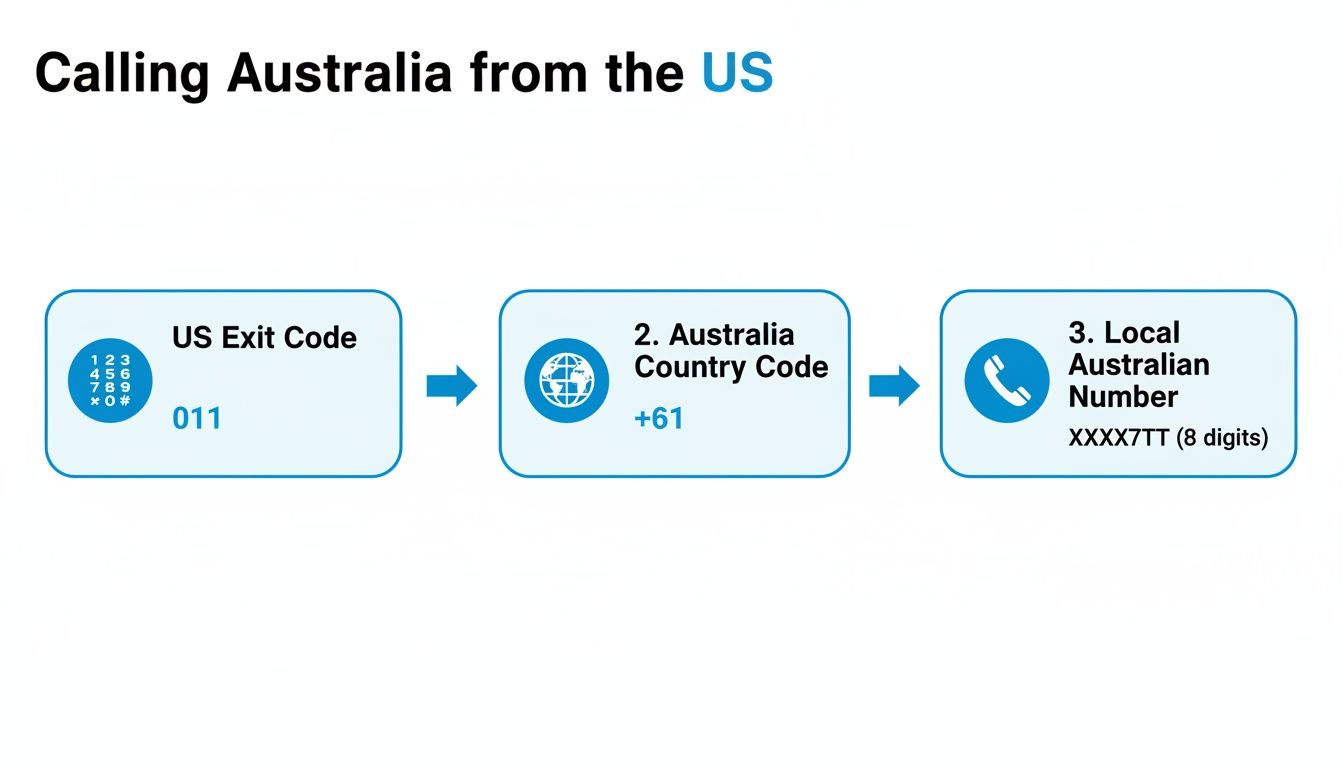
As you can see, every international call from the US starts with an exit code, followed by the country code and then the local number.
Australia Dialing Code Cheat Sheet
To make it even easier, here’s a quick reference table with the codes you'll need.
| Code Type | Code | Purpose |
|---|---|---|
| US Exit Code | 011 |
Signals your call is international. |
| Mobile Shortcut | + |
Replaces the exit code on mobile phones. |
| Australia Country Code | 61 |
Directs the call to the Australian network. |
Using a modern service like VoIP can make this process even simpler, often with better call quality and lower rates. If you're new to the technology, you can learn more by checking out our guide on what VoIP phone service is and how it can benefit you.
Getting the Dialing Sequence Right
Making an international call is all about punching in the right sequence of numbers. Each part of that sequence is a specific instruction that tells your phone network exactly where to send the call—from your phone in the US, across the ocean, and to a specific phone in Australia.
Getting this wrong is the most common reason a call won’t go through. Once you understand the structure, you'll not only connect every time but also know exactly what to fix if you run into trouble.
The US Exit Code: 011
First things first, you need to tell your phone provider that you're calling outside the United States. You do this by dialing the US exit code, which is 011.
Think of it as opening the gate to the international phone network. If you skip this, your phone will assume it's a domestic call and you'll get an error message. This is the starting point for any international call from a US landline or VoIP service.
A Better Way for Mobiles: If you're using a cell phone, there's an easier way. Just press and hold the
0key until the + symbol appears. This little symbol automatically acts as the correct exit code for whatever country you're calling from. It's a great habit to get into for all international dialing.
Australia's Country Code: 61
Right after the exit code, you'll dial 61. This is Australia's unique country code.
This number tells the global network to route your call down under. Every country has one, and dialing 61 makes sure your call ends up in Australia and not, say, Austria (which is 43).
Australian Area Codes and Local Numbers
The last part of the number includes the area code and the local phone number. This is where most people make a critical mistake.
Australian domestic numbers, whether for a landline or a mobile, almost always start with a zero. For example, a Sydney number might be (02) 1234 5678, and a mobile number could be 0412 345 678.
Here’s the golden rule: When you call from outside Australia, you must drop that leading zero.
- For a landline like
(02) 1234 5678, you would actually dial...61 2 1234 5678. - For a mobile like
0412 345 678, you would dial...61 412 345 678.
Forgetting to remove that first zero is, without a doubt, the #1 reason calls from the US to Australia fail to connect.
Putting It All Together: Calling Australia in the Real World
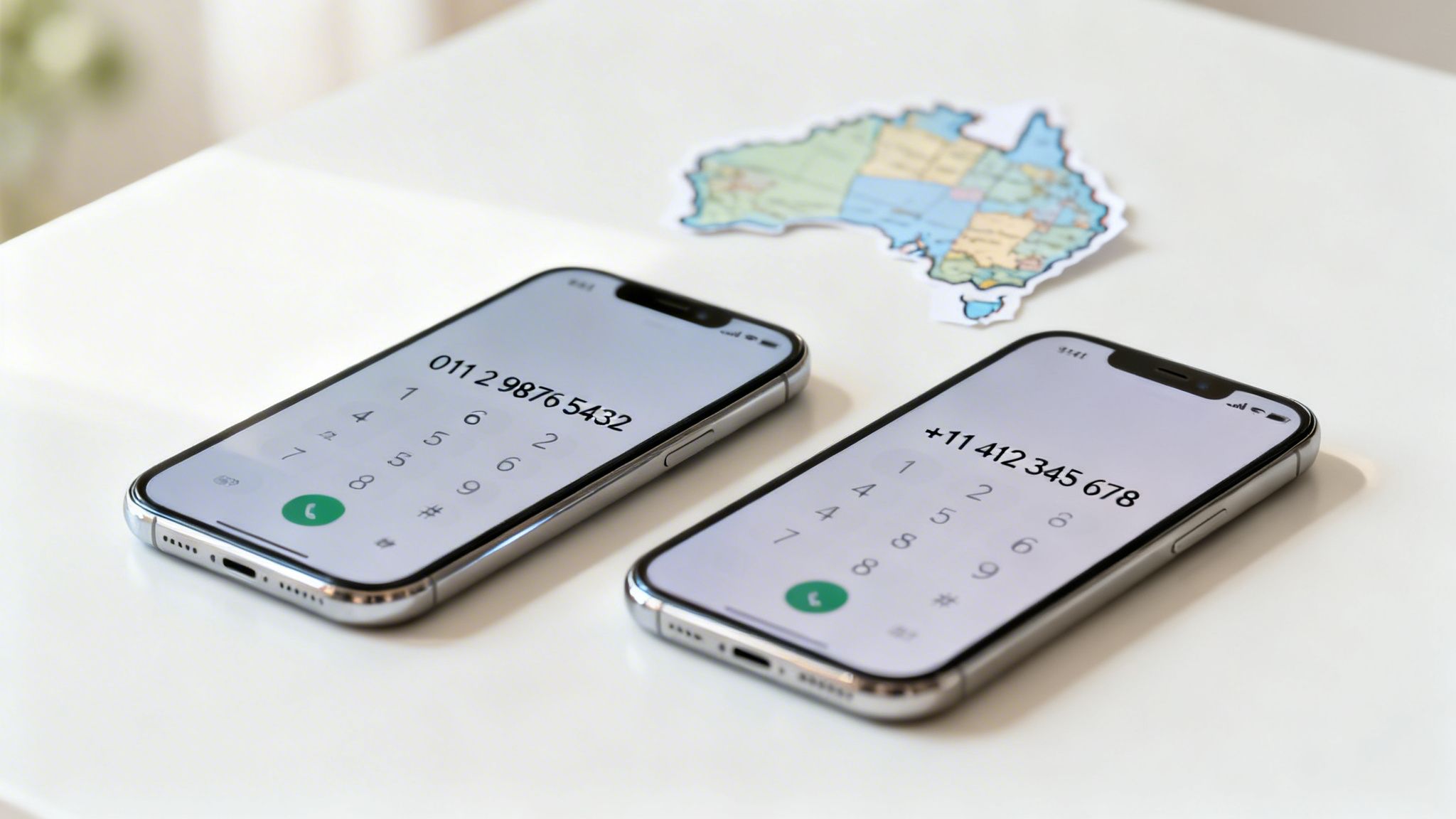
Knowing the codes is one thing, but seeing them in action makes all the difference. Let's walk through a few common scenarios so you know exactly how to dial Australia from the USA, whether you're calling a landline or a mobile.
The full number you punch in will depend on the Australian number you have and whether you're using a landline or a smartphone.
Calling a Sydney Landline
Let's say you're trying to reach a colleague in Sydney. Their number is (02) 9876 5432.
The area code here is 2, which covers New South Wales. The most important thing to remember is to drop the leading 0 when dialing from overseas.
- From a US landline: Dial
011 61 2 9876 5432 - From a US mobile: Dial
+61 2 9876 5432
Both get you there, but the + symbol on your mobile is the universal shorthand that works anywhere. This same logic applies no matter where you're calling—it's the same process if you dial to Mexico or any other country.
Calling an Australian Mobile Number
Now, imagine a friend traveling Down Under gives you their local mobile number: 0412 345 678. Australian mobile numbers almost always start with a 4 right after the country code. Just like with landlines, you'll need to drop that first 0.
- From a US landline: Dial
011 61 412 345 678 - From a US mobile: Dial
+61 412 345 678
The structure is simple and consistent. All you're doing is swapping out the area code and local number.
A Quick Word on VoIP: If you're using a VoIP service, you'll dial just like you would on a landline (
011 61...). The real advantage, though, is in the cost and call quality. A VoIP call made over a solid fiber internet connection is often crystal-clear and costs just a fraction of traditional per-minute rates. It’s a much better choice for frequent calls or long chats.
How to Avoid Expensive International Calling Fees
Making a call to Australia shouldn't break the bank, but if you just dial from your mobile without a second thought, you could be in for a nasty surprise. Traditional cell carriers are notorious for charging shocking per-minute rates that can easily top a dollar. A simple one-hour chat could end up costing you more than a nice dinner out.
For anyone who makes regular calls down under—whether it’s for weekly family catch-ups or daily business check-ins—those costs add up incredibly fast. Thankfully, there’s a much better way.
The VoIP Advantage
The secret to affordable international calls is Voice over IP (VoIP). Instead of relying on old-school phone lines, VoIP routes your call over the internet, which slashes the cost dramatically.
Just look at the numbers. While some mobile carrier rates can hit an astounding $3+ per minute, a VoIP call can cost as little as $0.0268 per minute. That’s a savings of over 99%.
The bottom line is simple: if you plan on talking for more than a few minutes, a standard mobile call is a financially poor choice. For the price of one minute on a traditional plan, you could talk for over 30 minutes using a quality VoIP service.
Making the Switch to Better Calls
Switching to a VoIP provider is a smart move for your wallet and your call quality. All you really need is a stable internet connection. A reliable fiber network is ideal, as it provides the symmetrical upload and download speeds needed for crystal-clear conversations without the frustrating lag or dropped calls you might get on older networks.
This simple switch turns what was once a pricey luxury into an affordable, everyday tool. It’s also worth checking for service bundles. Many providers will give you even better pricing when you combine your VoIP service with your internet plan.
If you’re ready to stop overpaying for international calls, you might be interested in our guide to low-cost VoIP solutions for your home or business.
Practical Tips for a Flawless Calling Experience
Getting the numbers right is just half the battle. The other half? Making sure you aren't calling a business contact in the middle of their dinner or waking up a family member at 3 AM.
A few simple habits can be the difference between a smooth conversation and a frustrating, failed attempt. Let's get into the practical side of things.
Nail the Timing: A Guide to Australian Time Zones
Australia is literally on the other side of the planet, which means the time difference is massive—often a full day ahead of the US. Calling at the wrong time isn't just awkward; it's a surefire way to start things off on the wrong foot.
For example, a call at 5 PM in New York (EST) lands you at a perfect 7 AM the next day in Sydney (AEST). That’s a great slot for a business chat before their day gets too busy.
But if you call at 5 PM from Los Angeles (PST), it's already 10 AM the next day in Sydney. The window can shift quickly depending on where you are.
A good rule of thumb is to aim for your late afternoon or early evening. This almost always lines up with the next morning in Australia's major cities.
To make it even easier, here’s a quick reference table for coordinating calls to Eastern Australia (Sydney/Melbourne/Brisbane) from major US time zones.
Best Times to Call Australia from US Time Zones
| Your US Time Zone (Day) | Corresponding Time in Sydney (AEST) |
|---|---|
| 4 PM to 8 PM Eastern (EST) | 6 AM to 10 AM the next day |
| 3 PM to 7 PM Central (CST) | 6 AM to 10 AM the next day |
| 2 PM to 6 PM Mountain (MST) | 6 AM to 10 AM the next day |
| 1 PM to 5 PM Pacific (PST) | 6 AM to 10 AM the next day |
Remember, Australia has its own daylight saving time changes, so always double-check with a world clock app if the call is critical!
What to Do When Your Call Won't Connect
Hearing an error tone after carefully dialing is beyond frustrating. Don't panic or immediately assume the number is wrong. It's usually a small, fixable mistake.
Before you hit redial, run through this quick checklist:
- Check the Codes: Did you dial 011 from a landline or use the + symbol from your mobile? Is the country code definitely 61?
- Drop the Leading Zero: This is the #1 mistake. An Australian number written as
(02) 1234 5678must be dialed as...61 2 1234 5678. That first zero has to go! - Look for Carrier Blocks: Some phone plans block international calls by default to prevent bill shock. You might need to call your provider and ask them to enable it.
- Confirm Your Balance: If you use a prepaid plan or a calling card, make sure you have enough credit to cover an international rate.
A reliable connection is also crucial for clear, drop-free conversations. If you're a heavy VoIP user, ensuring you have the right bandwidth for VoIP can make all the difference.
Frequently Asked Questions About Calling Australia
Once you have the dialing sequence down, a few other practical questions usually pop up. Getting these details right can save you both time and money. Here are the answers to the questions we hear most often.
What Is the Cheapest Way to Call Australia?
Your cheapest option is almost always going to be a Voice over IP (VoIP) service. While major mobile carriers can charge high per-minute rates, VoIP uses your existing internet connection to make calls for just pennies per minute.
This is a huge cost-saver, especially if you talk often or for long periods. As long as you have a stable internet connection, the call quality is typically excellent.
Do I Still Need to Dial 011 From a Cell Phone?
Nope. On any modern smartphone, you can just use the plus (+) symbol instead of the 011 US exit code. You can find it by pressing and holding the 0 key on your dial pad.
The + symbol automatically acts as the right international exit code, no matter what country you’re calling from.
Using +61 followed by the Australian number (without its first zero) is the modern way to dial. It's a great habit to get into because it simplifies international calls and works anywhere in the world.
How Can I Tell If a Number Is a Mobile or Landline?
You can usually figure it out by looking at the first digit right after the +61 country code.
- Mobile numbers in Australia almost always start with the digit 4. A typical mobile number will look like:
+61 4XX XXX XXX. - Landline numbers use geographic area codes, such as 2 for Sydney or 3 for Melbourne.
If you’re coordinating travel, you might find resources for planning a trip to Australia helpful. But if the number you've been given starts with a 4 after the country code, you can be sure you're calling a mobile phone.
Ready for crystal-clear calls without the high cost? Premier Broadband offers reliable, affordable VoIP phone services for homes and businesses. Make international calling simple and cost-effective.