

At its core, Spectrum VoIP (often called Spectrum Business Voice) is a modern phone service that simply uses your internet connection to make and receive calls, completely replacing the need for traditional landlines. It works by turning your voice into digital data and sending it over the internet—think of it like streaming a video, but for your phone calls.
Unpacking Spectrum VoIP for Your Business
Imagine your business communication system jumping from crackly, old-school AM radio straight to crystal-clear digital audio. That’s the kind of upgrade you get when moving from traditional phone lines to Voice over Internet Protocol (VoIP). Instead of depending on a physical network of copper wires, Spectrum VoIP runs on the high-speed internet connection you already have.
This shift from analog to digital is what opens up a whole world of powerful communication tools. For a deeper dive into the technology, you can learn more about how a VoIP phone works in our detailed guide. For businesses, this means more than just placing calls; it means building a more flexible, efficient, and professional communication hub.
From Basic Calls to a Communication Powerhouse
The real benefit of a Spectrum VoIP system comes from its features, which are built to solve everyday business problems and make operations smoother. It’s not just about getting a dial tone; it’s about creating a smarter way to work.
Here are a few key advantages of making the switch:
- Cost Efficiency: You can often lower your monthly phone bills by getting rid of separate, expensive landline contracts.
- Geographic Flexibility: Your business number isn't stuck to a physical location anymore, making it easy for remote and hybrid teams to stay connected.
- Advanced Features: Get access to professional tools like auto-attendants, call forwarding, and voicemail-to-email without buying pricey hardware.
- Scalability: It's simple to add or remove phone lines as your business grows or during seasonal shifts, without waiting for a technician to install new wiring.
A common myth is that VoIP is complicated. The truth is, modern systems are designed to be incredibly user-friendly. If you can plug in a router, you can set up a VoIP phone, making it a great fit for any small business owner.
The growth of VoIP technology has been incredible. The global market shot up from $86 billion in 2015 to nearly $195 billion by 2024. This boom shows just how many businesses are choosing internet-based calling for its clear advantages.
Exploring Core Features and Business Benefits

When you switch to Spectrum VoIP, you're getting more than just a new way to make phone calls. You're adopting a whole suite of tools built to solve everyday business problems and turn your phone system into a real asset.
Think about your front desk during a lunch rush. Instead of callers hitting a busy signal, an Auto Attendant acts as your digital receptionist. It greets every caller professionally and guides them to the right person or department. It's an instant customer service upgrade that frees up your team.
That’s really just the tip of the iceberg. The whole system is designed to keep your business running smoothly, no matter where you or your team happen to be.
Enhancing Professionalism and Productivity
A ton of the features baked into VoIP are there to make your daily grind easier and help you put your best foot forward with customers. They completely change how your team handles calls and messages.
- Voicemail-to-Email: This is a lifesaver. It converts voicemails into text and shoots them right to your inbox. You can scan a message in the middle of a meeting without missing a beat.
- Call Forwarding: Never let a critical call go to voicemail again. If you step out, calls can be automatically sent to your cell phone, keeping business moving.
- Music on Hold: Don’t leave people sitting in silence. You can play professional music or share updates about your business while they wait, making for a much better experience.
These aren't complicated tools—they just work in the background, letting your team focus on what they do best.
To see what this looks like in practice, here's a quick rundown of some of the most impactful features.
Spectrum VoIP Key Feature Breakdown
| Feature | Description | Primary Business Benefit |
|---|---|---|
| Auto Attendant | A virtual receptionist that greets callers with a custom menu. | Frees up staff and ensures every call is answered and routed correctly, improving customer experience. |
| Voicemail-to-Email | Transcribes voicemails and sends them as text to your email inbox. | Allows for quick review of messages without listening, boosting efficiency for busy team members. |
| Mobile App | Turns any smartphone into a full-featured business phone. | Enables remote work and maintains a professional image by using the business number, not personal lines. |
| Call Forwarding | Automatically redirects incoming calls to another number (like a cell phone). | Guarantees you never miss an important call, even when you're away from your desk. |
These features work together to create a communication hub that’s flexible, professional, and built for the way we work today.
Empowering Remote and Hybrid Teams
With so many businesses embracing flexible work, staying connected on the move is non-negotiable. Spectrum VoIP nails this with a powerful mobile app that essentially puts an office phone in every employee's pocket.
Team members can make and take calls using your official business number, which keeps their personal numbers private and ensures your company looks professional every time.
This shift is huge. The mobile VoIP market is expected to hit an incredible $81.80 billion by 2030, largely because of the boom in remote and hybrid work. You can dig into more of the data on the growth of mobile VoIP communications.
This mobile integration means your team is always connected, whether they're at the office, at home, or on the road. For companies figuring out their next move, comparing different VoIP solutions for small business makes it clear just how vital these mobile-first features have become.
Your Guide to Setup and Technical Requirements
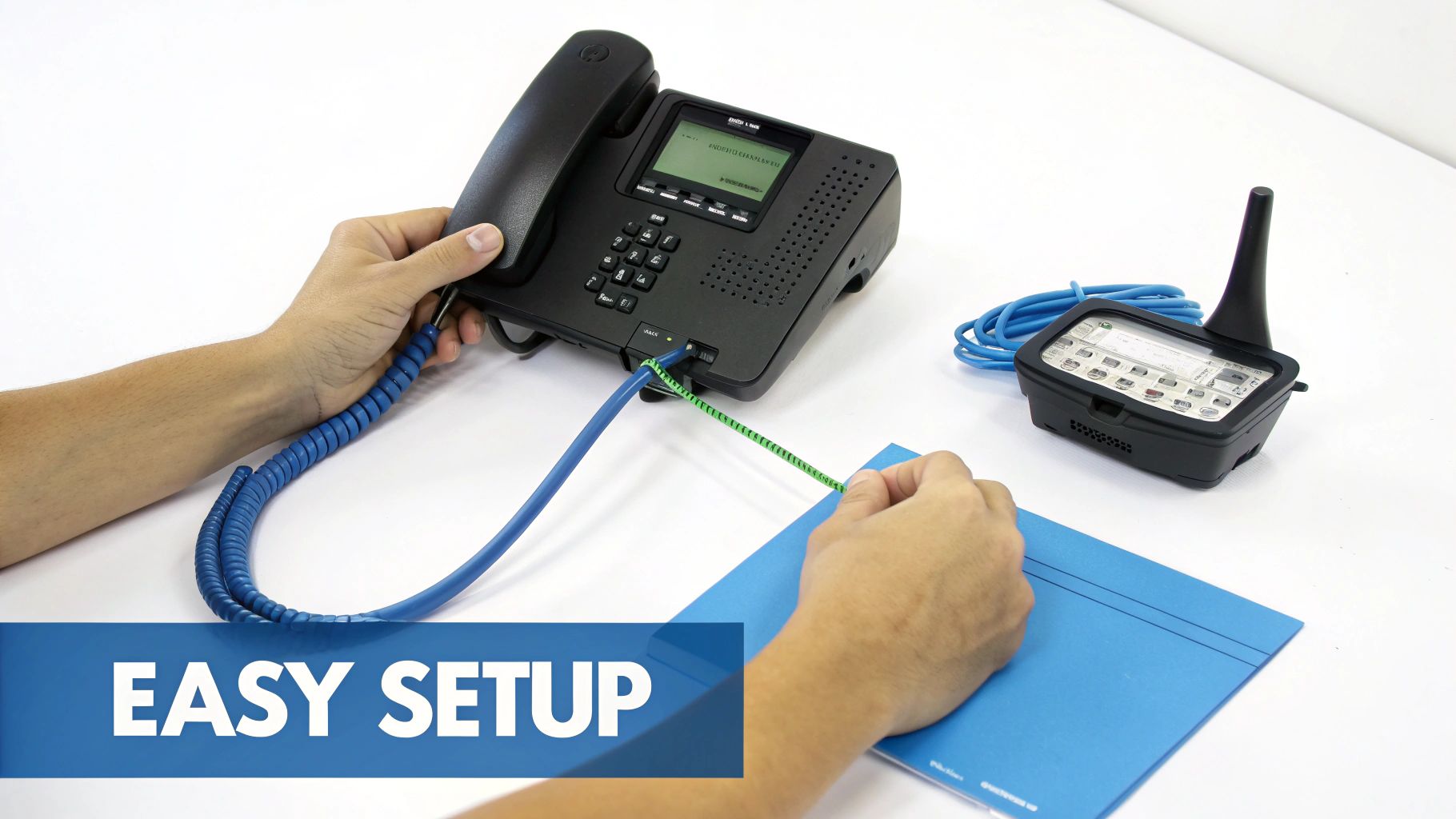
Making the jump to a new phone system might sound like a huge technical hurdle, but getting started with Spectrum VoIP is surprisingly simple. The whole process really just boils down to a few key things, starting with the one absolute must-have: a solid, high-speed internet connection.
Think of your internet connection as the highway for your phone calls. A smooth, clear highway means your calls sound great. If it’s congested or full of potholes, you’ll end up with lag, jitter, or even dropped calls. You need consistent bandwidth for that professional, crystal-clear quality.
The Essential Hardware
Next up is the hardware. For most businesses, this just means getting a few VoIP-compatible phones. Spectrum often includes pre-configured IP desk phones as part of their service package, which really takes the guesswork out of setup.
These phones are built for a true plug-and-play experience. You just hook them up to your internet network with an Ethernet cable, and they automatically set themselves up to work with the service. No complex configurations, no headaches. You can be up and making calls almost right away.
The whole point is to keep it simple. You shouldn't need an on-call IT squad just to get your phones working. In most cases, plugging a new phone into your router is all it takes to bring a new line to life.
Keeping Your Business Number
Worried about losing the phone number your customers already know? Don't be. Bringing your number over to Spectrum VoIP is a routine process called number porting.
This lets you transfer your existing number from your old provider to your new VoIP service, so there's no disruption for your business. Your customers can keep calling the same number they've always used, and they'll never even know you switched systems. Spectrum’s team handles the porting process and will walk you through it. Just remember one crucial tip: never cancel your old service until you get confirmation that the port is 100% complete.
Configuring Your Network
While setup is usually a breeze, some internet routers have settings that can mess with VoIP calls. A common culprit is a feature called Session Initiation Protocol Application Layer Gateway, or SIP ALG. It’s meant to help, but it can often end up garbling or dropping calls without warning. If you want to dive into the nerdy details, you can learn more about what SIP ALG is and why it affects VoIP.
The good news is that you don't have to figure this out alone. Spectrum’s support team is there to help you track down and fix these kinds of network issues, making sure your calls always come through loud and clear.
An Honest Look at the Pros and Cons
Like any business tool, Spectrum VoIP isn't a perfect fit for everyone. It’s important to get a clear, balanced picture of where it shines and where you might run into limitations. Let’s break down the real-world trade-offs to see if it makes sense for you.
For most businesses, the biggest draw is the potential to save a lot of money. When you stop paying for traditional landlines and run calls over the internet you’re already using, your monthly phone bill can drop significantly. It also makes budgeting a whole lot easier with predictable, flat-rate monthly costs instead of confusing, surprise charges.
Another huge win is how easy it is to grow. Need a new phone line for a new team member? Just plug in a new device. There’s no waiting around for a technician or paying for expensive new wiring to be installed. This kind of flexibility is a game-changer for businesses that deal with seasonal rushes or are in a growth spurt.
The Upsides of Spectrum VoIP
Here’s a quick rundown of the main benefits:
- Significant Cost Reduction: Say goodbye to the high costs that come with old-school copper landlines.
- Predictable Billing: A flat monthly fee keeps your communication budget simple and straightforward.
- Effortless Scalability: Add or remove lines whenever you need to, without waiting for physical installations.
- Feature-Rich Communication: Get access to professional tools like auto-attendants and call forwarding—features that used to be only for big corporations.
Potential Downsides and Considerations
Now for the other side of the coin. It's critical to know that the whole system lives and dies by your internet connection. If your internet goes out, so does your phone service. While features like forwarding calls to a cell phone can help, a full outage at your main office can still bring things to a halt.
In the same way, your call quality completely depends on how healthy your network is. A slow or overloaded internet connection will lead to choppy audio, weird delays, or dropped calls. This means having a strong, fast internet plan isn't just a suggestion—it's a must-have for a good experience.
One of the most important things to know is that Spectrum VoIP is often bundled exclusively with Spectrum Business Internet. If you are happy with your current internet provider and don’t want to switch, this service may not be an option for you.
This "all-or-nothing" approach can be a deal-breaker for some businesses, but for others, it's a convenient way to get one simple bill. The global VoIP market is growing fast—projected to hit $413.36 billion by 2032—because the benefits are real, but these kinds of dependencies are a crucial part of the decision. You can learn more about VoIP's impressive market growth and what's driving it.
How Spectrum VoIP Compares to Top Alternatives
Picking a VoIP provider is about more than just a list of features. It’s about finding the right communication partner for your business. When you put Spectrum VoIP up against other big names like RingCentral or specialists like Premier Broadband, you start to see some major differences right away.
Spectrum's biggest selling point is its all-in-one bundle. It’s built from the ground up to work seamlessly for existing Spectrum Business Internet customers. This means one bill, one point of contact for support, and no headaches trying to manage different services. For a small business owner, that simplicity is a huge plus.
But that bundled approach is also where you find its main drawback. If you're happy with your current internet provider and don't want to switch, Spectrum VoIP simply isn't an option. Standalone providers give you the freedom to mix and match, pairing their phone service with any internet connection you like.
Comparing Key Decision Factors
When it's time to choose, most businesses zero in on a few crucial things: the pricing, how well it connects with other software you use, and how flexible the contract is.
This flowchart gives you a quick way to see if Spectrum’s core requirement—a Spectrum internet connection—is the right fit for you.
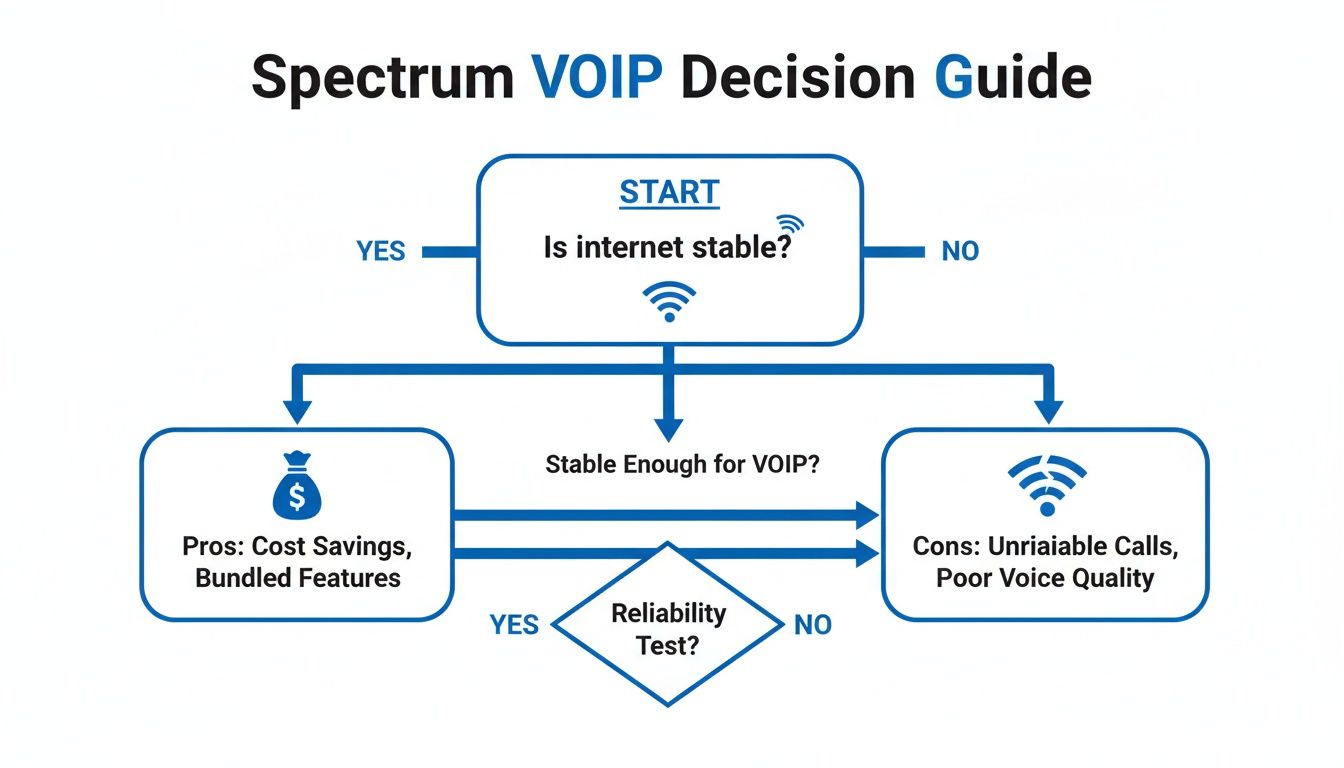
As you can see, a stable internet connection can lead to real savings, but if your connection is shaky, your call quality will suffer right along with it.
To help you see the bigger picture, we've put together a head-to-head comparison of Spectrum VoIP against other leading business VoIP providers. This table breaks down the crucial factors you need to consider.
Spectrum VoIP vs Top Competitors
| Feature/Aspect | Spectrum VoIP | Alternative (e.g., Premier Broadband) | Alternative (e.g., RingCentral) |
|---|---|---|---|
| Pricing Model | Bundled, flat-rate plan tied to internet service. | Flexible per-user, per-month plans; often bundled with fiber internet. | Tiered per-user, per-month pricing that scales with features. |
| Integrations | Limited to basic connections; not a primary feature. | Focused on core business communication tools and reliability. | Huge app marketplace with hundreds of CRM and productivity integrations. |
| Contract Flexibility | Usually requires a contract tied to your Spectrum internet service. | Often offers no-contract or flexible month-to-month options. | Offers both monthly plans and annual contracts for a discount. |
| Ideal User | Small businesses already using or switching to Spectrum internet. | Businesses of any size seeking reliable, specialized voice service with fiber internet. | Companies needing deep software integration and advanced features. |
This comparison makes it clear that while Spectrum offers an easy-to-manage package, other providers focus on giving you more control and advanced capabilities.
Where Alternatives Might Shine Brighter
If your business lives inside specific software—like a CRM or a project management tool—then providers like RingCentral often make more sense. Their deep integration libraries let your phone system "talk" to the other critical apps you use every day. This means you can automate tasks, log calls instantly, and get a much richer view of your customer interactions.
Ultimately, the choice comes down to what you value most: simplicity or customization. Spectrum delivers a straightforward, all-in-one package that just works. Alternatives give you a powerful toolkit that you can shape to fit your exact workflow.
On top of that, providers who specialize only in voice—a key factor when looking for the best internet telephone service—often pack in more advanced call routing, analytics, and contact center features. These are built for businesses handling a high volume of calls and can give you incredible insight into your team's performance.
So, what’s the right call? If you want a dependable, cost-effective phone service from the same company that handles your internet, Spectrum VoIP is a solid choice. But if you need powerful integrations, standalone flexibility, and enterprise-level tools, it's worth exploring the wider world of specialized VoIP providers.
Answering Your Top Questions About Spectrum VoIP
Thinking about switching to Spectrum VoIP? You've probably got a few last questions on your mind. That's completely normal. Making sure you understand all the details helps you pick the right service with confidence. We’ve pulled together the most common questions we hear from business owners and laid out the answers, plain and simple.
Let's clear up those final points, from keeping your business number to what happens if the internet goes out, so you know exactly what to expect.
Can I Keep My Current Business Phone Number?
Yes, you absolutely can. This is a big one for most people, and the answer is a definite yes. The whole process is called number porting, and it's a standard part of switching to just about any VoIP provider, including Spectrum.
When you sign up, their team will walk you through transferring your number from your old provider. The most important thing to remember is this: do not cancel your old phone service until the port is completely finished. This makes sure you don't lose your number or miss any calls while you switch over.
What Is the Backup Plan If My Internet Fails?
It's a smart question. Since VoIP runs over your internet, your desk phones will stop working if your office connection drops. But the system is designed with this in mind and has backups to keep you in business.
You can set up calls to automatically forward to another number, like a cell phone or a backup landline. This way, even if your office is offline, you won't miss a call from a client.
The service's mobile app is another great backup. As long as your employees have a cell signal (like 4G or 5G), they can keep making and taking business calls on their smartphones, completely bypassing the internet outage at the office.
Do I Have to Buy Special Phones?
Most of the time, no. Spectrum usually includes pre-configured, VoIP-ready IP phones as part of their business packages.
These phones are plug-and-play. You just connect them to your internet, and they're ready to go. This makes setup a breeze and guarantees the phones work perfectly with all the system's features. While you can sometimes use older analog phones with a special adapter (an ATA), sticking with the phones Spectrum provides is the easiest way to get the best call quality and avoid compatibility headaches.
Is This a Good Solution for Remote Teams?
Spectrum VoIP is a great fit for businesses with remote or hybrid teams. The mobile app is what really makes it work so well.
The app turns any smartphone into a full-fledged business phone. Your team can make and take calls using their personal cell phones, but the customer will always see your main business number. It keeps things professional and protects your employees' privacy.
A few other features really help a scattered team stay connected:
- Voicemail-to-Email: Get voicemails transcribed and sent to your email, so you can read messages on the go.
- Easy Call Routing: Seamlessly transfer calls between team members, no matter where they’re working.
- Unified Presence: See who's available, on a call, or away from their desk to make teamwork smoother.
The only thing you need is a solid, high-speed internet connection for each remote employee to keep calls sounding crisp and professional.
Ready to modernize your business communications with a reliable, crystal-clear connection? Premier Broadband offers scalable Hosted VoIP solutions built on a 100% fiber network, ensuring your business stays connected with unparalleled quality and reliability. https://premierbroadband.com