

When you think of a business phone, what comes to mind? For many, it's a clunky desk phone tied to a wall jack. But the role of a Texas phone system provider has completely changed. They’re no longer just the phone company—they're the partners that keep your entire business connected through integrated voice, internet, and security.
What a Modern Texas Phone System Provider Really Does

Think about how you use your personal phone. A decade ago, a simple flip phone for making calls was enough. Today, your smartphone is a powerhouse for video calls, messaging, and managing your day. The same shift has happened for business communications.
Trying to run a modern company on an old landline system is like using that flip phone today. It technically works, but you're missing out on the speed, features, and flexibility needed to keep up. A modern Texas phone system provider gives your business the equivalent of a smartphone upgrade.
From Utility Company to Strategic Partner
The days of just paying a bill for a dial tone are over. Today’s providers are strategic partners, delivering a complete communications toolkit designed to help you compete in the fast-paced Texas market.
What does that look like in practice?
- VoIP (Voice over Internet Protocol): This is the heart of a modern phone system. It runs over your internet connection, delivering crystal-clear calls packed with advanced features.
- High-Speed Fiber Internet: VoIP is only as good as the internet it runs on. A fast, reliable fiber connection is the non-negotiable foundation for perfect calls and video meetings.
- Managed Security: Protecting your network and conversations from online threats is more important than ever. A good provider bakes security right into their service.
The table below shows just how much things have changed. What was once a simple utility has become a comprehensive service that supports your entire operation.
Traditional vs Modern Phone System Provider Services
| Service Area | Traditional Provider Focus | Modern Provider Focus (e.g., Premier Broadband) |
|---|---|---|
| Primary Service | Providing a dial tone and phone number over copper lines. | Integrated VoIP, high-speed fiber internet, and security. |
| Infrastructure | Relies on aging copper wire networks. | Owns and operates a modern, 100% fiber network. |
| Features | Basic calling, voicemail, and caller ID. | Auto-attendants, call recording, mobile apps, and cloud faxing. |
| Reliability | Susceptible to weather, physical damage, and signal degradation. | High uptime (99.9%), symmetrical speeds, and consistent quality. |
| Support | Often siloed; phone and internet are separate issues. | One point of contact for all connectivity and communication needs. |
As you can see, a modern provider like Premier Broadband isn't just selling you a phone line; we're providing the core infrastructure your business runs on.
Built on a Future-Proof Foundation
This is where the network itself makes all the difference. A provider that owns and operates its own infrastructure has a huge advantage. At Premier Broadband, our services—including our powerful modern business phone systems—are built on a 100% fiber network.
This investment matters. It ensures the connection that powers your phone calls is stable, incredibly fast, and secure.
Unlike providers who just rent space on older copper or cable lines, a fiber-first company delivers a system designed for today's business demands. That means no more dropped calls with clients or choppy video conferences with your team.
Choosing an all-in-one provider built on a superior network isn't just about buying a phone service. It's an investment in a reliable communications hub that will grow right alongside your business. That’s what it means to partner with a true Texas phone system provider in 2026 and beyond.
Understanding the Texas Telecommunications Landscape
If you're looking for the right Texas phone system provider, you first have to get a feel for the market itself. The Lone Star State isn't just massive—its economy is a genuine powerhouse, fueled by incredible growth and a business-friendly spirit that jumps on new technology. That makes for a very competitive, and sometimes confusing, telecom scene.
The market is really a tale of two different kinds of companies: the huge national corporations and the smaller, more agile providers who are deeply rooted in the communities they serve. Knowing the difference is the first step to making a smart decision for your business communications.
The Titans and the Trailblazers
On one side, you have the industry giants. These are the household names you see on TV, with national networks and massive resources. Their sheer size means they can offer a ton of different services, but that scale can sometimes come at the expense of personal, hands-on support.
Then you’ve got the trailblazers—the local and regional providers focused on serving specific Texas communities. These companies often compete by rolling up their sleeves and offering better, community-based customer service and phone systems built for the real-world needs of Texas businesses. Our guide on choosing DFW VoIP phone service providers takes a closer look at this local dynamic. This is exactly where companies like Premier Broadband fit in, investing directly in local fiber infrastructure to give our neighbors a better connection.
A Market of Extremes
The scale of the Texas market is just staggering. As of March 2026, AT&T is the undisputed leader among Texas phone system providers, bringing in a massive $124.5 billion in revenue. Headquartered right in Dallas, their revenue absolutely dwarfs the next closest competitors, Crown Castle ($6.4 billion) and Frontier ($6.1 billion).
That kind of financial muscle shows the power of the big national players. But it also carves out a huge opportunity for providers who focus on doing one thing exceptionally well: serving their local communities.
The most important thing to remember is that the biggest revenue number doesn't automatically mean the best fit for your business. A national giant might serve millions, but a local provider will know your area and can offer responsive, Texas-based support when you need it most.
What This Means for Your Business
Navigating this market means looking past the slick marketing of the big guys. The question isn't "who's the biggest provider?" It's "who is the best provider for me?"
As you evaluate your options, keep these Texas-specific factors in mind:
- Infrastructure Investment: Is the provider just reselling someone else's old network, or are they like Premier Broadband, actively building new, high-speed fiber in your community? A provider's local investment has a direct impact on your service quality.
- Customer Support: When something goes wrong, are you calling a support center thousands of miles away, or are you talking to a local Texas team that actually understands your area? Local support gets issues fixed faster. Period.
- Service Flexibility: Can the provider build a solution that actually fits your business, or are you stuck with a one-size-fits-all plan designed for a national audience?
Choosing a Texas phone system provider is really about finding a true partner. It’s about picking a company whose network, support, and business model are all geared toward helping you grow and succeed right here in this dynamic state.
Choosing Your System: VoIP vs. Traditional Landlines

When it comes to your business's communication, you're at a fork in the road. You can stick with traditional landlines or move to a modern Voice over Internet Protocol (VoIP) system. Making the right call here is the first step toward finding the perfect Texas phone system provider.
Think of a traditional landline as an old railroad. It’s a single track of copper wire built for one job and one job only: carrying a voice signal from point A to point B. The system is decades old, rigid, and can’t do much else.
Now, picture VoIP as a brand new, multi-lane superhighway. It uses the internet connection you already have to carry everything at once—voice, video, and all your data. This simple shift completely redefines what a phone system can do for your business.
How VoIP Transforms Your Business Calls
So how does it work? VoIP takes your voice, converts it into digital data, and sends it over the internet just like an email. This process unlocks a world of flexibility and features that old-school landlines could never offer.
Because it’s software-based, a VoIP system isn't chained to a specific desk phone or physical office. That freedom is a game-changer for any Texas business with remote staff, multiple locations, or employees who need to stay connected on the move.
The big idea behind VoIP is simple: use a single, powerful internet connection for all your communications. This streamlines your entire setup and cuts costs by getting rid of the need for expensive, separate phone lines for every single employee.
For instance, an office with 10 employees on a traditional system would need 10 separate, costly phone lines. With VoIP, all 10 employees can make calls at the same time over just one robust business internet connection, putting money right back in your pocket.
The Features That Power Modern Business
The real power of VoIP comes from the features that are built right in. These aren't just small perks; they're tools that boost productivity, elevate your customer service, and give your business the professional edge of a large corporation.
Here are a few of the game-changing features you can expect from a quality VoIP provider:
- Auto-Attendant: This is your 24/7 automated receptionist. It greets every caller professionally and routes them to the right person or department—"Press 1 for Sales, Press 2 for Support."
- Voicemail-to-Email: Get voicemails sent as audio files directly to your email. You can listen from anywhere, save important messages, and forward them to your team for quick follow-up.
- Mobile App Integration: Turn any smartphone into a full-featured office phone. Make and take calls from your business number, so you always look professional, no matter where you are.
- Cloud-Based Management: Forget calling a technician for every little change. With a simple online portal, you can add users, set up call forwarding, and check call logs in minutes.
These tools empower your team to work smarter, not harder. To see a full cost comparison, check out our guide on how hosted VoIP saves small businesses more money.
The Premier Broadband Difference
A VoIP system is only as good as the internet it runs on. This is where a top-tier Texas phone system provider like Premier Broadband really shines. We deliver our crystal-clear VoIP service over our 100% fiber-optic backbone.
That fiber foundation is your guarantee for the high speeds and low latency needed for flawless, jitter-free calls. While others might offer VoIP over old cable or DSL lines, our fiber network ensures your business communications are always reliable, secure, and professional.
Why a Fiber Network Is the Foundation for Great VoIP
Your VoIP system is only as good as the internet connection running it. That’s the hard truth. For any business that depends on clear, reliable communication, the difference between old-school cable and a true fiber network is night and day. A top-tier Texas phone system provider knows great service isn't just about the phones themselves—it starts with the network.
Think of it like the plumbing in your building. An old cable or DSL connection is a narrow, shared pipe. When everyone else on the block turns on their faucets, your water pressure drops to a trickle. That’s exactly what happens to your data—your calls, video meetings, and file transfers—when it’s forced to compete for space, leading to frustrating slowdowns.
A 100% fiber network is completely different. It's your own private, massive water main connected directly to your business. You get a powerful, consistent flow of data that isn't choked by your neighbors' activity. This is the real secret to clear and dependable business communications.
Symmetrical Speeds: The Key to Modern Work
One of the biggest game-changers with fiber is symmetrical speed. This simply means your upload speed is just as fast as your download speed. Cable and DSL connections are notoriously asymmetrical, giving you decent download speeds but painfully slow uploads.
Why is that a problem for your phone system?
- Flawless Voice Calls: Every time you speak into the phone on a VoIP call, you are uploading data. Slow uploads lead to choppy, robotic-sounding audio, which makes your business sound unprofessional.
- Crystal-Clear Video Conferences: High-definition video meetings upload massive amounts of data in real time. Fiber’s lightning-fast upload speeds keep your video stream smooth and sharp, not frozen or pixelated.
- Rapid File Sharing: Sending large project files, proposals, or cloud backups depends entirely on your upload bandwidth. Symmetrical speeds make this happen instantly, not in a half-hour.
With a symmetrical fiber connection, your team can host a major video conference, make sales calls, and upload huge project files all at the same time, without a single hiccup in quality.
Imagine trying to have a serious business conversation while someone is shouting over you. That's what it’s like for your VoIP system on a slow upload connection. Symmetrical fiber gives every conversation a quiet, private room to be heard clearly.
Eliminating Latency for Real-Time Communication
Beyond raw speed, fiber also delivers ultra-low latency. Latency is just the technical term for lag or delay—the time it takes for a piece of data to travel from your office to its destination and back. High latency is the culprit behind those awkward conversational pauses, echoes, and dropped calls that drive everyone crazy.
Cable networks, because of their shared lines and older technology, are prone to high and unpredictable latency. Fiber-optic cables transmit data literally at the speed of light, which all but eliminates that delay. For any business that relies on real-time communication (and what business doesn't?), low latency is non-negotiable.
Choosing a provider like Premier Broadband, which has invested in building its own fiber infrastructure, is a strategic move for your business. You aren't just getting a phone system; you're building your entire communications strategy on a rock-solid foundation of speed and reliability.
By understanding these core advantages, it’s easy to see why fiber is the only serious choice for a modern business. You can dive deeper into this topic in our guide detailing the benefits of fiber-optic internet. This ensures every call, every meeting, and every customer interaction is as dependable as you are.
How to Evaluate and Choose Your Texas Provider
Picking the right Texas phone system provider is a big deal for your business. You’re not just buying a phone service; you're choosing a partner to handle one of your most critical assets—your connection to your customers. With a mix of national giants and local Texas specialists all vying for your business, you need a smart way to cut through the marketing noise.
The process has a lot in common with other major business decisions, like choosing a digital marketing agency. It all comes down to digging into the details: features, reliability, and the quality of the support you’ll get when things go wrong.
To get started, this simple decision guide can point you toward the right kind of network for your business.
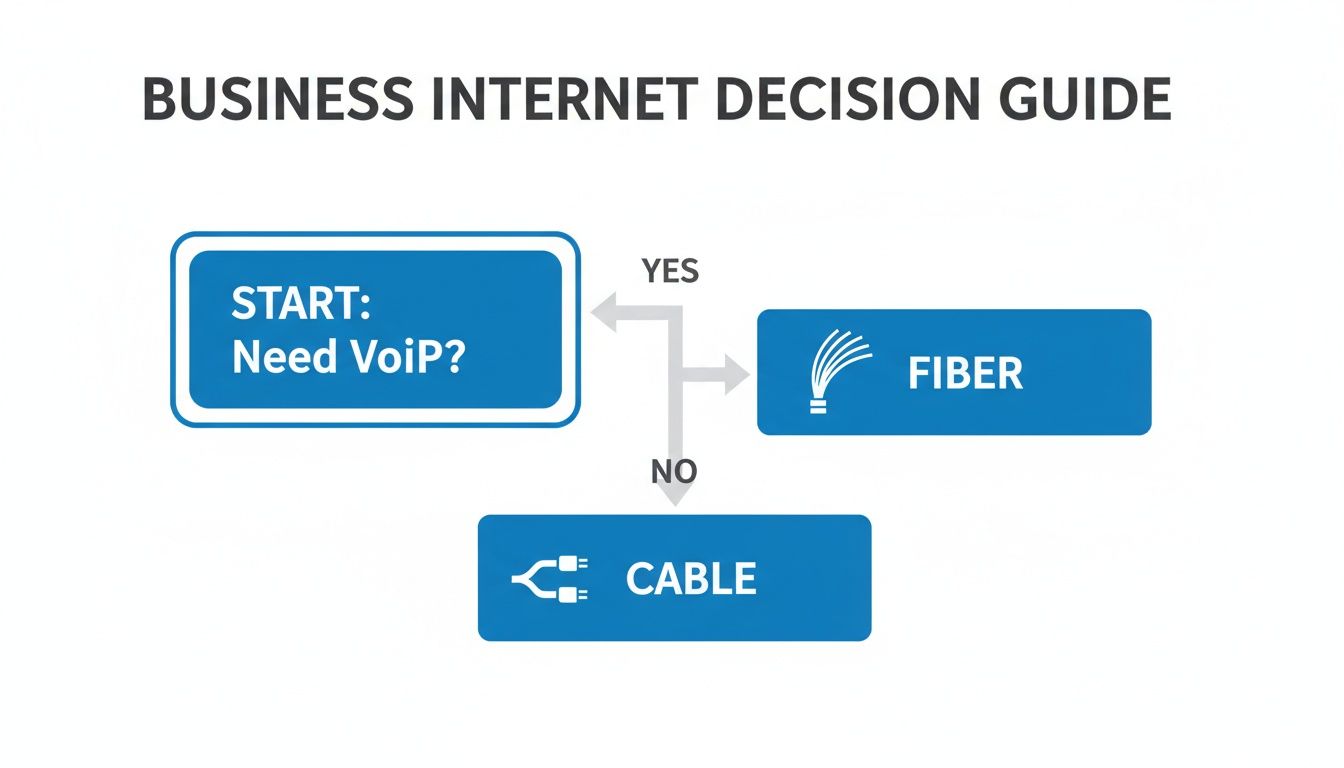
The flowchart lays it out clearly: if your business depends on modern VoIP for communications, a fiber internet connection isn't just a nice-to-have, it's the foundation for great performance.
Analyze the Feature Set
First, think beyond just making and taking calls. A modern phone system should be packed with tools that actually help you run your business better. Don’t just ask for a list of features—ask how they solve everyday problems.
Here are a few key features to look for:
- Auto-Attendant: Can the system professionally greet and route callers 24/7? A good one makes you sound like a major enterprise, even if you’re a small shop.
- Mobile & Desktop Apps: Can your team use their business line from anywhere, on any device? For hybrid or remote teams, this is non-negotiable.
- Call Analytics: Can you see data on call volume, wait times, and missed calls? This information is gold for making smart staffing decisions and improving customer service.
A provider like Premier Broadband builds these tools right into the service, because we know they aren’t "extras"—they're essential for staying competitive.
Scrutinize Network Reliability and Support
Your fancy phone system is completely useless if the network it runs on keeps dropping. This is where you have to get serious and ask the tough questions. A provider’s Service Level Agreement (SLA) is your starting point, as it’s a written promise for a certain level of uptime.
But the most important question you can ask is about what happens when things break: "When I have a problem, who am I calling?" A provider with local, Texas-based support is going to solve your issue worlds faster than one that routes you to a call center overseas.
You should also ask about their actual network. Are you getting 100% fiber, or are they just reselling an old cable or DSL line? Fiber's built-in stability is your best defense against the choppy audio and dropped calls that drive customers crazy.
Evaluate Security and Pricing Models
In a world full of digital threats, security can't be an afterthought. Ask potential providers what specific steps they take to lock down your voice data and your network.
You want to see a layered approach, not just a basic firewall. For example, Premier Broadband offers Managed Network Edge services to act as a digital gatekeeper for your whole network, plus our Premier Protection Plan to cover the physical equipment. It’s about creating a secure bubble for all your communications.
Finally, look closely at the price tag. Be skeptical of deals that seem too good to be true. Many providers will hook you with a low price, then slam you with hidden fees for taxes, support, and features you thought were included. A trustworthy Texas phone system provider gives you clear, all-in-one pricing you can actually budget for.
To help you compare your options, use this checklist to make sure you're asking the right questions and looking for the right answers.
| Provider Evaluation Checklist |
| :— | :— | :— |
| Evaluation Criterion | Key Questions to Ask | What to Look For (The Ideal) |
| Feature Set | Do you offer an auto-attendant, mobile apps, and call analytics? | A full suite of modern tools included as standard, not as expensive add-ons. |
| Network Reliability | What is your guaranteed uptime (SLA)? Is this a 100% fiber network? | A strong SLA (99.9%+) and a true fiber-optic infrastructure for top performance. |
| Customer Support | Is your support team based locally in Texas? What are your support hours? | 24/7, in-house, local support from experts who know the area and the network. |
| Security | What security measures are included to protect my data and network? | Proactive security solutions like managed firewalls and equipment protection plans. |
| Pricing | Is your pricing all-inclusive, or are there hidden fees? | Transparent, flat-rate pricing with no surprises on your monthly bill. |
| Scalability | How easily can I add or remove phone lines and features as my business changes? | A flexible system that lets you scale up or down without hassle or high costs. |
By systematically going through these points, you can move past the sales pitches and find a true partner that will support your business's growth for years to come.
Building Your All-In-One Business Communication Hub
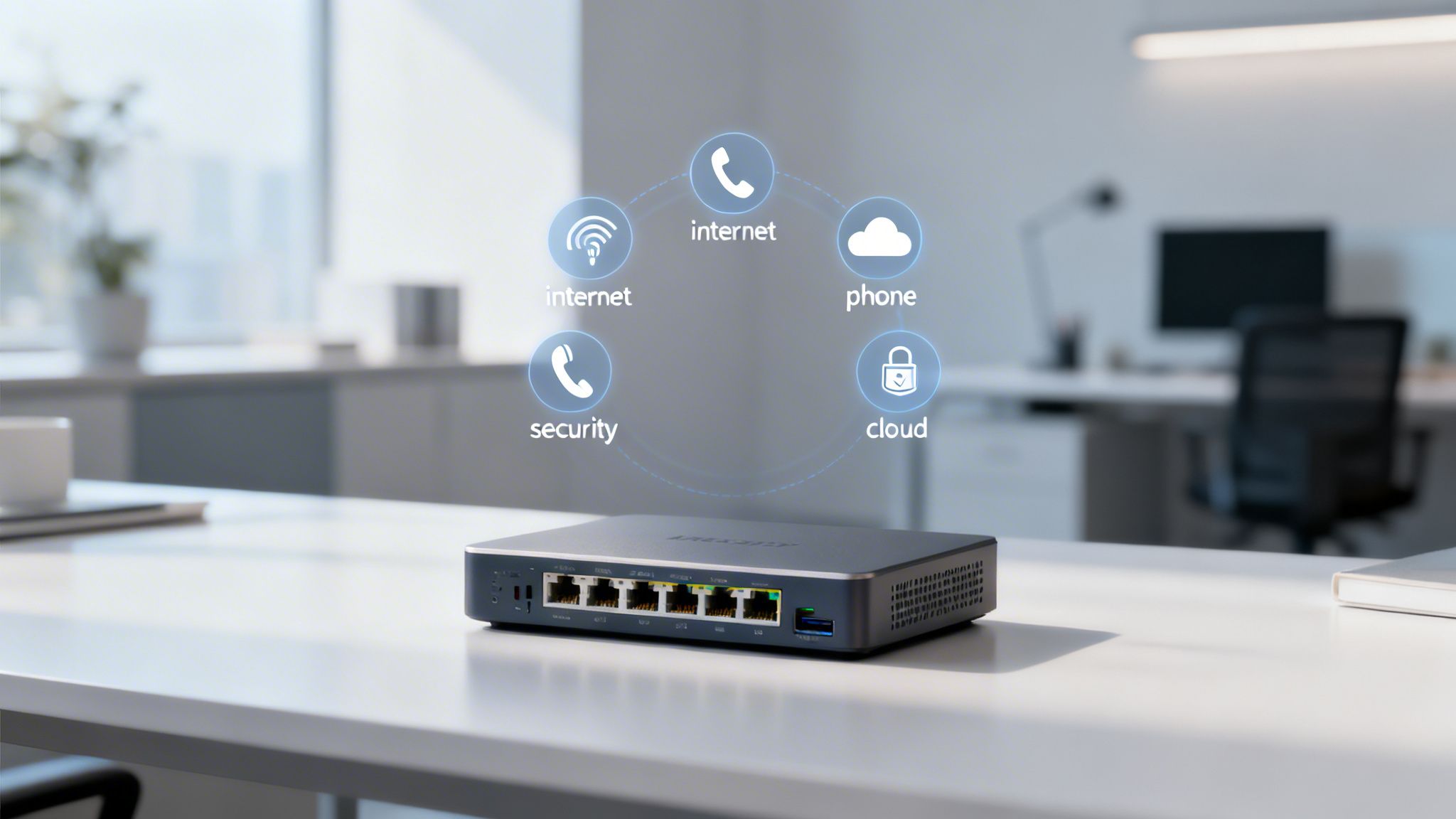
Getting a new phone system is a great start, but the real advantage comes when you stop juggling separate vendors for your internet, phones, and security. Smart businesses are simplifying their operations by partnering with a single provider who can deliver it all in one seamless package.
Imagine one simple bill, one number to call for support, and a whole suite of services built to work together perfectly. When your internet, VoIP, and security come from the same trusted Texas provider, you get rid of compatibility headaches and the frustrating blame game between different companies.
The Premier Broadband Ecosystem
This is exactly the unified strategy we’ve built at Premier Broadband. By bundling our essential services, we create a complete communication and security hub designed specifically for Texas businesses. It’s an ecosystem where every part makes the others stronger.
Our integrated model gives you:
- High-Speed Fiber Internet: The rock-solid foundation. This provides the raw speed and stability needed for every other service to run without a hitch.
- Enterprise-Grade VoIP: Crystal-clear voice service packed with business features, running flawlessly over our fiber network.
- Managed Network Edge: Our all-in-one security and network management solution that protects your entire operation from a single, powerful device.
When you combine these, you aren’t just buying disconnected services. You’re investing in a secure, easy-to-manage platform that can grow with you. That’s the real benefit of working with a true Texas phone system provider that offers a complete solution.
Demystifying the Managed Network Edge
One of the most powerful parts of this modern setup is the Managed Network Edge. Think of it as your business’s dedicated digital gatekeeper.
It’s a physical device that sits between your internal network and the outside internet, giving you robust security and simplified management. Instead of trying to patch together a separate firewall, router, and other gear, a Managed Network Edge solution does it all. It actively scans for threats, manages your internet traffic to prioritize critical tasks like VoIP calls, and makes it simple to add new users or locations.
Your business needs a partner, not just another utility. The right provider acts as a strategic ally, proactively securing and streamlining your operations so you can focus on what you do best—running your business.
This streamlined approach is tapping into the growing strength of our state's connectivity. The Wired Telecommunications Carriers industry in Texas, which is home to key phone system providers, is projected to hit a market size of $7.4 billion in 2026. This growth is fueled by businesses demanding reliable internet and VoIP—precisely what integrated solutions from providers like Premier Broadband deliver. You can read more about the growth of this vital Texas industry.
Ultimately, building an all-in-one communication hub is about future-proofing your business. It means creating an environment where your technology works for you, not the other way around. By choosing a single, dedicated partner, you get the simplicity, security, and scalability you need to thrive.
Frequently Asked Questions
Got a question about business phone systems? We've got the answers. As a Texas phone system provider, we hear the same questions from business owners all the time. Here are our straightforward answers to help you make the right call.
Is a VoIP Phone System Really Cheaper Than a Traditional Landline?
Absolutely. For almost every business, VoIP is a lot easier on the budget. It works over the internet connection you already pay for, so you can ditch the extra cost of separate, old-school phone lines and the clunky hardware that comes with them.
You’ll also get a ton of features—like an auto attendant and mobile apps—that used to cost a fortune, now included in one simple monthly bill. It’s just a smarter way to spend your money compared to a traditional landline.
Think about it this way: instead of paying for ten different phone lines, your whole team can make calls over a single fiber internet connection. That switch alone adds up to huge monthly savings while giving you better technology.
What Happens to My Phone Service if the Internet Goes Out?
That's a great question, and it's something we’ve planned for. If your main internet connection ever goes down, a good VoIP system is designed to keep you in business. Our system, for instance, can instantly forward all your calls to a cell phone or another backup number.
This means you never have to worry about missing a customer's call. Plus, when you choose a provider with a 100% fiber network, the chances of an outage happening in the first place are incredibly low. Fiber is just that much more reliable.
How Hard Is It to Switch My Business to a New VoIP System?
It’s surprisingly simple when you have the right partner. A good provider handles everything for you. We manage the whole process, including "porting" your current business numbers over so you don't have to change a thing.
We’ll get your new system set up and make sure your team knows how to use it. Since modern systems are cloud-based, there's very little hardware to install, making the switch fast and smooth with no downtime for your business.
Ready to upgrade your business communications with a partner that puts you first? Premier Broadband delivers crystal-clear VoIP and ultra-reliable fiber internet built for Texas businesses. Explore our business solutions today.