
Here’s what happens when your tech is a jumbled mess: you have one company for your internet, another for your phone system, and maybe a third handling your network security. You're stuck juggling multiple bills, remembering different account numbers, and trying to figure out who to call when things go wrong. It's inefficient and honestly, a huge headache.
What Are Unified Solutions and Why Do They Matter?
Think of it like trying to drive a car with a separate steering wheel for each tire. It would be pure chaos. That's what managing tech feels like with a fragmented setup.
Unified solutions swap that chaos for a single, elegant control panel. It’s a smarter approach that bundles all your essential technology—internet, phones, security—into one cohesive package from one expert partner. You get one simple, integrated system that just works.
A Simpler Approach for Homes and Businesses
For a home, this could mean getting your high-speed fiber internet, home phone line, and even your streaming TV from a single company. The result is seamless performance, one simple bill, and just one number to call if you ever need help. No more finger-pointing between your internet and phone providers when the connection drops.
For a business, the benefits are even bigger. A solid unified solution brings together several critical pieces:
- High-Speed Connectivity: It all starts with a rock-solid, 100% fiber internet connection.
- Modern Communications: This includes VoIP phone systems packed with useful features like voicemail-to-email and branded caller ID.
- Robust Security: Managed Network Edge services act as a protective shield over your entire digital operation.
This isn't just about making life easier. It's about creating a system where every part is designed to work in perfect harmony, which boosts efficiency and reliability across the board.
To see just how different these two approaches are, let's break it down.
Fragmented Tech Vs Unified Solutions At A Glance
This table really highlights the key differences between juggling multiple tech services and moving to a single, integrated platform.
| Aspect | Traditional Fragmented Approach | Modern Unified Solution |
|---|---|---|
| Management | Multiple vendors, bills, and contacts | Single point of contact and one simple bill |
| Support | Blame game between providers | One call for troubleshooting and support |
| Performance | Inconsistent; components may not work well together | Optimized for seamless integration and reliability |
| Security | Gaps and vulnerabilities between systems | Comprehensive, layered security from one provider |
| Cost | Often higher due to separate, unbundled services | More predictable and cost-effective with bundled pricing |
| Scalability | Complex and slow to add or change services | Simple to scale up or down as needs change |
As you can see, the shift to a unified model is less of a minor tweak and more of a fundamental upgrade to how you manage technology.
Meeting Modern Demands
With so many of us now working remotely or in hybrid setups, the need for this kind of integrated, high-performance tech has never been greater. We're all leaning heavily on our digital tools, and they have to be dependable. A great real-world example is an omnichannel communication platform, which pulls all customer interactions into one place, proving just how powerful a connected system can be.
The market numbers back this up, too. The global unified communications market hit USD 146.2 billion and is expected to skyrocket to USD 530.5 billion by 2033. This massive growth shows just how many businesses are realizing that a connected, simplified system is the way forward.
The Building Blocks of a Powerful Unified System
A great unified solution doesn't just happen by accident. It's built from a few core components that have to work together in perfect harmony. Think of it like a high-performance engine where every part is precisely tuned to deliver maximum power and efficiency. When these essential pieces are integrated correctly, they create a system far more powerful than the sum of its parts.
At the heart of it all is robust system orchestration, the technical magic that ensures every component communicates and operates seamlessly as one.
This infographic gives you a clear visual of how these individual services fit together.
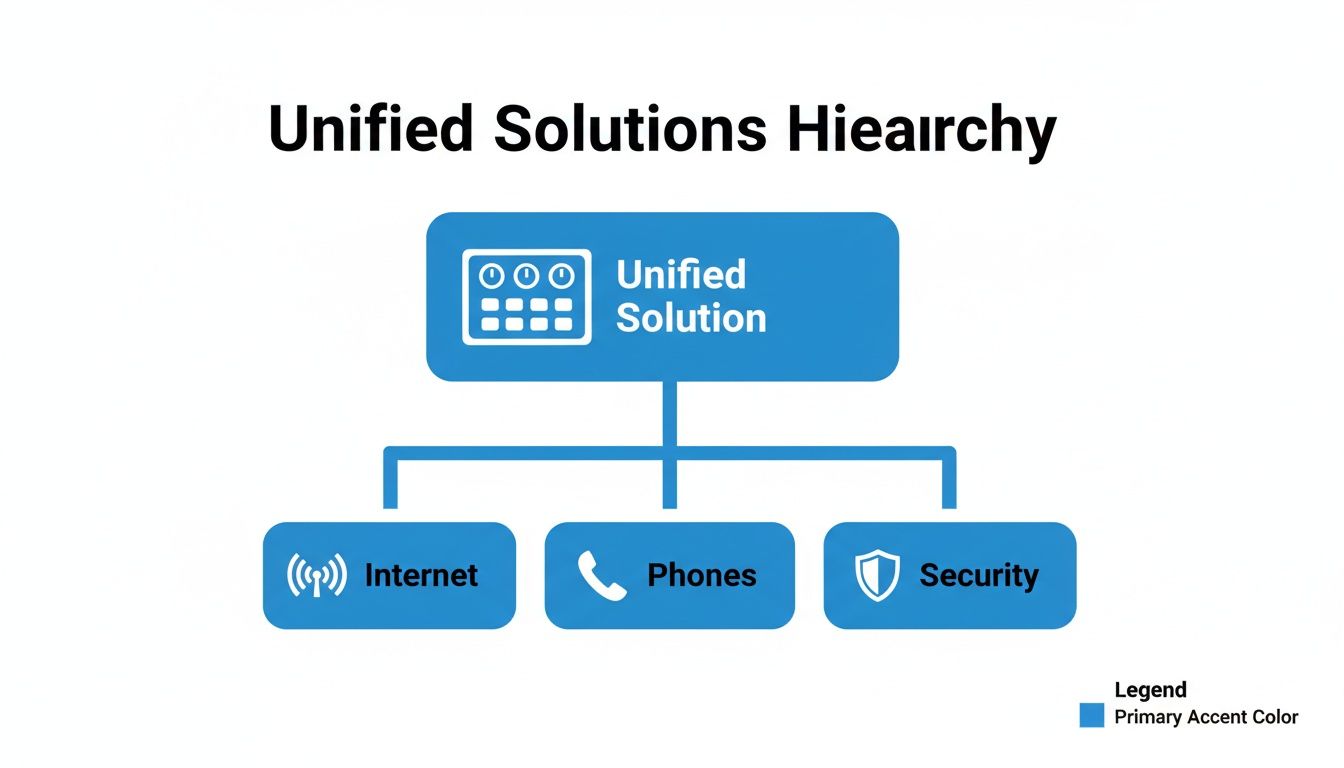
As you can see, a single, managed solution sits on top, directing the foundational pillars of internet, phones, and security.
The Foundation: A 100% Fiber Internet Connection
Everything starts with the connection. The absolute backbone of any modern unified solution is a 100% fiber-optic internet connection. Unlike older cable or DSL technologies that were built for a different era, fiber is designed from the ground up for today’s data-heavy demands.
Its most critical feature is symmetrical speeds, meaning your upload and download speeds are equally fast. This isn't just a "nice-to-have"—it's essential for how we work and live now.
Think about a video call. You are constantly uploading your video and audio feed while simultaneously downloading everyone else's. Symmetrical speeds make this exchange smooth, eliminating the frustrating lag, pixelated video, and dropped calls that plague slower connections. The same goes for remote work file transfers, competitive online gaming, and live streaming.
The Communication Hub: Modern VoIP Phone Services
With a rock-solid internet foundation in place, the next building block is communication. Modern VoIP (Voice over Internet Protocol) phone services completely replace traditional landlines by running your calls over your internet connection. This simple shift opens up a world of advanced features that boost professionalism and efficiency for homes and businesses alike.
These aren't your grandpa's old rotary phones. They come packed with powerful tools:
- Voicemail-to-Email: Get audio files of your voicemails sent straight to your inbox, so you can listen and respond from anywhere.
- Branded Caller ID: Let your business name show up when you call customers, which helps increase answer rates and builds trust instantly.
- Mobile App Integration: Take your business or home phone number on the go. You can make and receive calls from your smartphone as if you were sitting at your desk.
These features transform a simple phone line into a dynamic communication tool. They're a core part of what makes Unified Communications as a Service (UCaaS) so powerful. You can learn more about how UCaaS integrates voice, video, and messaging by exploring our detailed guide on the topic: https://premierbroadband.com/what-is-ucaas/
The Protective Shield: Security and Management
Finally, the third crucial component provides security and oversight for your entire digital world. Without a strong protective layer, even the fastest connections and most advanced tools are vulnerable. This is where Managed Network Edge services come in.
Instead of you having to configure firewalls or constantly monitor for threats, a managed service provides a single, professionally managed security solution. This shield is placed at the "edge" of your network—right where your internal system connects to the public internet—to inspect traffic and block malicious activity before it can cause harm.
On top of that, many unified solutions now include AI-powered camera systems. These smart cameras do more than just record video; they can identify specific events, send intelligent alerts, and provide actionable insights, adding another layer of physical and digital security. Together, these elements create a secure, reliable, and easily managed environment.
Real-World Benefits for Your Home and Business
Okay, let's move past the tech specs. The real magic of unified solutions is how they make your day-to-day life and work genuinely better. It’s all about trading complexity for simplicity and finding new ways to get things done, whether you're running a household or a company.

This isn't just some niche trend, either. The market for what’s called Unified Communications and Collaboration (UC&C) is expected to balloon to USD 181.84 billion by 2034. For families, this shift is already leading to big savings. Bundling internet with streaming can slash costs by up to 50% compared to old-school cable, all running on a single, rock-solid fiber line. You can dive deeper into this growing market in this detailed industry analysis from fortunebusinessinsights.com.
Transforming Your Home Life
For everyone at home, from busy families to remote workers, unified solutions offer practical wins you’ll notice right away. It’s about building a connected home that's easier to manage and performs way better.
Picture it: instead of juggling separate bills for internet, phone, and TV, you have just one predictable payment. When it's movie night, the family enjoys flawless 4K streaming with zero buffering because your fiber connection was built for it. And if something does go wrong? You make one call to one company to get it fixed, ending that frustrating blame game between different providers.
- Cost Savings: Bundling services like fiber internet and a cloud-based phone system almost always adds up to serious monthly savings.
- Superior Entertainment: A fiber backbone means lag-free gaming, seamless streaming, and lightning-fast downloads for everyone in the house.
- Simplified Support: One call is all it takes to get help. That saves you time, headaches, and a whole lot of hassle.
This approach simply removes the friction from managing your home technology. It frees you up to enjoy the perks of a fast, reliable connection without the administrative nightmare of dealing with multiple vendors.
Elevating Your Business Operations
For businesses, the perks of a unified system hit the bottom line directly through better productivity, tougher security, and growth without the growing pains. An integrated platform becomes a strategic tool that actually helps you grow instead of holding you back.
Think about a small business hiring a new employee. With a unified solution, getting them set up is a piece of cake. A new phone extension can be activated in minutes through an online portal, instantly connecting them to the secure company network. No need to call a separate phone company, bring in an IT consultant, or stress about security holes. The system just works, letting your team stay focused on their real jobs.
To get a feel for the technology driving this, check out our guide on what a cloud phone system is and how it empowers modern businesses.
The Competitive Edge for Companies
These operational gains are huge, and they create a real competitive advantage.
- Boosted Productivity: Smooth communication tools like VoIP and messaging keep teams connected and working together, whether they’re in the office or across the country.
- Fortified Security: A professionally managed network edge acts as a powerful shield, protecting your business from cyber threats without you needing to be a security expert.
- Effortless Scalability: As your company grows, your tech grows with you. Adding new users, locations, or services is simple and doesn't require a massive IT overhaul.
This integration gives you a stable, secure foundation to build on. It’s what allows a remote employee to nail a client presentation over a crystal-clear video call or lets a growing e-commerce shop handle a surge in orders without worrying if the network can keep up. At the end of the day, unified solutions let you focus on what really matters: your family, your work, and your goals.
All the theory is great, but the real test for any tech is how it actually works in the day-to-day grind. Let's look at a few stories from real people who made the switch and never looked back. Each one tackles a common problem, shows the practical fix, and highlights the powerful results of moving to a single, integrated system.
These examples really bring home how a well-designed unified platform can smooth out the friction in our daily lives, both at work and at home.
The Overwhelmed Small Business Owner
Meet Sarah. She runs a growing marketing agency and was stuck juggling three different vendors: one for her internet, another for a clunky old phone system, and a third for cybersecurity software her team couldn't stand. Every month was a mess of bills, and when something broke—like a slow connection during a huge client pitch—each vendor just pointed fingers at the others.
Sarah was spending more time fighting with tech than running her business. The answer was to bundle everything she needed into one unified solution.
- The Problem: Vendor chaos, unpredictable costs, and shaky performance were eating up her time and money.
- The Solution: She moved to a single provider that packaged fiber internet, a modern VoIP phone system, and Managed Network Edge services.
- The Outcome: Sarah now gets one, predictable monthly bill, and her team has a consistently fast connection. With just one number to call for support, problems get solved in minutes, not days. Best of all, she has peace of mind knowing her network is secure, letting her get back to growing her agency.
For business owners like Sarah, the value isn't just about the tech itself. It’s about the simplicity and security that lets them compete without needing a full-blown IT department.
The Home Office Hero
Next up is Mark, a remote project manager. His home office was supposed to be his command center, but his tech was failing him. His cable internet had painfully slow upload speeds, making his video calls pixelated and sending large project files feel like it took forever. Dropped calls and constant buffering were starting to hurt his professional image.
Mark needed a setup that was as reliable as he was. A simple fiber internet and VoIP bundle completely changed his work-from-home game.
- The Problem: Slow upload speeds and an unreliable connection were killing his productivity and professionalism.
- The Solution: He upgraded to a 100% fiber internet plan with symmetrical upload and download speeds, bundled with a VoIP home phone.
- The Outcome: Mark's video calls are now crystal-clear. Large files upload in seconds, not minutes. He can lead client presentations with total confidence, knowing his connection won’t bail on him. That unified approach made his home office a true extension of corporate headquarters.
The Modern Connected Family
Finally, let’s look at the Millers, a busy family with a lot going on online. The kids are serious online gamers who need lightning-fast connections, while the parents love to stream movies in 4K. With everyone online at once, their old internet plan just couldn't keep up, leading to constant fights over who was hogging the bandwidth. They also worried about keeping their kids safe online.
They needed one platform that could handle it all—from high-demand gaming to rock-solid security—without skipping a beat.
A single unified solution was the perfect answer. By combining high-speed fiber with managed Wi-Fi and security controls, they built a home network that works for everyone. If you want to get similar results, you can find out more about safeguarding your network with our guide on managed network security solutions.
- The Problem: Their old connection choked when gaming, streaming, and browsing all happened at once, and they didn't have easy-to-use security tools.
- The Solution: They switched to a unified provider offering gigabit fiber, whole-home managed Wi-Fi for great coverage everywhere, and built-in network protection.
- The Outcome: Now, the kids can game lag-free while the parents stream movies without any buffering. The Millers also use the included tools to manage screen time and filter content, giving them confidence that their family is protected. Their home is now a seamlessly connected—and secure—hub for work and play.
How to Choose the Right Unified Solutions Provider
Picking the right partner for your unified system is a big deal. It’s a lot like choosing a general contractor to build your dream home—you need someone with a rock-solid reputation, proven skills, and the flexibility to bring your vision to life.
This decision will directly impact the speed, reliability, and security of everything you do online. Don't get distracted by flashy ads. The very first question you should ask is simple but critical: Is the service built on a 100% fiber network?
Fiber is the foundation. It provides the kind of serious, symmetrical speeds and unwavering reliability that modern homes and businesses absolutely need. Anything less is like building that dream house on a shaky foundation. It just won’t hold up.
Assess Scalability and Future-Proofing
Your needs are going to change. The family gets bigger, the home office turns into a real business, or the company brings on more staff. A good unified solution has to grow with you, not hold you back.
Steer clear of providers who try to lock you into a rigid, one-size-fits-all box. The best ones offer services you can mix and match. Start with what you need today, and easily add more power later. Can you bump up your internet speed, add a few phone lines, or add security features without a massive headache and a whole new contract? That’s the kind of flexibility that future-proofs your investment.
The smartest providers have moved to a pay-as-you-go model. This shift is a game-changer for unified communications, letting businesses ditch clunky old hardware for scalable, cloud-based systems that are cheaper and more secure. You can see the full trend in this market analysis from mordorintelligence.com.
This modular thinking is perfect for small businesses, too. They can bundle internet, VoIP, and security into one powerful package. If you want to dive deeper, we break it all down in our guide explaining what managed network services are.
Scrutinize Support and Security Features
When things go sideways—and they eventually do—you find out what your provider is really made of. The whole point of a unified solution is having one number to call. But that only helps if someone knowledgeable and helpful actually answers the phone.
Look for providers with a reputation for great service. Check reviews, and don't be shy about asking direct questions about their support process before you sign anything.
Just as important is security. A great provider doesn't just hand you an internet connection and wish you luck; they actively help protect you from the nasty stuff out there. Make sure to ask about their security tools:
- Managed Firewalls: Do they have pros managing a firewall to block junk traffic before it ever gets to you?
- Content Filtering: Are there easy-to-use tools to help keep kids away from inappropriate content?
- Threat Monitoring: Is someone actively watching the network for new threats?
A provider that takes security seriously is one that genuinely cares about its customers. It's a non-negotiable. By looking closely at a provider's infrastructure, flexibility, support, and security, you can find a partner who will deliver a seamless, reliable experience for years to come.
Your Simple Checklist for a Smooth Transition
Jumping into a unified solution doesn't have to be a massive headache. When you break it down into a few common-sense steps, you'll find the whole process is surprisingly smooth and genuinely rewarding. This is your game plan for turning a complex-sounding project into a simple win for your home or business.
Step 1: Assess Your Current Needs and Future Goals
First things first: before you can find the right setup, you need to know exactly what you’re trying to fix and where you’re headed. Start with the frustrations. Is your internet dragging during important video calls? Are you tired of paying three different companies for three different services?
Now, think bigger. Are you planning to add more smart home tech? Bringing on remote employees who need reliable connections? Or maybe you're building out the ultimate online gaming rig. Answering these questions gives you a crystal-clear picture of what an ideal solution looks like, making sure it solves today’s problems and grows with you tomorrow.
Step 2: Audit Your Existing Services
Time to do a little digging. Pull out your last couple of bills for internet, phone, security, and any other tech services you pay for. This isn't just about adding up numbers; this audit does two very important things.
It gives you a hard baseline for your current monthly spending. More importantly, it shines a spotlight on where you can consolidate and save some serious cash. You might be surprised to find you're paying for features you don't even use or that bundling everything could slash your costs.
Step 3: Consult with an Expert Provider
With your needs clearly defined and your current bills in hand, you're ready to talk to a pro. A good provider isn't just trying to sell you a box. They act more like a consultant, asking the right questions to help you design a system that actually fits your life or your business.
Bring everything from Step 1 to the conversation. A true expert will use that info to recommend the right internet speed, the phone features that make sense for you, and the security options you actually need—nothing more, nothing less.
Think of this as building a partnership. The goal isn't just to buy a service; it's to create a solution that feels like it was custom-built just for you.
Step 4: Plan a Seamless Installation
A smooth switch is all in the planning. Once you've picked your provider and package, it’s time to get the installation on the calendar. If you're moving a phone number over, make sure you understand the porting process so you don't have any downtime.
A little prep goes a long way. Think through the details:
- Scheduling: Pick a day and time that won't disrupt your family's routine or your business operations.
- Preparation: Make sure the technician can easily get to all the spots they need to, like where your modem and router will go.
- Communication: Ask how long the installation should take and have a backup plan (like your phone's mobile hotspot) ready just in case.
Step 5: Onboard Your Team or Family
You're almost there! The final piece of the puzzle is making sure everyone knows how to use the new setup. For a business, this could be a quick 15-minute training on the new VoIP phone system. At home, it might just mean showing everyone how to connect to the new, blazing-fast Wi-Fi and walking them through any new security features.
A little guidance right at the start ensures everyone can tap into the full power of your new unified solution from day one.
Got Questions About Unified Solutions? We've Got Answers.
Making a tech change always brings up a few questions. When it comes to unified solutions, most people want to know if bundling services is really a good fit for their small business or busy home. Let's tackle those common questions head-on so you can feel confident about the switch.
We'll clear up the confusion and show you how getting your tech on the same page can work for you.
Aren't These Solutions Just for Big Companies?
Not anymore. While huge corporations have used unified systems for years, the technology is now perfectly sized and priced for small businesses and homes. Modern providers offer flexible packages that give you the same powerful perks—like tighter security and easier management—without the enterprise price tag.
For a small business, this means getting top-tier tools like a VoIP phone system and managed security. For your home, it means blazing-fast fiber internet and one simple bill from a single, reliable provider.
The whole point of a unified solution is to make things simpler and more efficient. That idea is just as valuable for a five-person startup or a family of four as it is for a Fortune 500 company.
How Flexible Are the Packages?
The days of rigid, one-size-fits-all bundles are long gone. Today's best unified solutions are built to be modular. You can pick and choose the exact services you need, building a custom package that fits your goals and your budget.
You could start with a rock-solid fiber internet connection and add a VoIP phone service later on as your business expands. That kind of flexibility means you only pay for what you use, but you always have an easy path to upgrade when you're ready.
What’s the Switching Process Really Like?
It’s a lot smoother than you probably think. A good provider handles all the heavy lifting for you, from planning the install to moving your existing phone numbers over with almost no downtime. They're your partner in the process, guiding you every step of the way.
The goal is to get you up and running fast so you can start enjoying a simpler, more powerful system without any major headaches.
How Do Unified Solutions Actually Improve Security?
Security is always stronger when it's built-in, not bolted on. Instead of trying to patch together different security products that can leave gaps, a unified solution creates a single, solid wall of defense. A Managed Network Edge service, for example, watches and filters out threats right where your network meets the internet, stopping bad actors before they ever get inside.
This central approach means everything—from your internet line to your phone system—is protected by one consistent security strategy managed by pros.
Ready to simplify your tech and see what a truly connected system can do? Premier Broadband offers all-in-one solutions that combine 100% fiber internet, crystal-clear VoIP, and solid managed network services designed for your home or business. Learn more at Premier Broadband.