

At its heart, a VoIP office phone system ditches old-school, copper-wire landlines and uses your internet connection to handle all your business calls. It’s like swapping out a clunky, single-purpose flip phone for a powerful smartphone—suddenly, you have access to a whole universe of features and flexibility.
What Is a VoIP Office Phone System?
VoIP, which stands for Voice over Internet Protocol, is the technology that powers modern business communication. It works by converting your voice into digital signals, sending them across the internet, and then reassembling them on the other end for the person you’re talking to. The result is a crystal-clear conversation that travels over the same network you use for email and web browsing.
This isn’t just some niche technology; it’s the new standard for businesses everywhere. The VoIP services market was valued at $169.38 billion in 2025 and is expected to rocket to $264.27 billion by 2029. With 78% of enterprises and 61% of small businesses already on board, it’s clear that sticking with an outdated phone system means getting left behind.
Let's take a look at how these modern systems stack up against the old way of doing things.
Traditional Phone Systems vs. VoIP Office Phone Systems
| Feature | Traditional Phone System (PSTN) | VoIP Office Phone System |
|---|---|---|
| Technology | Copper wires (Public Switched Telephone Network) | Internet connection (Broadband, Fiber) |
| Hardware | Bulky on-site PBX equipment, limited phone models | IP phones, softphones (apps), mobile devices |
| Scalability | Difficult and expensive; requires new lines and hardware | Easy to scale up or down by adding/removing users online |
| Features | Basic calling, voicemail, caller ID | Auto-attendant, call recording, visual voicemail, mobile app |
| Mobility | Tied to a physical desk and location | Work from anywhere with an internet connection |
| Cost | High initial setup, per-minute call charges, maintenance fees | Lower setup costs, bundled plans, free feature updates |
This quick comparison makes it easy to see why businesses are making the switch. VoIP simply offers more power, more flexibility, and better value.
The Core Components of a VoIP System
To get a VoIP system up and running, you really only need three things to work together. Think of them as the foundation for your entire communications setup.
- A Solid Internet Connection: Your internet is the highway your calls travel on. A reliable, high-speed connection—like a fiber network from Premier Broadband—is key to ensuring every call is sharp and free from annoying lag or dropped words.
- VoIP Hardware: These are the tools you use to talk. It could be sleek desk phones, cordless handsets, or even "softphones"—apps on your computer or smartphone that turn any device into your business line.
- VoIP Provider Software: This is the brains of the whole operation. Our cloud-based software at Premier Broadband manages all the powerful features like call routing, auto-attendants, and voicemail-to-email that old phone lines just can't handle.
This diagram shows how these three pieces—internet, hardware, and software—all connect to give your business a powerful and modern phone system.
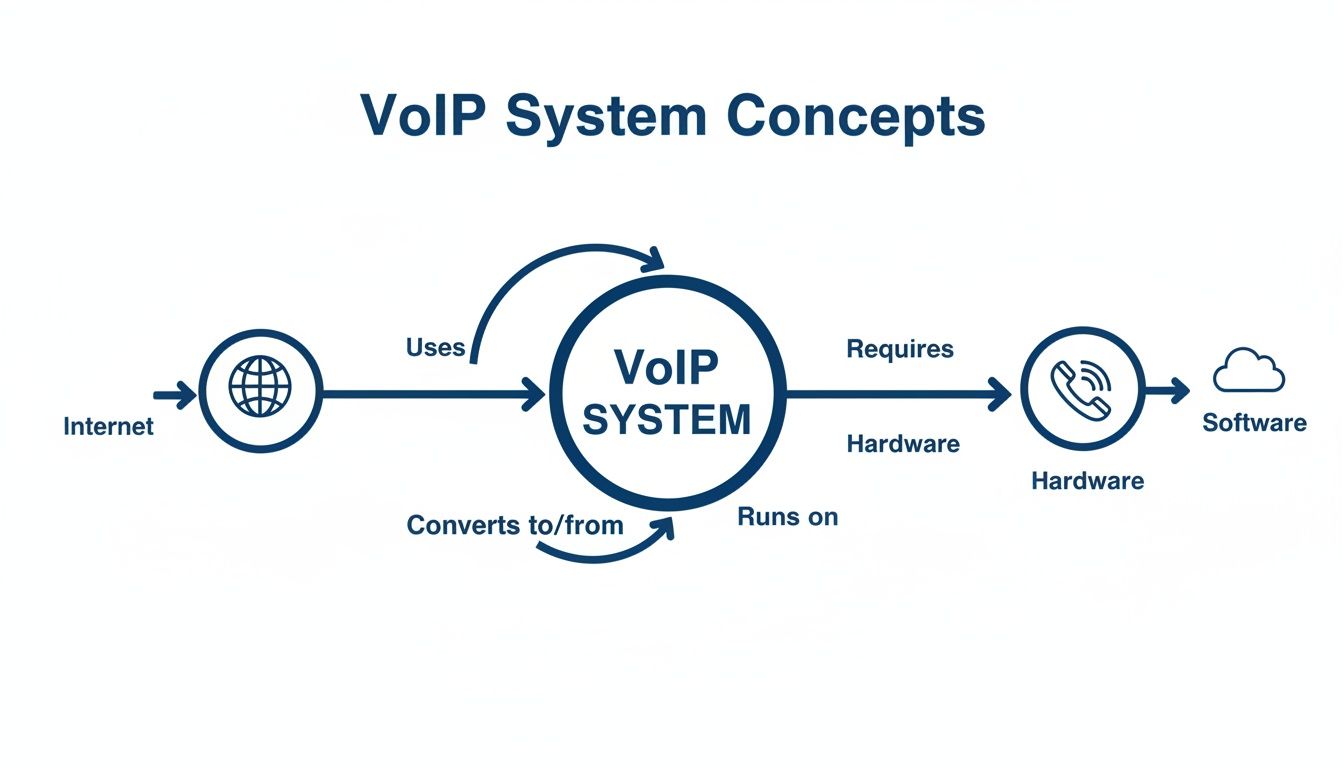
As you can see, your phones simply connect through the internet to our software, creating a seamless network that keeps your team connected.
So, How Does It All Actually Work?
When you pick up the phone and start talking, the magic happens in an instant. Your VoIP system immediately converts the sound of your voice into tiny digital packets of data.
These packets are then zipped across your internet connection to your provider’s server, which intelligently routes them to their final destination. On the other end, the packets are instantly reassembled in the right order, and the person you’re calling hears your voice as if you were in the same room.
This entire digital journey—converting, sending, and reassembling your voice—happens in milliseconds. It feels just as fast as a traditional call, but it’s built on a foundation that’s infinitely more powerful and flexible.
Want to dive a bit deeper into the technical side? You can learn more about how a VoIP phone works on our blog. For a complete overview, an in-depth resource like The Ultimate Guide to VoIP Phone Systems for Small Business in Australia can also provide a ton of great information.
The Real-World Benefits of a VoIP Phone System
So we’ve talked about the technology, but let's get down to what really matters: what can a VoIP office phone system actually do for your business? Making the switch from an old-school landline isn't just a simple upgrade. It’s a move that brings immediate, tangible benefits to your bottom line and your team's day-to-day workflow.

For most businesses, the first and most welcome benefit is the cost savings. Traditional phone systems are notorious for their hidden fees and unpredictable expenses. You’re paying for line rentals, per-minute charges, and sky-high international calling rates. VoIP completely changes that tired old model.
With a provider like Premier Broadband, you get one predictable, flat monthly rate. This single bill covers everything, getting rid of the need for separate, expensive phone lines and often including unlimited calling across the country. In fact, many businesses see their phone bills drop by 50-70% after switching.
Work from Anywhere with True Flexibility
In today's world, being chained to a desk is a thing of the past. VoIP frees your business communications from a physical location, empowering your team to work effectively from anywhere. Your business number isn't tied to a specific wire in the wall; it's linked to a user.
This opens up a whole new level of operational freedom:
- Take Your Office With You: An employee can answer their "desk" phone from a laptop at home, a mobile app on the road, or a traditional handset in the office. For the person calling, the experience is exactly the same.
- Connect Your Hybrid Team: VoIP is the essential glue for a modern hybrid workplace. It bridges the communication gap between your in-office staff and remote workers, making sure everyone stays in the loop.
- Never Miss a Call: A single business number can ring on multiple devices at once—the desk phone, a computer softphone, and a mobile app. This ensures critical calls always find the right person.
The numbers don't lie. Managers have found that their remote and hybrid teams are 62% more productive when they have a VoIP system compared to teams stuck in the office. This isn't just about convenience; it's about better performance.
Scale Your Business in Minutes, Not Weeks
Picture this: your business is taking off and you need to hire someone new. With a traditional phone system, that means scheduling a technician, waiting for them to run a new line, and paying for the installation. It's a slow, costly headache.
With a VoIP office phone system, scaling up (or down) is practically instant.
Need to add a new salesperson? Just log into your online portal, create a new user profile, and assign them a number. The whole thing takes a few minutes, not a few weeks. You can grow your team on your own terms, without waiting for a service call or paying extra hardware fees.
Think about a small e-commerce store hiring three remote customer service agents in different states. Instead of the nightmare of setting up three separate business lines, the owner can add them to their Premier Broadband VoIP plan in less than an hour. Each agent instantly gets a professional business number on their computer or smartphone, fully integrated into the company's system. That’s how you grow without limits and without breaking the budget.
Must-Have Features of a Modern VoIP System
Beyond the impressive cost savings and flexibility, what really makes a VoIP office phone system a game-changer are its features. These aren’t just minor add-ons; they are powerful tools built to solve real business challenges, make your team more productive, and completely change how you interact with customers.
Let's break down the essential features that turn a simple phone system into the communications hub of your business. These tools are designed to smooth out your workflows and reclaim precious time, letting your team operate with more efficiency and focus.
Features That Boost Team Productivity
Productivity features are all about working smarter, not harder. They handle the tedious tasks and make sure information gets to the right people without a single delay, keeping your business running like a well-oiled machine.
- Voicemail-to-Email Transcription: This feature is a massive time-saver. It automatically turns voice messages into text and sends them right to your email. You can read a message in the middle of a meeting or quickly scan for urgent issues without ever dialing into your voicemail.
- Intelligent Call Routing: Also known as find me/follow me, this lets you set up smart rules to forward calls to different devices in any order you choose. A call can ring your desk phone, then your mobile app, and finally a colleague, making sure you never miss that important call.
- Mobile and Desktop Apps (Softphones): These apps turn any device with an internet connection—like a laptop, tablet, or smartphone—into a complete business phone. Your team can make and take calls using their business number, check voicemail, and manage their settings from literally anywhere.
These tools have completely reshaped how modern teams work. Managers have found that their hybrid and remote teams are 62% more productive when they have a VoIP system compared to teams stuck in the office. And with 74% of employees now using mobile VoIP apps for business, the line between the office and everywhere else has vanished. You can dig into more data on how VoIP is powering today's workforce in this comprehensive report on VoIP statistics.
Tools for a Superior Customer Experience
You only get one chance to make a first impression, and a modern VoIP system ensures every customer interaction is professional and smooth. These features help you manage incoming calls gracefully, giving callers a seamless experience that makes your brand shine.
An auto-attendant, for instance, acts as your 24/7 virtual receptionist. It greets every caller with a professional, custom message and gives them a simple menu to get to the right person or department ("Press 1 for Sales, Press 2 for Support").
This one feature instantly elevates your business's image. It can make a one-person shop sound like a fully staffed enterprise, getting callers the help they need quickly without the frustration of being transferred to the wrong place.
Other key features for your customers include:
- Call Queues: When all your lines are busy, a call queue places callers on hold with professional music or custom updates until someone is free. It’s a world away from a frustrating busy signal or an unanswered phone.
- Ring Groups: You can have a single number ring multiple phones at once. This is perfect for a sales or support team, allowing the first available person to grab the call and slash customer wait times.
Many of these tools are part of a bigger concept called Unified Communications as a Service (UCaaS). If you're looking to combine voice, video, and messaging into a single, powerful platform, you can learn more about the benefits of UCaaS solutions in our guide. This integrated approach is the next logical step to building a truly connected business.
Choosing The Right VoIP Deployment Model
When you decide to upgrade to a VoIP office phone system, one of the first big questions you'll face is where the system will live. This choice between an on-premise or a hosted model will define everything from your upfront costs and maintenance duties to how easily you can grow in the future.
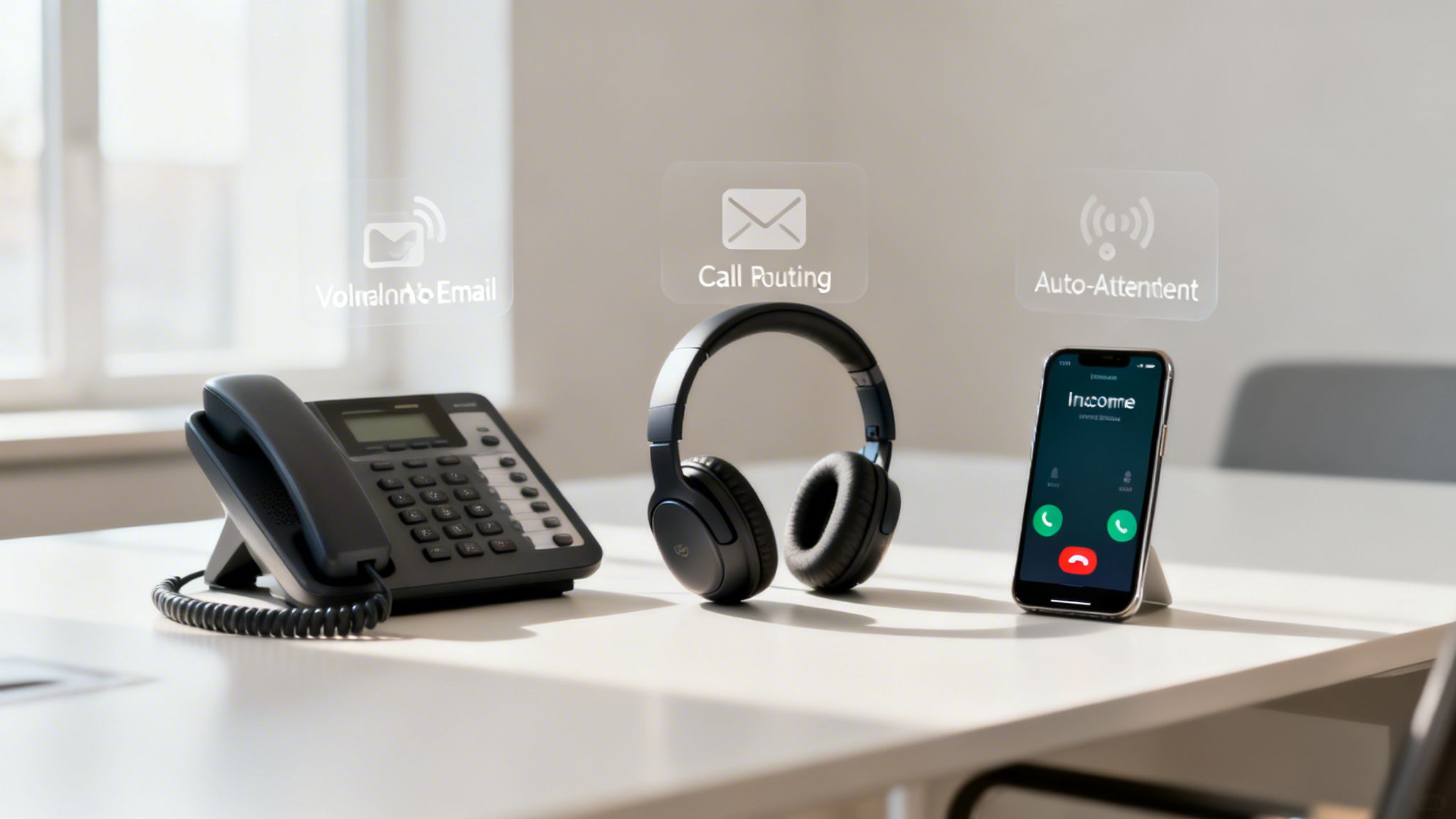
It’s a bit like choosing between owning a home versus renting a high-end apartment.
An on-premise system is like owning a house. You're in charge of everything—the foundation, the plumbing, the roof. This gives you total control, but it also means you’re on the hook for every single repair, upgrade, and maintenance task. It’s a major commitment of both time and money.
A hosted VoIP system is much more like renting a luxury apartment. You get all the premium features and amenities without worrying about upkeep. The building manager (your provider) handles all the maintenance, security, and upgrades, all for a simple, predictable monthly fee.
Hosted VoIP: The Cloud-Based Approach
With a hosted setup, your VoIP provider takes care of all the complicated hardware and software at their own secure, professional data centers. All you have to do is connect your phones to the internet, and you’re ready to go. It’s no surprise this has become the go-to choice for most businesses today.
The biggest win here is the low upfront cost. You don't have to buy a pricey PBX server for your office. Instead, it’s just a predictable monthly subscription, which turns a huge capital expense into a manageable operating cost.
Plus, your provider handles all the maintenance, security updates, and new features behind the scenes. This frees up your IT team to work on things that actually grow your business, not just maintain the phones. It's a huge reason why the cloud infrastructure market is expected to jump by 26% between 2024 and 2029.
On-Premise VoIP: The Traditional Method
Going the on-premise route means you buy, install, and manage all the phone system hardware (the PBX server) right there in your office. Your own IT staff is responsible for every part of its setup, configuration, and ongoing maintenance.
The main draw is having complete control. Since you own the equipment, you can customize it to fit perfectly with any other legacy systems you have and fine-tune it to your exact needs. But that level of control comes with a hefty price tag.
You’re looking at a huge initial bill for server hardware, software licenses, and professional installation. You also have to factor in the ongoing cost of your IT team’s time for maintenance, troubleshooting, and keeping it secure. When you need to add more phone lines or want new features, it often means buying more hardware and paying for complex upgrades. We break down the real-world savings in our guide on how hosted VoIP saves small businesses money.
To make the decision clearer, let's look at a side-by-side comparison of the two models. This will help you see which path aligns best with your company's budget, IT resources, and future plans.
On-Premise vs. Hosted VoIP Deployment Models
| Consideration | On-Premise PBX | Hosted VoIP (Cloud-Based) |
|---|---|---|
| Initial Cost | High. Requires buying expensive server hardware, software licenses, and paying for installation. | Low. No server hardware to buy. A simple, predictable monthly subscription fee per user. |
| Maintenance | Your responsibility. Your IT team handles all updates, security, and troubleshooting. | Provider's responsibility. All maintenance and updates are handled by the provider automatically. |
| Scalability | Difficult and expensive. Adding more users or locations often requires new hardware and licenses. | Easy and fast. Add or remove users in minutes through a simple online portal. |
| IT Resources | Requires in-house expertise. You need IT staff who are knowledgeable about phone systems. | Minimal. Frees up your IT team to focus on core business tasks instead of the phone system. |
| Feature Upgrades | Complex and costly. Often requires manual software updates or hardware replacement. | Automatic and included. New features and improvements are rolled out automatically at no extra cost. |
| Control | Total control. Full customization to integrate with unique, on-site legacy systems. | High flexibility. Excellent features and customization options suitable for nearly all businesses. |
While both options have their place, the table makes it clear why most businesses are choosing a hosted solution. The ease of use, predictable costs, and effortless scalability are hard to beat.
For most small and medium-sized businesses, the high upfront cost, need for specialized IT expertise, and ongoing maintenance burden make on-premise systems impractical. The agility and cost-effectiveness of hosted VoIP present a far more attractive and modern solution.
Ultimately, the right choice is about what fits your business's resources and long-term goals. That said, the industry trend is overwhelmingly moving toward the cloud for its unmatched flexibility and predictable, budget-friendly costs.
How to Select the Best VoIP Provider
Choosing a partner for your voip office phone systems is a huge decision. It's not just about picking a service—it’s about choosing the communication backbone for your entire business. The right provider works silently in the background to help you succeed, but the wrong one can become a source of daily headaches.
This checklist will help you cut through the noise and find a provider that’s a perfect fit for your company.
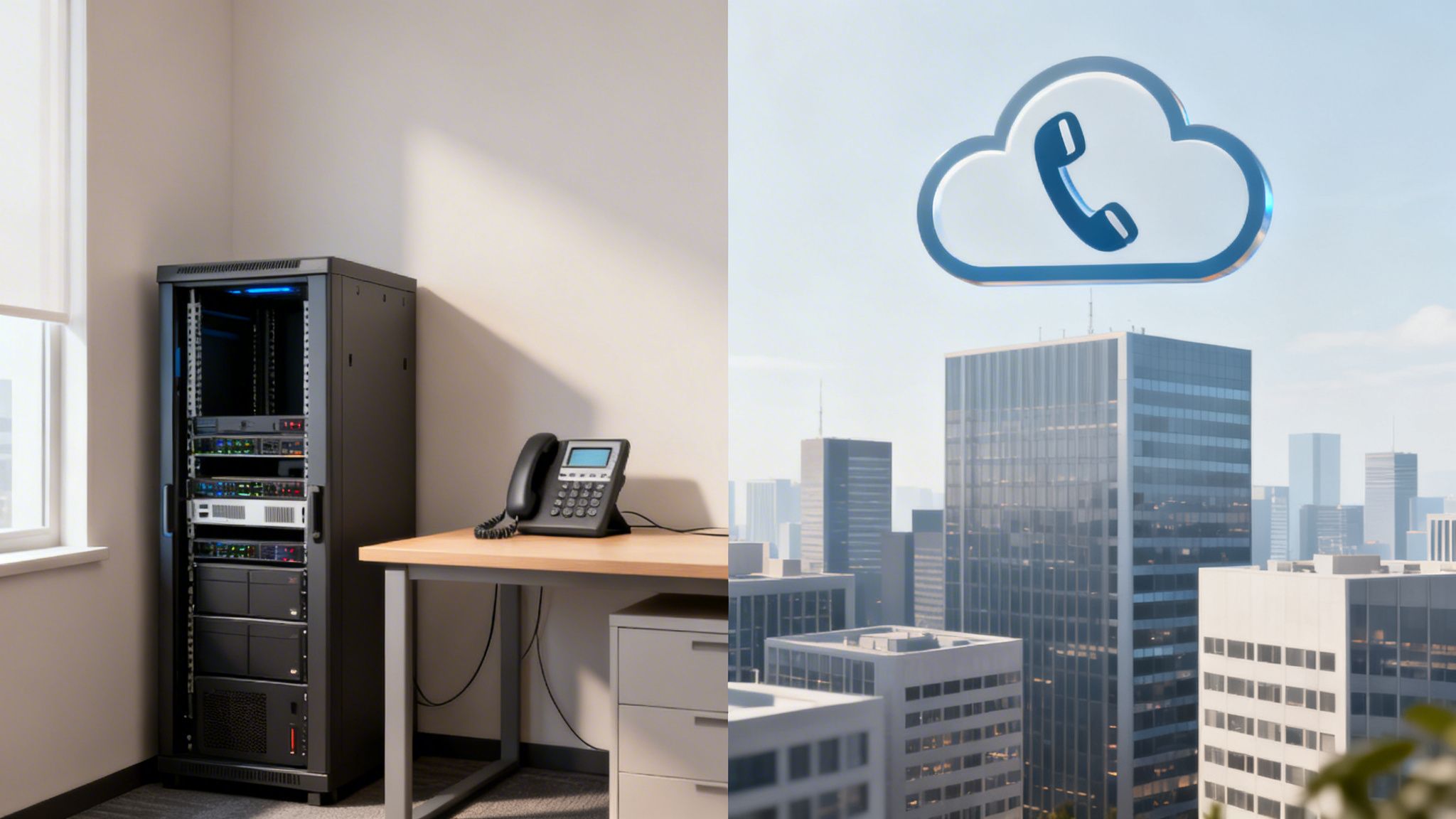
The number one factor to consider is network reliability. All the fancy features in the world won’t matter if your calls are choppy or dropping all the time. A VoIP system is only as good as the internet connection it runs on, which is why you should always look for providers who own and operate their own infrastructure, like a 100% fiber network.
When you're talking to potential providers, ask about their network uptime guarantees. This is usually spelled out in a Service Level Agreement (SLA), a document that promises a specific level of performance. A solid SLA will clearly define what you can expect for call quality and system reliability.
Evaluate Security and Compliance Measures
In a world where data breaches are a constant threat, the security of your business conversations can't be an afterthought. Your voice data is traveling over the internet, and it needs to be locked down from anyone trying to listen in. Any top-tier VoIP provider will have robust security built into their service from the ground up.
Here are the key security features you should be asking about:
- Call Encryption: Make sure they use protocols like Transport Layer Security (TLS) and Secure Real-Time Transport Protocol (SRTP). This technology scrambles your call data, making it completely useless to eavesdroppers.
- Network Security: How do they protect their network from threats like Denial-of-Service (DDoS) attacks? An attack like that could knock your entire phone system offline.
- Compliance Certifications: If your business is in a regulated field like healthcare (HIPAA) or finance, you must confirm the provider meets those specific compliance requirements.
Security is not an optional extra; it's a fundamental requirement. If a provider is vague about their security practices, that's a serious red flag. Proactive security can save an organization an average of $2.22 million compared to those who don't have it.
Assess Customer Support and Transparency
When something goes wrong with your phones, you need help—fast. Before you sign on the dotted line, give their customer support a test run. Can you get a real person on the phone easily? Is their support team based in the U.S.? Checking out recent customer reviews on third-party sites can also give you an honest look at what their support is really like.
Beyond that, you need total financial transparency. The price you’re quoted should be the price you actually pay. Go through any potential contract with a fine-tooth comb and look for sneaky hidden fees, such as:
- Per-minute surcharges
- Regulatory "compliance" fees
- Charges for calling technical support
- Fees for adding or removing users
A provider you can trust will give you clear, all-inclusive pricing. They should be able to walk you through every single line item on a sample bill, so you know there won't be any surprises waiting for you.
Confirm Scalability and Contract Flexibility
Your business is going to grow and change, and your VoIP provider needs to be ready to scale with you, not hold you back. One of the best things about hosted voip office phone systems is how easily you can add or remove lines. Setting up a new employee should take minutes, not days of waiting.
Pay close attention to the contract terms before you commit. Look for a provider that offers flexible terms and doesn't try to lock you into a long, rigid agreement. The right partner will give you the technology and the flexibility to support your growth, wherever it takes you.
For a side-by-side look at the major players, our guide to the top VoIP providers for business can help you compare your options.
Future-Proof Your Business Communications
Choosing a new phone system isn’t just about buying new hardware. Think of it as a strategic investment in where your business is headed. Moving to a **VoIP office phone system** is the single best step you can take to build a communications platform that’s ready for whatever comes next.The pace of change in business communication is only getting faster. The next big thing is already here: Artificial Intelligence (AI). We're now seeing advanced VoIP systems that can analyze a customer's tone of voice in real-time, giving your team instant feedback on satisfaction. Once the call ends, AI can generate instant summaries, so no one wastes time on manual notes and key details are always captured.
The Rise of Unified Communications
This evolution is all part of a larger shift toward what we call Unified Communications as a Service (UCaaS). It’s a fancy term for a simple, powerful idea: bringing all your communication tools—voice, video meetings, and team chat—together under one roof. No more jumping between different apps.
Your team gets a single, streamlined workspace to collaborate and connect with customers. By adopting a modern VoIP solution today, you’re laying the foundation to take advantage of these tools as they become standard. Of course, this all hinges on a solid internet connection. If you use wireless for any of your devices, knowing how to improve WiFi signal strength is crucial for crystal-clear calls.
A Global Shift in Communication
This isn't just a local trend; it's a worldwide move. While North America still holds a strong 27% of the market, the Asia-Pacific region is quickly taking the lead with a 38% share of the global VoIP market. Analysts are forecasting it will be the fastest-growing region, expanding at around 12% CAGR through 2033. It’s clear proof that businesses everywhere are embracing more flexible and connected ways of working.
When you boil it all down, choosing the right VoIP provider is a major business decision. It's about more than just a dial tone. It's about finding a partner who will help you build a more efficient, competitive, and future-ready business.
Frequently Asked Questions About VoIP
Thinking about upgrading your office phones? You probably have some questions. We get it. Here are the straight answers to the things we hear most often about voip office phone systems.
Is My Internet Connection Fast Enough for VoIP?
Chances are, yes. A single VoIP call only needs about 100 kbps of upload and download speed, which most business connections can easily handle. The real secret to great call quality isn't just speed—it's stability.
A rock-solid, low-latency connection like fiber optic is the gold standard. It’s what prevents annoying issues like jitter (that choppy, robotic audio) or dropped calls. Before you make any switch, a provider like Premier Broadband will look at your network to make sure it’s ready to deliver crystal-clear calls, even when your team is busy with other online tasks.
Can I Keep My Existing Business Phone Number?
Absolutely. You can bring your current business phone number with you through a process called "porting." Your new provider handles all the technical details, coordinating directly with your old carrier.
This gives your customers a completely seamless experience—they just keep calling the number they’ve always known. The key is to let your new provider start the porting process before you cancel your old service. This prevents any downtime and keeps the calls coming in.
A key benefit of VoIP is continuity. Porting your number means you maintain your established business identity without missing a beat, ensuring customers can always reach you.
What Happens to My Phones If the Internet Goes Out?
This is a great question, and it's something modern VoIP systems are built to handle with a feature called call forwarding, or business continuity.
If your office ever loses its internet connection, your phone system can automatically and instantly reroute all incoming calls to a backup number you’ve already chosen. That could be a cell phone, a home office line, or even a phone at another one of your locations. The failover is instant, so you'll never miss a critical call. Your business stays open, even during an outage.
How Secure Are VoIP Phone Calls?
Any reputable VoIP provider will tell you security is a top priority. Your conversations are protected with powerful encryption protocols like Transport Layer Security (TLS) and Secure Real-Time Transport Protocol (SRTP).
Think of it like an armored digital tunnel for your calls. These protocols scramble the voice data while it travels over the internet, making it totally unreadable to anyone trying to listen in. Many providers also use round-the-clock network monitoring to defend against threats. When talking to a provider, always ask about their security measures and any compliance certifications they hold, especially if you work in industries like finance or healthcare.
Ready to unlock the power of a modern, flexible, and cost-effective communication system? Premier Broadband offers crystal-clear, reliable VoIP office phone systems built on our 100% fiber network. Get a quote today and see how much you can save.