

At its core, a VoIP (Voice over Internet Protocol) phone system for business simply lets you make and receive phone calls over the internet. It ditches the old, copper-wired phone lines for good.
Think of it this way: VoIP technology converts your voice into digital data and sends it across your broadband connection. It effectively moves your entire business phone system out of a dusty closet and into the cloud, making it a flexible, software-based service.
What Is a Business VoIP Phone System?
If a traditional phone line is like sending a letter through the mail—slow, tied to one location, and surprisingly costly—then a VoIP system is like sending an instant email. It’s faster, far more affordable, and you can access it from anywhere you have an internet connection.
This is more than just a minor upgrade. Businesses are quickly moving away from the outdated Public Switched Telephone Network (PSTN) because VoIP uses the internet connection you already have. This slashes costs by eliminating line rentals and high per-minute charges, all while giving you powerful communication features that used to be out of reach for smaller companies.
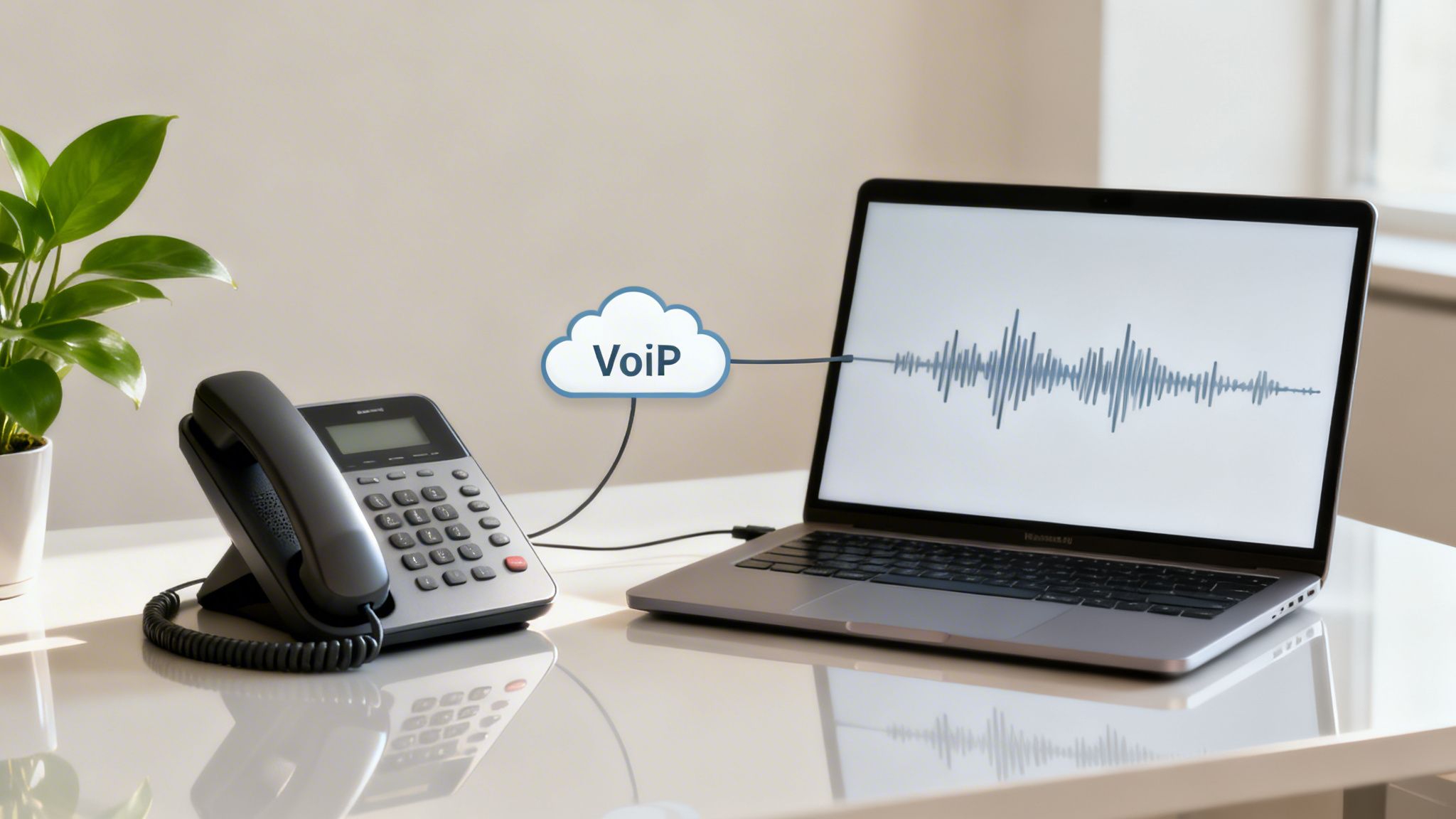
From Hardware to Software
The biggest change with modern VoIP is the shift from bulky hardware to powerful software. Most VoIP providers now operate on a subscription model. This is very similar to the SaaS business model used for so many other business tools today, and it completely removes the need for an on-premise Private Branch Exchange (PBX) box.
Instead, your provider manages all the call routing, voicemail, and other features in the cloud. For you, this means:
- No more expensive hardware maintenance. You’re no longer on the hook for repairing or upgrading a phone server at your office.
- Scale up (or down) effortlessly. Adding a new employee is as easy as assigning them a license in an online portal—no need to run new physical phone lines.
- Work from anywhere. Your team can make and take calls on a desk phone, a laptop softphone, or a mobile app, all using the same professional business number.
Comparing Traditional and Modern Phone Systems
Seeing the two systems side-by-side really highlights the difference. The contrast in technology, cost, and flexibility makes it clear why VoIP is the new standard for business communications. If you want a deeper dive into the mechanics, you can learn more about how VoIP phones work in our detailed guide.
The global mobile VoIP market is expected to grow from $46.9 billion in 2024 to $120 billion by 2033. This explosive growth shows just how many businesses are embracing internet-based calling for its incredible flexibility and cost savings.
Let's break down the key distinctions between the old way and the new way.
Traditional Phone Lines vs Modern VoIP Systems
This table compares the essential differences between legacy landlines and a modern VoIP phone system for business.
| Feature | Traditional Phone System (PSTN) | VoIP Phone System for Business |
|---|---|---|
| Technology | Analog signals over copper wires | Digital data packets sent over the internet |
| Cost Structure | High monthly line rental fees plus per-minute long-distance charges | Lower, predictable monthly subscription fees, often with unlimited calling plans |
| Hardware | Requires a bulky, on-premise PBX hardware box and physical phones | Cloud-hosted PBX managed by the provider; uses desk phones, computers, or mobile apps |
| Scalability | Complicated and expensive; requires new physical wiring and technician visits | Simple and affordable; add or remove users instantly through a web portal |
| Flexibility | Tied to a single physical office location | Completely location-independent; accessible anywhere with an internet connection |
| Features | Basic calling, voicemail, and caller ID | Advanced features like auto-attendant, call recording, mobile apps, and CRM integrations |
The choice is clear. VoIP doesn't just replace your old phone system—it gives your business a powerful communication toolkit built for the way we work today.
The Core Features That Power Modern Business
Sure, saving money and gaining flexibility are great reasons to switch to VoIP. But where these systems really shine is in the features. These aren't just bells and whistles; they’re tools that can fundamentally change how your business operates, communicates, and serves your customers. A modern VoIP system turns your phone from a simple calling device into the command center for your entire operation.
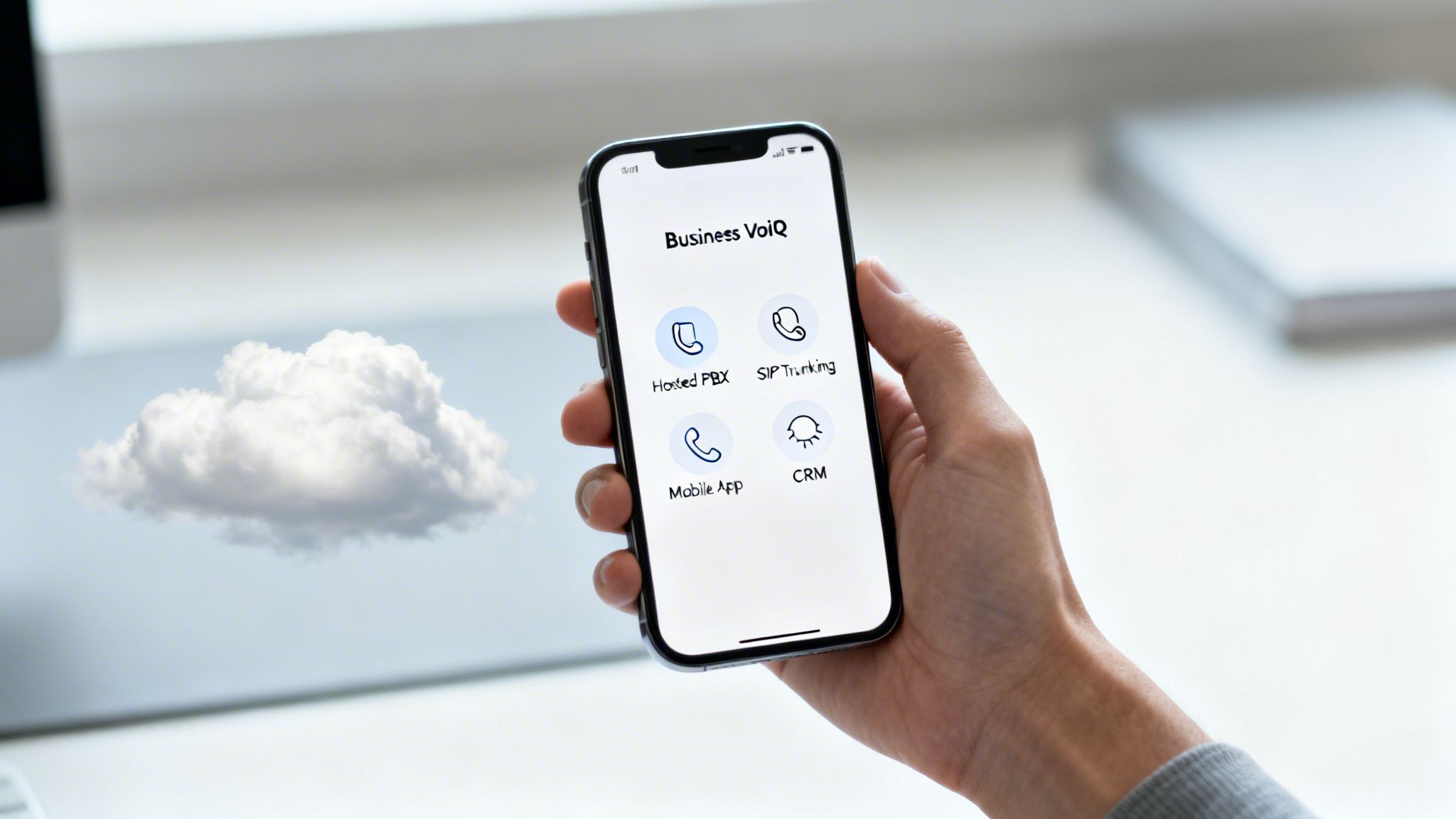
All these features work together to create what we call a unified communications experience. It's such a powerful concept that the global market for it is expected to grow at an annual rate of 17.4% through 2030. That’s a massive signal from the business world that an all-in-one approach is the future.
Let's break down the core components that make it all happen.
Hosted PBX: The Virtual Switchboard
Think of all the hardware that used to run a company's phone system—call routing, voicemail, conference bridges. Now imagine all of that running in the cloud, completely managed for you. That’s a Hosted PBX (Private Branch Exchange).
It’s your business’s virtual switchboard, and it completely gets rid of that expensive, clunky hardware box sitting in a closet. No more specialized technicians or maintenance calls. Instead, you manage everything from a simple web portal. Adding new employees, changing how calls are forwarded, or tweaking settings is as easy as a few clicks.
SIP Trunking: Your Digital Superhighway
If the Hosted PBX is your virtual switchboard, then SIP Trunking is the digital highway connecting you to the outside world. SIP (Session Initiation Protocol) trunks are essentially virtual phone lines that operate over your internet connection, replacing old-school analog lines entirely.
This tech is a game-changer for two big reasons:
- Massive Cost Savings: SIP trunks are far cheaper than renting bundles of physical phone lines, especially when you make a lot of long-distance or international calls.
- Effortless Scalability: Need to handle a sudden spike in calls? You can add more capacity instantly. There's no need to call a technician out to install new wiring. It's no surprise the SIP trunking market is projected to grab the largest market share by the end of 2030.
Mobility and Remote Work Enablement
With a modern VoIP system, your team is no longer chained to their desks. Mobile apps can turn any smartphone, tablet, or laptop into a secure extension of your office phone system. This lets your team make and receive calls from your main business number, no matter where they are.
This is absolutely essential for how businesses work today. With 64% of workplaces now using a hybrid model, VoIP ensures communication stays professional and seamless between the office and remote workers. A sales rep can answer a client call from their laptop in a coffee shop, and to the customer, it sounds exactly like they’re at their desk.
With mobile VoIP, your business number follows your employees, not the other way around. This ensures a consistent and professional brand presence while giving your team the flexibility they need to be productive anywhere.
Smart Automation and Powerful Integrations
VoIP does more than just handle calls; it automates key parts of your business. An auto-attendant, for instance, acts as a virtual receptionist. It can greet every caller with a professional, custom message and route them to the right person or department, 24/7. This makes sure every call gets handled perfectly, even when you're closed.
Even better, VoIP systems can connect with the other software you already use. A popular and powerful example is linking your phone system to your Customer Relationship Management (CRM) platform. When a customer calls in, their entire history can pop up on your employee's screen automatically. This gives your team instant context and helps them provide much better service. It's a proven strategy used by around 40% of businesses that have a CRM.
You can learn more about how all these platforms come together in our guide that explores what UCaaS is.
How VoIP Delivers Real Business Benefits
While the list of features for a VoIP phone system is impressive, the real story is the results it gets for your business. Moving to VoIP isn’t just a tech upgrade; it’s a move that delivers real returns you can see in your budget, your professional image, and your daily operations.
For most businesses, the first and most obvious win is financial. By ditching expensive physical phone line rentals and slashing the per-minute costs for long-distance and international calls, companies see an immediate impact. It’s common for a business to cut its monthly phone bill by 40% or more after switching.
That’s not just about saving money. It's about freeing up cash to reinvest in what really matters—like marketing, developing new products, or growing your team.
The Small Business Transformation
Think about a small local marketing agency. Before, they were juggling three separate landlines, a clunky answering machine, and sky-high monthly bills. Switching to a VoIP phone system for business completely changed the game for them.
Almost instantly, their phone bill was cut nearly in half. But more importantly, they set up a professional auto-attendant to greet callers with a polished menu. Now, callers could be routed to "Sales," "Support," or a specific person, making the five-person company sound like a much larger, more established operation. That boost in professionalism helped them land bigger clients who were impressed by their seamless communication.
Unifying Distributed and Remote Teams
Now, picture a tech company with a sales team spread out across the country. Their old setup was a mess. Reps used their personal cell phones, which looked unprofessional and created security headaches. There was no good way to track calls or make sure every customer got the same great experience.
VoIP unified their entire communication platform. Suddenly, a sales rep in a coffee shop could take a client call on their laptop using the main office number.
This is a massive shift as more workplaces go flexible. With 62% of managers saying their remote and hybrid teams are more productive, VoIP provides the communication backbone that makes this possible without sacrificing a professional appearance.
This ability to work from anywhere while using the main business identity means that no matter where an employee is, the customer experience is always consistent and professional.
Centralized Control for the Enterprise
These benefits only get bigger for large companies with multiple locations. Imagine an IT director trying to manage the phone systems at ten different branch offices. With old-school phone systems, that means ten separate hardware closets, ten different service contracts, and ten different sets of problems. It’s an administrative nightmare.
A VoIP phone system brings everything under one roof. From a single, easy-to-use dashboard, that IT director can now:
- Oversee all locations at once: Monitor call quality, user activity, and system health from a single screen.
- Make changes instantly: Add a new user in the Seattle office or adjust call routing for the Miami branch with just a few clicks.
- Standardize features and security: Ensure every office has the same professional auto-attendant, call recording rules, and security policies.
This centralized control drastically cuts down on administrative work and lets the IT team manage a global communication network with ease. It shows that a modern VoIP phone system for business is so much more than just a way to make calls—it’s an investment that pays for itself through better efficiency, a stronger brand image, and the ability to grow without limits.
Ensuring Your VoIP System Is Secure and Reliable
When you’re thinking about switching up a core part of your business like your phone system, a couple of big questions always pop up: Is it safe? And will it actually work when we need it most?
These are completely fair questions. For any business phone system, security and reliability aren't just extra features—they have to be the bedrock of the entire service. Many people assume that calls over the internet are less secure than an old-school phone line, but a modern, professional VoIP system is built with security measures that leave older tech in the dust.
Protecting Your Business Conversations
Think of your business calls like sensitive documents that need to be locked away. That's exactly what good VoIP security does. The most critical piece of this puzzle is end-to-end encryption, which essentially scrambles your call data from the moment you start talking until it reaches the other person's ear.
This makes your conversations completely unreadable to anyone trying to listen in. It’s a powerful defense against eavesdropping and data theft. But top-tier providers don't stop there; they actively monitor the network for threats. It's also worth remembering that up to 68% of security incidents involve a human element, so solid technology needs to be paired with good team habits.
This process flow shows how we layer security and reliability into your service from the ground up.
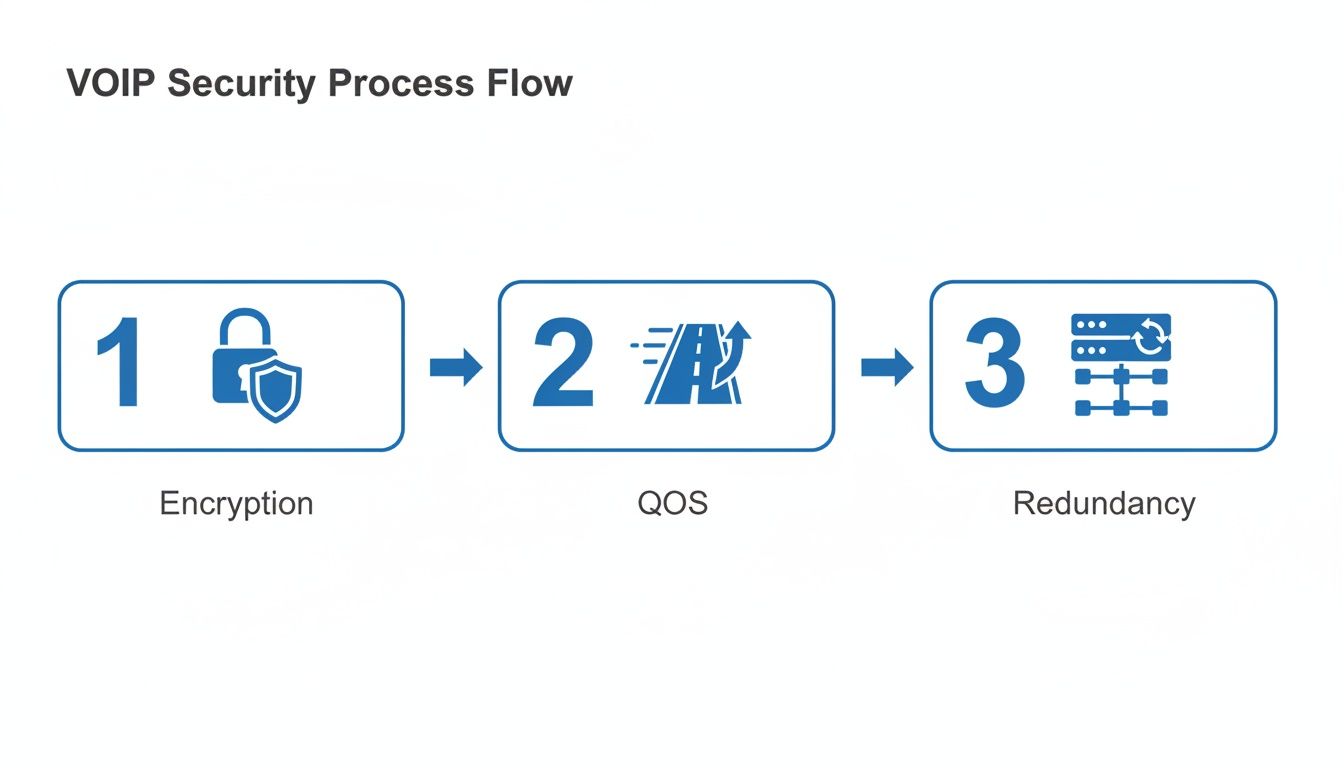
As you can see, great VoIP service isn’t about a single feature. It's about encryption, smart traffic management, and backup plans all working together seamlessly.
Building Unshakeable Reliability
A phone system isn’t much good if it’s not dependable. With VoIP, call quality and uptime are tied directly to your internet connection. This is precisely why a stable, high-speed connection—especially from a 100% fiber network—is the non-negotiable foundation for a business-grade VoIP setup.
You wouldn't build a house on a shaky foundation, and you can't run a crystal-clear VoIP system on a spotty internet connection. It all starts with the network.
To make sure your calls always get top priority, providers use a technique called Quality of Service (QoS). Think of your internet connection as a highway. QoS sets up a dedicated express lane just for your voice traffic, so your calls never get stuck in traffic behind big file downloads or video streams. This prevents the choppy audio, lag, and dropped calls you might have experienced on lower-quality systems. Some network hardware can accidentally interfere with this, so it’s a good idea to understand SIP ALG and why you should disable it.
On top of that, any true business solution has to include network redundancy. This is your automatic backup. If your main internet line has a problem, your phone traffic is instantly rerouted over a secondary connection, so your phones stay online without a hitch. This combination of a strong fiber connection, intelligent QoS, and built-in fail-safes is what makes a VoIP system both secure and incredibly dependable.
How to Plan a Smooth Migration to VoIP
Switching your company’s phone system can seem like a huge undertaking, but it doesn’t have to disrupt your business. With the right roadmap, you can move to a modern VoIP phone system for business seamlessly and start seeing the benefits from day one. A successful switch is all about smart, upfront planning.
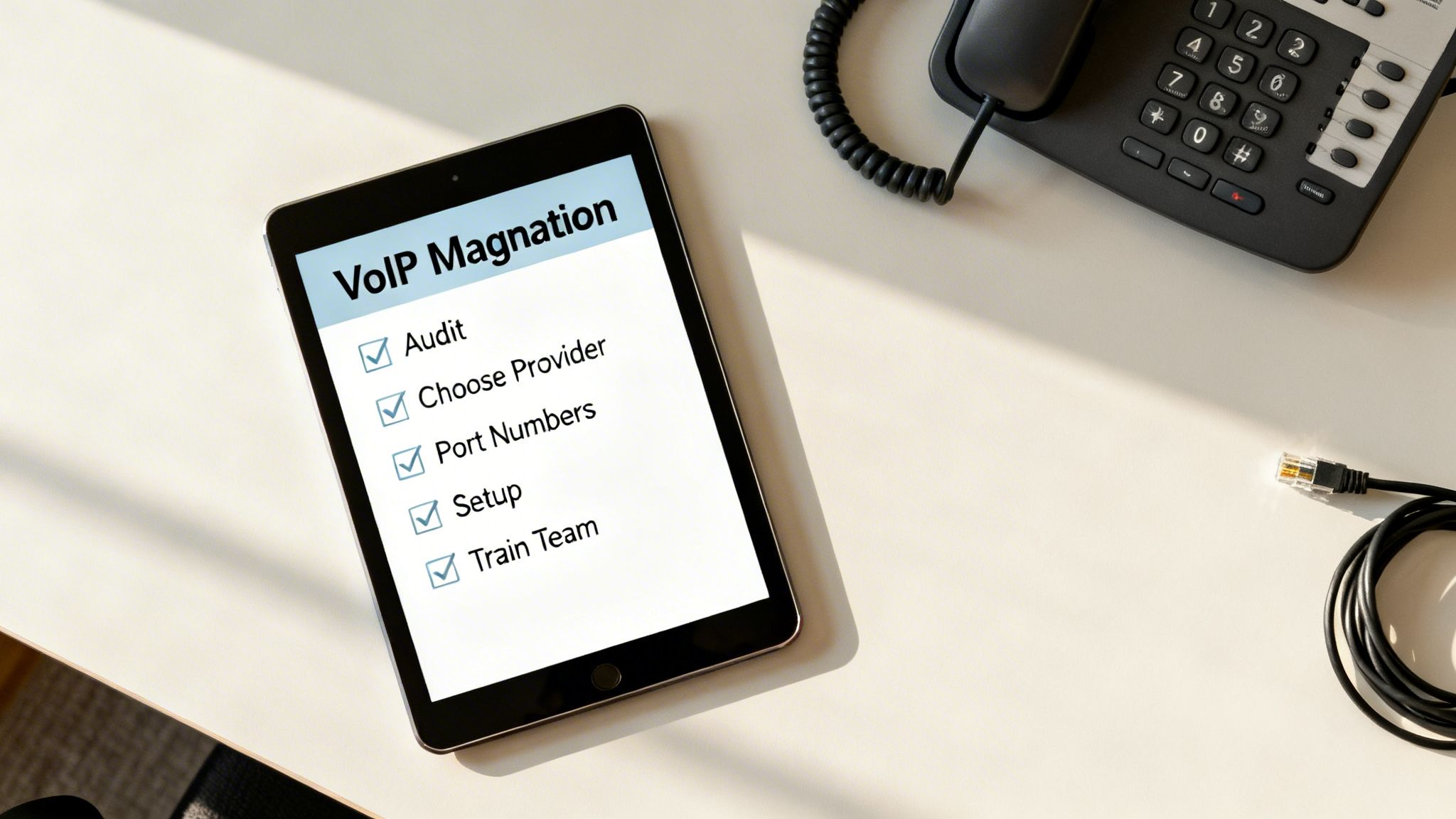
First, let's get a clear picture of your current setup. Think of it as creating a blueprint for your business communications. How many phone lines do your employees need? Are they in the office, working from home, or both? This count is the foundation for getting an accurate quote and making sure no one gets left behind.
Next, list out the "can't-live-without" features your team depends on. Does your sales team need call recording? What about an auto-attendant to direct calls after hours? Nailing down these must-haves ensures your new system works exactly how you need it to, right out of the box.
Assess Your Network Readiness
Before you flip the switch, you need to know for sure that your internet connection is ready for VoIP. Your phone system’s performance is completely dependent on the network it runs on. Run a speed test to check your current upload and download speeds—crystal-clear calls rely on fast, stable internet.
For the absolute best performance, a fiber internet connection is what we always recommend. Fiber gives you symmetrical speeds, which means your upload speed is just as fast as your download. That’s the key to eliminating lag and jitter during calls.
Choose the Right Partner Not Just a Provider
With your needs clearly defined, it’s time to find the right VoIP partner. This is the most critical decision you'll make. Look past the price tag and find a provider who can guarantee long-term success and reliability. A partner like Premier Broadband is different because we own our 100% fiber network, giving us total end-to-end control over your service quality.
When you're talking to potential partners, ask these questions:
- Do you offer managed installation? A partner who handles the entire setup saves you a ton of time and technical headaches.
- What is your support like? You want responsive, U.S.-based support that can fix any issue fast.
- Can you bundle internet and voice? Getting both from one provider simplifies your billing and guarantees the services work perfectly together.
A true VoIP partner is an extension of your IT team. They should be invested in your success, offering proactive support and expert guidance to ensure a seamless transition with zero disruption to your business.
Navigate the Implementation and Training Process
Once you’ve picked the right partner, the final step is implementation. This is where all your planning pays off. The process involves a few key stages that a good provider will manage for you.
First up is number porting—the process of moving your existing business phone numbers over to the new service. A great provider handles this transfer for you so you never lose contact with your customers. If you’re using SIP trunks, this is usually a quick and easy part of the setup. You can check out our guide to learn more about how SIP trunks work and how they fit into a modern phone system.
Next, your new VoIP phones are configured and installed. A provider that offers managed installation will make sure every phone is set up correctly and fully tested. It's also the time to implement strong security protocols; adding features like real-time fraud detection is crucial for protecting your business communications from new threats.
Finally, make time for team training. Even the most user-friendly system needs a quick walkthrough. A solid training session makes sure your team can use all the new features confidently—from setting up voicemail-to-email to using the mobile app—so you get the most out of your investment.
Your Action Checklist for a Smooth Switch to VoIP
Switching your business phone system feels like a huge step, but it doesn't have to be overwhelming. We’ve put together this simple, actionable checklist to walk you through the process.
Think of this as your game plan. It’s here to help you ditch the old, clunky phone setup and confidently choose a voip phone system for business that actually works for you.
Step 1: Take a Hard Look at Your Current Setup
First things first, you need a clear picture of what you have now. This isn't just about costs; it's about figuring out what’s working and what’s not.
- Dig Into Your Phone Bill: Grab your last three phone bills. What are you really paying? Add up all the line rental fees, charges for long-distance calls, and any hidden hardware maintenance costs. This number is your starting point and shows you exactly where you can save.
- List Your Must-Haves: Get your team involved. Does sales absolutely need call recording? Do your people working from home need a solid mobile app? Make a list of your non-negotiables, whether it's an auto-attendant, voicemail sent to your email, or linking with your CRM.
- Do a Headcount: Count up every single person who needs a phone line. This includes your full-time and part-time staff, and don't forget any remote contractors who need to be on the system.
With this info, you're no longer guessing. You have a concrete set of needs to take to potential providers.
Step 2: Check Your Tech Readiness
A VoIP system is only as good as the internet it runs on. Before you go any further, you have to make sure your connection is ready for the job.
Your internet connection is the foundation of your new phone system. Ensuring it’s fast and stable is the single most important technical step for crystal-clear, reliable calls.
- Test Your Internet: Run a speed test, but do it during your busiest time of day. You need to know your real-world speeds. Pay close attention to the upload speed—that's what keeps your voice from sounding choppy or delayed. A strong connection means happy customers, not frustrated ones.
Step 3: Choose Your Partner
You've done your homework. Now for the most important part: picking the right partner, not just another vendor. A true partner provides an all-in-one solution and has your back for the long haul.
- Schedule a Consultation: Talk to an expert who gets what you need. A partner like Premier Broadband can bundle high-speed fiber internet with an enterprise-grade hosted VoIP phone system. This means you get incredible performance, all from one provider. Ask them about their network, their support, and their installation process so you can make a choice you feel good about.
Your VoIP Questions, Answered
Making the switch to a VoIP phone system for business is a big decision, and it’s smart to have questions. We hear a lot of the same ones from businesses just like yours, so we’ve put together some clear, straightforward answers to help you make the right choice with confidence.
Can I Keep My Existing Business Phone Number?
Yes, absolutely. You won’t have to change a thing.
The process is called "number porting," and a professional provider like us handles the entire transfer for you. This means you can get all the benefits of a modern phone system without disrupting your customers or changing the business identity you’ve worked hard to build.
What Kind of Internet Connection Do I Need for VoIP?
While VoIP works on most stable broadband connections, we highly recommend a high-speed fiber internet connection for the best possible call quality.
Fiber gives you matching upload and download speeds, which is the secret to crystal-clear conversations without any lag or dropped words. Think of it as the solid foundation your business communications are built on.
Many small and medium-sized businesses report cutting their monthly phone bills by 40% to 60% after moving to VoIP. The savings come from eliminating line rentals, getting cheaper long-distance calling, and avoiding expensive on-site hardware costs.
Is a VoIP Phone System Difficult to Set Up and Manage?
Not at all. Modern VoIP systems are designed to be incredibly simple for anyone to manage, not just IT experts.
Most tasks, like adding a new employee or changing how calls are routed, are done through a simple online dashboard. A great provider will also give you:
- Managed Installation: We handle all the technical setup for you.
- Ongoing Support: You’ll have a dedicated team ready to help whenever you have a question.
- User-Friendly Interface: The control panel is built for business owners, plain and simple.
This means you can get back to running your business instead of worrying about your phones. The right VoIP system makes your life easier, not more complicated.
Ready to see how a modern VoIP phone system can transform your business communication and cut costs? Premier Broadband offers an all-in-one solution with 100% fiber internet and enterprise-grade Hosted VoIP. Schedule your free consultation today!