

You’ve probably heard the term VoIP, but what does it actually mean for your business? At its core, Voice over Internet Protocol is a way to make and receive phone calls using your internet connection instead of a traditional phone line.
For a small business, this opens up a world of possibilities. It means getting a powerful, flexible, and surprisingly affordable phone system without the headache of complex, on-site hardware. Essentially, your internet connection becomes your all-in-one communications hub.
What Is VoIP and Why Should Your Business Care

Think of an old-school business phone line like a dedicated delivery truck. It can only travel on one specific road to carry voice messages back and forth. It works, but it’s expensive and totally inflexible. If that road gets blocked, all communication grinds to a halt. That’s pretty much how a traditional landline, or Public Switched Telephone Network (PSTN), operates.
A VoIP small business phone system, on the other hand, is completely different. It’s more like a fleet of smart drones using the massive highway of the internet. It takes your voice, breaks it into tiny digital packets, and zips them across your existing broadband connection to their destination. On the other end, they’re instantly reassembled into crystal-clear audio.
The Core Technology Behind Your Calls
This entire process happens in milliseconds, so your conversation feels just as natural and immediate as a landline call. The real magic is in the pathway. Instead of being stuck on copper wires owned by a phone company, your calls travel over the very same network you use for email, browsing the web, and streaming video.
This simple but powerful shift from analog signals to digital data unlocks features and flexibility that small businesses could only dream of before. It’s no longer just about making and taking calls; it's about building a smarter communication platform that works for you.
Why This Matters for Small Businesses
For a small business, this technology is a game-changer. It gives you access to the same sophisticated tools that were once reserved for giant corporations with huge IT budgets. This isn't just about replacing old tech—it's about finding a much more efficient way to operate and connect with your customers. You can dive deeper into the technical side by exploring how VoIP phones work in our detailed guide.
By moving your phone service to the cloud, you can:
- Present a professional image, even if you’re a one-person shop. Features like an auto-attendant (“Press 1 for Sales…”) and custom on-hold music make you sound like a major player.
- Embrace remote and hybrid work. Your team can take business calls on their laptops or personal smartphones from anywhere with an internet connection, keeping everyone connected.
- Scale up effortlessly. Adding a new employee? Just configure a new user in an online portal. There’s no need to call a technician to install a new physical phone line.
VoIP transforms your phone system from a simple utility into a strategic business asset. It’s a tool that supports flexibility, boosts productivity, and helps you deliver a superior customer experience without breaking the bank.
Key Features That Drive Business Growth
Sure, a VoIP small business phone system lets you make and take calls. But the real magic is in the features that come packed inside. These aren't just bells and whistles; they’re strategic tools built to solve real business problems—saving you time, making you look like a major player, and ultimately, boosting your bottom line.
Think of it like getting a complete digital toolkit for your company. Each tool gives you a specific edge, helping even a one-person shop operate with the same polish and efficiency as a huge corporation. Let’s dig into the features that really move the needle for growing businesses.
Project a Polished Corporate Image
First impressions are everything. How you answer the phone instantly tells a customer a lot about your business, and VoIP gives you the tools to make sure every single caller has a professional experience.
The star of the show here is the auto-attendant. It’s your 24/7 virtual receptionist, greeting callers with a custom message and offering a simple menu ("Press 1 for Sales, Press 2 for Support"). Right away, this makes your business sound bigger and more organized, all while getting calls to the right person without anyone having to lift a finger.
This one feature alone prevents missed calls and frustrated customers. People get where they need to go, fast. A few other key features help build that solid brand image:
- Custom On-Hold Music: Ditch the dead air. Use the waiting time to play professional music or share quick marketing messages about your services.
- Ring Groups: Make multiple phones ring at once—like the entire sales team—so the first available person can grab important calls right away.
- Voicemail-to-Email Transcription: Get voicemails sent as text right to your inbox. You can scan messages in seconds and respond without having to listen to them one by one.
Untether Your Team and Embrace Mobility
The modern workplace isn’t tied to a desk anymore. With VoIP, your business phone number travels with you, keeping your team connected and productive no matter where they are.
Most VoIP providers include a mobile app that turns any smartphone into a full-blown business phone. This means your team can make and receive calls from their business number, check voicemail, and manage their settings, all from their personal cell. It's a game-changer for remote workers, traveling salespeople, or technicians in the field.
When your communications aren't stuck in one physical place, your business becomes incredibly agile and responsive. Your team can handle critical client calls from home, on the road, or even in a different time zone, ensuring customers get the help they need, instantly.
This freedom also creates consistency. Your business caller ID always shows up, maintaining that professional look no matter where the call is actually coming from. It's a huge part of what makes Unified Communications as a Service (UCaaS) so powerful. You can explore our guide to learn more about UCaaS and see how it brings voice, messaging, and video together on one platform.
Gain Deeper Insights with Advanced Tools
The best VoIP systems do more than just connect calls—they give you valuable data to help you improve how you operate.
Call recording is a perfect example. By recording calls (always following local laws, of course), you can unlock some serious advantages:
- Enhance Quality Assurance: Listen back to customer calls to find out what’s working and what’s not in your sales or support scripts.
- Improve Employee Training: Use real-world call examples as powerful coaching tools for new hires to get them up to speed faster.
- Resolve Disputes: Keep an accurate record of conversations to clear up any confusion and protect your business if a misunderstanding pops up.
Another powerhouse feature is call reporting and analytics. Through a simple dashboard, you can track key numbers like call volume, when your busiest hours are, how long calls last, and how many calls were missed. This data helps you make smarter decisions about staffing and spot trends in customer needs, turning your phone system from a simple utility into a source of real business intelligence.
Breaking Down VoIP Costs and Maximizing Your ROI
For any small business, the bottom line is king. Any new tech you bring on board has to make financial sense, and this is where VoIP small business phone systems really shine. The way VoIP is priced completely flips the script on how you pay for communications, turning it from a big, unpredictable capital expense into a simple, manageable operational cost.
Gone are the days of buying a bulky, expensive Private Branch Exchange (PBX) box that lives in a closet and needs an expert to maintain it. Instead, you pay a straightforward monthly subscription. This "per-user, per-month" model is incredibly transparent and scales perfectly with your business. Hire a new team member? Just add another user. Need to scale back? You can do that too, without getting stuck with pricey hardware you don’t need anymore.
The Clear Path to Savings
But the real story for small businesses is the savings. We're not just talking about avoiding the initial hardware purchase; the financial benefits run much deeper. When you switch to a VoIP system, you eliminate a ton of hidden costs that come with traditional phone lines.
These savings pile up from a few key areas:
- No On-Premise PBX: You completely cut out the need for an expensive on-site server and all the costs that come with it—installation, cooling, and power.
- Reduced Maintenance Contracts: Forget paying a technician to come out and physically fiddle with wires or update your system. Most of the management happens through a simple online dashboard.
- Lower Call Charges: Many VoIP plans bundle in unlimited local and long-distance calling. On top of that, international call rates are drastically lower, turning what was once a major expense into a minor one.
This is a game-changer for small businesses. Studies show that businesses making the switch to VoIP are slashing their communication costs by 30% to 50% on average, with some reporting savings as high as 60%. For a typical 10-person team, that could mean saving anywhere from $20 to $50 per user every single month. That's a serious boost to your bottom line. You can discover more insights about these VoIP savings and how they are changing SME operations.
The chart below shows the most popular VoIP features that businesses are using to drive efficiency and, in turn, get the most bang for their buck.
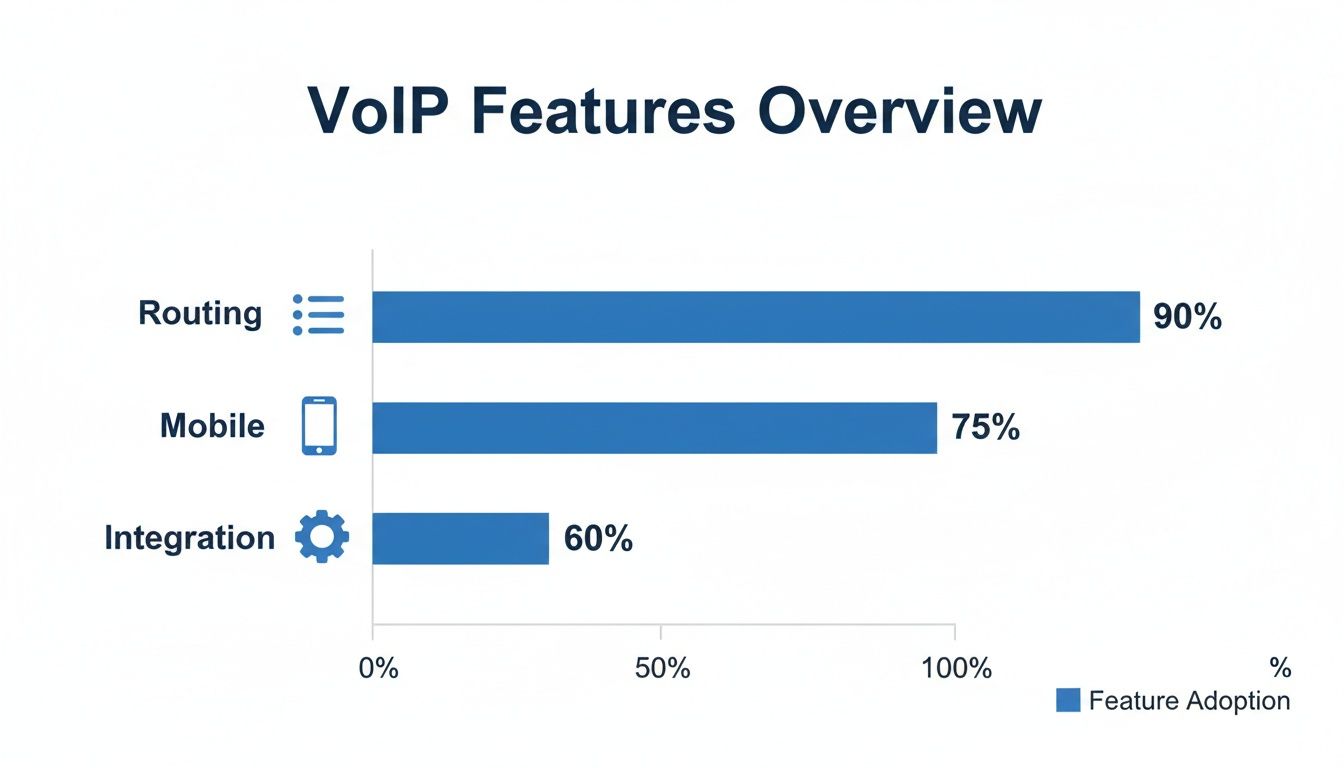
It’s pretty clear from the data: businesses are leaning heavily on features like call routing and mobile access. These tools directly boost efficiency and save money by making sure calls get to the right person and that your team can stay connected, no matter where they are.
Visualizing the Return on Investment
To really get a handle on the financial impact, it helps to see a side-by-side comparison.
Think about a small business with 10 employees. The monthly bills for a traditional phone system versus a modern VoIP solution are worlds apart. Old-school systems nickel-and-dime you with line rental fees, per-call charges, and hefty maintenance contracts.
Here’s a quick look at how the monthly costs might break down:
Cost Comparison Traditional Phone System vs VoIP System (Per Month)
| Cost Factor | Traditional Phone System (Estimated) | VoIP Phone System (Estimated) |
|---|---|---|
| Line Rental/User Fee | $300 (10 lines @ $30/line) | $200 (10 users @ $20/user) |
| Calling Charges | $150 (Varies with usage) | $0 (Included in plan) |
| PBX Maintenance Contract | $100 | $0 (Included in service) |
| Total Monthly Cost | $550 | $200 |
VoIP wraps all of this into one predictable bill. The numbers speak for themselves. This shift doesn't just save you money; it also makes your accounting and vendor management a whole lot easier.
Your return on investment isn't just measured in dollars saved. It’s also measured in reclaimed time, increased productivity, and the ability to present a more professional image to your customers, all of which drive growth.
Even better, many providers offer bundled services. When you get your VoIP phone system and your high-speed fiber internet from the same provider, you can often unlock even bigger savings and simplify your billing down to a single invoice. This synergy makes sure your voice and data are perfectly tuned to work together.
Making the Switch a Smooth and Simple Process
The idea of swapping out your company’s entire phone system might sound like a huge headache, but moving to a VoIP small business phone system is a lot simpler than you'd think. These days, good providers handle almost all the heavy lifting behind the scenes.
Your main job is just getting things ready and telling the system how you want it to work. It’s not about flipping a switch and hoping for the best; it's a planned process designed to avoid any downtime and keep things running smoothly for your team and your customers.
Let's walk through what it really takes.
Your Pre-Flight Checklist
A little prep work goes a long way. The single most important piece of the puzzle is your internet connection. Since your calls are traveling over the internet, a stable, fast connection is what gives you that crystal-clear audio quality.
A high-speed fiber connection is the gold standard here. It gives you equally fast upload and download speeds, which means it can easily handle all your phone calls right alongside everything else your business does online.
To get ready, you’ll want to:
- Assess Your Bandwidth: Your provider can help you figure out if your current internet plan is robust enough for the number of calls you expect to have going at once.
- Check Your Network Gear: Make sure your router and switches are up-to-date and can prioritize phone calls. This feature is often called Quality of Service (QoS), and it's key to preventing choppy audio.
Another big question is always about your phone number. Can you keep it? The good news is, yes, you almost certainly can.
Number Porting: This is the official term for moving your phone number from your old provider to your new one. It's a standard, regulated process that makes sure you hold onto the number your customers already have saved.
Any reputable provider will manage this whole transfer for you. All you typically have to do is give them a copy of a recent phone bill and sign an authorization form. They’ll take it from there.
Setting Up Your New System
Once the technical foundation is solid, you get to the fun part: customizing the system. Most of this is done through a simple online portal where you can tweak every detail of how your calls are handled, no IT degree required.
The initial setup usually boils down to a few key steps:
- Creating User Accounts: You’ll set up each person on your team with their own extension and, if you want, a direct phone number.
- Configuring the Auto-Attendant: This is your virtual receptionist. You'll record your main business greeting and create the menu options (like "Press 1 for Sales, Press 2 for Support").
- Setting Up Voicemail: Every user can record a personal greeting and choose how they get their messages, like having them sent straight to their email inbox.
- Establishing Ring Groups: You get to decide which phones ring for which calls. For example, you can make every phone in the sales department ring at the same time when a new lead calls in.
Connecting Your Essential Tools
One of the biggest wins with a VoIP system is how well it plays with other business software. Linking your phones to tools like your Customer Relationship Management (CRM) platform can make a massive difference in your team's efficiency.
Imagine a customer calls, and instantly, their entire history pops up on your employee's screen. That’s what an integration does. It gives your team the context they need to provide faster, more personal service.
Thinking about which tools you want to connect during the setup process is a smart move. Your provider can show you what integrations are possible and help you get them configured to make the biggest impact on your day-to-day workflow.
How VoIP Delivers Reliable Quality and Security
Let's be honest—can you really trust your most important client calls to the internet? It’s a fair question, and the answer is a confident yes. Modern VoIP small business phone systems are built from the ground up to deliver outstanding call quality and solid security, often going far beyond what traditional landlines can offer.
Think of it like building a house. The reliability of your VoIP service starts with a solid foundation, and that foundation is your internet connection. A high-speed fiber connection provides the stable, consistent bandwidth you need for crystal-clear, jitter-free conversations. With that in place, your VoIP provider adds layers of technology to make sure every call is clear, consistent, and secure.
The Foundation of Crystal-Clear Calls
Great call quality doesn’t just happen by accident; it's the result of smart network management. VoIP providers use a technology called Quality of Service (QoS), which basically creates a VIP express lane on your internet highway. It tells your network to prioritize voice data packets above everything else, like emails or general web browsing.
This prioritization ensures your conversations don't have to compete for bandwidth. The result? Smooth, uninterrupted audio without the frustrating lag or choppiness that can make a business sound unprofessional. To get the best results, you need enough internet muscle, and you can learn more about calculating the right bandwidth for VoIP to make sure your foundation is strong.
Layering on Robust Security
Just as important as call quality is protecting the conversations themselves. With VoIP, your calls are digital data, and top-tier providers treat that data with the same level of security you’d expect for your financial information. This is where a multi-layered security approach comes in.
Leading providers build their systems with several key security features:
- End-to-End Encryption (E2EE): This scrambles your call data from the moment it leaves your phone until it reaches the person you're talking to, making your conversations unreadable to anyone trying to listen in.
- Secure Real-time Transport Protocol (SRTP): This is another layer of encryption that protects call data while it's in transit across the internet, adding authentication to prevent unauthorized access.
- Redundant Data Centers: Reputable providers operate multiple, geographically separate data centers. If one has an issue, your service automatically fails over to another, ensuring constant uptime.
Security isn't just the provider's job; it's a partnership. While the VoIP service provides the heavy-duty encryption and network protection, your business plays a crucial role in securing the local environment where calls are made and received.
Because VoIP systems rely on your network, implementing strong network security best practices is fundamental. This includes simple but effective steps like using unique, complex passwords for user accounts and ensuring your office Wi-Fi network is secure and password-protected.
By combining the provider’s advanced security architecture with your own smart network habits, you create a formidable defense around your business communications. This ensures every conversation remains private and your phone system is always ready when you and your customers need it most.
Choosing the Right VoIP Provider for Your Needs
Jumping into the world of VoIP small business phone systems can feel overwhelming. With so many options out there, how do you find the perfect partner for your company without just taking a shot in the dark?
The key is to look past the flashy ads and zero in on what really matters for your daily operations. The right provider isn't just a utility—they're a partner in your communication strategy. You need a solid checklist to make sure you pick one that truly fits your needs, budget, and where you want your business to go.
The global VoIP market has exploded to USD 161.79 billion, a huge jump from about USD 132.5 billion in 2023. That kind of growth shows just how vital these cloud-based phone systems have become for businesses everywhere.
Evaluate Uptime and Reliability Guarantees
Your phone system is the lifeline to your customers. So, the first question for any potential provider should be about reliability. Plain and simple. Ask to see their Service Level Agreement (SLA), which is their formal promise on performance and uptime.
You're looking for a provider that guarantees 99.999% uptime, often called "five nines reliability." What does that mean for you? Less than six minutes of potential downtime in an entire year. A company willing to put that in writing has seriously invested in a tough, redundant network.
Scrutinize Customer Support and Onboarding
When a problem pops up, you need help from a real person who knows what they're doing—and you need it fast. Don't just take their word for it; dig into their support setup.
- Availability: Is support available 24/7/365, or just during business hours? Tech issues don't stick to a 9-to-5 schedule.
- Support Channels: Can you reach them by phone, live chat, and email? A direct phone number to a support agent is usually a great sign.
- Onboarding Process: Will they walk you through the setup and help move your existing numbers over? A bumpy start can cause major headaches, so a smooth onboarding process is crucial.
A great VoIP provider doesn’t just sell you a service and walk away. They should have a dedicated onboarding process to get you set up right from day one and offer quick, expert support whenever you need it.
As you look at different VoIP options, it helps to understand how to choose a cloud provider in general, since most modern VoIP runs on the cloud. This gives you a better lens for judging the infrastructure that powers your phone service.
Assess Scalability and Future-Proofing
Your business is going to grow, and your phone system needs to be able to keep up. A good VoIP small business phone system should scale with you without any friction. That's the real magic of a cloud-based system.
Adding a new employee should be as easy as logging into a portal and creating a new user. Ask providers how simple it is to add or remove lines, upgrade your plan, or connect with other tools like your CRM. A flexible provider lets you pay for what you need now, with the power to easily adapt for whatever comes next.
For a closer look at potential partners, you can also check out our guide on top VoIP providers for business. It's a great resource for finding a service that’s not just a tool for today, but a platform for your future.
Frequently Asked Questions About VoIP Systems
Making the switch to a new phone system is a big step, and it's natural to have a few questions. We've put together some simple, straightforward answers to the things business owners ask us most about VoIP small business phone systems.
Do I Need Special Hardware for a VoIP System?
Not necessarily, and that's one of its biggest perks. While dedicated IP phones are built for VoIP and offer a fantastic, seamless experience, you've got other flexible options.
You can easily use "softphone" apps on your computers or mobile apps on your team's smartphones. This instantly turns the devices you already own into a business line, which is perfect for remote staff or just keeping those initial costs down. You can even connect your old-school analog phones to the VoIP network using a simple device called an ATA (Analog Telephone Adapter).
What Happens to My Phone Service if the Internet Goes Out?
That’s a top concern for many business owners, and any good VoIP provider has a plan for it. Most quality systems have a built-in feature, often called call continuity or automatic call forwarding.
If your internet connection ever drops, the system instantly and automatically reroutes all incoming calls to a backup number you've already chosen, like your cell phone. This way, you never miss a customer call, even during an outage.
Of course, the best defense is a rock-solid internet connection. A reliable fiber connection provides the stable foundation your calls need to stay crystal clear.
How Difficult Is It to Add or Remove Phone Lines?
It's unbelievably simple—in fact, it's one of VoIP's greatest strengths. Forget the old days of waiting for a technician to show up and install physical wiring. With VoIP, you manage everything from an online dashboard.
Need to bring on a new team member? You can add a new user, give them an extension, and set up their personal call preferences in just a few minutes, from anywhere with an internet connection. This means your phone system can grow (or shrink) right alongside your business, with no delays or extra site-visit fees.
Ready to upgrade your business communications with a system that's flexible, reliable, and affordable? Premier Broadband offers crystal-clear, fiber-backed hosted VoIP solutions designed to help your small business thrive. Learn more and get a custom quote today.