
So, what exactly is a VoIP phone number?
Think of it this way: for decades, your phone number was physically chained to a copper wire in your wall. It was like a DVD player—it only worked if you had the right physical disc in the right machine. A VoIP phone number, on the other hand, is like streaming a movie. It uses your internet connection to give you instant access from anywhere, on almost any device.
What Are VoIP Phone Numbers Simply Explained
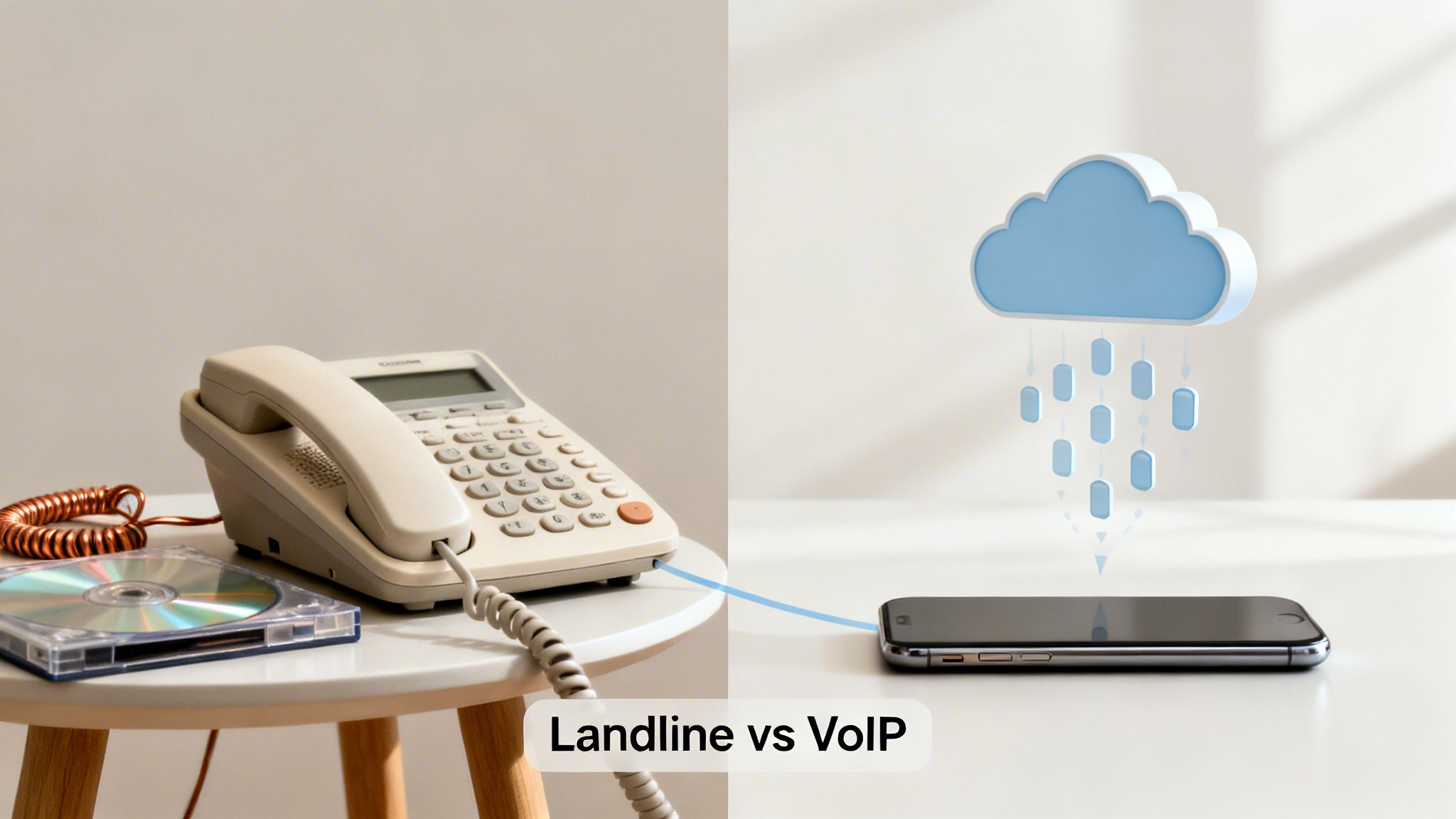
At its heart, a VoIP phone number completely separates your phone service from a specific, physical location. Instead of relying on the old-school Public Switched Telephone Network (PSTN), your voice is converted into digital data that travels seamlessly over your existing internet connection—whether that's fiber, cable, or even LTE.
This fundamental change from analog to digital is what opens up a whole new world of communication for both homes and businesses. Because your number isn't stuck to one place, you can take it with you. Make and receive calls from your desk phone at the office, a software-based phone on your computer, or a mobile app on your smartphone, no matter where you are.
VoIP Phone Numbers vs Traditional Landlines at a Glance
To make it even clearer, let's break down the core differences between a modern VoIP number and an old-fashioned landline. This quick table highlights how the technology has evolved.
| Feature | VoIP Phone Number | Traditional Landline |
|---|---|---|
| Underlying Technology | Internet Protocol (Digital) | Public Switched Telephone Network (Analog) |
| Connection Type | Internet (Fiber, Cable, DSL) | Physical Copper Wires |
| Location Dependency | Independent (Use anywhere with internet) | Tied to a single physical address |
| Device Flexibility | Desk phones, computers, mobile apps | Specific landline phones only |
| Core Features | Advanced features are standard (caller ID, forwarding) | Basic calling; features often cost extra |
| Scalability | Easily add or remove lines instantly | Requires a technician for physical installation |
As you can see, the shift to VoIP isn't just a minor upgrade; it's a completely different way of thinking about phone service, built for flexibility and the way we work and live today.
The Driving Force Behind VoIP Adoption
This isn't just a niche trend; it’s a massive shift in how the world communicates. The global VoIP market is on track to explode from $161.79 billion in 2025 to a staggering $415.20 billion by 2034. This incredible growth was fueled by the rise of remote work, as businesses and individuals scrambled for flexible, powerful, and affordable communication solutions.
Key Takeaway: A VoIP number is a virtual phone number that uses your internet connection. This simple change leads to lower costs, incredible flexibility, and a host of advanced features that traditional landlines just can't match.
This technology is a game-changer, especially for businesses looking to operate more efficiently and project a more professional image. To really see the impact, it helps to understand the ins and outs of VoIP for Small Business and how it allows smaller companies to access powerful, enterprise-grade phone features without the enterprise-level price tag.
How Your Voice Travels Across the Internet
Ever wondered how your voice gets from your phone to the person on the other end using the internet? It’s not magic, but it’s pretty close. Think of it like sending a package—an extremely fast one.
When you make a VoIP call, your voice isn't sent in one continuous stream. Instead, it's broken down into tiny digital pieces called data packets.
Each packet is tagged with an address and sent on its way over the internet, the same network you use for everything else. They travel the fastest route possible and are reassembled on the other end, recreating your voice in near real-time. This all happens in a blink.
The Key Players in a VoIP Call
Several technologies work together behind the scenes to make this happen. They're like the crew and directors of your call, making sure everything runs without a hitch.
The first major player is the Session Initiation Protocol (SIP). Think of SIP as the traffic controller for your call. Its job is to:
- Start the call: It tells the network you want to begin a conversation.
- Keep it going: It makes sure the connection stays open and stable.
- End the call: When you hang up, it closes the session cleanly.
Simply put, without SIP, your call wouldn't know where to start or when to end. It’s the rulebook that makes internet calling work.
Next up is the Cloud PBX (Private Branch Exchange). In the old days, businesses needed a whole closet full of expensive, clunky hardware to manage their phone system. A Cloud PBX moves all of that into the cloud, turning it into a virtual, software-based system.
A Cloud PBX is your company's virtual switchboard. It directs calls, handles features like voicemail and call forwarding, and lets you add new lines instantly—all without needing a single piece of physical hardware in your office.
This means you can control your entire phone system from a simple online dashboard. To get a closer look at the nuts and bolts, you can learn more about how a VoIP phone works in our detailed guide.
Of course, all of this relies on one critical ingredient: a solid internet connection. That's the secret sauce for crystal-clear conversations, ensuring those data packets arrive quickly and in the right order without any lag.
Choosing the Right Type of VoIP Number for Your Needs
Now that you know how VoIP sends your voice zipping across the internet, let's talk about the different tools you have at your disposal. Not all VoIP phone numbers are the same—they’re specialized for different jobs, which means you can build a communication strategy that perfectly matches your goals.
Picking the right one can make a huge difference in how professional and efficient your business runs.
This diagram shows how your voice becomes digital data and travels over the internet during a VoIP call.
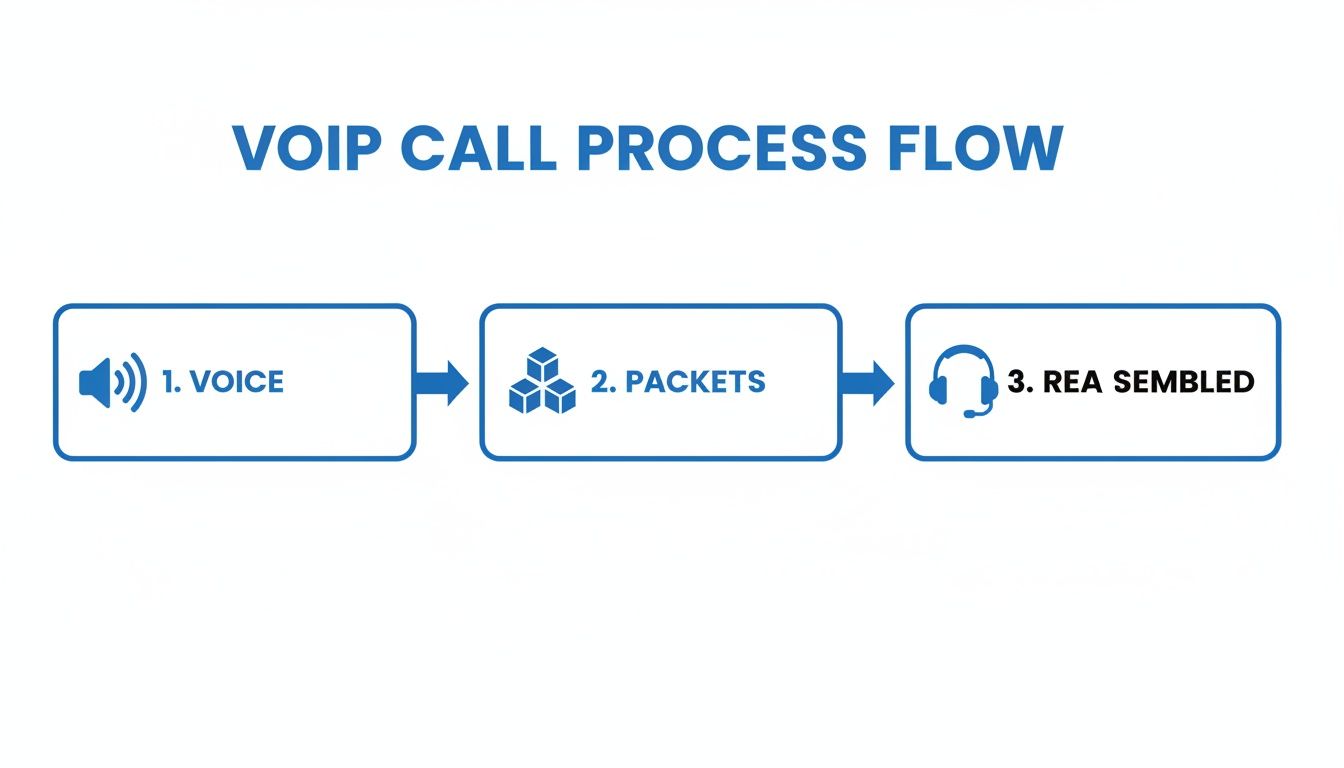
It’s this clever process of converting voice into data packets that gives VoIP its incredible flexibility and makes all these different number types possible.
Establish a Local Presence Anywhere
One of the most popular options is a Local Number. These are just standard phone numbers with a specific area code. The twist? You can pick an area code from almost anywhere, no matter where your office is actually located.
Imagine you're a marketing agency in Austin, Texas. You can get a local VoIP number with a New York (212) area code. When you call clients in Manhattan, it shows up as a local call, which instantly builds a bit of trust and makes people more likely to answer.
Make It Easy for Customers to Reach You
Toll-Free Numbers (like 800, 888, or 877) have been a business staple for a long time, and for good reason. They let customers call you from anywhere in the country without getting hit with long-distance charges.
Using a toll-free number removes a reason for customers not to call and shows them you're an established, accessible business that's ready to help. It’s a simple gesture that can really boost your call volume.
Boost Your Brand with Memorable Numbers
Vanity Numbers are a fantastic marketing tool. These are toll-free or local numbers that spell out a word or phrase, making them incredibly easy for customers to remember. Think of 1-800-NEW-ROOF for a roofing company or 1-888-TAX-PROS for an accountant.
These aren't just phone numbers; they're branding. A catchy vanity number sticks in a customer's mind, making your business the first one they think of when they need your services.
Get Calls to the Right Person, Every Time
Finally, Direct Inward Dialing (DID) numbers are a must-have for any growing team. Instead of having just one main number that goes through a receptionist, DIDs let you give a unique, direct phone number to each employee or department.
This means calls go straight to the right person without any extra steps, which cleans up your internal communication and makes everyone more efficient. To see how this technology fits into a bigger picture, check out our guide on what a cloud phone system is and how it can completely organize your business communications.
Unlocking the Real-World Benefits of a VoIP System
Knowing the technology behind VoIP phone numbers is great, but the real question is: what can it actually do for you? For both homes and businesses, the practical advantages are what make switching an easy decision.
At home, the biggest and most immediate benefit is the cost savings. Many of our customers cut their monthly phone bills by over 50% compared to a traditional landline. You’re simply using the internet connection you already pay for, not a whole separate service.
Then there’s the incredible portability. Your home phone number is no longer physically tied to your house. With a mobile app, you can make and receive calls on your home number from anywhere in the world with an internet connection. It’s a total game-changer for frequent travelers or families on the go.
How Businesses Gain a Competitive Edge
For a business, a VoIP system does more than just save money—it fundamentally changes how you operate and grow. The numbers speak for themselves: 78% of enterprises and 61% of small businesses are expected to use VoIP by 2026, with most cutting communication costs by a massive 50-75%. You can dig into more of this data with these VoIP statistics and market trends from Brightlio.com.
But it’s about more than just the bottom line. Here are some of the key ways businesses come out ahead:
- Effortless Scalability: Need to add a new phone line for a new employee? You can do it in minutes from an online dashboard. No more calling a technician or running new wires through the walls.
- Enhanced Productivity: Features that used to be exclusive to giant corporations are now at your fingertips. Get your voicemails automatically converted to text and sent to your email so you never miss a critical message.
- Professional Image: An auto-attendant (e.g., "Press 1 for Sales, Press 2 for Support") gives even a one-person shop the polished feel of a large company, making sure every caller gets to the right place, every time.
A VoIP system empowers a small business to project the image and efficiency of a much larger enterprise. It levels the playing field, making powerful communication tools accessible to everyone.
Advanced Features for Modern Work
Work isn't confined to a desk anymore, and VoIP is built for that reality. You can seamlessly forward calls from your desk phone straight to your cell, making sure you’re always available for important calls, whether you're in the office or on the road.
Many VoIP systems also come with business messaging built-in. This allows you to send and receive text messages from your business number, which is perfect for keeping your personal and professional communications completely separate. If this sounds like a good fit for you, our guide explains how VoIP text messaging works for businesses.
Ultimately, a VoIP phone number is far more than a simple landline replacement. It’s a complete communications hub that saves you money, makes your team more productive, and delivers the flexibility you need to succeed.
Understanding VoIP Limitations and 911 Services
VoIP phone service brings a ton of flexibility and savings, but it's important to go in with your eyes open about the technology's limitations. The greatest strength of VoIP is that it runs over the internet, and that’s also its primary weakness.
You need to be aware of a few factors, especially how power, your internet connection, and emergency services all work together.
Simply put, if your internet connection goes down, your phone service goes down with it. The same goes for a power outage. Traditional landlines get their power right from the phone company's lines, but your VoIP system needs local electricity to power your modem, router, and phones.
The Critical Role of Your Internet Connection
The quality of your VoIP calls is tied directly to the health of your internet service. A spotty or slow connection will quickly lead to frustrating call issues.
- Latency: This is that awkward delay between when you speak and when the other person hears you, causing you to talk over each other.
- Jitter: When call data arrives out of order, voices can sound choppy or robotic.
- Packet Loss: If bits of data get lost on their way to you, you'll have gaps where parts of the conversation are missing completely.
For clear, reliable calls, a stable, low-latency connection isn't just a recommendation—it's a requirement. Sometimes, the problem isn't your internet speed but network congestion from a misconfigured router. To learn about one common conflict, our guide on what SIP ALG is explains a router setting that often interferes with VoIP.
How VoIP Works with 911 Services
This is the most important limitation to understand. When you dial 911 from a traditional landline, your number is tied to a physical address, so emergency services automatically know exactly where you are. A portable VoIP number doesn't work that way on its own.
To handle this, VoIP providers use a system called Enhanced 911 (E911).
When you first set up your service, you register a physical address. When you dial 911, this is the address that gets sent to the emergency dispatcher. It is absolutely critical to keep this address updated if you move or even just take your equipment to a different location.
If you make a 911 call from a location that isn't your registered E911 address, first responders will be sent to the wrong place. Part of being a responsible VoIP user is making sure your location information is always current.
How to Get Started with Your New VoIP Number
Ready to upgrade your phone service? Switching to a VoIP phone number is much easier than you might imagine. Think of it less like a complicated technical project and more like a simple, powerful refresh for how you communicate.
We know one of the biggest questions people have is, "Can I keep my phone number?" The answer is almost always yes. The process is called number porting, and it lets you bring that familiar number you've had for years right over to your new Premier Broadband voice service.
Porting Your Existing Phone Number
You own your number, and we can handle the heavy lifting of moving it for you. It's a regulated and straightforward process. Here’s how it works:
- Don’t Cancel Your Old Service Yet: This is the golden rule. If you cancel your current phone plan before we finish porting your number, it could be lost for good. We’ll handle the cancellation with your old provider as part of the switch.
- Give Us Your Account Info: All we need is a copy of your most recent phone bill. It has all the necessary details, like your account number, that we need to authorize the transfer on your behalf.
- We’ll Handle the Rest: The porting process usually takes a few business days. We’ll keep you in the loop and let you know the second your number is live on our network.
Setting Up Your VoIP Hardware
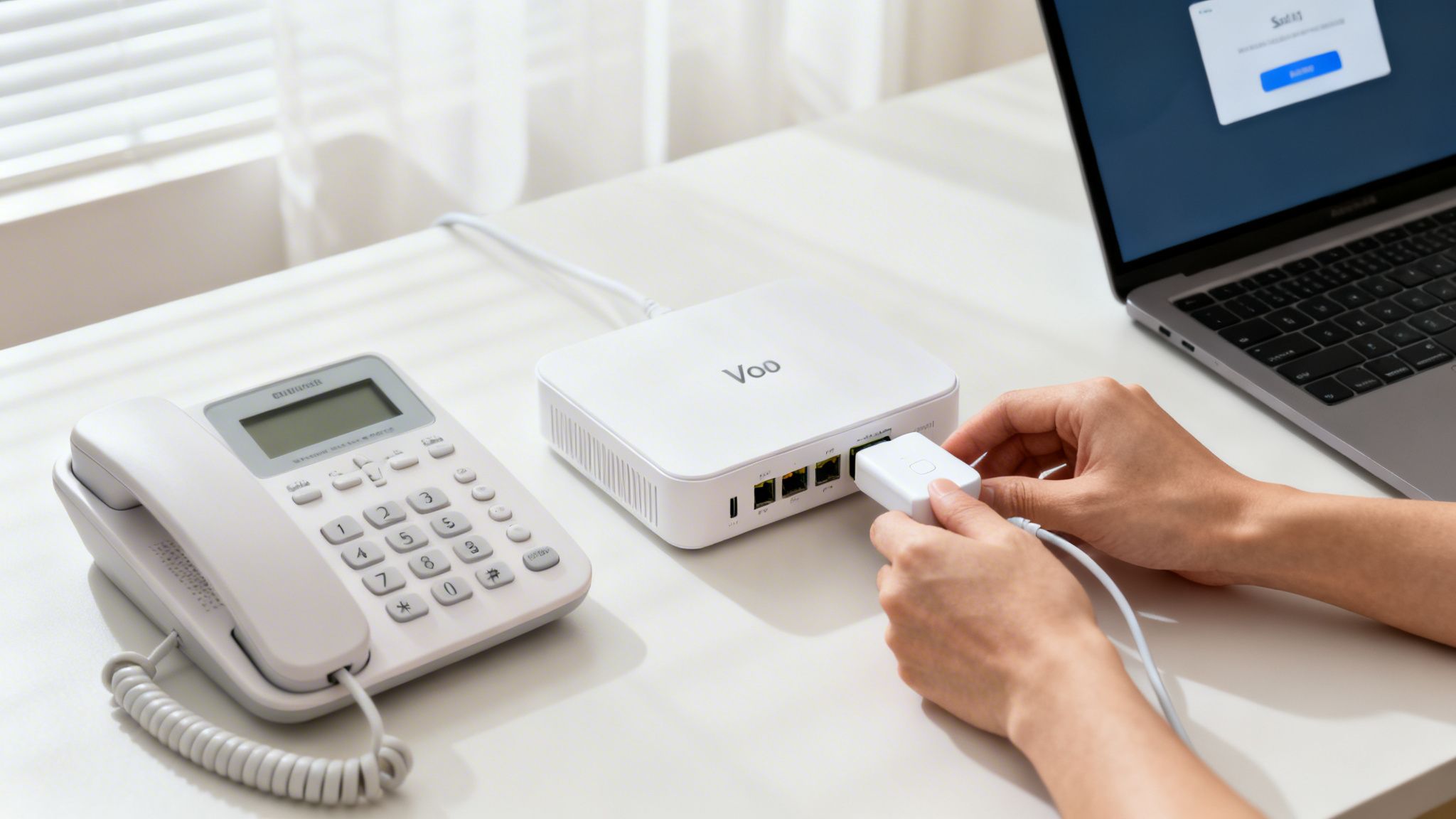
Once your number is ready to go, the final step is plugging in your equipment. Forget waiting all day for a technician. Most VoIP hardware is plug-and-play, designed to get you up and running in minutes.
VoIP setup puts you in control. It's designed to be a simple, do-it-yourself process that has you making calls in minutes, not days.
If you’re keeping a classic analog phone, you'll use a small box called an Analog Telephone Adapter (ATA). Just plug your internet cable into the ATA, then plug your phone into the adapter.
Using a dedicated VoIP phone? It’s even simpler. You just plug it directly into your internet connection. That’s it—you’re all set to enjoy clearer, more flexible calls with Premier Broadband.
Your Top VoIP Questions, Answered
Thinking about making the switch to VoIP? It’s a big step, and it's smart to have questions. We’ve got the answers to the most common ones we hear from our customers.
Can I Keep My Current Phone Number?
Yes, you almost always can. This is the first question on everyone's mind, and the answer is a relief. You don’t have to part with the number your family, friends, and clients have saved.
The process is called number porting. We'll help you move your existing number from your old phone company right over to your new Premier Broadband VoIP service.
What Internet Speed Do I Need for VoIP?
You’ll be surprised at how little bandwidth a VoIP call actually uses. A single, high-quality call only needs about 100 kbps (or 0.1 Mbps) for both upload and download.
Any modern broadband connection can handle that with ease, even with multiple calls going at once while you browse or stream.
It's not just about speed—it's about stability. A steady, reliable fiber connection is what delivers those crystal-clear calls without any frustrating lag or drops.
Do I Need to Buy a Special Phone?
Not unless you want to. You’ve got a few great options to fit how you work and live:
- Use your existing phone: A simple device called an Analog Telephone Adapter (ATA) connects your current landline phone right to your internet router.
- Use a softphone: Take calls directly on your computer or smartphone with a dedicated app. Perfect for when you're on the go.
- Upgrade to an IP phone: These are purpose-built desk phones that plug straight into your internet connection, often packed with advanced calling features for your home office or business.
Switching to VoIP is a simple upgrade that gives you more freedom and better features for modern communication.
Ready to enjoy clearer calls and more flexibility? Premier Broadband offers crystal-clear VoIP phone service for homes and businesses, backed by our 100% fiber network. Explore Premier Broadband's VoIP solutions today.