
If you're trying to make sense of an old phone bill, a legacy office system, or a service provider telling you it's time to migrate, you're probably asking a very practical question: what is Integrated Services Digital Network, and why did it matter so much for so long?
ISDN was one of the first big attempts to turn the traditional phone network into something more useful for the digital age. For a time, it felt like a breakthrough. It let people send voice and data over the same copper line, and it did that with cleaner, more structured digital signaling than old analog service. For homes, that meant faster internet than dial-up. For businesses, it meant more dependable calling, conferencing, and remote connectivity.
Most explainers stop there and say ISDN is dead. That's mostly true, but it misses an important detail. In some environments, ISDN survived longer than expected because its dedicated, circuit-switched design made it a dependable backup when internet-based systems failed. That small but important role helps explain why people still talk about it today, even as fiber and VoIP have taken over nearly everything that matters.
Remember Dial-Up From Innovation to Obsoletion
Before broadband became normal, getting online often meant tying up the phone line. You'd hear the modem connect, wait for pages to crawl open, and hope nobody picked up another handset in the house. That was the everyday internet experience for a lot of people.
ISDN arrived as a major upgrade to that world. It wasn't just another phone feature. It was a foundational telecommunications standard that many people expected to spread widely. In fact, the U.S. Department of Commerce forecast in 1981 that ISDN would become widespread globally by 1990 and achieve universal adoption by the year 2000 in its long-range view of telecom development, as noted in this NTIA publication.
That tells you how important ISDN once looked. People didn't see it as a niche tool. They saw it as the future of communications.
Why it felt revolutionary
ISDN solved two frustrations that older analog connections created:
- One line, more than one job: You could handle voice and data on the same service instead of treating data as an awkward add-on.
- Digital instead of analog noise: The line carried cleaner, more structured signals.
- Less waiting: Calls and data sessions felt more responsive than older analog systems.
ISDN wasn't exciting because it was fast by today's standards. It was exciting because it made the phone network feel digital for the first time.
That shift matters if you're comparing old systems to current ones. ISDN was the bridge between the analog phone era and the always-on internet era. To understand why modern fiber and VoIP are such a leap forward, it helps to see ISDN for what it really was: not a failure, but an important stepping stone that eventually got overtaken.
The Core Concept Behind ISDN
At its heart, Integrated Services Digital Network was built around one simple idea: make the old telephone network carry different kinds of communication in digital form over the same copper wires.
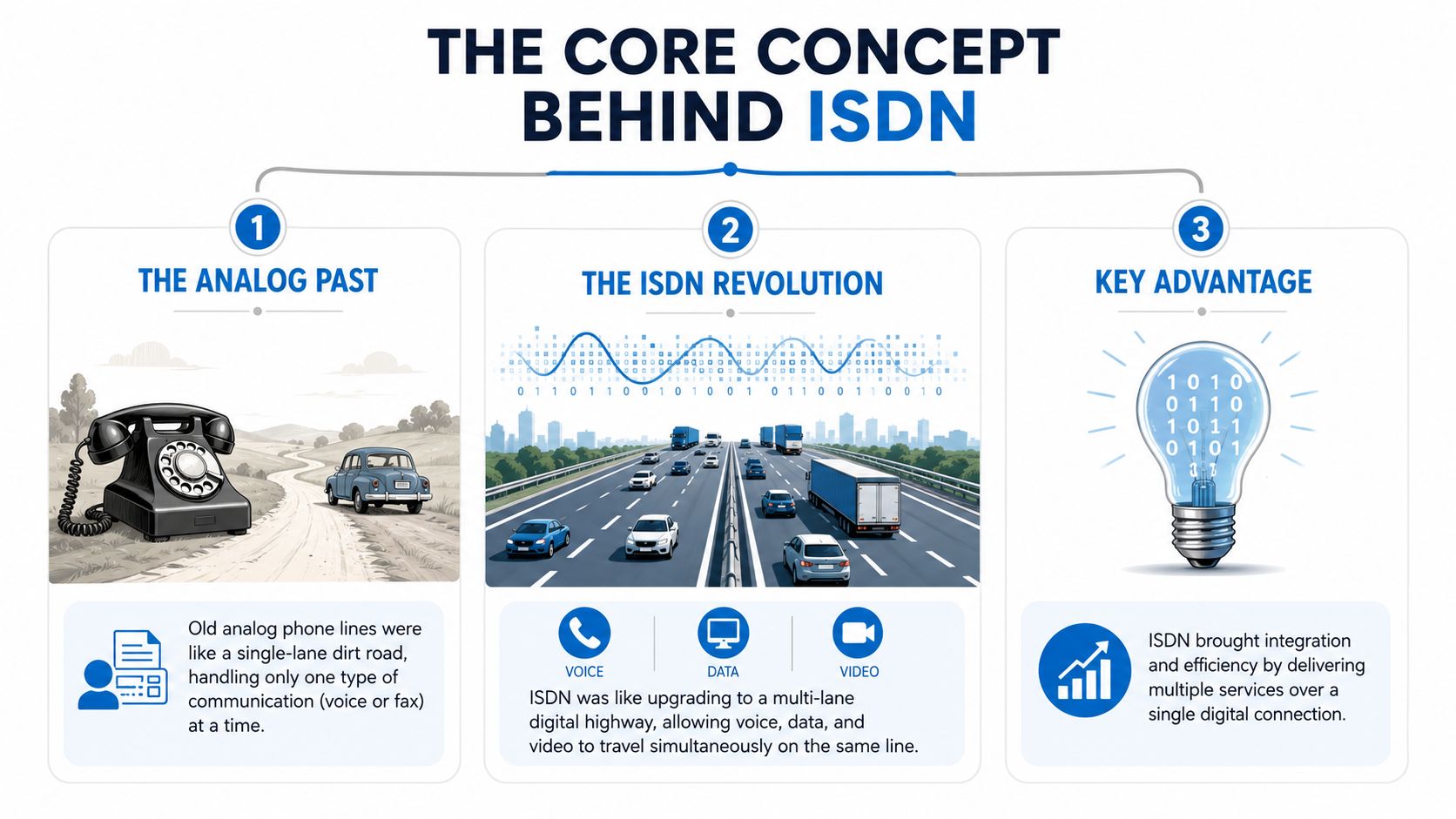
Think of an old analog phone line as a narrow dirt road. It worked, but it wasn't flexible. It mainly handled voice, and anything else felt like squeezing a different kind of traffic onto a road that wasn't designed for it.
ISDN was more like paving that road and adding organized lanes. Voice could travel in one lane, signaling could travel in another, and the whole trip became cleaner and more predictable.
What “integrated services” really means
The phrase sounds more technical than it needs to be. “Integrated services” meant that voice, data, text, and even video could move through one digital framework instead of living as separate worlds.
Older systems often treated data as the odd one out. ISDN changed that by making data part of the design, not an afterthought.
Here's the plain-English version:
| Old analog approach | ISDN approach |
|---|---|
| Voice was the default use of the line | Voice and data were both planned for |
| Data often felt bolted on | Data was built into the service model |
| One activity could interfere with another | Multiple services could coexist more neatly |
Why businesses cared
For a business owner, ISDN's appeal was straightforward. If one line could support better calling and digital data at the same time, you got more value from the infrastructure you already had. You didn't need to think of “phone” and “computer connection” as totally separate utility categories anymore.
That was the promise. ISDN used traditional copper phone wiring, but it delivered a more digital experience end to end.
Practical takeaway: If you've ever wondered why ISDN mattered, the answer isn't raw speed alone. It brought order, predictability, and multiple services to a network that had mostly been built for plain old voice calls.
How ISDN Works Channels and Interfaces
To understand ISDN mechanically, it helps to keep the highway analogy. A connection wasn't just one undifferentiated stream. ISDN divided work into channels, and each channel had a job.
The two key channel types were B channels and D channels. The B stands for bearer. That's the lane that carries the actual conversation or data. The D stands for delta, and that's the lane used for signaling, which means call setup, control, and coordination.

B channels and D channels
A useful way to picture it is this:
- B channels carry the payload: your voice call, your data session, or another active service
- D channels handle traffic control: dialing, setup, and signaling
- Separation improves order: the network doesn't have to mix conversation and control in the same path
That separation was one reason ISDN could set up calls faster and behave more reliably than older analog systems.
Basic Rate Interface for smaller setups
The best-known version for homes and small offices was BRI, or Basic Rate Interface. According to this ISDN teaching reference, BRI provided two 64 Kbps Bearer channels and one 16 Kbps Delta channel, totaling 144 Kbps, and it could bond the two B channels for 128 Kbps data. That same source notes this was three times faster than the fastest modems available at the time of its design.
That layout explains why people liked BRI. You could use one B channel for a call and the other for data, or combine both B channels for faster data when needed.
Here's the simplest way to think about BRI:
| Part | Role |
|---|---|
| Two B channels | Carry voice or data |
| One D channel | Handles signaling |
| Bonded B channels | Combine for a faster data session |
For a small office, that made sense. One line could do more than one job without feeling chaotic.
Primary Rate Interface for bigger offices
Larger organizations often used PRI, or Primary Rate Interface. PRI was the version built for office phone systems, PBX connections, and environments where many calls had to run together.
ISDN became part of business telephony rather than just internet access. A company could connect its internal phone system to the outside world through a structured digital service instead of relying on older analog trunks. If you're comparing that older model with modern calling, this guide to how SIP trunks work is a useful next step because SIP trunking now fills much of the role that PRI once handled.
One of ISDN's smartest design choices was simple: it separated the road used for control from the road used for conversation.
That may sound modest now, but at the time it gave users a more organized, business-ready connection.
Common ISDN Use Cases Then and Now
ISDN earned its reputation by solving real communication problems. It wasn't admired because of theory. People used it because it worked better than the options they had.
In its stronger years, ISDN showed up in places where stable digital communication mattered more than cutting-edge speed. Early video conferencing systems depended on it. Broadcast and studio environments used it for dependable audio links. Businesses used it for remote office connections, PBX access, and internet service before broadband became common.
Where ISDN made sense
Some historical use cases were especially easy to understand:
- Early remote work: Staff could connect to office systems without relying on slower analog modem behavior.
- Business phone systems: Offices used PRI connections to support multiple simultaneous calls.
- Video conferencing: Professional environments valued predictable connections over novelty.
- Retail and service environments: Critical transactions and communications benefited from dedicated lines.
A modern reader might look at that list and think, “So it was just an older internet service.” Not quite. ISDN was often less about internet in the modern sense and more about dependable digital transport.
The legacy failsafe role
This is the part most basic articles skip. Even after better broadband arrived, some organizations kept ISDN because it behaved differently from internet-based systems. ISDN is circuit-switched and independent of the public internet, which gave it value as a backup path.
According to this Fusion Connect glossary entry on ISDN, recent industry analysis confirms that 4G/5G wireless and DSL fail under high-traffic congestion, whereas ISDN maintains stable, dedicated throughput independent of the public internet. The same source notes that businesses in major markets still retain ISDN PRI lines for this “always-on” backup capability.
That explains why some companies delayed migration. If your office phones, transaction systems, or critical communication tools absolutely had to stay available, an old ISDN line could still serve a purpose.
A technology can be obsolete for mainstream use and still remain valuable in a narrow backup role.
If you're sorting through old business telephony terms, it also helps to understand the office equipment ISDN often supported, such as a PABX system, because many legacy phone environments were built around that combination.
The Decline of ISDN Why Did It Fade Away
ISDN didn't disappear because it was badly designed. It faded because the world moved to services that were faster, simpler, and better suited to internet-heavy work.
The biggest reason was bandwidth. Once DSL, cable, and later fiber became available, users no longer had to squeeze modern work into narrow channels designed in an earlier era. Cloud apps, large file transfers, streaming, and always-on connectivity all pushed in a direction ISDN couldn't comfortably follow.
What changed in the market
ISDN had strengths, but newer technologies matched the moment better:
- Broadband stayed connected all the time: users didn't have to think in the same call-session mindset
- Internet use changed: websites, cloud tools, and media-rich applications demanded more capacity
- Hardware got easier: broadband equipment felt more natural for homes and offices than specialized legacy setups
ISDN also suffered from a practical problem that hits many old technologies. Even if a system still works, carriers eventually stop wanting to maintain aging infrastructure.
A clear sign of that shift came in 2025, when British Telecom announced plans to completely shut off its ISDN and PSTN services and transition to VoIP, as noted in this ISDN reference overview. Once major providers actively retire support, migration stops being optional.
Why the old reliability argument stopped carrying the day
The “legacy failsafe” case was real, but it couldn't hold off the larger transition forever. Businesses can only rely on a backup service for so long if the provider ecosystem is dismantling the platform behind it.
That pressure shows up in three ways:
Support gets harder
Legacy equipment becomes more difficult to maintain and replace.Carrier incentives change
Providers want to simplify networks around IP-based services, not preserve shrinking islands of copper-based infrastructure.User expectations rise
Teams expect cloud calling, video meetings, mobile apps, and flexible scaling. ISDN wasn't built for that model.
A short explainer can help if you want a visual contrast between legacy telephony and current network thinking:
The story of ISDN's decline is really the story of communications becoming software-driven, internet-based, and always connected.
Migrating from ISDN to Modern Solutions
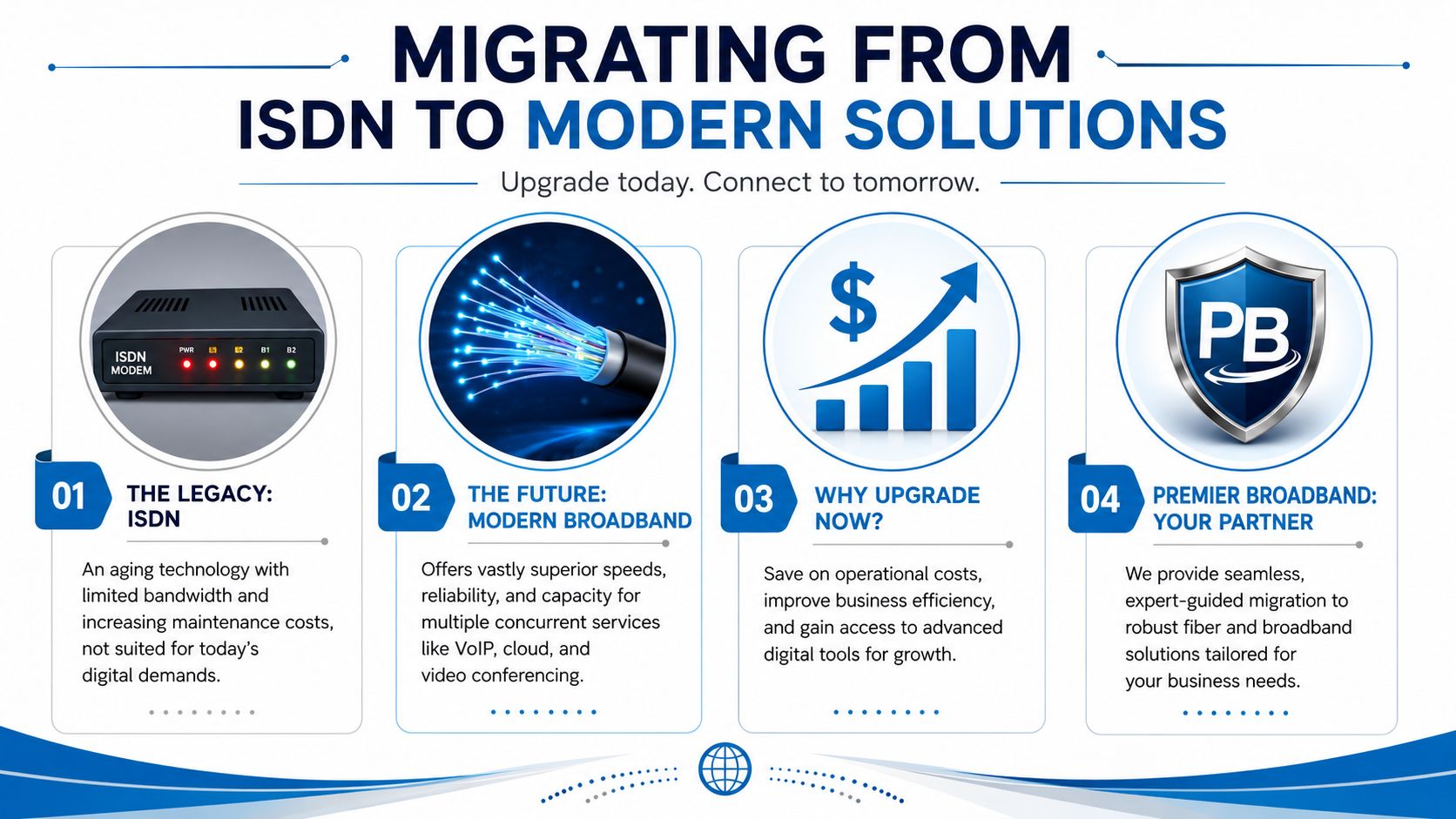
If you're still using ISDN, or supporting a site that is, migration usually comes down to two upgrades: fiber for connectivity and VoIP for calling.
That pairing replaces what ISDN once did well and adds the things ISDN never handled gracefully, such as cloud applications, mobile integration, remote collaboration, and modern scalability.
The bandwidth gap is no longer close
One of the clearest reasons to move is simple capacity. According to this contact center ISDN overview, ISDN PRI offers 2.048 Mbps, while entry-level fiber such as Premier Broadband's Home Office Hero plan delivers 100+ Mbps symmetrical speeds.
That isn't a minor improvement. It's a completely different class of service.
Here's the practical comparison:
| Connection type | What it supports well |
|---|---|
| ISDN PRI | Legacy calling, narrow-band dedicated tasks, older systems |
| Modern fiber | Video meetings, cloud apps, streaming, backups, large file transfers, VoIP, multi-user work |
Why VoIP replaces ISDN telephony
ISDN made digital calling practical in the phone-network era. VoIP does the same in the internet era, but with far more flexibility.
Modern VoIP systems can support features that businesses and households now expect, such as voicemail-to-email, mobile app access, caller tools, and easier scaling across locations. If you're weighing the old and new models directly, this comparison of VoIP vs landline gives a helpful baseline for decision-making.
A good migration plan focuses on continuity
The biggest fear with any telecom change is disruption. That's fair. Phone numbers, business hours, customer access, and internal workflows all depend on communication being stable.
A sensible migration usually includes:
- Audit the current setup: Identify which lines still handle phones, alarms, faxing, conferencing, or specialty equipment.
- Separate essential from historical: Some services remain mission-critical. Others are only there because nobody has removed them.
- Map each function to a modern replacement: VoIP, fiber internet, mobile failover, or specialized adapters may each play a role.
- Test before cutover: Don't assume a new service behaves exactly like the old one.
Migration rule: Replace the business function first, then retire the legacy circuit. Don't remove an old line until you know what job it was actually doing.
What about the reliability concern
Some owners hesitate. They remember ISDN as stable, and they worry that moving everything to IP means trading reliability for convenience.
That concern made sense during the transition years. It makes less sense when the alternative is aging copper, shrinking carrier support, and equipment that fewer technicians still work on. Modern fiber networks are built for current traffic patterns, and VoIP services are designed around today's communication habits rather than yesterday's constraints.
For nearly every home and business use case, modern infrastructure now does the job better and with far more room to grow.
The Future Is Fiber and VoIP
ISDN deserves some respect. It helped move communications from analog limitations toward digital integration, and for a while it solved problems that mattered. It even held onto relevance longer than many people expected because a dedicated circuit still had backup value in some environments.
But communications no longer revolve around narrow digital lanes on copper lines. Homes want smooth streaming, gaming, remote work, and strong uploads. Businesses want cloud apps, video meetings, flexible phone systems, and mobility across devices. That future belongs to fiber and VoIP.
If you're evaluating phone options beyond a desk handset, it's also worth reviewing modern mobile-friendly tools like these top iPhone VoIP services, because they show how far calling has moved from fixed copper infrastructure toward software-based communication.
For internet access, the same shift is even clearer. A modern network is expected to be fast, symmetrical, scalable, and ready for everything from smart homes to distributed teams. If you want a simple explanation of the access layer behind that change, this overview of fiber to the home is a solid place to start.
ISDN was an important bridge. Fiber and VoIP are the destination most users need.
If you're ready to leave legacy copper behind, Premier Broadband offers fiber internet and VoIP solutions built for the way homes and businesses work now. Whether you need dependable connectivity for remote work, better voice service for your company, or a full upgrade from outdated systems, Premier Broadband can help you move to faster, simpler, modern communications.