
VoIP, which stands for Voice over Internet Protocol, is simply a way to make and receive phone calls over an internet connection instead of a traditional copper landline. Think of it like sending an email versus a letter through the post office. This modern approach delivers crystal-clear call quality and opens the door to powerful features that old-school phone lines just can't match.
How VoIP Phone Service Actually Works
At its heart, VoIP phone service is a technology that turns your voice into digital information. Instead of using the old, clunky network of copper wires—the Public Switched Telephone Network (PSTN)—VoIP uses the same internet connection you already have for browsing the web or streaming movies. It’s a smarter, more flexible way to talk.
The process itself is incredibly fast and efficient. When you speak, your VoIP device instantly converts your voice into tiny digital files called data packets. These packets zip across the internet in milliseconds to their destination, where they’re reassembled back into clear audio for the person on the other end.
This four-step journey from a spoken word to a clear conversation is what makes it all possible.
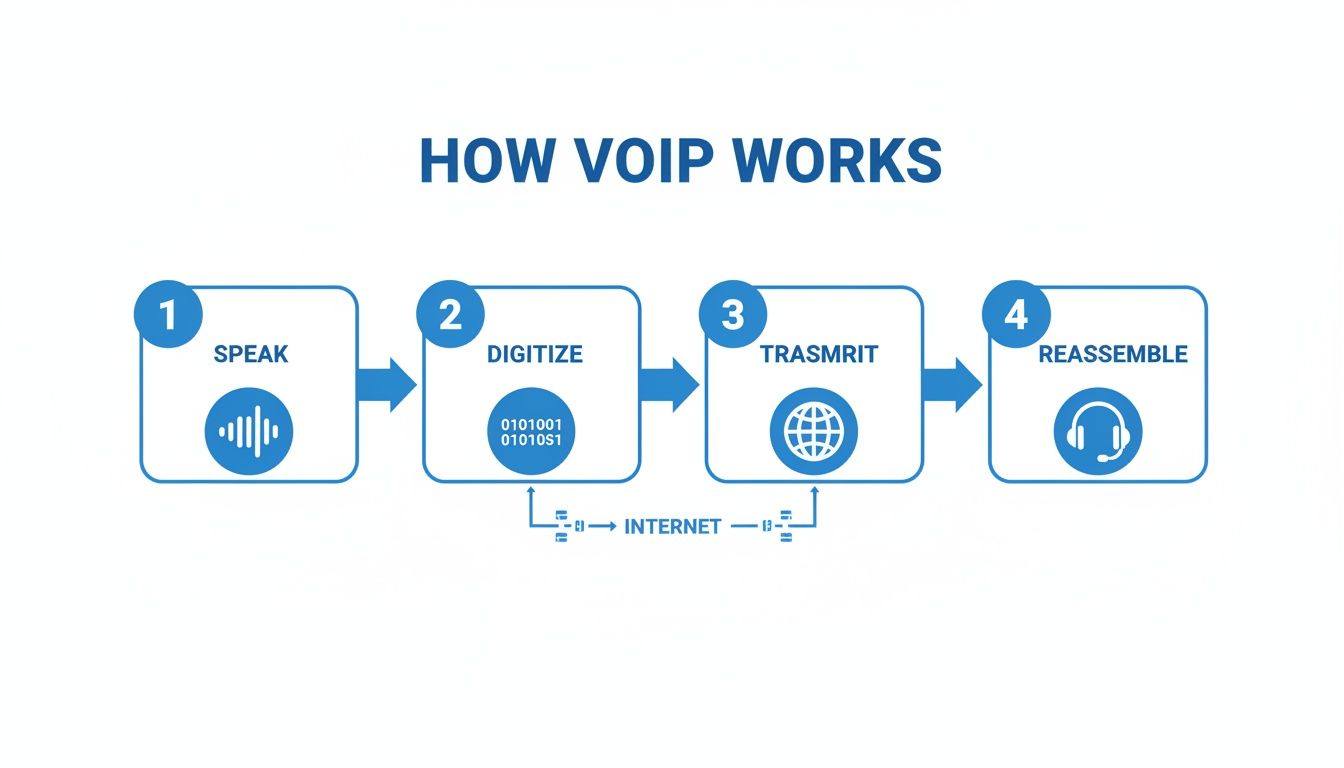
This seamless digital process is the engine behind VoIP, allowing it to deliver high-quality audio across town or across the globe in the blink of an eye.
VoIP at a Glance: Key Concepts Explained
To make things even clearer, here’s a quick breakdown of the core ideas behind VoIP technology. This table translates the tech jargon into simple terms so you can see exactly what’s happening behind the scenes.
| Concept | Simple Explanation | Why It Matters |
|---|---|---|
| Voice over IP (VoIP) | Making phone calls over the internet instead of a landline. | It's more flexible, cost-effective, and feature-rich than old phone systems. |
| Data Packets | Your voice, broken down into tiny digital files for travel. | This allows calls to travel efficiently over any internet connection, just like other data. |
| PSTN | The old-school copper wire network for traditional telephones. | VoIP bypasses this outdated network for better quality and reliability. |
| Cloud Phone System | A complete phone system that lives online, not in your office closet. | This gives businesses advanced features and scalability without expensive hardware. |
Understanding these basics shows why VoIP isn't just a different way to make calls—it's a fundamentally better one, built for the way we work and live today.
A Rapidly Growing Standard
This technology isn't just some niche alternative anymore; it's quickly becoming the new standard for how we communicate. In 2025, the global VoIP market was valued at approximately $161.79 billion.
That number is expected to explode to $453.75 billion by 2035, growing at a compound annual rate of 10.86%. This incredible growth shows just how many homes and businesses are leaving their landlines behind for a more modern solution.
From Analog to Digital Packets
The digital-first design is why VoIP can do so much more than provide a simple dial tone. Since your calls are treated as data, they can be managed, routed, and combined with other digital tools in ways that are completely impossible for analog technology.
For example, many businesses now run on a cloud phone system, which is an advanced type of VoIP that hosts your entire phone system online, freeing you from bulky on-site equipment.
VoIP vs. Landlines: The Real-World Differences

So, you understand the technology. But what does switching from a traditional landline to a VoIP phone service actually look like day-to-day? While both let you make and take calls, that's where the similarities end.
The most immediate change you'll notice is freedom. A landline literally tethers your phone number to a wall jack in a specific building. If your business moves, you might lose your number. With VoIP, your phone number belongs to you, not a physical address. You can answer calls on a desk phone in the office, a laptop at home, or your smartphone on the go.
Cost and Features Head-to-Head
The biggest divide appears when you compare costs and included features. Landline providers have a reputation for nickel-and-diming customers. Your basic monthly fee is just the start; features like caller ID, voicemail, and call waiting almost always cost extra. And international calls? They can get notoriously expensive.
VoIP flips that model completely. Most providers, including Premier Broadband, bundle a huge list of powerful calling features right into the standard plan. Things like auto-attendants, voicemail-to-email transcription, and call forwarding are included from day one. International calling rates are a tiny fraction of what old-school phone companies charge, often just pennies per minute.
The real value of what is VoIP phone service isn’t just in replacing your old phone line. It’s about getting a whole suite of modern communication tools that used to be reserved for giant corporations with massive budgets.
Because VoIP turns your voice into data, it seamlessly integrates with other digital tools, unlocking a level of functionality that landlines simply can't match.
Comparison: VoIP Phone Service vs. Traditional Landline
To really see the gap between old and new, a side-by-side comparison helps. The table below lays out the key differences that matter to both homes and businesses.
| Feature | VoIP Phone Service | Traditional Landline |
|---|---|---|
| Foundation | Uses your internet connection (fiber, cable) | Requires dedicated copper wire network |
| Mobility | Take your number anywhere with an internet connection | Tied to a single physical address |
| Core Features | Includes voicemail-to-email, auto-attendant, call forwarding | Caller ID, voicemail, and call waiting often cost extra |
| Scalability | Add or remove lines instantly through a web portal | Requires a technician visit and physical wiring |
| International Calls | Extremely low rates (e.g., $0.01/minute to the UK) | High rates (e.g., $1.21+/minute to the UK) |
| Hardware | Works on IP phones, computers, and mobile apps | Requires a specific analog telephone |
This contrast makes it clear why so many are making the switch. It's not just about saving money—it's about gaining superior capabilities that help you communicate more effectively.
Even older office tasks get an upgrade. For example, using VoIP allows for cloud-based faxing without needing a separate, dedicated phone line. It’s another way that VoIP helps businesses consolidate all their communication tools onto a single, modern, and cost-effective platform.
The Core Benefits of Making the Switch to VoIP

Now that you see the difference between old and new phone technology, let’s get into why so many homes and businesses are happily making the switch. Moving to a VoIP phone service isn’t just a small upgrade—it’s a move that brings powerful, immediate advantages.
For most people, the benefits fall into four main categories: major cost savings, powerful features, unmatched flexibility, and easy scalability. When you see what you get, making the change is a no-brainer.
Drastically Reduce Your Phone Bill
The first thing almost everyone notices with VoIP is the big drop in their phone bill. We all know how traditional phone companies work, with their confusing bills, line rental fees, and shocking per-minute rates for long-distance and international calls. VoIP cuts through all that complexity.
Since your calls travel over the internet connection you already pay for, most of those old fees just vanish. You stop paying for a physical phone line, period. On top of that, most VoIP plans come with unlimited calling in your own country, and international rates are just a fraction of what you’re used to. It's not uncommon for businesses to see their phone costs drop by over 50%.
And the savings don't stop with your monthly bill. With VoIP, you don’t need a closet full of expensive equipment or have to pay for a technician every time you want to make a change. Our guide on low-cost VoIP solutions digs deeper into how you can get the most bang for your buck.
Unlock Powerful Communication Features
VoIP is so much more than a dial tone. It turns your phone into a full-blown communication hub, loaded with features that make you more productive and professional. The best part? Most of these tools are standard, not expensive add-ons like they are with a landline.
Some of the key built-in features include:
- Auto-Attendant: Think of it as a virtual receptionist that greets callers and guides them to the right place (“Press 1 for sales, Press 2 for support”). It makes even the smallest business sound polished and professional.
- Voicemail-to-Email: This handy tool automatically turns your voicemails into text and sends them right to your inbox. You can read your messages anywhere and decide who to call back first.
- Call Recording: Need to save an important conversation for training, quality control, or just to have a record? You can do it with a single click.
- Mobile App Integration: Turn your smartphone into your business line. Make and receive calls with your business number from anywhere, keeping your personal number private.
These features aren't just for show; they deliver real results. In fact, 93% of enterprises say VoIP has made a huge difference in their workflow. Research shows employees get back an average of 32 minutes daily thanks to features like mobile integration. With a global user base of 1.93 billion, it's clear the business world has voted yes on these productivity boosts.
By adopting VoIP, a small business can instantly project the professional image and operational efficiency of a much larger corporation, all without the high cost.
Gain Flexibility for Modern Life and Work
A traditional landline literally ties your phone number to a wall jack. In today’s world of remote work and always-on-the-go lifestyles, that’s a massive limitation. VoIP completely frees your phone number from any single location, giving you true communication freedom.
This means you can:
- Work from the office one day and home the next without anyone knowing the difference.
- Travel across the country and answer your office line on your laptop in a hotel room.
- Set up rules to have calls ring your desk phone first, then your cell, then your home office, making sure you never miss that important call.
Scale Your Service Effortlessly
Finally, VoIP grows right alongside you. If your business is expanding, you no longer have to call a technician and wait for them to run new wires for a new employee. With a VoIP phone service, you can add a new line or user in seconds through a simple online dashboard. This agility lets you scale your phone system up or down whenever you want, so you only pay for exactly what you need.
Unlocking Powerful VoIP Features for Work and Home
A VoIP phone service is so much more than just a cheaper replacement for your old landline. Think of it as a complete communication toolkit for modern work and life. While the cost savings are definitely a big plus, the real power is in the smart features that come standard.
These tools completely change how you connect, making you more productive, professional, and always available. Let's look past the simple feature lists and see what they actually do for you. Imagine your phone system actively working on your behalf—that's what a great VoIP service delivers.
Your Personal Digital Assistant
Think about all the time wasted playing phone tag or trying to read your own scribbled-down messages. VoIP introduces features that work like a personal assistant, managing your calls so you can focus on what's important.
Voicemail-to-Email: This one is a total game-changer. Instead of dialing into a clunky voicemail box, VoIP can automatically transcribe your messages into text and send them right to your email. You can scan messages in seconds, prioritize who to call back first, and keep a digital record of everything.
Auto-Attendant: An auto-attendant is like having a virtual receptionist. It greets callers with a professional, recorded message and guides them to the right place (“Press 1 for sales, Press 2 for support”). This gives even a one-person shop the polished feel of a much larger company.
For a freelancer, an auto-attendant instantly makes their business sound more established. For a busy family, it can route calls from school directly to a parent’s cell phone while sending other calls to the home line.
Never Miss a Critical Call Again
One of the biggest worries with any phone system is missing that one important call you've been waiting for. VoIP’s flexibility solves this with intelligent call routing that makes sure you’re always reachable.
A key feature here is Find Me/Follow Me. This lets you set up a sequence of numbers for an incoming call to try. For example, a call to your business number could ring your desk phone for 15 seconds, then your mobile for another 15 seconds, and finally your home office. If you don't pick up, it goes to voicemail.
This intelligent routing means you're never tied to a single location. You can be on the road, at a job site, or working from home and still be completely responsive.
This is essential for anyone who needs to stay connected without being chained to a desk. It offers true peace of mind and keeps customers happy by making you easy to reach.
Turning Your Smartphone into a Business Line
This is where VoIP really shines. Most providers offer a mobile app that turns your personal smartphone into a full-featured business phone.
You can make and receive calls using your business number, right from your own smartphone. Your personal cell number stays private, but you get the convenience of only carrying one device. Better yet, the caller ID shows your business name, so you always look professional. Many companies use a virtual phone number for business to add even more flexibility and professionalism to their setup.
These apps do more than just calls. You can check business voicemail, send texts, and manage your call settings from anywhere. This truly untethers you from your desk and makes remote work seamless. Many businesses also combine VoIP with CRM systems to build an incredibly powerful workflow for their sales and support teams.
Getting Started with Your New VoIP Service
Ready to make the switch? You might be surprised at just how easy it is to move to a VoIP phone service. We've broken down the entire setup into a simple, step-by-step guide to get you up and running with better, more affordable phone service with minimal fuss.
We'll walk you through everything, from checking your internet connection to choosing your hardware and even keeping your current phone number.
Step 1: Check Your Internet Connection
A great VoIP experience starts with a solid internet connection. Because your calls travel over the internet, you need a stable, high-speed connection to get that crystal-clear audio quality without any frustrating drops or jitter.
Before you do anything else, make sure your internet is up to the task. Most standard broadband connections will work just fine, but if you want the absolute best performance, nothing beats a 100% fiber optic connection like the one offered by Premier Broadband. It provides the low latency and symmetrical speeds you need for flawless calls, every time.
Step 2: Choose the Right VoIP Provider
Once you know your internet is ready, it's time to pick a VoIP provider. This is the most important decision you'll make, since this partner will handle everything from call routing to customer support. You want a provider known for rock-solid reliability, excellent service, and fair pricing.
When looking at your options, ask these questions:
- Is the network reliable? Look for providers that guarantee high uptime and are backed by robust infrastructure, like a fiber network.
- What features are included? Does the plan come with everything you need, like an auto-attendant, voicemail-to-email, or a mobile app, without tacking on extra fees?
- What is their support like? If you run into an issue, can you get a real person on the phone quickly to help you solve it?
- What are the contract terms? Look for flexibility. You don't want to get locked into a long, rigid contract packed with hidden fees.
Choosing a provider like Premier Broadband that offers both high-speed internet and VoIP simplifies your setup and billing, ensuring both services work together perfectly from day one.
The move to VoIP is growing fast, especially in places with great internet. North America is leading the charge, holding 38% of the global VoIP market thanks to widespread broadband. By early 2025, it's projected that North America will account for 34.8% of all global VoIP revenue—a market worth around $58 billion. You can dive deeper into these trends and see the global distribution of VoIP adoption on sheerbit.com.
Step 3: Select Your Hardware
With your provider picked out, it's time to think about hardware. One of the best things about VoIP phone service is the flexibility. You aren't locked into a single type of device.
You've got a few great options to choose from:
- Dedicated VoIP Phones: These look just like the desk phones you're used to, but they plug right into your internet connection. They offer the best call quality and direct access to advanced features.
- Analog Telephone Adapter (ATA): Love your current landline phone? No problem. An ATA is a small, simple box that connects your old phone to your router, making it instantly compatible with VoIP.
- Softphones and Mobile Apps: For ultimate flexibility, you can use a software-based phone (a softphone) on your computer or a mobile app on your smartphone. This lets you make and take calls from your business number no matter where you are.
Step 4: Port Your Existing Phone Number
One of the biggest concerns people have when switching is the thought of losing their phone number. With VoIP, you don’t have to worry about that. You can bring your current home or business number with you through a process called number porting.
Your new VoIP provider will handle the entire transfer for you. It's a standard, regulated process designed to be completely seamless. Your friends, family, and customers can keep calling the same number they've always used, without any interruption.
Choosing the Right VoIP Provider for Your Needs
Not all VoIP providers are created equal. Choosing the right one is the single most important step to getting a phone service that works for you, not against you.
The best choice comes down to your specific needs. Are you a freelancer running a business from home? A growing team that needs to stay connected? Or a family looking to save money? The features that are essential for a busy office might just be overkill for your home. Let's break it down.
Defining Your User Profile
To cut through the noise, let's look at a few common scenarios and what you should really be looking for in a VoIP phone service.
The Home Office Hero:
When you're a remote worker or solopreneur, your professional image is everything. You need a service that makes you look like a major player, but without the enterprise-level cost.
Look for a dedicated business number, a mobile app that keeps your work and personal calls separate, and an auto-attendant to professionally greet and direct callers. A service backed by a high-speed fiber network, like Premier Broadband, is non-negotiable—it guarantees your client calls are always clear and reliable.
The Growing Small Business:
If you’re managing a team, you need a system that can grow with you. Forget calling a technician just to add a new employee. Your focus should be on scalability and collaboration.
You’ll want features like call queues to handle busy periods, internal extensions for seamless team communication, and the ability to integrate with the software you already use. This requires a provider with a serious business offering designed to scale on demand.
The Connected Family:
For the modern household, the primary goals are usually saving money and adding convenience. You need a dependable home phone replacement that won’t break the bank.
This means looking for affordable international calling to keep in touch with family abroad and features like simultaneous ring, so an important call can find you on your cell phone. Strong security and spam-blocking are also top priorities to keep your home line safe.
The key is to match the provider’s strengths to your daily communication needs. A mismatch can lead to paying for features you never use or missing out on tools that could save you time and money.
Your Provider Vetting Checklist
Once you know what your profile looks like, it's time to evaluate your options. Don't be shy about asking direct questions before you sign anything. A solid provider will have clear, confident answers. Our guide on the top VoIP providers for business dives even deeper, but here’s a checklist to get you started:
- Network Reliability: What’s your uptime guarantee? What kind of network (fiber, cable, DSL) is the service built on? A stable internet connection is the bedrock of good VoIP.
- Customer Support: What are your support hours? If something goes wrong, can I talk to a real person quickly, or am I stuck with chatbots?
- Contract Terms: Are plans month-to-month, or am I locked into a long-term contract? Are there hidden setup fees or equipment charges?
- Security Protocols: How do you protect my calls and account data from hackers and other threats? Is call encryption offered?
By asking these questions, you can move forward with a VoIP partner that truly supports your goals. You'll get all the power of modern voice technology without any of the headaches.
Frequently Asked Questions About VoIP Service
Thinking about making the switch to VoIP? It's normal to have a few questions. We've put together answers to the most common things people ask before upgrading their phone service.
Can I Keep My Current Phone Number
Yes, you can. We know how important it is for your friends, family, and customers to be able to reach you at the number they already have.
The process is called number porting, and it lets you bring your existing number with you. Your new provider, like Premier Broadband, handles the entire transfer behind the scenes. It's a smooth transition with no service interruption.
What Happens If My Internet Goes Down
This is a great question, since VoIP runs over your internet connection. But don't worry—quality VoIP systems have a backup plan built right in.
A feature called call forwarding or failover automatically detects if your internet goes down. When that happens, it instantly reroutes all your incoming calls to a backup number, like your cell phone. This way, you never miss an important call, and your business stays connected.
Is VoIP Phone Service Secure
Your security is our top priority. Reputable VoIP providers use powerful security measures to keep your calls private and your account safe from anyone who shouldn't have access.
High-quality VoIP services rely on strong encryption, like Transport Layer Security (TLS) and Secure Real-Time Transport Protocol (SRTP). This technology scrambles your call data, making it unreadable to anyone trying to listen in.
When you choose a trusted provider, you can feel confident that your calls are just as secure as a traditional landline—and in many cases, even more so.
Ready to get crystal-clear calls, powerful features, and big savings? Switch to a VoIP phone service backed by a 100% fiber network. Premier Broadband offers reliable, affordable solutions for both homes and businesses. Learn more and make the switch today at premierbroadband.com.