
When you first hang your shingle, consumer-grade internet might seem good enough. But as you grow, you start to feel the pinch. Dropped calls and painfully slow file transfers aren't just annoying—they're a liability that can throttle your growth. The moment you realize your connection is holding you back, it’s time to look at a professional small business internet and phone solution. Think of it not as an expense, but as a critical investment in your stability and professional image.
When to Upgrade Your Business Internet and Phone
Does your current setup feel like it's fighting against you? Many small businesses hit a wall where their basic internet and phone service actively gets in the way of progress. Moving from a "good enough" setup to a professional-grade system is a major step. It’s the point where you stop asking if you can afford to upgrade and start asking if you can afford not to.
Recognizing the Warning Signs
The signs that you've outgrown your system are often subtle at first, but they become more disruptive over time. Catching these growing pains early is the first step toward building a communication foundation that can actually support your business.
You might need an upgrade if you’re seeing:
- Poor Call Quality: Clients are complaining about choppy audio or dropped calls. Nothing damages your credibility faster than a bad connection during an important conversation.
- Slow File Transfers: Trying to upload large project files to the cloud feels like watching paint dry, creating bottlenecks and delaying deadlines.
- Team Collaboration Issues: Video meetings are a mess of frozen screens and lagging audio, making remote collaboration a frustrating chore for your team.
- Limited Phone Features: Your current phone system is bare-bones. It lacks essentials like an auto-attendant or call forwarding, making your operation seem small and less professional.
The investment you make in a true small business solution goes straight to your bottom line. It's about enhancing security, boosting productivity, and delivering a superior customer experience.
From Cost to Investment
It’s crucial to shift your mindset and see a modern communication system as a strategic investment, not just another monthly bill. An integrated system, like bundled fiber internet and Voice over IP (VoIP), is designed to solve these exact problems. This approach gives you the speed, reliability, and advanced features you need to support a growing team. It turns your technology from an obstacle into a catalyst for growth.
How Bundling Fiber and VoIP Unlocks Growth
To really get a handle on modern business communication, we need to look at its two main pillars: fiber internet and Voice over IP (VoIP).
Think of fiber internet as your own private, multi-lane superhighway built just for your business data. It lets you completely bypass the traffic jams and slowdowns you see with older cable or DSL connections.
VoIP is the flexible, powerful phone system that cruises along this superhighway. Instead of relying on ancient copper wires, VoIP uses your internet connection for every call, turning your old phone system into a modern communication powerhouse. When these two work together, you get a small business internet and phone bundle that just makes sense.
The Power of a Dedicated Highway
The secret to communication that never fails you is the quality of your internet connection. At the end of the day, a VoIP system is only as good as the internet it runs on. When your business depends on crystal-clear video meetings and client calls that don't drop, you need a connection that’s rock solid.
Fiber internet provides that foundation with two huge advantages:
- Massive Bandwidth: Fiber delivers symmetrical speeds, meaning your uploads are just as fast as your downloads. This is a game-changer for sending large files, backing up data, or hosting HD video calls without any frustrating lag.
- Unmatched Reliability: Unlike cable, which often slows down when everyone in the neighborhood gets online, fiber gives you a dedicated line. Your connection stays consistently fast, so your call quality won't suddenly tank during peak business hours.
Why Bundling Makes Business Sense
Pairing your fiber internet and VoIP phone service with a single provider is about more than just convenience—it gives your business a real leg up. This approach simplifies everything and strengthens your entire tech setup.
A big win is streamlined management. Instead of juggling bills and support numbers for different companies, you have one person to call for everything. That means troubleshooting is faster and you have one partner who’s fully invested in keeping your business connected.
Combining a robust fiber connection with a feature-rich VoIP system isn't just an upgrade—it's a strategic move. This powerful pairing creates a communication infrastructure that is fast, reliable, and built to scale with your ambitions.
On top of that, bundling almost always leads to serious cost savings. Providers give you better rates when you combine services, which directly lowers your monthly overhead. To really make the most of this strategy, it's smart to research the best VoIP systems for small business and explore different VoIP solutions for small business to find the perfect match.
The results speak for themselves. Small businesses that switch to high-speed internet are seeing 30% faster growth rates than their competitors. With average U.S. broadband speeds now at 231.1 Mbps, even a small operation can easily handle cloud services and other data-heavy tasks without breaking a sweat.
Decoding The Technical Needs For Your Business
Let's be honest, diving into the technical side of a small business internet and phone bundle can feel a bit like learning a new language. But you don't need to be an IT genius to make a smart decision. Understanding just a few key ideas will give you the confidence to choose the right setup for your company.
Think of bandwidth as the size of the pipe bringing data into your office. The bigger the pipe, the more data can flow through it at once. This is what allows your whole team to be on video calls, use cloud apps, and serve customers simultaneously without everything slowing to a crawl.
Mastering Your Connection Quality
But raw speed isn't the whole story. You also need to control how that data moves, which is where Quality of Service (QoS) comes into play. If your internet connection is a highway, QoS is the express lane reserved for your most important traffic.
It smartly prioritizes real-time data—like your VoIP phone calls and video conferences—over less urgent things like background updates or emails. This simple act of prioritization is what prevents those frustrating choppy calls and frozen video screens, ensuring you always sound professional, even when your network is busy. To get a better handle on your needs, our guide on what a good upload speed is breaks down what different business activities require.
A true business-grade internet connection isn’t just about the speed you buy. It’s about how that speed is managed to deliver rock-solid, consistent performance for the tools that actually make you money.
This graphic shows how a bundled strategy brings all these critical pieces together.
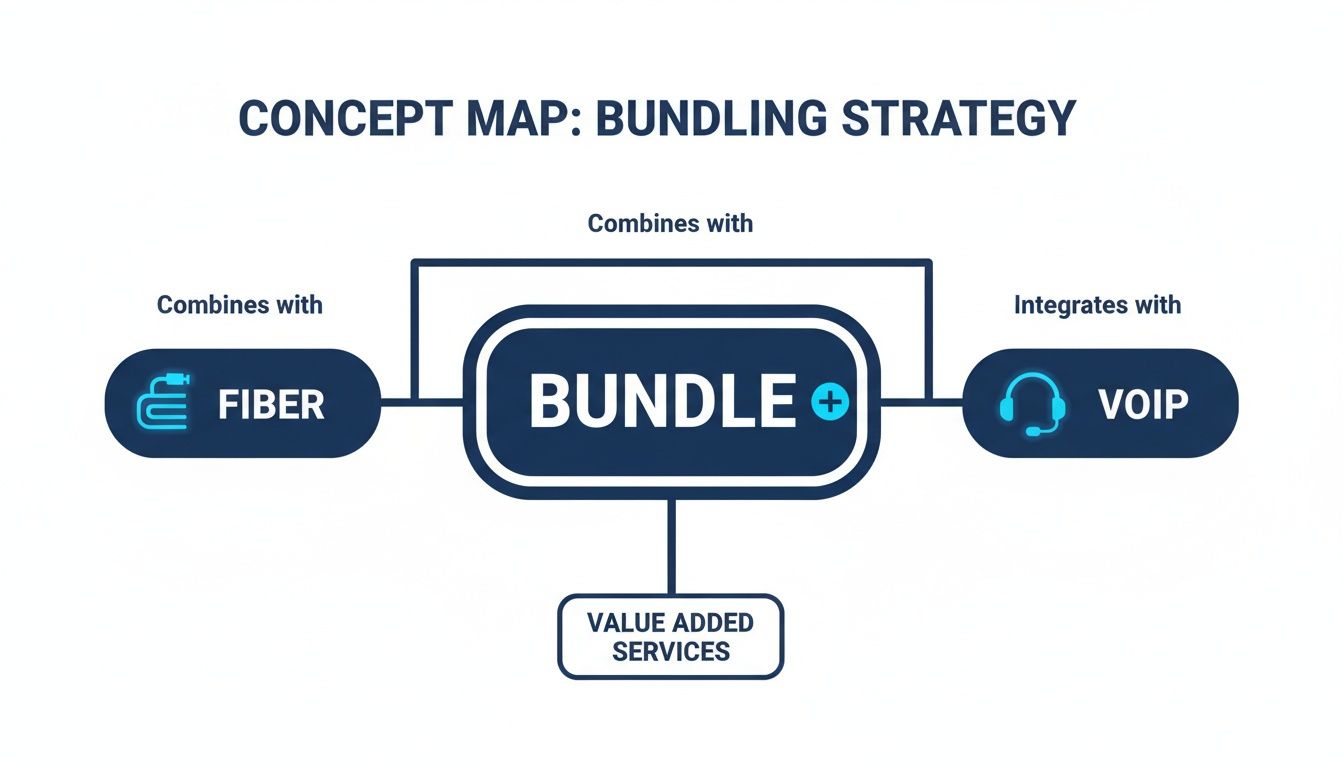
As you can see, pairing fiber and VoIP doesn't just replace old tech—it creates a single, powerful system for all your communications.
Making The Switch Seamless
The great news is that moving to a modern phone system doesn't mean you have to start over from scratch. A couple of key technologies make the transition smooth, letting you keep your business identity intact without any disruption. As you weigh your options, resources like this guide to the Top Small Business Phone Systems can help you compare what's out there.
Here’s what you need to know:
- SIP Trunking: Think of this as the digital version of old-school phone lines. SIP (Session Initiation Protocol) trunks connect your VoIP system to the wider phone network right over your internet connection. This gets rid of the need for expensive, outdated copper wiring.
- Number Porting: This is the simple service that lets you bring your existing business phone number with you to your new VoIP provider. It’s a seamless process that means your customers can keep calling the number they already have saved.
By getting a handle on these core components, you can easily cut through the technical jargon and focus on what really matters: choosing a solution that will help your business thrive.
Building a Secure and Reliable Communication System
For a small business, downtime isn't just an inconvenience. It means lost sales, unhappy customers, and a hit to your reputation. The same goes for a security breach, which can be absolutely devastating.
That’s why any modern small business internet and phone setup must be built on a foundation of security and reliability. It’s simply non-negotiable.
Promises You Can Count On
A critical piece of this puzzle is the Service Level Agreement, or SLA. Don't think of it as just a long legal document—it's your provider's promise to you, written in black and white.
An SLA is their guarantee of performance. It clearly states their commitment to keeping you online, often promising 99.99% uptime. If they don't meet that promise, the SLA outlines exactly what happens next, ensuring you're protected. It turns reliability from a vague sales pitch into a real, measurable commitment.
Proactive Defenses for Your Business
Beyond just staying online, your system has to actively defend against today's threats. Did you know that a staggering 60% of small companies go out of business within six months of a major cyberattack? This is why you need more than just a firewall.
Your provider should offer a multi-layered defense to keep your calls and data safe. Here are a few must-have features:
- Call Encryption: This scrambles your conversations, making them unreadable to anyone trying to listen in. Think of it as a private, soundproof meeting room for every call you make.
- DDoS Attack Mitigation: These attacks are designed to overwhelm your network and knock your business offline. Good providers can spot and block this malicious traffic before it ever reaches you.
- Robocall and Spam Filtering: We all hate them. Advanced filters block these nuisance calls automatically, saving your team’s time and reducing the risk of someone falling for a phone scam.
To really get a handle on protecting your network, it’s worth looking into managed network security solutions to see how you can fortify your business.
Ensuring You're Always Open for Business
So, what happens if a construction crew accidentally cuts the fiber line down the street? This is where network redundancy becomes your safety net.
Think of network redundancy like a backup generator for your communications. When the main power goes out, the generator kicks on automatically. You don't miss a beat.
A "failover" system does the same thing for your internet. If the primary connection fails, it can instantly switch over to a secondary line, like a cellular backup. This keeps your credit card terminals, VoIP phones, and cloud apps running, so you can keep serving customers no matter what. It's the ultimate safeguard for business continuity.
Simplifying Your IT with Managed Services
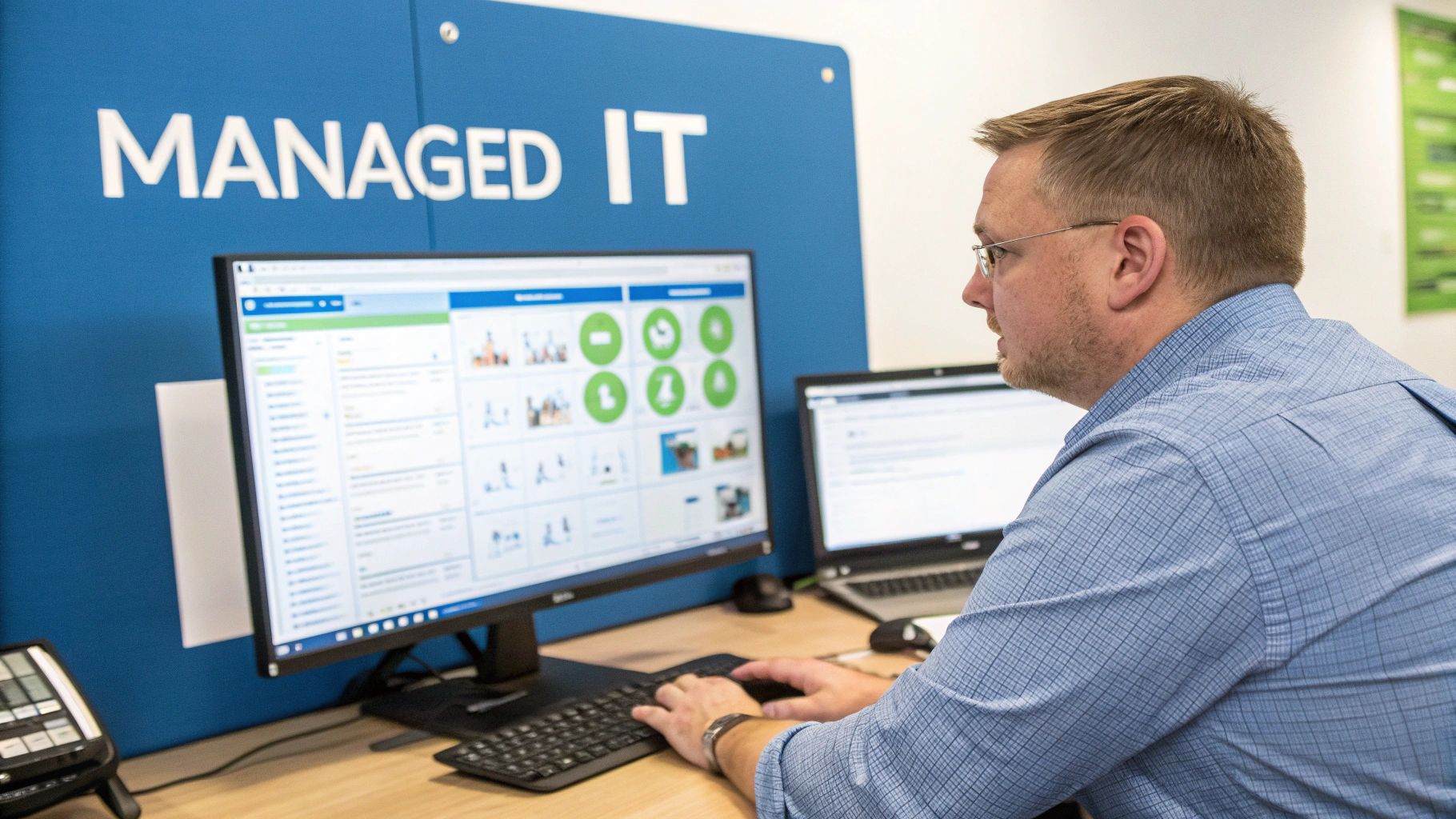
Running a business is tough enough without moonlighting as your own IT department. That’s where managed services for your small business internet and phone system come in. Think of it as having your own dedicated team of tech experts handling all the complicated stuff behind the scenes.
This lets you tap into powerful, enterprise-level technology without the cost of hiring a full-time IT staff. Your provider takes full responsibility for monitoring, upkeep, and troubleshooting, which frees you up to focus on what you're best at—growing your business.
Intelligent Traffic Control with SD-WAN
One of the biggest game-changers in managed services is SD-WAN (Software-Defined Wide Area Network). In simple terms, it's a super-smart traffic controller for your entire network that is always finding the fastest, most reliable route for your data.
Imagine you have both a main fiber line and a cellular backup connection. SD-WAN acts like a GPS with real-time traffic alerts for your network. If your fiber connection suddenly gets congested or, worse, goes down, SD-WAN instantly and automatically reroutes critical things like your VoIP calls over the backup line. This keeps your business running smoothly, providing a level of resilience that used to be only for the big corporations.
Managed services shift the burden of network management from your shoulders to your provider's. This proactive approach prevents problems before they start, ensuring your technology is an asset, not a constant headache.
Your Digital Security Guard
Another critical piece of the puzzle is the Managed Network Edge. This is all the hardware that sits at the edge of your network—the gateway between your private business data and the public internet. A managed service provider takes complete control of these crucial devices.
This includes essential security hardware like:
- Managed Routers: We professionally configure and watch over these to make sure data flows into and out of your network securely and efficiently.
- Managed Firewalls: This is like having a professional security guard for your internet connection. We constantly update them to block unauthorized access, viruses, and other cyberthreats before they can cause trouble.
When you let a provider manage your network edge, you get rock-solid, up-to-the-minute security without ever having to configure a device or worry about security patches. It’s a completely hands-off approach to protecting your most important data, giving you invaluable peace of mind. These services ensure your network isn't just fast and dependable, but also locked down and ready for whatever comes next.
Choosing the Right Provider and Contract
Picking the right partner for your small business internet and phone services is a lot more than just chasing the fastest speed or the lowest price tag. It's really about building a relationship with a company that’s going to have your back as you grow. To do that, you need a smart approach to cut through the marketing noise and find a provider that truly gets what your business needs.
Your final choice comes down to one simple thing: knowing exactly what you’re paying for and what you’ll get in return. Let's break down how providers typically structure their deals so you can go in with your eyes open.
Understanding Common Pricing Models
Internet and phone services are usually priced a bit differently, so it pays to know what you’re looking at on a quote. For internet, you’ll typically see tiered packages based on bandwidth—the more speed you need, the higher the price. That's pretty straightforward, but always ask if the speeds are symmetrical. Fast upload speeds are a game-changer for using cloud apps, sending large files, and having crystal-clear video calls.
When it comes to VoIP phone systems, the pricing is almost always a per-user, per-month fee. This model is fantastic for scaling because you only pay for the employees you actually have. Just be sure to ask what features are baked into that base price versus what’s considered an "add-on" that will bump up your monthly bill.
The right provider acts as a partner, not just a vendor. They should be invested in your success, offering the flexibility to adapt your services as your business evolves and providing reliable support when you need it most.
Key Questions for Potential Providers
Before you even think about signing a contract, you need to do your homework and vet any potential partners. Having a checklist of tough questions ready will save you from nasty surprises later. Checking out a guide on the best business internet providers can also give you a great starting point for what to look for.
Make sure you ask every provider these questions:
- What does your customer support look like? Is help available 24/7? Are your technicians local? If we have a major outage, what's your average response time?
- What is the installation and onboarding process? How long will it actually take to get us up and running? Will you provide hands-on training for our team on the new phone system?
- How do you support business growth? If we need to add more phone lines or crank up our internet speed, how easy is that? What’s the process, and are there extra fees involved?
What to Look for in a Contract
The contract is your safety net, so reading the fine print is an absolute must. Pay close attention to the term length, which is usually somewhere between one and three years. Longer terms might snag you a lower monthly rate, but they also lock you in, reducing your flexibility if your business needs to pivot.
Finally, hunt for any mention of hidden fees—things like installation charges, equipment rental costs, or penalties for ending the contract early. A good, transparent contract will also have clear scalability clauses that spell out exactly how you can adjust your services up or down. Choosing a provider with a straightforward and fair contract ensures your communications will be a solid foundation you can build on for years.
Answering Your Top Questions
Making the move to a professional communication system is a big step, and it’s completely normal to have questions. We get it. Below, we’ve tackled some of the most common ones we hear from business owners thinking about an upgrade to their small business internet and phone service.
Can I Keep My Existing Business Phone Number?
Yes, absolutely. This is probably the biggest concern we hear from established businesses, but the process is surprisingly simple and seamless. It's a process called number porting, and any reputable business VoIP provider will handle the entire transfer for you.
This means you can upgrade your technology to a modern system loaded with features without confusing your customers. No need to update all your business cards, marketing materials, or online listings. Your phone number is a key part of your brand, and porting makes sure you can bring it right along with you.
How Much Internet Speed Does My Small Business Need?
This really depends on your team's size and what you're doing online day-to-day. A good rule of thumb is to budget for about 5-10 Mbps per employee. But think of that as just a starting point.
If your team is constantly in video conferences, running cloud backups, or sending huge files back and forth, you’ll want to aim higher. A fiber internet connection is almost always the best choice here. It gives you more than enough bandwidth to handle everything you're doing now, with plenty of power left over for whatever comes next.
Is a VoIP Phone System Secure Enough for My Business?
Modern VoIP systems are incredibly secure—often even more so than old-school landlines. Business-grade providers build their services with multiple layers of protection to guard your sensitive conversations and company data.
Business-grade VoIP uses advanced security protocols, including call encryption (like SRTP and TLS), to shield your conversations from anyone trying to listen in. They also build in network-level security to defend against denial-of-service attacks and other digital threats.
These security measures make sure your private business communications stay exactly that—private and protected from outside interference, so you can have some peace of mind.
Ready to build a communication system that grows with you? The experts at Premier Broadband can design a secure, reliable fiber internet and VoIP solution that fits your business perfectly. Explore our business solutions today.