
When you hear about the benefits of fiber internet, three things consistently stand out: blazing-fast symmetrical speeds, incredible reliability, and ultra-low latency.
In simple terms, this means your downloads, uploads, streaming, and gaming are not just faster but also far more stable and responsive than what you can get with old-school cable or DSL.
What Is Fiber Internet and Why Does It Matter?
To really get why fiber is such a big deal, you have to understand how different it is from the technology it’s replacing.
Think of your current cable internet as a busy city street. All the data, traveling as electrical signals through copper wires, gets jammed up in traffic, especially when everyone is online. This is what causes that dreaded buffering, lag, and inconsistent speed.
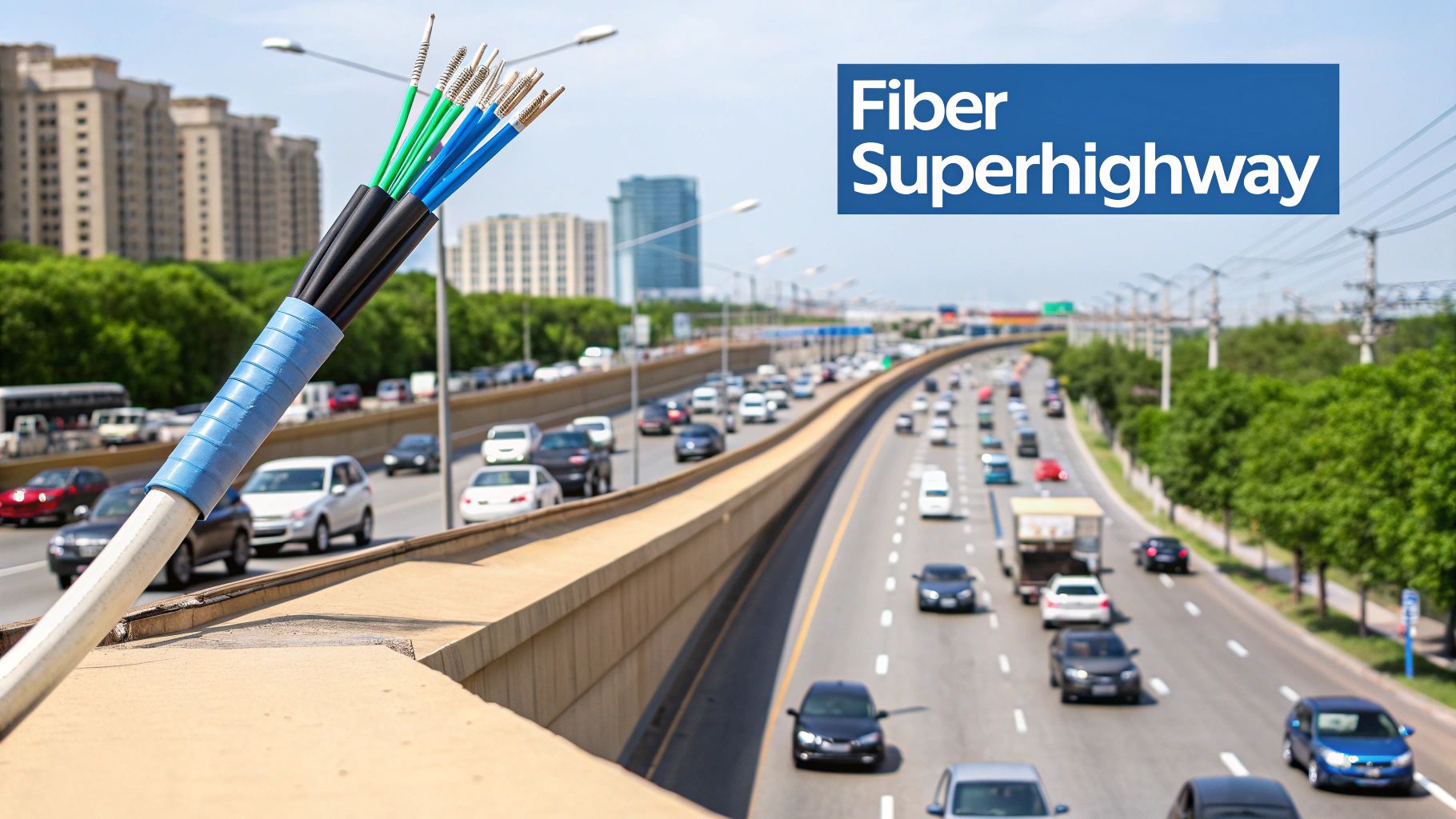
Fiber optic internet is a completely different animal. It’s like having your own dedicated, multi-lane superhighway. Instead of copper, it uses impossibly thin strands of glass to send data as pulses of light. This allows information to travel at nearly the speed of light, completely bypassing the digital traffic jams that bog down cable and DSL networks.
This image really highlights the difference.
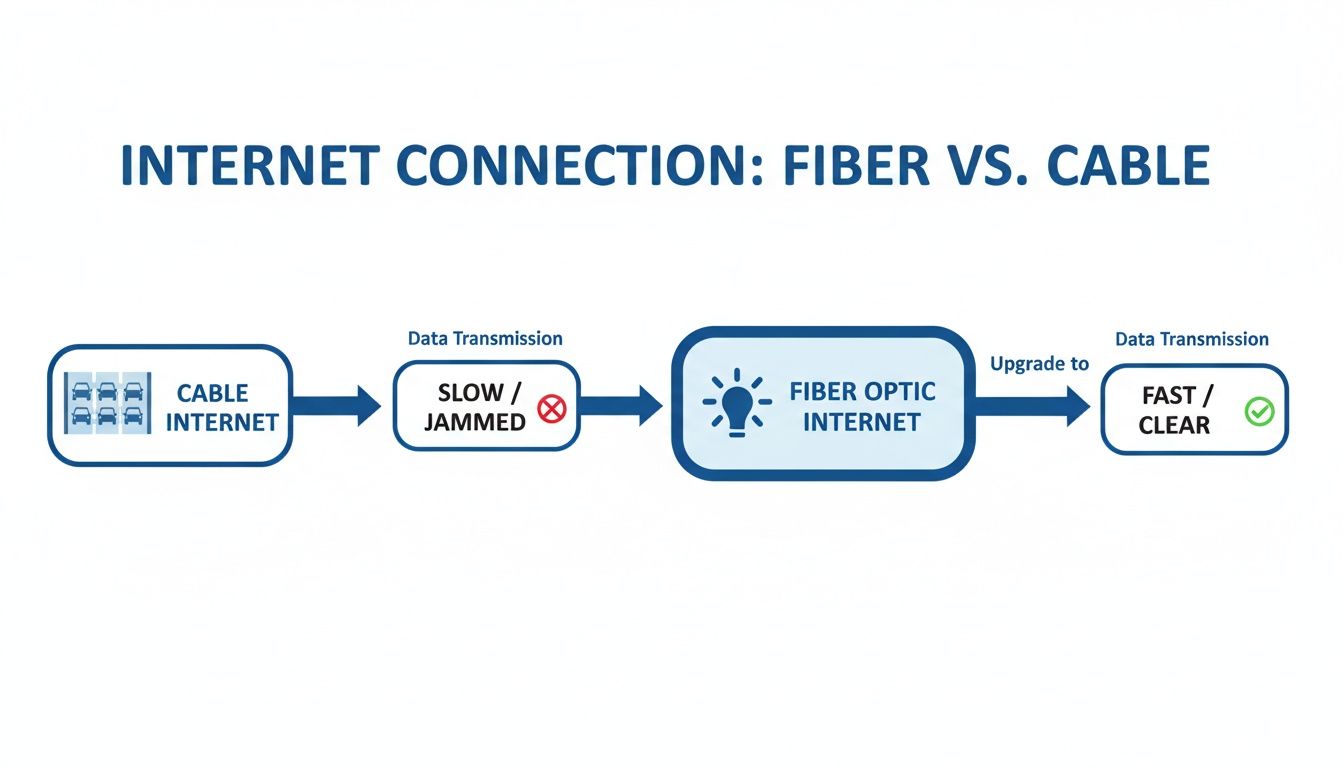
As you can see, fiber gives data a clear, direct path, which is the secret to a fast and rock-solid connection.
For a quick breakdown, here’s how fiber stacks up against the older internet technologies you might be used to.
Fiber Internet vs Traditional Internet At a Glance
| Feature | Fiber Optic Internet | Cable Internet | DSL |
|---|---|---|---|
| Technology | Light pulses via glass fibers | Electrical signals via coaxial cable | Electrical signals via phone lines |
| Max Speed | Up to 10 Gbps or more | Around 1 Gbps | Around 100 Mbps |
| Upload Speed | Symmetrical (same as download) | Asymmetrical (much slower) | Asymmetrical (very slow) |
| Reliability | Extremely high; immune to interference | Moderate; shared network, congestion | Low; sensitive to distance |
| Latency | Very low | Moderate | High |
This table makes it pretty clear—fiber is just in a different league when it comes to performance.
The Shift to a Superior Connection
This technological leap is why millions of people are making the switch. In a single year, fiber broadband deployment passed 10.3 million new homes in the United States alone. With more than 45% of households signing up where it's available, it's obvious that families are ready to leave outdated cable behind for the kind of speeds you need for 4K streaming and lag-free gaming.
This "superhighway" design is what powers all the advantages we're about to cover. It’s not just a small step up; it’s a completely different class of connection built for how we live today. Understanding what fiber to the home means helps show how this powerful technology connects directly to your life. The core of a fiber network is simply stronger, more dependable, and ready for whatever comes next.
Because data travels as light through dedicated glass strands, your connection stays fast and stable, no matter how many neighbors are online or if there’s an electrical storm.
That stability and massive capacity are precisely why fiber matters. It delivers the raw performance you need in a world full of high-definition streaming, real-time video calls, and a house full of connected devices.
Unlock Symmetrical Speeds for Flawless Performance
When you start looking into fiber internet, one of the biggest game-changers you'll hear about is symmetrical speed. It’s a simple concept with a huge impact: your upload speeds are just as fast as your download speeds. This creates a balanced, two-way data highway that older internet technologies just can't match.
For years, internet providers put all their focus on download performance—how fast you could pull things from the internet. That made sense when we mostly browsed websites or streamed videos. But how we use the internet has completely shifted.
These days, we are constantly sending massive amounts of data back to the internet. From video calls to cloud backups and gaming, our connections need to be powerful in both directions. Symmetrical speeds eliminate those frustrating bottlenecks caused by slow uploads.
Why Fast Uploads Matter More Than Ever
Ever been on a Zoom call when your video freezes? Or tried to send a big file for work, only to watch the progress bar crawl for what feels like an eternity? Those are the classic signs of a weak upload speed. With cable internet, for instance, upload speeds are often just a tiny fraction of the download speed—sometimes as low as 5% to 10%.
With fiber, you get a powerful connection in both directions. This removes the digital choke point, allowing you to download a 4K movie while someone else uploads a high-resolution video project without either one slowing to a crawl.
This is absolutely essential for modern households and professionals who depend on smooth, real-time interaction online. Understanding what is a good upload speed helps put into perspective just how much of a difference fiber makes in your daily life.
Symmetrical Speeds in Action
Let's break down how this actually improves your experience. Even a connection with blazing-fast downloads can feel sluggish if the upload side can't keep up.
- For the Remote Worker: Sending a large presentation or syncing project files with the cloud happens in seconds, not minutes. Video conferences on Zoom or Microsoft Teams stay crystal-clear and lag-free, even when you're sharing your screen.
- For the Content Creator: You can live-stream on Twitch or YouTube in crisp HD without dropped frames or buffering for your viewers. Uploading that finished video file takes a fraction of the time it used to, getting you back to creating faster.
- For the Modern Family: Imagine one person on a video class, another competing in an online game, and a third backing up the family photos to the cloud—all at once. None of these upload-heavy tasks will interfere with someone else streaming a movie.
At the end of the day, symmetrical speeds are the foundation of a truly modern and responsive internet connection. It’s a core benefit of fiber that ensures your ability to send information is just as powerful as your ability to receive it, making your entire online experience smoother and more productive.
Gain a Competitive Edge with Ultra-Low Latency
While speed gets all the attention, there's another factor that's just as crucial for a great internet experience: latency. You can think of latency, also known as ping, as your internet's reaction time. It’s the split-second it takes for your command to travel to a server and get a response.
A low latency connection means your actions feel instantaneous. Click a link, and the page loads right away. Move your character in a game, and it happens in real-time.
This is where fiber internet truly shines. Data travels as pulses of light through glass strands, an incredibly efficient method that drastically cuts down on delay. This light-speed transmission gives you a real, tangible edge in any activity that depends on a fast response.
How Low Ping Makes a Real-World Difference
High latency is the secret villain behind most online frustrations. It's that awkward pause on a video call that makes you talk over someone else. It's the deadly lag in an online game that gets you eliminated. One of the best benefits of fiber is its power to make these problems disappear.
For online gamers, this is a total game-changer. In competitive titles like Valorant or Call of Duty, where matches are won or lost in milliseconds, ultra-low latency means your actions register instantly. This gives you a serious advantage over opponents struggling with slower, less responsive cable connections.
A connection’s reaction time is just as important as its speed. Fiber’s near-instantaneous response makes every online interaction feel more fluid, natural, and immediate, whether you're in a business meeting or a digital battlefield.
This level of responsiveness is quickly becoming essential for everyone. As technology moves forward, more of what we do online will depend on real-time data exchange. It's a key reason why over 85% of new 5G base stations worldwide will be connected by fiber—the infrastructure needs to be ready for instant communication, from remote work to immersive entertainment.
Smoothing Out Your Everyday Connections
Beyond gaming, low latency makes a huge difference in everyday communication. Video conferences feel more natural and less draining when there are no delays. Conversations flow just like they would if you were in the same room. For anyone working from home, that means clearer calls and more productive meetings.
If you’re currently dealing with annoying lag or delays, you might want to learn more about how to fix high latency and see if your connection is the root of the problem. By minimizing this digital delay, fiber internet ensures your connection doesn’t just keep up—it gives you an edge.
Get Rock-Solid Reliability and Future-Proof Your Home
Speed is great, but what good is it if your connection drops during a storm or slows down when your neighbor fires up their microwave? A truly great internet connection is one you never have to think about. That's the promise of fiber internet—unshakeable reliability.
Unlike old-school cable internet that relies on copper wires, fiber optic lines are made of glass. This isn't just a technical detail; it's the key to why fiber is so much more stable and consistent than the internet you're used to. It's built differently, from the ground up, to deliver a connection that just works.
Built Tough for a Connection You Can Count On
A big reason fiber is so dependable is its sheer physical resilience. It uses light to send data, not electricity, which means it sidesteps all the common problems that plague copper-based networks.
- Weather? No Problem: Fiber optic cables stand up to temperature swings, rain, and bad weather that can easily mess with copper lines.
- No Electrical Buzz: They are completely immune to electromagnetic interference from power lines or other appliances, giving you a clean, steady signal 24/7.
This all adds up to fewer frustrating outages and a connection that's there when you need it, day in and day out.
Get Ready for Tomorrow, Today
Choosing fiber isn't just an upgrade for right now; it’s an investment in your home's future. The term future-proofing gets thrown around a lot, but fiber is the real deal. It’s built with so much extra capacity that it can handle whatever new technologies are coming down the pike.
From streaming in 8K to immersive virtual reality and a house packed with smart gadgets, fiber has the bandwidth to handle it all without breaking a sweat. Your internet connection won't be the bottleneck holding you back.
This is why fiber is quickly taking over. Worldwide, 42.5% of all fixed broadband connections are now fiber, blowing past older copper networks. And with next-gen Wi-Fi expected to power 2.1 billion devices soon, you'll need a connection that can keep up. You can see how fiber's growth is reshaping connectivity and why it's becoming the new standard.
With Premier Broadband, you're not just getting faster internet. You’re laying a digital foundation that will support your family's needs for years to come. It’s the smart choice for a powerful, reliable connection that's built to last.
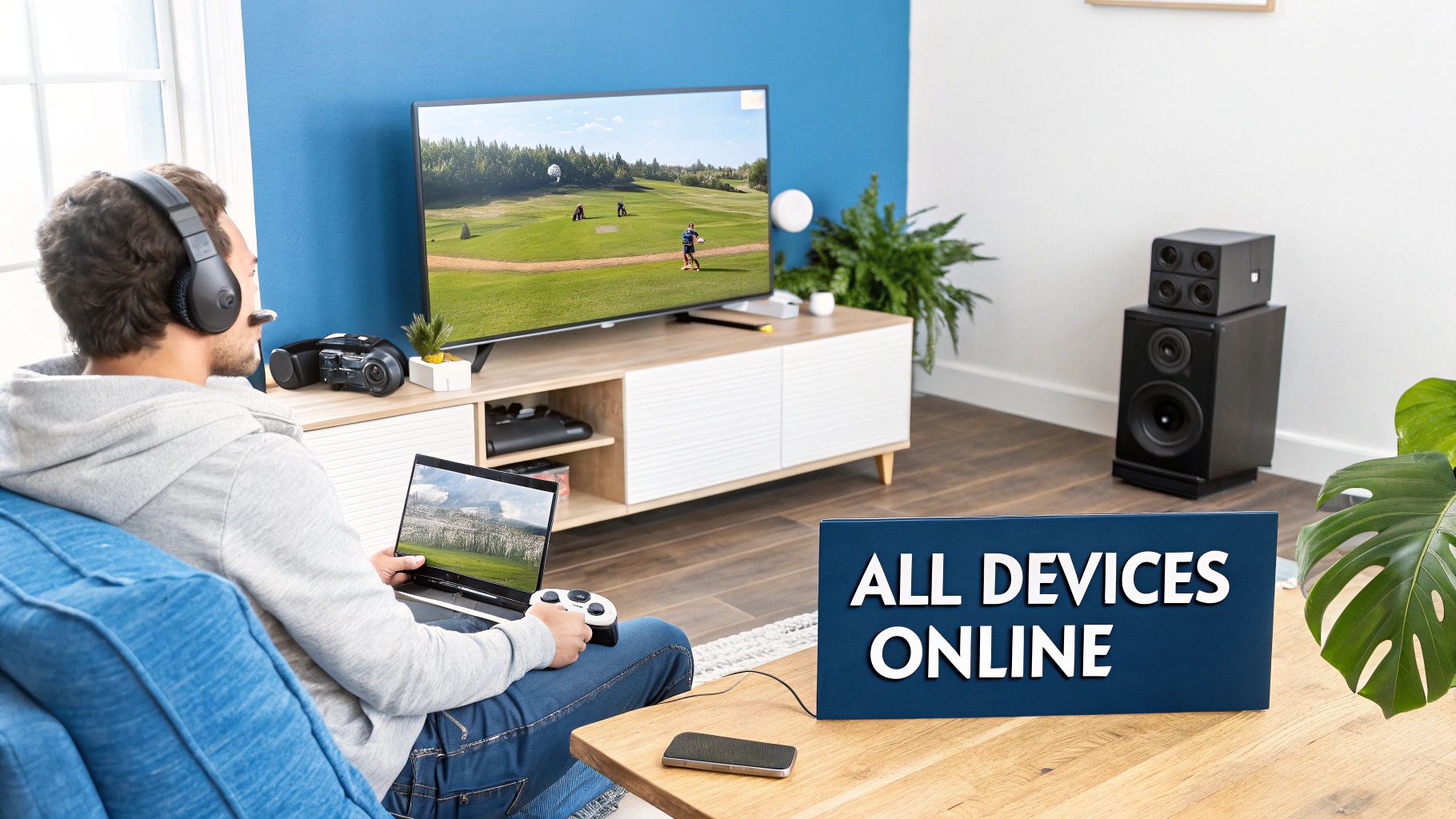
Support Every Device in Your Connected Home
These days, the average home is a beehive of digital activity. Laptops, smart TVs, security cameras, gaming consoles, and even smart appliances are all fighting for a slice of your Wi-Fi network. With a standard cable connection, this digital traffic jam quickly turns into a frustrating mess of slowdowns and buffering.
This is where fiber internet really shines. Fiber’s massive capacity is like having your own private, multi-lane superhighway for data. It’s built to handle dozens of devices at once without hitting the brakes on performance for any of them.
A Seamless Digital Experience for Everyone
Picture a typical evening at home, powered by fiber. Someone’s streaming a 4K movie in the living room, another person is on a crucial work video call, and a gamer is deep in an online match where every millisecond is the difference between winning and losing. All the while, your smart thermostat, security cameras, and voice assistants are humming along in the background.
On a lesser connection, this would be a recipe for disaster—laggy gaming, a pixelated movie, and a frozen video call. But with fiber, none of these activities get in each other's way. Every device gets the bandwidth it needs to work perfectly.
Fiber internet creates a truly seamless digital environment where every device operates at its peak potential. You no longer have to ration your internet usage or ask family members to log off so you can get your work done.
This high-capacity, stable connection keeps your entire digital life running without a hitch. It’s the key to unlocking experiences like seamless IPTV streaming for multiple devices, where quality is everything.
The Bandwidth to Power Your Smart Home
As our homes get smarter, the demand for a rock-solid internet connection just keeps growing. Every new smart gadget you bring home, from a video doorbell to a smart fridge, needs a constant, stable connection to do its job right.
A fiber connection delivers the huge amount of bandwidth needed to support this ever-growing network of devices. This isn't just about speed; it's about sheer capacity.
- Brilliant 4K Streaming: Watch ultra-high-definition movies and shows on multiple screens at the same time, without a single moment of buffering.
- Responsive Smart Devices: Your smart speakers, lights, and security systems will respond instantly to commands, with none of those frustrating delays.
- Lag-Free Gaming and Work: Gamers and remote workers get the low-latency, high-speed connection they need to stay on top of their game and be productive.
A powerful fiber connection is the engine that drives a truly connected home. Of course, even the fastest internet in the world needs a strong Wi-Fi signal to reach every room. Learning more about Premier Broadband’s whole-home Wi-Fi solutions can help you make sure every single device gets the flawless performance it deserves, no matter where it is in the house.
How to Choose the Right Fiber Internet Plan
Okay, so you see why fiber is the way to go. But now comes the important part: picking a plan that actually fits your life. You want to get all that amazing performance without paying for speed you’ll never touch. It really just comes down to matching your home’s internet habits with the right package.
Think about it like this: you wouldn't use a giant sledgehammer to hang a picture frame, right? In the same way, you need the right tool for the job. The goal is to find the perfect fit for what you actually do online.
Matching Your Needs to the Right Speed
To figure out your perfect fit, take a quick look at how your family uses the internet day-to-day. Are you mostly streaming and browsing by yourself? Or is it a full house with gamers, remote workers, and 4K movie fans all online at once? Every situation is different.
-
For the Small Household (1-2 People): If your online time is mostly streaming HD shows, scrolling social media, and jumping on a few video calls, a solid starter plan is usually the perfect choice. You’ll get a smooth, buffer-free experience for all your daily activities.
-
For the Connected Family (3-5 People): Once you’ve got multiple people trying to stream in 4K, game online, and attend virtual classes simultaneously, you’re going to need more power. A mid-tier plan gives everyone enough bandwidth to do their own thing without causing slowdowns for everyone else.
-
For the Power User or Remote Professional: Are you a serious gamer who needs the lowest latency? A content creator uploading huge video files? Or a pro working from home who can't afford a single dropped connection? A top-tier gigabit plan is what you need. It delivers the raw power required for the most intense online tasks.
Choosing a plan is all about finding that sweet spot. A good provider will have clear, simple options so you only pay for what you’ll actually use—with the freedom to upgrade if your needs change down the road.
When you’re honest about your daily usage, you can pick a package that delivers all the incredible benefits of fiber internet in a way that’s built just for you. Here at Premier Broadband, we make it simple with straightforward plans designed for every kind of user.
Frequently Asked Questions About Fiber Internet
Making the jump to a new internet connection is a big decision, and it’s natural to have a few questions. We get it. You want to feel confident you’re making the right call for your family and your home.
To help out, we’ve put together some simple, no-nonsense answers to the questions we hear most often about switching to fiber.
Is Fiber Internet Really That Much Better Than Cable?
Yes, it absolutely is. While some cable companies advertise fast download speeds, they can't touch fiber when it comes to symmetrical uploads, incredible reliability, and super-low latency.
Fiber sends data using light pulses through glass strands, making it totally immune to the electrical noise and network clogs that plague cable systems, especially when everyone in the neighborhood is online. The result is a consistently faster and smoother experience for everything you do, from streaming to gaming to video calls.
Will I Need New Equipment to Switch to Fiber?
You will, but don’t worry—your provider handles all of it for you. A technician will run a dedicated fiber optic line right to your home and install a small device called an Optical Network Terminal (ONT). Think of it as a modem, but for fiber.
From the ONT, you just plug in your Wi-Fi router and you’re good to go. Companies like Premier Broadband manage the entire installation and give you all the gear you need, making the switch completely seamless.
A common myth we hear is that fiber is delicate or complicated. The truth is, modern fiber lines are incredibly tough, and the equipment we use is built to be simple, durable, and reliable for years of trouble-free service.
Is Fiber Internet More Expensive Than Other Options?
It used to be, but not anymore. Today, fiber prices are very competitive, and when you look at the big picture, it often delivers way more bang for your buck.
When you account for the equal upload and download speeds, rock-solid connection, and the fact that it’s built for the future, the cost-per-megabit for fiber is often much lower than what you’d pay for a top-tier cable plan. Plus, its superior stability means no more frustrating downtime, making it a smarter investment in the long run.
Ready to feel the difference a true fiber connection can make? Premier Broadband has simple, powerful plans for every kind of household, from casual streamers to work-from-home professionals. Find the perfect plan for your needs and make the switch today.