
Picking a Dallas phone system provider is a big deal. It’s a decision that directly impacts how reliable and efficient your company is day-to-day. This isn't just about getting a dial tone; it's about finding a partner who genuinely understands the unique, high-stakes telecom world of the Dallas-Fort Worth metroplex. The right local partner delivers superior call quality, lower latency, and support that’s actually responsive when you need it.
Why Your Phone System Provider Matters in Dallas

Dallas isn't just another big city; it's a globally recognized telecommunications hub. When you choose a phone system provider with deep roots here, you’re giving your business a real, tangible advantage by turning our local infrastructure into your competitive edge.
Tapping Into World-Class Infrastructure
The DFW area is home to some of the most advanced digital infrastructure on the planet. This isn’t just marketing fluff—it translates into real-world benefits for your business communications.
In the bustling Dallas-Fort Worth metroplex, a hotspot for telecom innovation, over 80 business broadband providers are constantly competing. More than a third of them deliver high-speed fiber, which is the backbone of any good modern VoIP phone system. This dense network means low latency and incredible redundancy, landing Dallas the #4 spot globally in data center market size. All of that power directly supports reliable, cloud-based phone systems.
This powerful network means your calls are clearer and your connections are more stable. You can finally say goodbye to the frustration of laggy audio or dropped calls. Whether your team is in an office in the Arts District, working from home in Frisco, or on the road for a client meeting, a local provider leverages this incredible infrastructure for top-tier performance.
A provider that's physically connected to the local network fabric can often deliver a more resilient and higher-quality service than a national provider whose nearest data center might be hundreds of miles away.
The Advantage of Local Expertise
Beyond just the tech, a Dallas-based provider brings an invaluable understanding of our regional business landscape. They get the specific challenges and opportunities that DFW companies face every day. That local insight almost always leads to more personalized and effective support when you need it most.
Choosing the right partner is a foundational step. If you’re looking for specific recommendations, you might find our guide on the top DFW VoIP phone service providers helpful as you weigh your options.
First Steps to Defining Your Communication Needs
Before you even think about calling a Dallas phone system provider for a quote, you need to do a little homework. Jumping in without a clear plan is like trying to build a house without a blueprint—you'll end up with a mess that costs you a fortune to fix. The idea here is to get past vague notions and build a concrete list of what you actually need.
A great place to start is with your last three to six months of phone bills. Don't just glance at the total. This is a bit of detective work. You're looking for the story your data tells:
- When are your peak call times?
- What's your average call volume, both incoming and outgoing?
- Are you paying for features nobody uses?
- Do you constantly get hit with overage charges?
These numbers will give you a solid, factual baseline to work from.
Uncovering How Your Team Really Works
Your phone bills give you the what, but your team can tell you the why. They're the ones on the front lines, dealing with communication hiccups and frustrations every single day. You'd be amazed what you can learn by simply asking.
A quick, anonymous survey can pull back the curtain on problems you didn't even know existed. Try asking some pointed, open-ended questions:
- What’s the single most annoying thing about our current phone system?
- Where do you see calls getting dropped or communication failing with customers?
- If you could snap your fingers and add one feature to make your job easier, what would it be?
The feedback you get is pure gold. Maybe your sales team is struggling to make calls from their cell phones without giving out personal numbers. Or perhaps your customer service crew needs a better way to route calls so customers aren't left waiting.
Tailoring Needs to Your Business Type
Let's be honest, a fast-growing tech startup in Richardson has completely different needs than a busy logistics company out by DFW Airport. The startup might be all about scalability and CRM integrations, while the logistics firm needs rugged phones that work in a noisy warehouse and never, ever drop a call.
Don't let a vendor sell you a generic, one-size-fits-all package. Your business has unique challenges, and you need a system that fits your specific workflow and industry, not the other way around. A good Dallas phone system provider will understand this and help guide you.
Once you've looked at your bills and talked to your team, make two simple lists: "Must-Haves" and "Nice-to-Haves." This little exercise is your best friend for staying on track and on budget. The must-haves are your non-negotiables—the features you can't operate without. The nice-to-haves are the bells and whistles you can consider down the road.
Doing this prep work means you'll walk into conversations with providers holding a clear, documented set of requirements. It puts you in the driver's seat. For businesses also thinking about their internet connection, our guide on small business internet and phone bundles can offer some valuable perspective.
Hosted VoIP vs On-Premise PBX: What Works for You?
Choosing between a cloud-based phone system and traditional on-premise hardware is one of the biggest decisions you'll make. This isn't just about technology; it directly impacts your budget, your team's flexibility, and who you have to call when something goes wrong.
Let's break down what this really means for a Dallas business.
A Hosted VoIP system is a lot like a subscription service. You pay a simple monthly fee per user, and a Dallas phone system provider handles all the complicated hardware and software off-site in their secure data centers. Think of it as streaming a movie on Netflix instead of buying the DVD—you get all the benefits without owning the physical box.
On the other hand, an On-Premise PBX (Private Branch Exchange) is a system you buy and own completely. It's a physical server in your office that routes all your calls. This model gives you total control, but it also means you're responsible for all the maintenance, security, and upgrades that come with it.
Understanding the Cost and Control Trade-Off
The first thing you'll notice is the difference in cost. Hosted VoIP usually has a very low upfront cost—often just for the desk phones themselves—followed by a predictable monthly bill. This operational expense (OpEx) model is perfect for businesses that want to avoid a big capital hit.
An on-premise PBX is the opposite. You're looking at a significant upfront capital investment (CapEx) for the server, software, and installation. While your ongoing monthly costs might be lower (just for the phone lines), you're on the hook for any future repairs or upgrades, which can pop up unexpectedly.
For many businesses, it boils down to a simple question: Do you prefer a predictable monthly fee, or are you comfortable with a large one-time purchase and taking on the responsibility for long-term maintenance?
Flexibility for a Growing Dallas Business
This is where Hosted VoIP really pulls ahead, especially for dynamic companies. Need to add a new employee? It's as simple as calling your provider to turn on a new line. That kind of agility is invaluable for businesses with seasonal rushes or those in a rapid growth phase.
An on-premise PBX is much more rigid. You buy hardware designed for a specific number of users. If you outgrow that capacity, you could be looking at expensive hardware upgrades or even replacing the whole system. For any multi-site business, it's critical to understand how each system handles growth. You can dive deeper into our comparison of Hosted VoIP vs traditional systems for multi-site businesses.
This flowchart helps visualize how to approach your phone system assessment from the start.
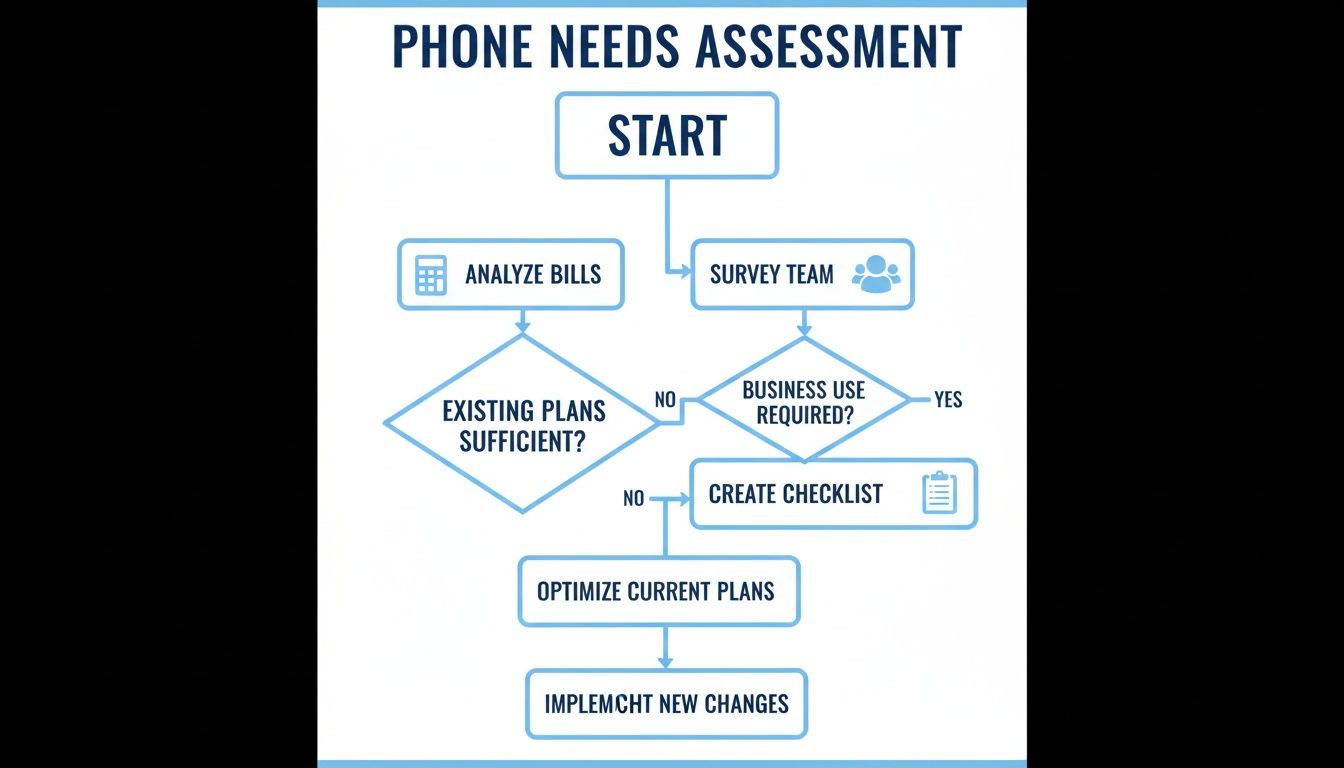
It all starts with analyzing your data and getting feedback from your team before you even start making a feature checklist.
Hosted VoIP vs On-Premise PBX A Head-to-Head Comparison
To make the choice clearer, we've broken down the key differences between cloud-based and traditional phone systems. This should help you decide which path is the right fit for your business goals.
| Feature | Hosted VoIP (Cloud-Based) | On-Premise PBX |
|---|---|---|
| Initial Cost | Low (OpEx Model) | High (CapEx Model) |
| Ongoing Costs | Predictable monthly fee per user | Lower monthly line costs, but unpredictable maintenance expenses |
| Maintenance | Handled by the provider | Your responsibility (or your IT team's) |
| Scalability | High – easily add or remove users | Low – requires hardware upgrades to grow |
| Control | Less direct control over hardware | Full control over the system |
| Support | Provider is responsible for uptime | You are the first line of defense |
Ultimately, Hosted VoIP offers flexibility and predictable costs, making it ideal for growing businesses. An on-premise PBX provides more control but requires a significant upfront investment and ongoing internal management.
Reliability and Support You Can Count On
With an on-premise system, you're the one in the hot seat. If the system goes down, it's up to your team to figure out why and fix it. With Hosted VoIP, your provider is responsible for keeping things running, including uptime, security, and all the backend maintenance.
To better grasp the core distinctions, it helps to understand the fundamental difference between cloud and on-premise solutions.
The Features a Modern Dallas Business Can't Live Without
Let's be honest, a modern phone system is so much more than just a dial tone. It's really the command center for your business. Picking the right features can make a huge difference in how your team gets things done. It's time to look past the generic spec sheets and focus on the tools that will actually help your Dallas business compete.
Mobility and Unified Communications
In a world where business happens everywhere, your office number can't be stuck on a desk. A good phone system puts your office line right onto your team's cell phones through a simple app. That means an employee can take a crucial business call from a coffee shop in Bishop Arts or a client site in Plano, and to the customer, it looks like they're calling the main office. No personal cell numbers given out, just pure professionalism.
This is all part of a bigger idea called Unified Communications as a Service (UCaaS). The goal is to bring all your communication channels—voice, messaging, video—into one seamless platform.
Think about voicemail-to-email. Instead of wasting time dialing in to check messages, your team gets an audio file and a text version sent straight to their inbox. It's a small change that saves a surprising amount of time and makes important info easy to find later.
If you want to dive deeper into how this all works, our guide explaining what UCaaS is breaks it all down.
Seamless Software Integrations
One of the biggest productivity killers is constantly switching between apps. A top-tier Dallas phone system provider will offer a system that plugs directly into the software you already rely on every day.
Just imagine how this could work for you:
- CRM Integration: A client calls in, and a box pops up on your screen with their entire history from Salesforce or HubSpot. Your team has all the context they need before they even say "hello."
- Team Collaboration: Start calls right from inside Microsoft Teams or Slack. It keeps communication flowing where your team is already working, cutting down on disruptions.
These kinds of integrations mean less manual data entry and give your team the background they need to provide fantastic service on every single call.
Actionable Call Analytics
Data is everything, and your phone system is sitting on a goldmine of it. Modern analytics do a lot more than just count your calls; they give you real, practical insights into how your business is running.
With a solid analytics dashboard, you can track key metrics like:
- Peak call times to make sure you have enough staff on hand.
- Average call duration to spot where your team might need more training.
- Missed call rates to identify gaps in your customer service.
This isn't just theory—it's information you can use to make smarter decisions, improve how you operate, and keep customers happy. In a competitive market like Dallas, that's a huge advantage. The city is a telecom powerhouse, home to giants like AT&T and massive data centers from Google and Microsoft. When you use these analytical tools, you're tapping into a world-class infrastructure that can give your business a serious edge.
Alright, you've done your homework and have a solid list of requirements. Now for the fun part: talking to vendors. This is where the rubber meets the road, and you get to see who's a genuine partner and who’s just a slick salesperson.
Going into these calls prepared with the right questions is your best defense. It's how you protect your business and make sure the system you buy is the one you actually need.
Forget their canned sales pitch. We need to get past the glossy brochures and dig into the reality of their service. The goal here is to get straight, clear answers that let you stack up providers apple-to-apples.
Let's start with the basics of their service. These questions cut through the feature-talk and get right to the heart of what makes a Dallas phone system provider a partner you can count on.
Probing Network Reliability and Support
Let’s be honest, your phone system is only as reliable as the network it runs on and the team standing behind it. Don't let anyone get away with vague promises like "great uptime." You need to see the proof. Ask them for the specifics that show how they'll react when—not if—things go wrong.
A great place to start is network redundancy. What happens if their main data center has a problem? Do they have automatic failover systems to keep your phones ringing?
I've learned this the hard way: the best providers aren't the ones who never have issues. They're the ones who fix them fast and tell you exactly what’s going on. How they answer questions about outages tells you everything you need to know about their commitment to keeping your business online.
Make sure these questions are on your list for every single call:
- What is your guaranteed uptime, and is it backed by a real Service Level Agreement (SLA)? This is about accountability. Follow up by asking what kind of credit you get if they don't hit that number.
- What does your local Dallas support actually look like? If a piece of hardware fails at your office, can they send a technician out, or are you stuck dealing with a remote call center a thousand miles away?
- Walk me through your exact process for a system-wide outage. How will you notify me? What are your target resolution times? Who is my direct point of contact when things are down?
Uncovering the True Cost and Contract Details
The price on the proposal is almost never the price you'll actually pay. I've seen it time and time again—hidden fees, confusing contract terms, and surprise surcharges can turn a great deal into a nightmare. Your job is to sniff out every single potential cost before you sign on the dotted line.
Kick things off by asking for a complete, itemized breakdown of all one-time and recurring fees. This needs to include everything from installation and training to those pesky taxes and regulatory surcharges. Also, find out their process for adding or removing users. Are there penalties? Is it a hassle?
Get crystal clear on the contract terms. Is it a one-year deal? Three years? Five? What happens if you need to cancel early? A trustworthy Dallas phone system provider will be completely transparent about their pricing and contract. They won't hide the details, ensuring you know exactly what you're getting into without any nasty surprises later on.
Frequently Asked Questions
When you're looking at a new phone system, a lot of questions come up. We get it. Here are some straightforward answers to the most common things Dallas businesses ask, helping you get ready to make the right call.
How Important Is a Provider's Local Dallas Presence?
While a national provider can technically service Dallas, having a team that’s actually in Dallas makes a real difference. Local providers know the North Texas network inside and out, including how to plan for things like our unpredictable weather that can cause outages.
But the biggest advantage? When you need help, you get it fast. A local team can provide on-site support when you need it most. They're part of the same business community you are and tend to offer a more personal touch than you'd get from a massive, remote call center.
What Kind of Internet Connection Do I Need for a Reliable VoIP System?
For clear, reliable VoIP calls, your internet connection is everything. A fiber optic connection is what you want—it's the best option because it gives you matching upload and download speeds, which is crucial for conversations and video calls that don't lag.
Fiber also has lower latency, which means you avoid that choppy audio or those dropped calls that drive customers crazy. We always recommend a dedicated, business-grade fiber connection. It ensures your calls get the priority they need to stay crystal-clear.
A lot of people think any "fast" internet is good enough. But VoIP quality really hinges on your upload speed and network stability, not just the big download number you see advertised for streaming movies.
Can I Keep My Existing Business Phone Number?
Yes, absolutely. In nearly every case, you can bring your current business phone number with you. The official term for this is "porting," and your new provider handles the whole process for you. It's a standard procedure protected by the FCC, so you don't have to worry.
Before you sign anything, ask your potential Dallas phone system provider what their porting process looks like, how long it usually takes, and if they charge any fees for it.
Here's the most important part: do not cancel your old phone service until your new provider confirms the port is 100% complete. If you cancel too soon, you could lose your number for good. A good partner will walk you through this step-by-step to make sure everything switches over smoothly.
Ready to upgrade to a phone system that’s as reliable and dynamic as your business? Premier Broadband offers crystal-clear VoIP solutions backed by a 100% fiber network and local Dallas expertise. Find out how we can support your business today.