

A VoIP office phone system ditches the old-school copper phone lines and runs your business calls over your internet connection instead. It’s a lot like switching from an ancient cable box to a streaming service like Netflix—you get way more flexibility, a ton of modern features, and it's often a lot easier on your budget. This tech is a game-changer for how businesses talk to customers and each other.
How a VoIP Phone System Actually Works
At its core, a VoIP office phone system is a pretty straightforward idea. It takes something analog, like the sound of your voice, and turns it into digital data that can zip across the internet. This simple process is what frees your business from the costs and headaches of the traditional phone network.
Think about it like sending a picture in an email. Your computer breaks that photo down into tiny digital pieces, sends them over the internet, and your colleague’s computer puts them back together perfectly. A VoIP call works almost exactly the same way.
From Voice to Digital Packets
When you talk into a VoIP phone, your voice is instantly converted into digital code. This code is then compressed and chopped up into little bundles of data called "packets." Each one of these packets gets stamped with the destination IP address—the unique online location of the person you’re calling.
These packets travel across the internet, each one finding the quickest path to its destination. As soon as they arrive, they’re reassembled in the right order and turned back into clear audio for the person on the other end. The whole trip happens in milliseconds, making the conversation feel seamless and in real-time.
Most of the tech we use today works on similar digital principles. Since modern phone systems lean heavily on cloud infrastructure, taking a look at essential cloud services solutions can give you a solid idea of how these platforms are built.
The Key Difference from Landlines
The real split from traditional phones is the network they use. Landlines are stuck on the Public Switched Telephone Network (PSTN), a century-old web of copper wires. When you make a landline call, you’re basically renting a dedicated physical circuit between you and the other person for that call.
A VoIP office phone system skips that outdated infrastructure completely. It uses the exact same powerful network you already rely on for email, web browsing, and everything else: the internet. Shifting from physical wires to digital packets is what unlocks a whole new world of features and flexibility. For a deeper dive, our guide explains in more detail how VoIP works.
The biggest advantage of VoIP is that it can send so much more than just your voice. Because it’s internet-based, it can easily bundle voice, video, messaging, and data into a single, unified communications platform.
This isn’t just a technical detail—it has a huge impact on your daily operations and your company's bottom line. The table below breaks down the key differences that matter most.
VoIP Office Phone System vs Traditional Landline System
Here’s a quick look at how modern VoIP stacks up against old-school landlines for business use.
| Feature | VoIP Office Phone System | Traditional Landline System |
|---|---|---|
| Infrastructure | Uses your existing internet connection (fiber, cable) | Requires dedicated, physical copper phone lines |
| Scalability | Easily add or remove users and lines with software | Requires physical installation of new lines by a technician |
| Mobility & Flexibility | Make and receive calls from anywhere via desk phones, computers, or mobile apps | Tied to a physical location; calls can only be made from the desk phone |
| Features | Includes advanced features like video conferencing, call recording, and voicemail-to-email | Basic features like caller ID and call waiting often cost extra |
| Cost Structure | Typically a predictable monthly fee per user; often lower international call rates | Involves line rental fees, per-minute charges, and maintenance contracts |
The comparison makes it clear. For any business looking to stay agile and control costs, moving away from the limitations of the PSTN is a logical and powerful next step.
Choosing Between Hosted and On-Premises VoIP
When you decide to get a VoIP office phone system, one of the first big questions you'll face is how you want it set up. Really, it comes down to a simple choice: do you want to rent or buy your phone system?
Each route has its own perks and is built for different kinds of businesses with different resources and goals. Let's break it down.
The most popular option is hosted VoIP, which you might also hear called a cloud phone system. Think of it like renting a fully furnished, serviced apartment. A provider like Premier Broadband owns and takes care of all the complicated tech—the servers, the software updates, security, and all the maintenance—in their own secure data centers.
All you have to do is pay a predictable monthly fee, usually per employee. This bundles everything you need—the service, the features, and the support—into one neat package. It's easy to see why it’s a go-to for small and medium-sized businesses.
Understanding Hosted VoIP
With a hosted system, getting started is incredibly simple. You get to skip the huge upfront expense of buying your own server hardware (that big box is called a PBX, or Private Branch Exchange). Instead, you just need some VoIP-ready desk phones and a reliable internet connection. That's it.
This approach is also seriously flexible. As your team changes, you can add or remove phone lines almost instantly right from a simple online portal. That kind of agility is a massive win for a growing business. In fact, a huge benefit of hosted VoIP is its natural cloud computing scalability, which lets your phone system grow right alongside your company without any headaches.
This flowchart shows just how clear the decision can be for a business that needs modern features.
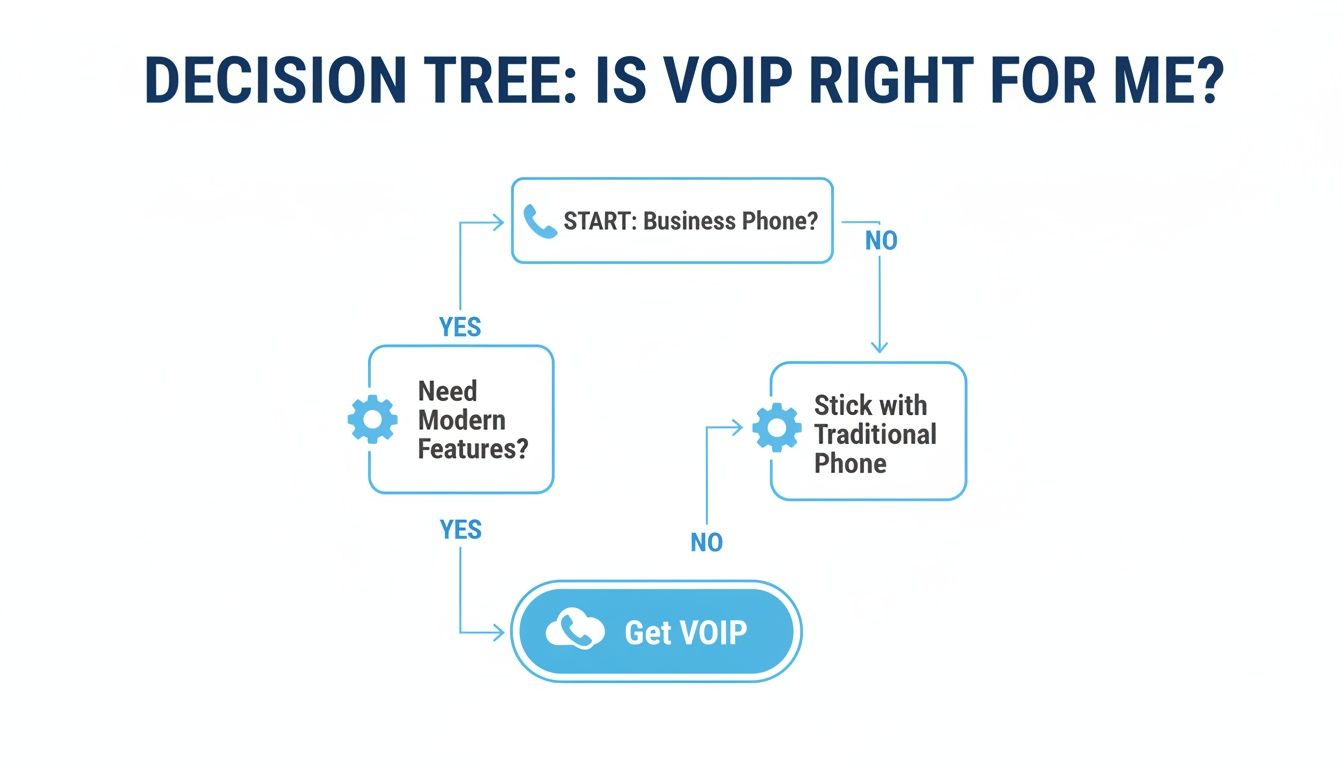
As you can see, if you need more than just a dial tone, a VoIP system is the logical choice.
Exploring On-Premises VoIP
Your other choice is an on-premises VoIP system. To stick with our analogy, this is like buying a house. Your company buys all the equipment—the servers (PBX), switches, and phones—and keeps it all right there in your office. Your IT team is then on the hook for installing, managing, maintaining, and updating the whole setup.
This path requires a big chunk of cash upfront. The upside? Your organization gets total control over every little detail, from security settings to how it connects with other software you already have on-site. If you want to dive deeper into how this differs from a cloud setup, our guide on what a cloud phone system is is a great read.
An on-premises system can make sense for huge companies that already have a big IT department and very specific, complex security or customization needs that make the high cost and extra work worth it.
In the end, it’s a trade-off between having total control and enjoying total convenience.
- Hosted VoIP is all about low startup costs, easy scalability, and minimal tech headaches. It's the perfect fit for most businesses that want a modern, worry-free solution.
- On-Premises VoIP gives you complete control and deep customization, but it demands a serious investment in both money and in-house IT expertise.
By thinking about these key factors—initial cost, future growth, who handles the tech, and how much control you need—you can confidently pick the model that works for your company. For the vast majority of businesses today, the flexibility and predictable cost of a hosted VoIP office phone system is the clear winner.
Essential Features of a Modern VoIP Phone System
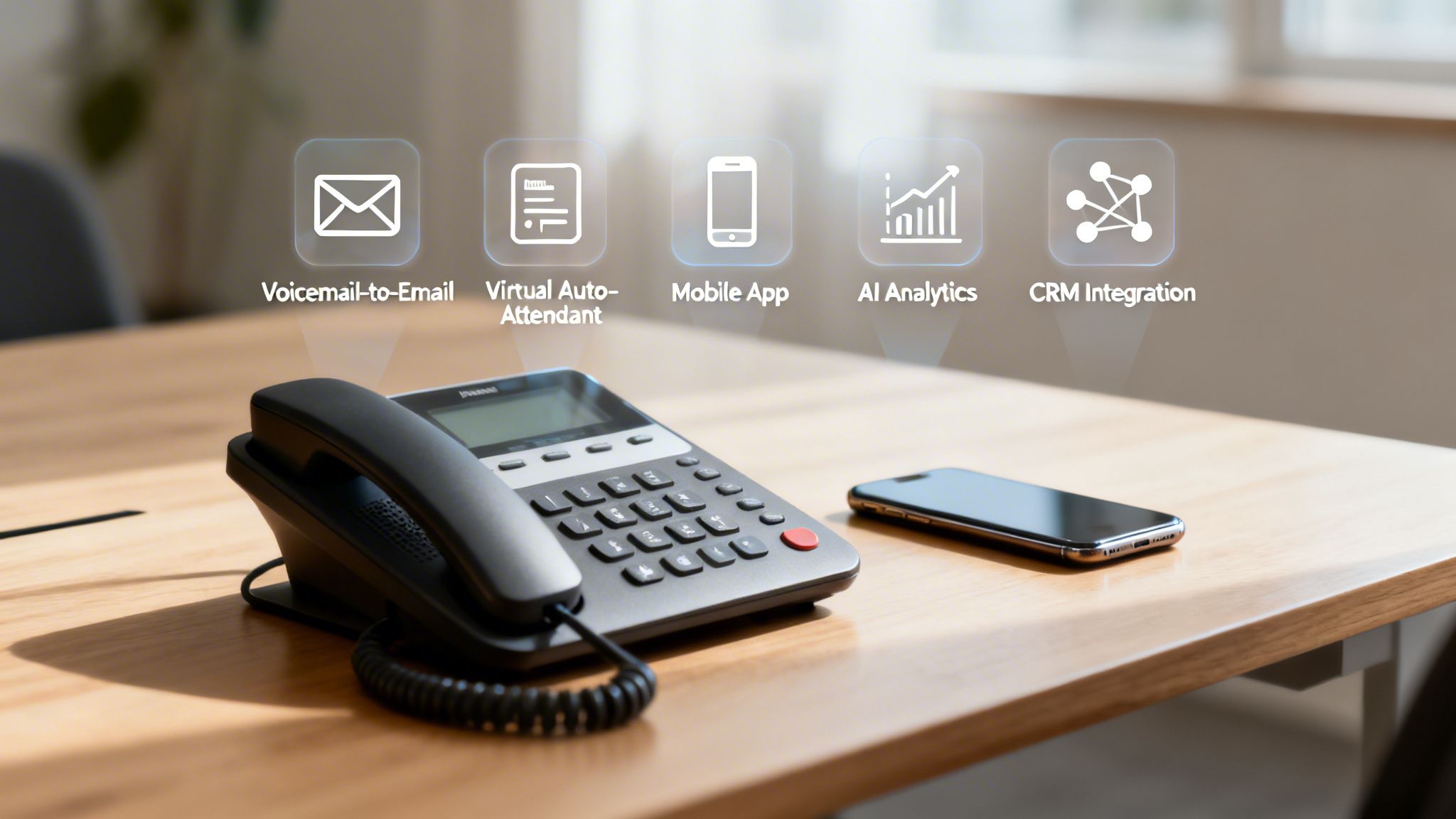
A modern VoIP office phone system is so much more than just a way to make and take calls. Think of it as a complete communications hub built to solve real business problems, make you look more professional, and make your day-to-day work a whole lot easier.
The real magic happens when your phone system stops being a separate tool and starts working with your business. These features help your team work smarter, not just harder.
Tools That Give You a Professional Edge
First impressions are everything. A good VoIP system can give even a one-person shop the polish and presence of a big company. It all starts with how you handle calls, making sure every customer has a great experience.
A perfect example is the auto-attendant. This feature works like a virtual receptionist, greeting callers with a custom message and guiding them with a simple menu—"Press 1 for Sales, Press 2 for Support." No more missed calls, and customers get to the right person, 24/7.
Then there’s voicemail-to-email transcription. Instead of dialing in to check messages, the system automatically turns voicemails into text and emails them to you. You can read messages on your phone between meetings, reply faster, and keep a searchable log of every important detail.
Unlocking True Mobility and Flexibility
In today's world, your business number can't be stuck at a desk. VoIP breaks that chain, turning any device with an internet connection into your business phone.
Mobile App Integration: This is huge for remote and hybrid teams. A dedicated mobile app lets your staff make and receive calls from their business number right on their smartphone. Their personal number stays private, but they always look professional, no matter where they are.
Find Me/Follow Me: This smart feature makes sure you never miss a critical call. You can set it to ring your desk phone, then your mobile app, and even a colleague’s line if you don't answer. It’s a safety net that keeps business moving.
Video Conferencing: Many VoIP platforms now include built-in video conferencing. This pulls your voice, video, and screen sharing into a single system, so you can ditch extra software subscriptions and make teamwork simple.
Here's a key takeaway: VoIP centralizes your communication. In fact, about 40% of businesses using a CRM also use VoIP. This lets them log calls, track customer history, and manage relationships all in one place.
Advanced Features for Smarter Decisions
Beyond the daily grind, a VoIP office phone system gives you data and tools to make better business decisions. This is what separates a basic phone line from a true business asset.
Take branded caller ID, for instance. It shows your company name and logo on the recipient's screen, even if they don’t have your number saved. This builds instant trust and can make a huge difference in answer rates for your sales and support calls.
On top of that, AI-powered call analytics give you incredible insight into your communications. You can track call volume, peak hours, customer wait times, and how long calls last. This data is gold for staffing your support desk, seeing how well marketing campaigns are working, and spotting ways to run things more efficiently. For anyone looking to get these kinds of powerful tools, our VoIP solutions for small business are a great place to start.
When you put them all together, these features create a communication system that isn’t just cheaper—it’s smarter, more flexible, and ready for whatever your business needs next.
How VoIP Powers Remote Work and Business Growth
The way we work has changed for good. Remote and hybrid models are here to stay, and a VoIP office phone system is the communication engine that makes it all click. It offers a level of flexibility and power that old-school landlines simply can't match.
Forget being chained to a desk. Your office number can now go wherever you do. Whether it's through a mobile app on your smartphone or a softphone on your laptop, your team gets full access to the company phone system from home, a coffee shop, or on the road.
This freedom from a physical location is a game-changer for growing businesses and the people who power them.
Fueling Growth and Empowering Teams
Imagine a small startup trying to punch above its weight and compete with bigger companies. Instead of pouring money into physical offices, they can use a VoIP system to set up local phone numbers in key markets. All those calls route right back to their core team, giving them an instant national presence without the overhead.
That’s the real power of a VoIP office phone system. It levels the playing field, letting smaller businesses project a polished, big-company image. That kind of agility is exactly what you need to scale up quickly and efficiently.
The best part about VoIP is how easily it grows with you. Adding a new team member is as simple as clicking a button in an online portal to assign them a license. No more calling a technician or waiting for weeks to get new lines installed. You can adapt at the speed you grow.
This flexibility also transforms how your team works together. With built-in features like video conferencing, team messaging, and file sharing, you create one unified hub where everyone stays connected, no matter where they are. This shift is a big reason the global VoIP phone market is expected to more than double to USD 132.33 billion by 2034. According to a full market analysis on FortuneBusinessInsights.com, managers are also finding that their hybrid teams are 62% more productive.
Tangible Outcomes for Modern Businesses
Making the switch to a VoIP office phone system isn't just about convenience; it delivers real results that help your bottom line and make your operations smoother.
- Significant Cost Savings: Stop paying for expensive landline rentals and maintenance contracts. Businesses often see a big drop in their monthly phone bills, and international or long-distance calls are typically much cheaper.
- Instant Scalability: As we mentioned, you can add or remove users instantly. This means you only ever pay for what you actually need, eliminating the waste of paying for phone lines that sit unused.
- Enhanced Collaboration: Bringing voice, video, and messaging together on one platform means less software juggling and more connected teams. This is crucial for keeping your company culture and productivity strong in a distributed workforce.
- Business Continuity: Your phone system lives in the cloud, so it isn’t tied to your physical office. If a local power outage hits, calls can be automatically forwarded to mobile phones so you never miss a customer call.
These features are no longer just "nice-to-haves"—they're essential for any business that wants to compete and grow today. If you're managing a distributed team, our guide on choosing the right remote work phone system has even more great tips. Put simply, VoIP gives you the tough, adaptable foundation your business needs.
Calculating the ROI of Your VoIP System
Any investment you make in your business has to make sense on paper. When you're looking at a VoIP office phone system, figuring out the true financial impact means looking past the monthly bill. Calculating the return on investment (ROI) is how you see the real value, not just the upfront cost.
The first step is simply understanding how VoIP is priced. It's a breath of fresh air compared to the notoriously complex invoices from old-school phone companies. VoIP pricing is almost always simple and predictable.
Common VoIP Pricing Models
Most hosted VoIP providers run on a subscription model, which makes budgeting a whole lot easier. You’ll generally find two main ways they structure it:
- Per-User, Per-Month: This is the most popular way to go. You pay a single flat fee every month for each person in your company who needs a phone line. This fee usually bundles in a core set of features and often includes unlimited calling in your region.
- Tiered Plans: Some providers package their services into different tiers (think Basic, Pro, or Enterprise). Each level unlocks more powerful features, like CRM integrations or deep-dive analytics, so you only pay for the tools your team will actually use.
This kind of predictability is the exact opposite of traditional landline bills, which are often packed with confusing charges for line rentals, maintenance contracts, and sky-high per-minute rates for long-distance calls.
A Simple Framework for Calculating Your ROI
To see the savings for yourself, all you need to do is compare what you’re spending now with the predictable costs of a VoIP system. Start by adding up all of your current monthly expenses related to your landline. This is your baseline.
Next, get a quote from a VoIP provider that’s based on your team’s specific needs. The difference between those two numbers is your direct monthly savings. But the true ROI of a VoIP office phone system goes much deeper than that.
A huge part of the ROI calculation is factoring in productivity gains and soft savings. For example, how much time does voicemail-to-email save your sales team every week? What’s the value of preventing even one missed customer call with a feature like Find Me/Follow Me?
These indirect benefits—things like happier, more productive employees, better customer service, and the flexibility to support a remote team—add up quickly. In many cases, they deliver more value than the direct cost savings alone. This is exactly why the market is shifting so dramatically.
The global VoIP services market is expected to balloon from an estimated $178.89 billion in 2026 to $413.36 billion by 2033. Businesses that make the switch regularly report saving up to 50% over their old legacy systems, a trend that’s accelerating as companies move away from expensive, clunky hardware. You can check out more on these trends and discover insights about VoIP market statistics on Tragofone.com.
To help you get started, use this simple worksheet to map out your potential savings.
ROI Calculation Worksheet: VoIP vs. Traditional Phone Line
| Cost Category | Current Monthly Landline Cost | Estimated Monthly VoIP Cost |
|---|---|---|
| Line Rental Fees | ||
| Per-Minute Calling Charges | ||
| Long-Distance Charges | ||
| International Calling | ||
| Hardware Maintenance/Leases | ||
| Feature Add-On Fees | ||
| Total Monthly Cost |
Once you fill this out, the difference in the "Total Monthly Cost" columns will give you a clear picture of your direct savings.
Questions to Ask Providers for a Clear Quote
To get a truly accurate comparison, you need a transparent quote. Go into the conversation armed with the right questions to avoid any surprises down the road.
- What’s included in the per-user monthly fee?
- Are there any setup, installation, or one-time hardware costs?
- Does the plan include unlimited local and long-distance calling?
- What are the international calling rates?
- Are key features like an auto-attendant, video conferencing, and mobile apps included, or are they extra?
- Is there a contract, and what are the terms?
By getting clear answers to these questions, you can build a solid financial case and make a confident decision that will pay dividends for years to come.
Why Your Internet Connection Is Key to VoIP Success

You can get the most advanced VoIP office phone system on the planet, but at the end of the day, its performance hinges on one thing: your internet connection. Think of your internet as the highway your voice data travels on. If that highway is clogged with traffic or full of potholes, your calls are going to have a rough ride.
Unlike old-school landlines that have their own dedicated copper wiring, VoIP shares the same internet connection you use for everything else. So, when you experience choppy audio, frustrating delays, or dropped calls, the phone system itself is rarely the culprit. More often than not, it’s a sign that your internet just can't keep up.
The Problem with Slow Upload Speeds
Here’s something many business owners don’t realize: most standard internet plans, especially from cable providers, are asymmetrical. That’s a fancy way of saying your download speed (for browsing and streaming) is much faster than your upload speed (for sending information out). For a VoIP phone system, that imbalance is a recipe for disaster.
Every time you speak on a call, you’re uploading data. If your upload speed is lagging, those little digital packets carrying your voice get stuck in a traffic jam. The result is what we call "jitter" and "packet loss"—which you hear as garbled, robotic audio or parts of your sentences cutting out completely.
Key Insight: Your call quality is only as good as your upload speed. For crystal-clear conversations and flawless video meetings, your connection has to be fast and stable in both directions. For any business that cares about professional communication, this is non-negotiable.
The Premier Broadband Fiber Advantage
This is exactly where a 100% fiber-optic network changes everything. Unlike cable, Premier Broadband’s fiber connections are symmetrical—you get the same blazing-fast speeds whether you're uploading or downloading. This creates a wide-open, reliable superhighway for your voice data, making sure it gets where it's going without a hitch.
- Flawless Video Conferencing: With strong upload speeds, your team can join video calls without freezing or glitching. Collaboration stays productive, not frustrating.
- Unwavering Call Reliability: Keep those crucial customer calls crystal-clear, protecting your professional image and preventing headaches.
- Future-Proof Bandwidth: A fiber network has more than enough capacity to handle everything your team throws at it—from VoIP calls to cloud apps—without even breaking a sweat.
This need for solid infrastructure is what’s driving massive growth in the industry. The global Unified Communications (UC) market is expected to rocket to $628.5 billion by 2033, and North America already holds a 48% market share in 2024. This boom is fueled by the demand for integrated solutions like stable video calls over high-speed fiber—which is precisely what we deliver. You can learn more about the Unified Communications market on Zoom.com.
When you choose Premier Broadband, you're not just getting an internet provider. You’re getting a partner committed to building a future-proof network that lets your VoIP office phone system perform at its absolute best.
Common Questions About VoIP Phone Systems
Even after seeing all the benefits, it's totally normal to have a few lingering questions. A VoIP office phone system is a game-changer, but you need to be confident before you make the leap. Let's get you the answers you need.
It's all about making sure your business is built on a solid foundation.
Can I Keep My Existing Business Phone Number?
Yes, you absolutely can. This is probably the most common question we get, and the answer is a firm "yes." The process is called "porting," and it's a standard, regulated procedure that moves your number from your old provider to your new VoIP service.
Your phone number is a huge part of your brand, and you shouldn't have to give it up. Your new VoIP provider, like us, handles all the technical details behind the scenes. We make sure the transition is seamless so there’s no disruption for you or your customers.
How Secure Is a VoIP System from Hacking?
This is a fair question for any service that runs over the internet, and VoIP is no exception. Any provider worth their salt takes security extremely seriously, using multiple layers of protection to keep your calls private.
A core part of that security is encryption. It works by scrambling your call data while it’s traveling over the internet, making it unreadable to anyone trying to listen in. Modern VoIP uses tough encryption protocols like TLS and SRTP to protect the call setup and the conversation itself.
On top of encryption, providers add other advanced security measures:
- Secure data centers that are protected both physically and digitally.
- Proactive network monitoring to spot and shut down suspicious activity.
- Regular security audits and software updates to stay ahead of new threats.
While nothing is 100% risk-free, going with a quality provider like Premier Broadband that puts security first drastically reduces your exposure and keeps your business conversations safe.
What Happens if the Power or Internet Goes Out?
This is where a cloud-based VoIP system really proves its worth over an old-school landline. If your office loses power or internet, a traditional phone system is just a paperweight. But since a hosted VoIP system lives in the cloud, it doesn't miss a beat.
Most systems include a feature called automatic call forwarding. You set it up ahead of time to instantly reroute all incoming calls to other numbers—like your team's cell phones or another location—if your office phones ever go offline. You'll never miss an important call, and your customers won't have a clue there was ever a problem.
Ready to make the switch to a communication system built for the modern world? Premier Broadband offers crystal-clear, reliable VoIP solutions powered by our 100% fiber network. Learn more and get a custom quote today at premierbroadband.com.