

Staring down a long list of business phone service companies can feel like a chore. You know you need to move on from that old landline, and these modern Voice over Internet Protocol (VoIP) systems offer way more flexibility and features for today's remote and hybrid teams. The cost savings don't hurt, either.
Why Your Business Needs A Modern Phone System

Let's face it: being tied to a desk phone is a thing of the past. Modern business communication is all about mobility, smart integrations, and giving customers a great experience every time they call. That's where cloud-based phone systems come in, moving your entire communications setup to a secure platform you can access from anywhere with an internet connection.
This isn't just a small upgrade; it’s a fundamental change in how businesses operate. The global business phone systems market was valued at $44.26 billion in 2025 and is expected to grow at an annual rate of 10.9% through 2034. This explosive growth is all about the switch to the cloud. You can dig into the numbers and see who the key players are in this detailed business phone systems report.
From Legacy PBX to Flexible Cloud Solutions
Many businesses are still running on traditional on-premise phone systems, often called a Private Branch Exchange (PBX). This means you have a bulky, expensive piece of hardware sitting in a closet that you have to maintain. It worked for its time, but it’s a real roadblock to running an efficient, modern company.
Cloud systems are a completely different animal. These platforms, also known as Unified Communications as a Service (UCaaS), bundle calling, video meetings, and team messaging into a single, easy-to-use app. If you're new to the term, check out our guide on what UCaaS is and how it helps businesses to get a better handle on the benefits.
This table breaks down the main differences pretty clearly:
| Feature | Legacy On-Premise PBX | Modern Cloud Phone System (VoIP/UCaaS) |
|---|---|---|
| Upfront Cost | High (hardware purchase, installation) | Low (subscription-based, no major hardware) |
| Maintenance | Requires IT staff or vendor contracts | Managed entirely by the provider |
| Flexibility | Tied to a physical office location | Accessible anywhere via apps (desktop, mobile) |
| Scalability | Complex and slow (requires new hardware) | Instant (add or remove users online) |
| Features | Basic calling, voicemail | Advanced routing, video, analytics, integrations |
The key takeaway is simple: Legacy systems chain your communications to a physical building, while cloud systems liberate them. For a business focused on growth and adaptability, the choice is clear.
By moving to a cloud-based service, you’re not just getting new tech. You’re building a more agile and customer-friendly operation that can grow with you. The right partner will help make that switch smooth, turning your phone system from a headache into a true business asset.
Essential Features That Define The Best Phone Systems
Shopping for a new phone system can feel like trying to decipher a foreign language. Every website from business phone service companies throws a ton of jargon your way. To make the right call, you have to cut through the marketing fluff and see which features will actually make a difference in your day-to-day.
Think of a modern phone system as the nerve center for all your customer conversations, not just a dial tone. The best ones are all about managing calls like a pro, bringing all your communication tools into one place, and giving you data you can actually use. Let's dig into the core features that really matter.
Streamline Your Inbound Calls
How you handle incoming calls is the first impression you make. The right call management features can make a small team look like a big, well-oiled machine, ensuring every caller has a smooth experience.
Here are the key tools you'll need:
- Auto-Attendant: This is your virtual receptionist. It greets callers with a custom message and gives them a simple menu ("Press 1 for Sales, Press 2 for Support"). It instantly makes your business sound more professional and gets callers to the right person without anyone having to lift a finger.
- Intelligent Call Routing: This is way more than just basic call forwarding. You can create custom rules based on your business hours, who's calling, or which team members are free. For instance, a call from a VIP client can go straight to a senior manager's cell phone, no matter where they are.
- Call Queues: If you have a busy sales desk or support team, call queues are a must-have. They put callers in a virtual line, play music or custom messages, and then route the call to the next available person. This simple feature prevents lost leads and keeps customers from getting frustrated.
A well-configured call management system is like having an invisible, hyper-efficient receptionist working 24/7. It ensures no call slips through the cracks and every customer feels valued from the moment they connect.
Unify Your Communication Channels
Work doesn't just happen at a desk anymore. The best business phone systems understand this and pull all your communication tools together onto a single platform. This is often called Unified Communications (UC), and it's what separates a simple phone service from a real productivity powerhouse.
Unified Communications brings these tools together:
- Mobile and Desktop Apps: Let your team make and take business calls, check voicemail, and message coworkers from their laptop or personal smartphone—all while using their business phone number. This is non-negotiable for supporting remote and hybrid work.
- Video Conferencing: Having video meetings built right in means you can stop paying for a separate Zoom or Webex subscription. You can flip a phone call into a video meeting with screen sharing in just a couple of clicks.
- Team Messaging: Think Slack or Microsoft Teams, but integrated with your phone system. It gives you dedicated chat channels for projects or departments, which cuts down on endless internal email chains and helps your team collaborate faster.
When you bring everything under one roof, your team can stop juggling a dozen different apps and just get work done.
Unlock Insights With Analytics And AI
The top business phone service companies give you tools that turn your call history into real business intelligence. Instead of just guessing how your team is performing, you can get hard data to back up your decisions. You can also explore our detailed guide on the best VoIP phone systems for small business to see how different providers package these features.
Look for a system that includes a strong analytics dashboard with real-time reports. This lets you track critical metrics like call volume, when your busiest hours are, how long customers are waiting on hold, and the performance of individual team members. This information is gold for scheduling staff and improving your customer service.
On top of that, many advanced systems now use Artificial Intelligence (AI) to dig even deeper. Features like AI-powered call transcription can turn calls into searchable text, while sentiment analysis can automatically flag conversations where a customer sounded unhappy. This lets managers quickly spot coaching opportunities and understand customer frustrations without having to listen to hours of recordings.
How To Compare Different Types Of VoIP Providers
Picking a VoIP system is about more than just a list of features. The provider you choose has a huge effect on your call quality, the support you get, and how easily you can grow. Not all business phone service companies are the same, and understanding how they operate is the first step to making a smart choice.
Most providers fall into one of three buckets: National VoIP Specialists, the giant Telecom companies, and Regional Fiber & VoIP Providers. Each has its own pros and cons that fit different business needs. Let's break them down so you can see which type is right for you.
National VoIP Specialists
These are the big names in business software, like RingCentral or 8×8. Their biggest advantage is a massive, feature-packed platform that they've spent years building. They're leaders when it comes to integrations, connecting to hundreds of other business apps right out of the box.
- Best For: Companies with teams spread across the country, large businesses that need complex call routing, and anyone who needs a wide range of software integrations.
- Key Consideration: These services are delivered "over-the-top," which means they run on whatever internet connection you have. If you start having call quality problems, you can get stuck in a frustrating blame game between your VoIP provider and your internet provider.
Their platforms are built for flexibility, letting a business with offices everywhere operate on one unified system. They are a natural fit for the remote and hybrid work models so many companies use today.
Telecom Giants
This group includes the household names you already know, like Verizon and AT&T. These companies are infrastructure titans that own massive networks stretching across the country. Their main business has always been providing the connection itself—from mobile service to business fiber.
While they do offer VoIP, it's usually positioned as an add-on to their core internet and mobile plans. The big appeal is getting all your services bundled on a single bill from a brand you recognize.
The downside is that their VoIP platforms might not be as advanced or have as many features as a dedicated specialist. Getting help can also be a headache. You’ll often be funneled into a massive call center where the person you talk to might not have deep knowledge of business phone systems.
This quick flowchart helps connect your business goals to the features that will actually achieve them.
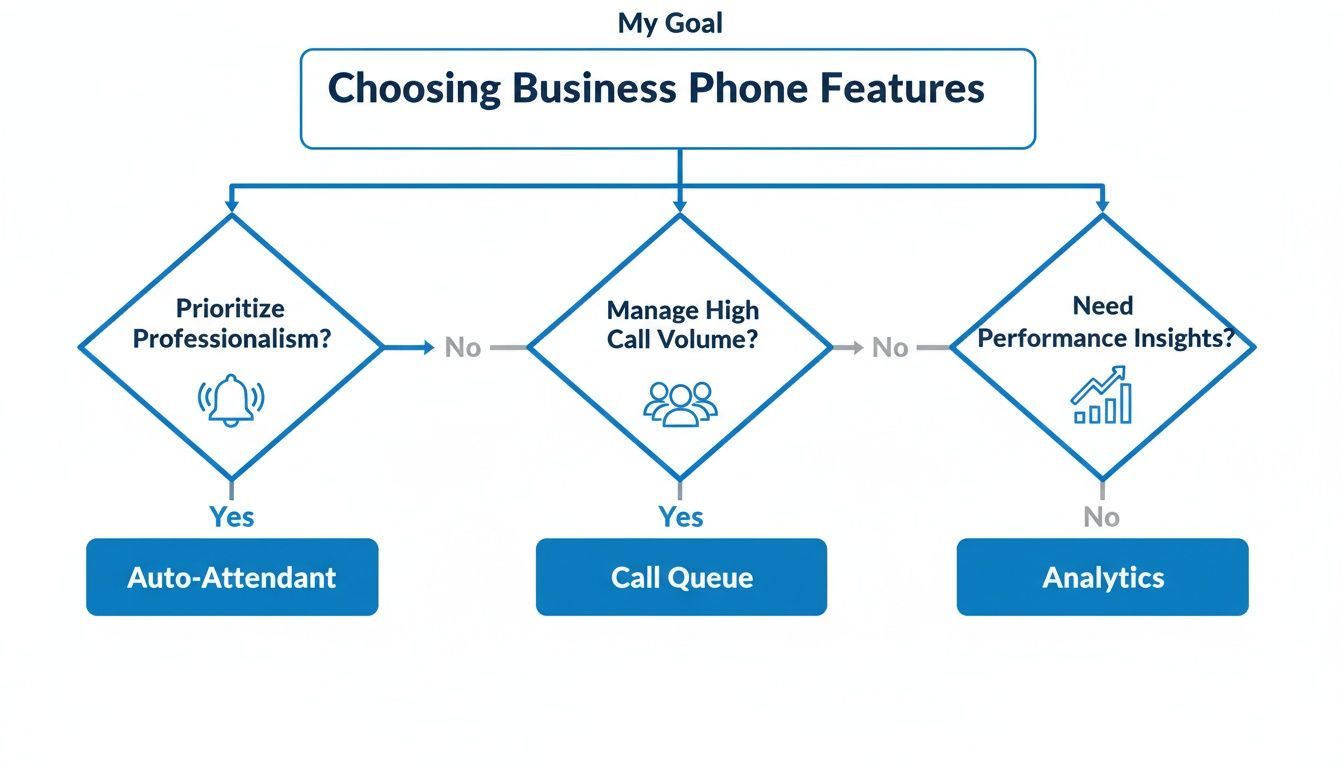
As you can see, there’s a direct line from a specific business need—like improving your professional image or managing a flood of calls—to the exact VoIP feature that gets the job done.
Regional Fiber And VoIP Providers
There’s a third option that’s becoming a powerful alternative: the regional provider. Companies like Premier Broadband own and manage their own fiber network and deliver VoIP service directly over that same connection. This creates a completely different kind of partnership, one built on total accountability.
This all-in-one approach puts an end to the blame game. Because one company controls the entire path from their data center to your office, they are the only party responsible for your call quality. There’s no separate internet company to point fingers at when you experience jitter or lag.
This model is part of a much bigger trend. The Voice over Internet Protocol (VoIP) market was valued at $161.79 billion in 2025 and is expected to hit $415.20 billion by 2034, growing at an 11% compound annual rate. North America holds a 48% share of that revenue, and this growth signals a huge global shift toward internet-based calling. You can dive deeper into these numbers in a recent VoIP industry report.
To make the choice even clearer, let's put these provider types side-by-side.
Provider Type Comparison Matrix
This table breaks down the key differences between the main provider types, helping you see where each one shines and where they fall short.
| Attribute | National VoIP Specialists | Telecom Giants | Regional Fiber/VoIP Providers (like Premier Broadband) |
|---|---|---|---|
| Network Control | None (relies on your ISP) | High (own their backbone) | Total (own the "last mile" connection to your office) |
| Call Quality | Variable; depends on your internet | Generally reliable | Highest; managed from end-to-end |
| Support Model | Large, often outsourced call centers | Massive, multi-product support queues | Local, dedicated, and specialized in voice |
| Scalability | Excellent for user counts & features | Good, but can be slow to make changes | Excellent within their service region |
Looking at the table, a clear picture emerges. For businesses where call clarity is everything—think medical offices, law firms, or busy sales teams—a regional provider offers an unmatched advantage. Their local support teams also mean you get a more personal and responsive experience when you need help.
You can see more direct comparisons in our list of the top VoIP providers for business.
In the end, the right choice comes down to your priorities. If you need a global reach and the absolute widest set of software integrations, a national specialist might be your best bet. If you just want simple bundling, a telecom giant could be fine. But for unbeatable reliability and support you can count on, the integrated model of a regional fiber and voice provider is tough to beat.
Key Technical Concepts For Making An Informed Choice
To really compare business phone service companies, you’ve got to get past the marketing fluff and understand a few key ideas. Knowing the lingo helps you ask the right questions and figure out if a provider's tech is as solid as their sales pitch.
You don't need to be a network genius. It's like learning the basics before buying a car—you want to know what's under the hood to make sure it can actually get you where you need to go, safely and reliably. Let's look at the terms that truly matter.
The Digital Highway For Your Calls
Every modern phone system runs on something called SIP Trunking. Think of it this way: if your voice call is a car, the SIP trunk is the digital superhighway it drives on. It completely replaces old, physical phone lines with a direct virtual connection from your office to the world, all over your internet.
How a provider handles SIP Trunking has a massive impact on your call capacity and reliability. It’s what determines how many calls your business can handle at once. You should always ask a potential provider if they manage their own SIP trunks or just resell someone else's. A company that controls its own infrastructure has far more power to guarantee quality.
Decoding Service Level Agreements
A Service Level Agreement (SLA) is one of the most critical parts of any business contract. It's the provider's written, binding promise on performance, availability, and support. When it comes to your phone system, the single most important number in that SLA is uptime.
An SLA isn't just a promise; it's a legal document. A good one will guarantee a specific uptime, like 99.999% (which works out to less than six minutes of downtime a year), and will spell out exactly what you get back if they don't hit that mark.
When you look at an SLA from different business phone service companies, get into the details. Does the uptime guarantee only cover their platform, or does it include call quality metrics like jitter and packet loss? The fine print tells you how confident a provider really is in their network.
Security For Your Conversations
Your business calls carry sensitive information, from client strategies to financial data. Protecting those conversations from anyone listening in is non-negotiable. That's where encryption comes in.
Look for providers that secure your calls using two key protocols:
- Transport Layer Security (TLS): This encrypts all the setup data for your calls—the information that starts, manages, and ends the call itself.
- Secure Real-time Transport Protocol (SRTP): This encrypts the actual audio of your conversation, turning your voice into unreadable data for anyone trying to intercept it.
When used together, TLS and SRTP provide true end-to-end security. Make sure any provider you consider includes both as a standard feature, not some pricey add-on.
The Power Of API Integrations
Finally, think about how your new phone system will work with the other software you use every single day. An Application Programming Interface (API) is what lets different programs talk to each other, and for a phone system, it's a huge boost to efficiency.
A good API, for example, lets you plug your phone system right into your CRM. That means "screen pops" can show you a caller's entire history the moment the phone rings. It can also log every call automatically, saving your team from tedious data entry and building a perfect record of every customer conversation. Always ask for a list of pre-built integrations and for their API documentation.
When A Single Provider For Internet And Voice Wins
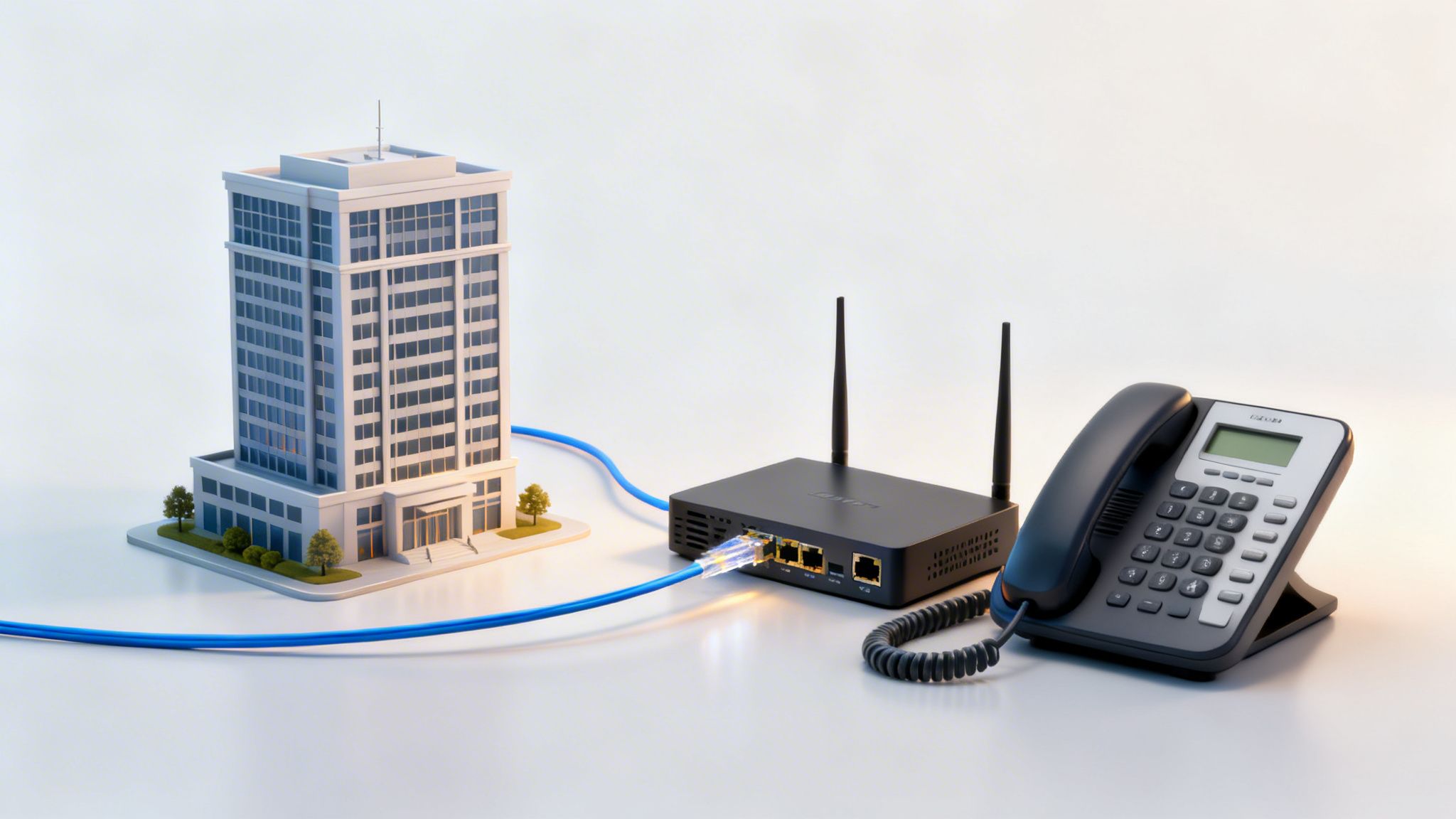
When you're comparing business phone service companies, it’s easy to focus on feature checklists. But one of the biggest factors that will impact your daily operations is how your phone service and internet connection work together. For any business that can’t afford dropped calls or garbled audio, bundling your voice and data with one provider is a smart, strategic move.
This approach puts an end to a common and deeply frustrating problem: the blame game. When you use separate companies for internet and VoIP, every call quality issue turns into a round of finger-pointing. The phone provider blames the internet, the internet provider says their service is working fine, and you’re stuck in the middle with no fix.
The Power Of A Single Point Of Accountability
Choosing a single provider to manage both your internet connection and your voice platform creates one point of accountability. It’s that simple. When a regional provider like Premier Broadband delivers VoIP over our own fiber network, there’s nowhere to hide. One company owns the entire path to your office, making us solely responsible for troubleshooting and guaranteeing performance.
This integrated approach is absolutely critical for organizations where clear communication is non-negotiable, like a medical practice discussing patient info or a financial firm executing a trade. The whole service, from our data center to your desk phone, is managed and monitored by one team.
When your internet and voice provider are one and the same, their Service Level Agreement (SLA) holds more weight. Uptime guarantees are no longer just about the platform; they reflect the end-to-end quality of the entire service delivery, providing true peace of mind.
This structure also streamlines more than just troubleshooting. It makes billing, vendor management, and even long-term planning much simpler. You have one partner to call for everything, which creates a more efficient and less complicated operation.
A Foundation Built On Symmetrical Fiber
The technical advantage of a single provider gets a massive boost when the connection is 100% fiber optic. Unlike old-school cable or DSL, fiber internet delivers symmetrical speeds—your upload speed is just as fast as your download speed. For a business phone system, this is a complete game-changer.
Think about it: a VoIP call is a two-way street. Your voice is uploaded while you download the other person's voice. Symmetrical speeds ensure your side of the conversation is transmitted with the same crystal-clear quality as the audio you receive. This eliminates the choppy, broken-up sound that plagues connections with weak upload bandwidth.
This stable, high-capacity foundation ensures your phone system performs perfectly, even when your team is also:
- Jumping on high-definition video conferences
- Uploading huge files to the cloud
- Running other data-heavy business applications
With fiber, you have plenty of bandwidth to handle all your business needs without ever compromising the quality of your voice calls. You can see how internet and phone services for small businesses can be bundled for maximum impact and reliability.
An Ecosystem Of Integrated Business Solutions
The best business phone service companies today do more than just voice and data. A real technology partner offers a whole suite of integrated services that work together to secure and simplify your operations. This is where a single provider’s value goes deep into your IT infrastructure.
For example, Premier Broadband's ecosystem includes solutions like Managed Network Edge. This service pulls your firewall, router, and Wi-Fi management into a single, cloud-managed platform. When you combine this with your internet and voice, you get a complete view and total control over your entire network from one dashboard.
Adding services like AI-powered security cameras only strengthens this unified approach. By choosing a partner who can deliver a complete technology stack, you cut down on vendor headaches, boost security, and ensure all your critical systems are built to work together from day one. This isn't just about bundling; it’s about building a more resilient and efficient business.
Frequently Asked Questions About Business Phone Systems
Making the switch to a modern phone system is a big step, and it's totally normal to have questions. When you're looking at different business phone service companies, getting clear, straight answers is the only way to make a decision you feel good about.
This section covers the most common questions we hear from businesses just like yours. We’ll break down everything from the tech requirements to how the switch actually happens, giving you the info you need to move forward.
What Is The Difference Between Hosted VoIP And An On-Premise PBX?
This is one of the first and most important questions to answer. The main difference comes down to where your phone system's hardware lives and who’s in charge of keeping it running.
An on-premise PBX (Private Branch Exchange) is the old-school way. You buy and keep all the physical phone equipment—servers, control units, and all—right in your office. This means a big upfront cost and puts your IT team (or an outside vendor) on the hook for all maintenance, updates, and repairs. While you have direct control, it's expensive and doesn't easily grow with your business.
Hosted VoIP, on the other hand, is a cloud-based service. The provider owns and manages all the complex hardware and software in their secure data centers. You just connect to the phone system over your internet, paying a predictable monthly fee for each user.
Hosted VoIP is the go-to choice for almost every modern business. It turns a large one-time purchase into a simple, manageable monthly expense. You get way more flexibility, easy scalability, and advanced features without the headache of managing hardware.
Ultimately, choosing hosted VoIP means you get to focus on your business, not your phone system.
Can I Keep My Existing Business Phone Numbers?
Yes, absolutely. We know how critical this is for any business. The good news is that the process is standardized and very reliable. You won't have to change the phone numbers your customers already use.
This ability to move your numbers from one provider to another is a protected process called Local Number Portability (LNP), which is regulated by the FCC. You'll often hear it called "porting" your numbers.
The porting process is straightforward:
- Authorization: You’ll give your new provider a recent phone bill and a signed Letter of Agency (LOA). This is the legal permission they need to start the transfer for you.
- Coordination: Your new provider works directly with your old one to schedule a specific date and time for the switch.
- Activation: On the scheduled day, your number is switched over to the new service seamlessly, with little to no downtime.
A good provider from the list of business phone service companies, like Premier Broadband, will handle this entire process for you. We manage all the behind-the-scenes work to make sure it's a smooth transition, so you can keep your business running without a single dropped call to your clients.
How Much Internet Bandwidth Do I Need For VoIP?
That’s a great question, and the answer is usually less than you’d think. For top-quality VoIP calls, a stable network is more important than raw speed.
A single VoIP call typically uses about 100 kilobits per second (kbps) for both uploads and downloads. You can figure out your needs with a simple formula: take the highest number of calls you expect to have at once and multiply it by 100 kbps. For example, if you have 10 employees on the phone at the same time, you'd need about 1,000 kbps, or 1 Megabit per second (Mbps), of dedicated bandwidth.
But the real make-or-break factor for call quality is your connection's consistency. This boils down to two things:
- Low Latency: This is the delay for data to travel from point A to point B. High latency creates that awkward lag in conversations.
- Low Jitter: This measures how much the latency varies. High jitter makes audio sound choppy and garbled because voice data arrives out of order.
This is exactly why fiber internet is the perfect foundation for a business phone system. Its equal upload and download speeds ensure you sound just as clear to others as they do to you. Its natural stability keeps latency and jitter super low, delivering crystal-clear conversations.
Even a "fast" internet connection can't save you if it isn't stable. Choosing the right internet service is just as important as picking the right phone provider.
What Happens To My Phone Service If The Internet Goes Down?
This is where modern cloud phone systems really prove their worth over old-school landlines, especially for keeping your business running. If your office internet goes down, your phones don't.
Top-tier business phone service companies build in a feature often called call continuity or automatic failover. This is a powerful tool that makes sure you never miss an important call, even if there’s a local outage.
Here’s how it works: the system instantly detects when your office internet is offline. It then automatically reroutes all incoming calls to backup numbers you've already chosen.
You can set these backup destinations to whatever works best for your business, including:
- Employees' cell phone numbers
- Voicemail boxes so callers can leave a message
- An automated greeting that informs callers of a temporary issue
- A phone number at another one of your business locations
This instant, automatic rerouting is a core benefit of a cloud system. It gives you a level of reliability that’s just not possible with an on-premise PBX or traditional phone lines, which would go completely dead in an outage. With automatic failover, your customers can always reach you, protecting your reputation and your bottom line.
Ready to see how a reliable, all-in-one voice and data solution can transform your business communications? Premier Broadband delivers crystal-clear VoIP over our 100% fiber network, ensuring unmatched call quality and reliability. Learn more about our integrated business solutions and get a partner you can count on.