
A business call recorder is a tool that captures your company's phone conversations, turning them into a valuable operational asset. Think of it like game tape for a sports team; it provides a definitive record of every customer interaction, allowing you to review performance, confirm details, and spot opportunities for improvement.
Why Your Business Needs a Call Recorder

In a competitive market, every single customer interaction is a chance to win or lose business. When you operate without a business call recorder, you're essentially flying blind, relying on memory and scattered notes. This leaves your company wide open to miscommunications, disputes, and missed coaching opportunities.
Call recording completely changes how you operate by creating a reliable source of truth. It’s no longer just a dusty compliance tool—it's a strategic asset for growth. Today, this technology is a core component of modern VoIP phone systems and a must-have for any competitive business. Feel free to take a deeper look at our business call recording solutions.
The demand for this technology is surging for a reason. The global call recording software market was valued at USD 4.64 billion in 2026 and is projected to climb to USD 8.16 billion by 2033. This growth is fueled by the critical need for compliance and quality assurance across nearly every industry. You can discover more about these market trends from Coherent Market Insights.
A Strategic Asset for Growth
A business call recorder delivers far more than just audio files; it provides actionable data that can improve almost every part of your company. By capturing and analyzing conversations, you unlock powerful benefits that directly impact your bottom line.
Call recording provides the objective evidence needed to settle disputes, verify orders, and ensure that both your team and your customers are on the same page. It eliminates the "he said, she said" dilemma.
Making the switch from manual note-taking to automated recording offers several key advantages that we'll explore throughout this guide:
- Protecting Your Business: Recordings serve as undeniable proof for compliance with regulations like GDPR. They can be critical in resolving legal disputes, saving your company from potential fines and reputational damage.
- Elevating Your Team: New hires can learn from your best people by listening to calls from veteran agents. This turns theoretical training into practical, real-world coaching and helps refine sales pitches and customer service skills.
- Ensuring Accuracy and Clarity: When a client questions a project's scope or a customer disputes an order detail, an instantly accessible recording can clarify the original agreement. This preserves the relationship and saves everyone valuable time.
By integrating a business call recorder into your workflow, you can move from reactive problem-solving to proactive improvement, making smarter decisions based on what's actually being said in your business.
Unlocking Powerful Benefits with Call Recording
A modern business call recorder is much more than a simple audio archive. Think of it as a powerful tool that delivers real, immediate value across your entire company.
Implementing call recording supports three critical areas of your business: protecting your company from risk, training your team, and ensuring every conversation is captured accurately. These aren't just abstract ideas—they translate directly into a stronger, more efficient, and more profitable operation.
Shield Your Business from Risk
In any industry, compliance is not negotiable. A business call recorder acts as your safety net, providing undeniable proof that you're following the rules. This is absolutely critical for businesses that handle sensitive information and must comply with regulations like HIPAA or GDPR, where one mistake can lead to massive fines.
Imagine a dispute over a verbal agreement. Without a recording, it’s a messy "he said, she said" situation that costs time and damages trust. With a recording, you can review the conversation instantly, get clarity, and resolve the issue before it ever escalates.
A call recording is your objective record—a factual account of agreements and consents that holds up under pressure. It protects your company by replacing guesswork with certainty.
This protection extends to every department. Sales can confirm terms and conditions. Customer support can document troubleshooting steps. Finance can verify payment authorizations. It’s a complete safety net for your entire business.
Elevate Your Team Through Practical Coaching
Training manuals and role-playing can only go so far. A business call recorder turns team development into a practical, hands-on experience by creating a library of real-world examples. New hires can listen and learn directly from your most successful team members.
Think about a new support agent struggling with a frustrated customer. Instead of just reading a script, their manager can have them listen to a call where a veteran colleague masterfully de-escalates a similar problem. The new agent hears the exact words, tone, and empathy needed to turn a bad experience into a great one.
This is how you provide targeted, effective coaching that actually sticks. You can highlight specific moments for improvement or praise, making feedback clear and actionable. This not only gets new hires up to speed faster but also helps sharpen the skills of your entire team.
Ensure Accuracy in Every Interaction
Misunderstandings are expensive. They cause rework, create client disputes, and hurt your bottom line. A business call recorder makes sure critical details are never lost to a bad memory or sloppy notes.
Picture this: a client argues about a project's scope, claiming certain features were part of the original verbal agreement. Instead of a long, frustrating back-and-forth, your project manager simply pulls up the recording of the kickoff call. Within minutes, the original terms are confirmed, the client relationship is saved, and you avoid costly scope creep.
The numbers back this up. Sales teams using a business call recorder report impressive results, including 15-40% improvements in win rates and 20% faster deal cycles. In customer service, reviewing calls has led to a 20% reduction in customer complaints. These are clear improvements that show a real return on your investment. Find out more about how call recording is driving sales success at ProShort.ai.
How to Choose the Right Call Recording System
Picking the right business call recorder doesn't have to be complicated. It all boils down to what works best for your specific business—your budget, your team's workflow, and your plans for growth.
Let's walk through the three main options you'll encounter: traditional on-premise hardware, third-party apps, and modern integrated cloud recorders.
The 3 Types of Call Recording Systems
Each type of call recorder has its own pros and cons. Thinking through these differences is the key to making a smart investment that pays off for years to come.
- On-Premise Systems: This is the old-school approach. You own and house all the physical hardware in your office. This gives you complete control, but it comes with a hefty price tag upfront, requires an IT team to manage it, and needs constant maintenance.
- Third-Party Software: Think of these as standalone apps you add to your existing setup. They offer flexibility and can be a quick fix for occasional recording needs. The major downside is that they rarely integrate well with your phone system, leading to compatibility headaches and manual work.
- Integrated Cloud Recorders: This is the modern, hassle-free choice. The recorder is built directly into a hosted VoIP phone system, like the ones we offer at Premier Broadband. There’s no hardware to maintain, it’s accessible from anywhere, and it scales with you.
To help you weigh these options, we've put together a quick comparison. This table breaks down what you can expect from each solution, making it easier to see which one aligns with your business goals.
Comparing Call Recording System Types
An analysis of the main call recorder solutions to help you choose the best option for your business needs.
| Feature | On-Premise System | Integrated Cloud Recorder | Third-Party Software |
|---|---|---|---|
| Initial Cost | High (hardware purchase) | Low (included with service) | Low to Medium (subscription/license) |
| Maintenance | High (requires IT staff) | None (managed by provider) | Low (software updates only) |
| Scalability | Difficult and expensive | Easy and instant | Varies, can be limited |
| Accessibility | Limited to the office network | Anywhere with internet | Anywhere software is installed |
| Integration | Complex, requires expertise | Seamless (built-in) | Poor, often requires workarounds |
| Security | Your full responsibility | Managed by provider | Varies by application |
For most businesses today, an integrated cloud recorder simply makes the most sense. It delivers powerful, enterprise-grade features without the complexity or cost, letting you focus on what really matters—running your business.
This infographic shows the core benefits you unlock the moment you start recording calls.
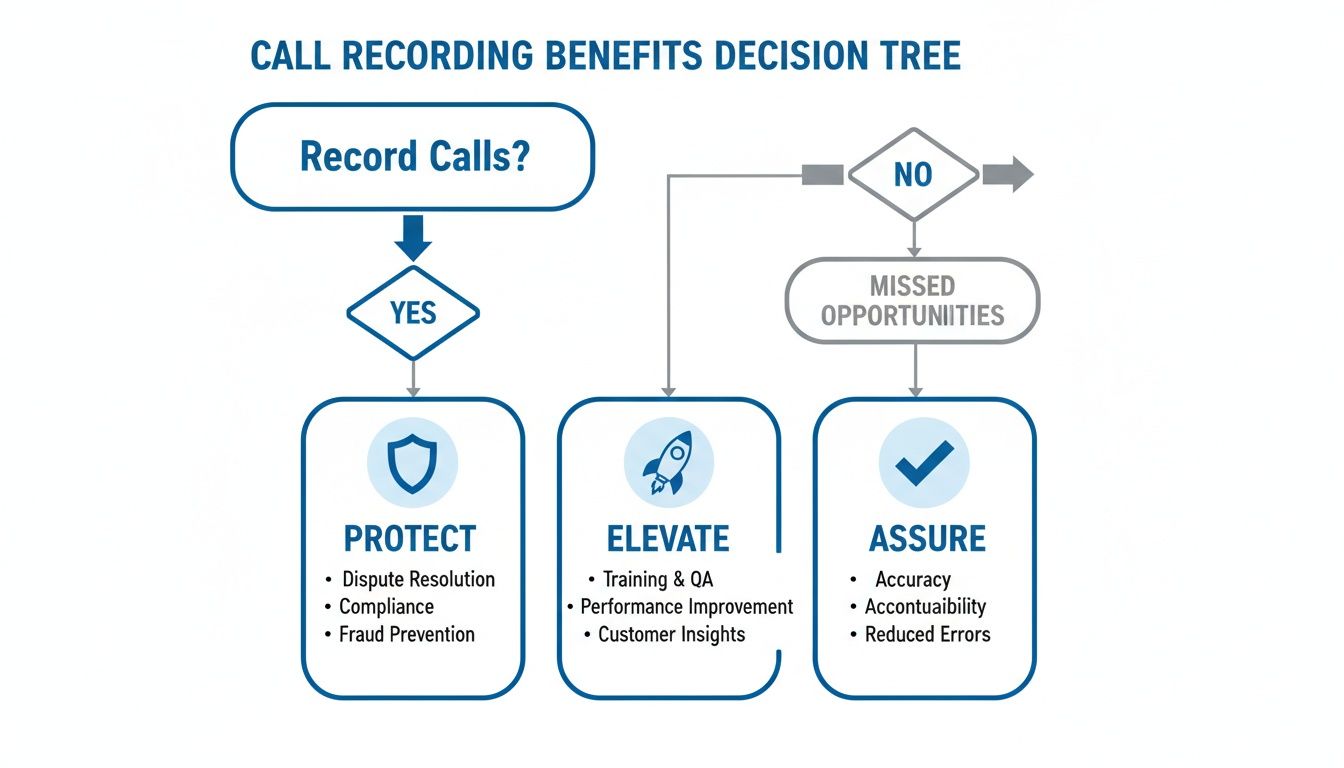
As you can see, recording your calls isn't just a feature; it’s a tool for protecting your business, training your team, and ensuring accuracy across the board. The market is taking notice.
The global market for this technology is booming. It generated USD 369.5 million in 2024 and is expected to explode to USD 1,017.4 million by 2030. This incredible growth shows just how much businesses rely on cloud-based recording tools. If you want to dive deeper, you can read the full research on call recording market trends.
A fully integrated business call recorder gets rid of the technical headaches so you can focus on using your recordings to make your company better. For businesses looking to simplify their tech and boost performance, this is the clear path forward.
If this sounds like the right approach for you, take a look at our guide to VoIP solutions for small business. We make it easy to get a system that works seamlessly with the tools you already use, setting you up for success.
Getting Call Recording and the Law Right
Using a business call recorder is a fantastic way to protect your company, train your team, and settle disputes. But it comes with one very important rule: you absolutely have to follow the law. The heart of the matter, legally speaking, is all about consent.
The legal landscape for call recording across the United States can be tricky. It's broken down into two camps: one-party consent and two-party (or all-party) consent. Which rules apply depends on where you and the person on the other end of the line are located. Get it wrong, and you could face serious trouble.
Disclaimer: Just a heads-up, this is for informational purposes and isn't legal advice. We always recommend consulting with a legal professional to make sure your business is fully compliant with federal, state, and local laws.
One-Party vs. Two-Party Consent States
Think of the U.S. as a patchwork of different rules. Your location—and your customer's—dictates which playbook you need to follow.
One-Party Consent: This is the more relaxed standard. In 38 states and D.C., as long as you are part of the conversation, you can legally record it without telling anyone else. It's the federal standard, and it's the rule in states like:
- New York
- Texas
- Ohio
- Georgia
- Virginia
Two-Party Consent (All-Party): These states take a stricter approach. You must get clear permission from everyone on the call before you hit record. It’s often called "two-party," but it really means "all-party." If five people are on a conference call, you need all five to say "yes." This is the law in states including:
- California
- Florida
- Illinois
- Pennsylvania
- Washington
Since you can't always know for sure where every caller is physically located, the safest and most professional move is simple: always act as if you're in a two-party consent state. This one simple policy can save you from a world of legal headaches.
How to Keep Your Call Recorder Compliant
Staying on the right side of the law is easier than you think. It's all about being upfront and making consent a routine part of every call.
Here’s how to make it happen:
Announce it Automatically. The easiest way is to have an automated message play at the start of every inbound call. A simple, "This call may be recorded for quality and training purposes," is usually all you need. If the caller stays on the line, they've given their consent.
Train Your Team. For any calls your team makes, they need to get verbal consent right away. Coach them to start conversations by saying something like, "Just to let you know, this call is being recorded. Is that okay?"
Secure Sensitive Data. If you handle payments over the phone, you have another layer of rules to follow to be PCI DSS compliant. Your business call recorder should have a feature to automatically pause and restart recording. This ensures you never store sensitive credit card details, protecting your customer and your business at the same time.
By building these simple habits into your daily workflow, you can confidently use all the powerful features of call recording, knowing you're doing it ethically and legally.
Integrating a Recorder with Your VoIP Phone System
Getting a business call recorder set up used to be a real headache. It meant bulky hardware and complex installations that could take weeks. Thankfully, those days are long gone. With a modern VoIP system, you can get a cloud-based recorder up and running in minutes, often without needing a dedicated IT team.
The whole process boils down to four simple steps. Understanding the different VoIP solutions for business helps, as it shows you just how easily features like this can be switched on and managed.
Let's walk through how to get your system fully operational.
Step 1: Define Your Goals
Before you flip a single switch, you need a clear game plan. A business call recorder is a powerful tool, but it works best when you know exactly what you want it to do for you.
Start by asking yourself a few key questions:
- Who needs it? Your sales and support teams are the usual suspects, but what about project managers who need to confirm client details? Or your finance department?
- What's the main purpose? Are you focused on training new hires, settling customer disputes, staying compliant, or just verifying verbal agreements?
- How long do we keep recordings? Compliance rules can be strict. For instance, some financial services firms have to store call data for several years.
Getting these answers down first will make the rest of the setup a breeze and ensure the tool actually helps your bottom line.
Step 2: Activate the Feature
With a modern VoIP system like Premier Broadband, turning on call recording is as easy as it gets. There’s no hardware to plug in or extra software to download. It’s a built-in feature you enable with a few clicks.
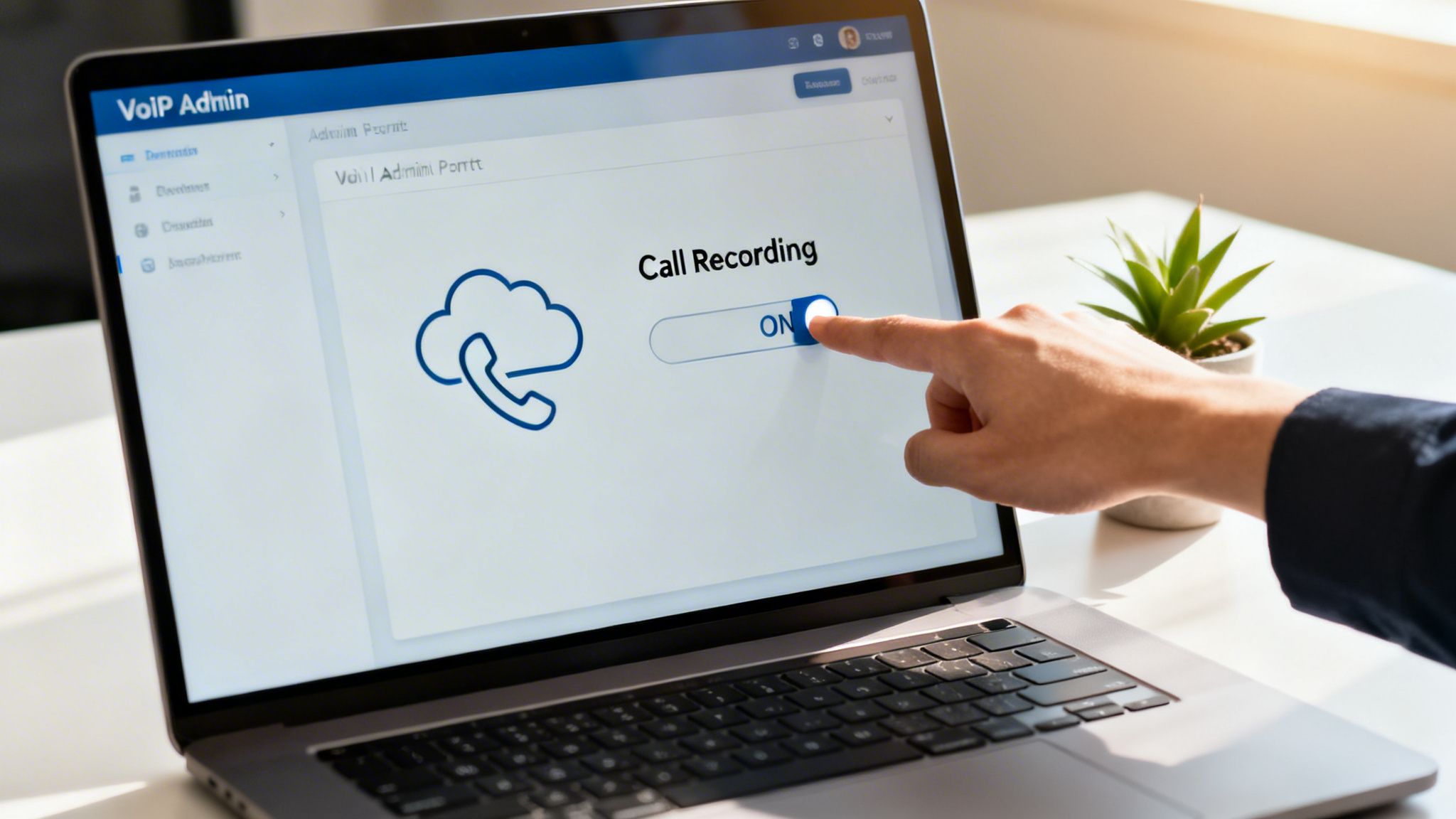
You simply log into your VoIP admin portal, go to the right user or department settings, and toggle the feature on. This is where an integrated system really shines—what once took an IT specialist can now be done in under a minute.
Step 3: Configure Your Settings
Once the feature is active, you can create rules to automate everything. This is where you put the goals from Step 1 into action, telling the business call recorder exactly how to work without you lifting a finger.
A well-configured system works silently in the background, capturing the right conversations automatically. This removes the burden from your team and ensures you never miss an important interaction.
Your VoIP portal lets you customize settings like:
- Automatic Recording: Set all calls for a department, like your support team, to be recorded by default.
- On-Demand Recording: Give agents the power to start and stop recordings themselves for specific calls.
- Announcements: Turn on an automated message like, "This call may be recorded for quality assurance," to meet legal consent rules.
Step 4: Train Your Team
The final piece of the puzzle is your team. This isn't just about showing them which buttons to press; it’s about explaining why you're doing it. When employees see call recording as a tool for their own improvement and protection—not micromanagement—they’re far more likely to get on board.
If you have team members interested in the nitty-gritty of how it all works, you can even point them to our guide on how SIP trunks work to see the technology behind the calls.
Your training should cover how to follow legal guidelines, like getting verbal consent, and how to find recordings for their own review. This turns your business call recorder from just a feature into a business asset that everyone actually uses.
Turning Call Data Into Actionable Insights
A modern business call recorder does so much more than just store conversations. Think of it as a rich source of business intelligence, ready for you to tap into. If you're only recording calls for compliance, you're missing out on the real value. The true power lies in turning that raw audio into strategic moves that fuel your company’s growth.
This is the point where you shift from just passively recording to actively improving. Instead of simply having a library of calls, you start analyzing them to find out what’s really going on. Modern VoIP platforms now come packed with powerful analytics tools, many using AI, to do all the heavy lifting for you.
Imagine being able to automatically pull key insights from every single conversation. This isn't science fiction—it's technology that can completely change how you understand your customers and train your teams, making your whole operation smarter.
From Audio Files to Business Intelligence
The main goal is to take unstructured audio and turn it into structured, useful information. It’s like having a translator that not only understands the words but also deciphers the intent, emotion, and crucial patterns hidden in your daily calls. This opens up a whole new playbook for boosting performance.
Advanced systems can automatically track metrics that were once impossible to measure at scale. By using call data effectively, businesses can make a real shift toward data-driven decision making, basing their next moves on solid evidence, not just gut feelings.
Here’s how a business call recorder with analytics gives you insights you can act on:
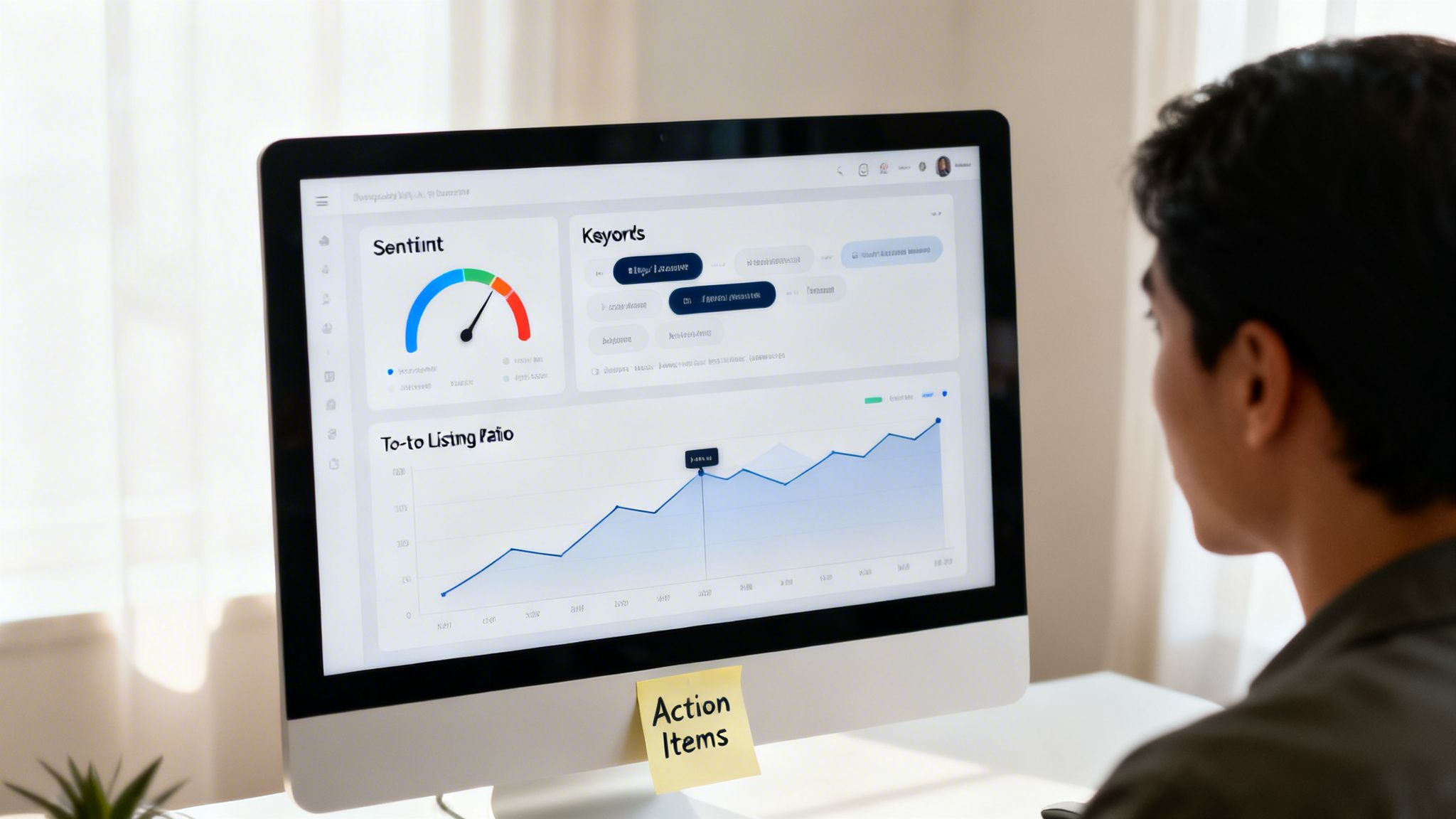
- Customer Sentiment Analysis: The system can detect the emotional tone in a customer's voice. This is a game-changer for flagging at-risk accounts or identifying frustrated customers, letting you follow up proactively before they decide to leave.
- Keyword Spotting: You can set up alerts for specific words or phrases. Want to know when a competitor is mentioned? Or how often a new product comes up? Keyword spotting gives you a real-time pulse on what your customers are thinking.
- Talk-to-Listen Ratio: This is an invaluable metric for sales and support. Seeing how much an agent talks versus how much they listen is a powerful coaching tool for building better customer rapport.
Creating a Structured Call Review Process
To get the most out of your recordings, you need a system. A structured review process ensures you’re consistently learning from your calls, not just picking them at random. It's about having a clear plan to find and use the valuable information inside.
Here's a pro tip: move beyond just listening for mistakes. Instead, make a point to identify moments of excellence. Highlighting what a top-performing agent did right is often far more effective for training than only pointing out what went wrong.
To get started, create a simple checklist for your reviews. When you set clear KPIs for what "quality" means, you make feedback objective, fair, and much more helpful. For a closer look at these capabilities, check out our advanced call analytics features.
Use this checklist to build your own review process:
- Set Clear Goals: What are you trying to improve? Is it first-call resolution, customer satisfaction, or closing more sales?
- Establish KPIs: Define what a "good" call actually looks like. This could mean sticking to a script, solving a problem on the first try, or achieving a positive customer sentiment score.
- Schedule Regular Reviews: Set aside time each week for managers and agents to review calls together. Consistency is what turns good practices into great habits.
- A/B Test Scripts: Use your recordings to see what really works. Have two agents try different opening lines or ways of handling objections, then analyze the calls to find the winner.
By putting a structured process like this in place, your business call recorder transforms from a simple recording tool into a powerhouse for continuous improvement that delivers measurable results.
Answering Your Top Questions About Business Call Recording
Thinking about adding call recording to your business phone system? It's a smart move, but we know you probably have a few questions. Let's get you some clear, straightforward answers so you can make the right decision for your company.
Is It Always Legal to Record Business Calls?
This is the big one, and the answer comes down to consent. In the U.S., you'll run into "one-party" and "two-party" consent laws depending on the state. For one-party states, only one person on the call needs to know it's being recorded—and that can be you or your employee.
But in two-party states, like California and Florida, everyone on the line must give permission. The tricky part? You might be in a one-party state, but your customer could be in a two-party one.
The only safe way forward is to always assume you need two-party consent. Start every call with a simple, automated message like, "This call may be recorded for quality and training purposes." It keeps you compliant and sets a professional tone right from the start. We always recommend checking with a legal pro to be certain you're covered.
How Much Storage Will I Need for Recordings?
This used to be a huge headache. With high call volumes, the storage needed can add up fast, especially if you have to keep files for compliance reasons. Old-school, on-premise systems meant buying and managing bulky, expensive hard drives.
Thankfully, modern cloud-based systems make this a complete non-issue. When call recording is built into a hosted VoIP service, your storage is in the cloud. It’s affordable and expands automatically as you need it, so you never have to worry about running out of space again.
Can I Record Video Meetings Like Zoom or Teams?
Absolutely. While we've focused mostly on phone calls, many of the best VoIP and unified communications platforms now include recording for video meetings, too. All the same rules and benefits apply.
Whether it’s an audio call or a video conference, the key steps are always the same:
- Get Consent: Just like a phone call, you have to let everyone know the meeting is being recorded.
- Use It for Good: Make the recordings a real asset for training, reviewing performance, or just remembering key decisions.
- Store It Securely: Protect that data. Make sure your video recordings are stored safely and in line with your security and compliance rules.
Ready to see how a Premier Broadband VoIP solution with an integrated business call recorder can protect and grow your business? Explore our business services and get started today.