
Your internet works fine until the moment you need it most. A work call starts freezing. Your game lags right as the match gets serious. A customer calls your business line and hears choppy audio instead of your voice.
That's usually when people start asking a smarter question than “What speed am I paying for?” They ask, “What is my provider promising me?”
That promise is where service level agreements matter. If you use internet or VoIP every day, an SLA turns vague expectations into something you can read, compare, and hold a provider to. For a family gamer, that means understanding whether the connection is built for real-time play. For a small business owner, it means knowing what happens if phones go down during business hours.
What Is a Service Level Agreement?
A service level agreement, or SLA, is the written agreement that spells out what service you should expect, how performance is measured, and what happens if the provider misses the target. Think of it as the difference between “we'll do our best” and “here's the standard, here's how we measure it, and here's the remedy if we fall short.”

A lot of people assume an SLA is only for giant companies with legal teams. It isn't. If your home depends on stable Wi-Fi for streaming, gaming, schoolwork, and remote work, or your business depends on internet and voice service to make sales and support customers, the SLA tells you what the service is supposed to deliver.
Why SLAs became important
In older service relationships, providers often relied on vague “best effort” language. Over time, that wasn't enough for technology and outsourcing customers who needed clearer commitments. As AWS explains in its overview of service level agreements, SLAs became especially important when providers started promising measurable targets like uptime, response time, and resolution time instead of loose promises.
That change matters because it turned service from a trust-only relationship into a documented one. The agreement could now define responsibilities, escalation steps, and remedies when performance missed the mark.
Practical rule: If you can't tell how a provider measures performance, you don't yet know what they're actually promising.
Think of it as a digital handshake
Here's the plain-language version:
- The provider says what's included. Internet access, voice service, support hours, maintenance rules, and covered locations.
- The provider defines the targets. Things like availability, response time, or repair expectations.
- Both sides know the process. If something breaks, you know who to contact, how issues are escalated, and whether compensation applies.
For customers using modern communications tools, this becomes even more useful. If your household or office uses cloud calling, video meetings, or messaging, it helps to understand how service commitments tie into platforms such as unified communications as a service.
What readers often confuse
People often mix up speed, reliability, and support as if they're the same thing. They're not.
A fast connection can still be unreliable. A reliable connection can still come with weak support. A polished sales pitch can still hide unclear exclusions. The SLA is the place where those differences stop being marketing language and start becoming specific terms you can review.
Understanding Core SLA Performance Metrics
Most SLAs become easier to read once you translate the technical terms into everyday experience. You don't need to be a network engineer to understand them. You just need to know what each metric feels like when you're on a call, in a game, or running a business.
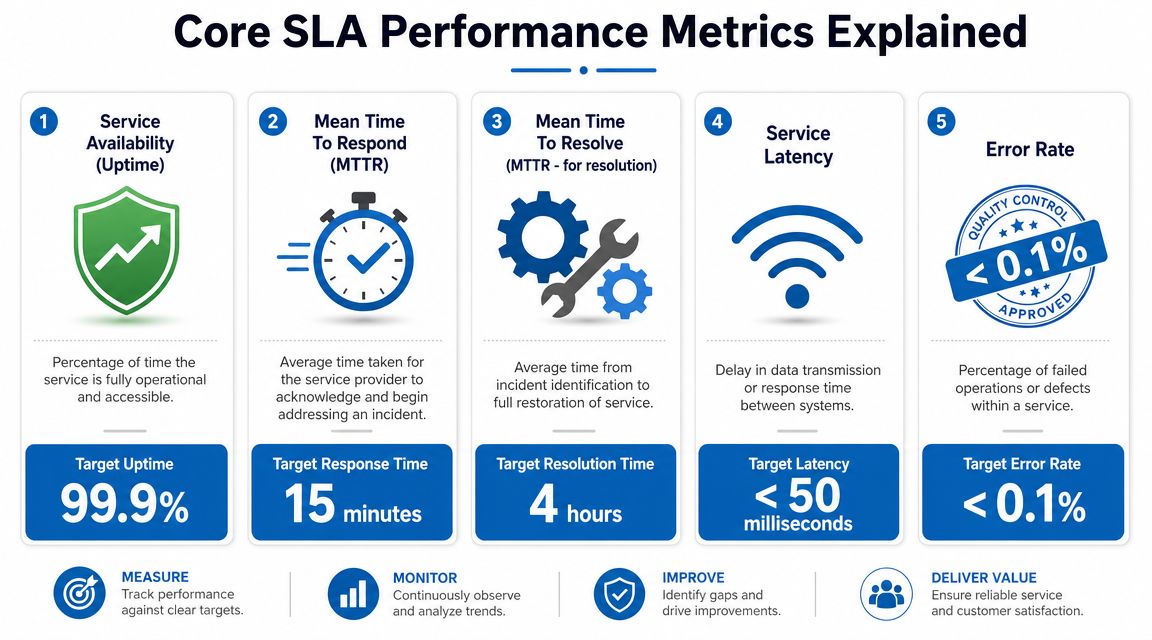
A quick visual helps:
Uptime and why percentages matter
Uptime is the percentage of time the service is available. It sounds abstract until you convert it into real downtime.
According to DataBank's explanation of SLA uptime levels, 99.9% uptime allows about 8.7 hours of downtime per year, while 99.999% uptime allows only 5.26 minutes annually. The difference between those two thresholds represents a reduction in allowable downtime of more than 99.9%, which is why availability targets matter so much in high-availability services.
For a home user, that may mean the difference between “occasional annoyance” and “my entire weekend setup is disrupted.” For a business, it can mean the difference between a brief interruption and a serious operational problem.
Response time and resolution time
These terms are often confused.
- Response time means how quickly the provider acknowledges the issue and starts working on it.
- Resolution time means how long it takes to restore service.
If your internet drops at 9:00 a.m. and support replies quickly, that's good response time. If the outage lasts most of the day, the resolution time is the bigger story.
Here's the section's video resource for a broader overview:
MTTR, latency, jitter, and packet loss
A well-designed SLA often uses engineering metrics that reflect how users experience the network. Flexential notes that strong SLAs translate business promises into measurable controls such as uptime, response time, mean time to recovery (MTTR), and error rates in its guide to what a service level agreement should include.
Here's a plain-English translation:
| Metric | What it means | What it feels like |
|---|---|---|
| MTTR | Mean time to recovery or repair | How long you're stuck waiting after something breaks |
| Latency | Delay in data travel | Button press feels delayed in gaming, voices pause on calls |
| Jitter | Variation in delay | Audio sounds uneven, calls feel jumpy |
| Packet loss | Some data never arrives | Frozen video, robotic voice, dropped game actions |
If you want a separate reliability primer, you can learn about reliability metrics from Forge Reliability, which is useful for understanding how support and repair terms are commonly discussed.
Good SLAs don't just promise that the service is “up.” They define whether the service is usable when people actually need it.
One practical way to read these metrics
Think of your network like a highway.
- Uptime asks whether the road is open.
- Latency asks how long the trip takes.
- Jitter asks whether travel time stays consistent.
- Packet loss asks whether some cars never arrive.
- MTTR asks how quickly crews reopen the road after a crash.
If you're comparing providers, it also helps to understand how resilience is engineered behind the scenes. This overview of network redundancy gives helpful context on how providers reduce the risk of service interruptions.
Key Clauses Inside Every Strong SLA
The numbers get most of the attention, but the clauses around those numbers are what protect you when something goes wrong. A strong SLA doesn't stop at “availability.” It explains how performance is measured, when it's measured, who reports it, what exceptions apply, and what remedies exist if the target is missed.
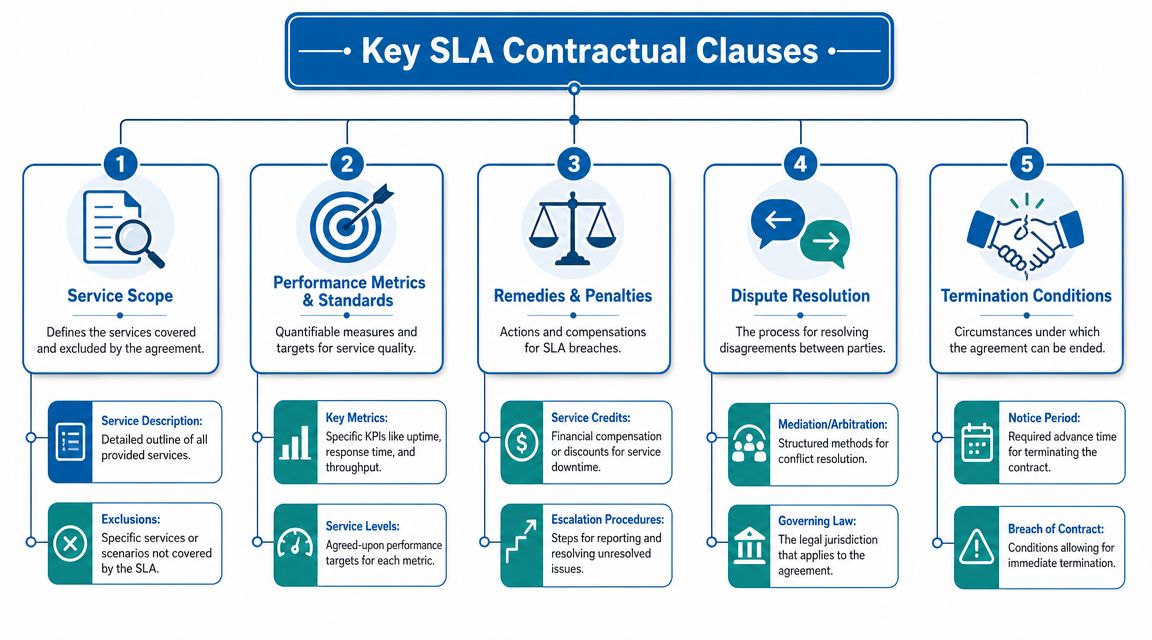
For network and communications services, the most useful SLAs define measurement standards, reporting frequency, time windows, and escalation or remediation logic such as service credits, as described in the Wikipedia overview of service-level agreements. That detail matters because a provider could hit an annual availability target while still delivering a poor experience during busy hours.
Service scope and exclusions
Start with the simplest question. What exactly is covered?
An SLA should state the service included in the agreement and what isn't covered. Exclusions often include planned maintenance, customer-caused issues, power problems on the customer side, or third-party failures outside the provider's control.
This isn't fine print you should skip. If your business depends on after-hours connectivity, an exclusion around maintenance windows can affect real operations.
Measurement rules and reporting
A phrase like “high availability” means very little without measurement rules.
Look for answers to these questions:
- How is uptime measured? Provider-side monitoring, customer-reported incidents, or both?
- How often is performance reported? Regular reporting helps customers verify what happened.
- What time window applies? Peak-hour performance can matter more than quiet overnight averages.
If an SLA only gives you one annual percentage and no measurement method, you're missing most of the story.
Remedies and service credits
A remedy clause explains what happens if the provider misses the service target. In many agreements, that means service credits or another form of compensation.
That clause creates accountability. It doesn't erase the inconvenience of an outage, but it does move the agreement beyond empty promises.
A useful way to think about it is this: a lease protects both landlord and tenant because the terms are written down and enforceable. If you've ever looked at how people create a lease agreement, the logic is similar. Clear responsibilities reduce disputes later.
Escalation paths and dispute handling
When something breaks, speed matters. A strong SLA should explain:
- Who to contact first
- How an issue gets escalated
- When management or advanced support gets involved
- What happens if the disagreement isn't resolved quickly
For a home customer, that may mean knowing whether chat, phone, or ticketing is the fastest route. For a small business, it may mean knowing whether there's a separate path for critical service issues affecting phones or payment systems.
The best SLA language is readable. If a clause sounds legal but doesn't tell you what to do during an outage, it's not helping enough.
SLA Examples for ISP and VoIP Services
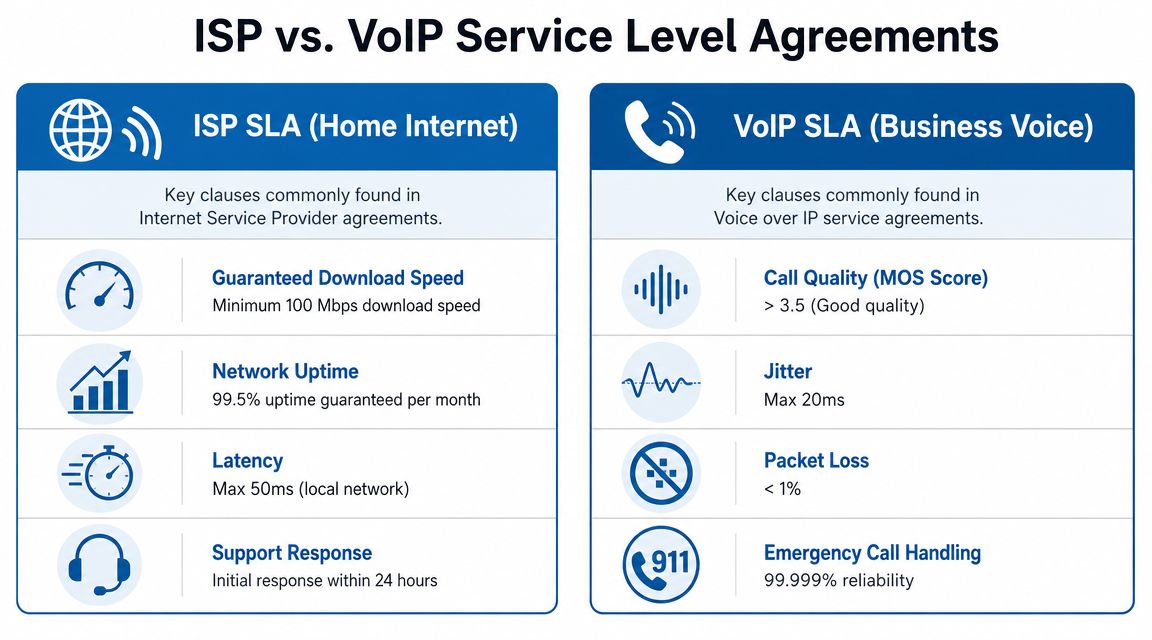
Not every service needs the same kind of promise. An internet SLA and a VoIP SLA can overlap, but they don't focus on the same pain points.
For internet service, users often care most about availability, consistent performance, and support when the line drops. For business voice, they also need call clarity, stable audio, and fast restoration because voice problems show up immediately in customer conversations.
Home internet example
A residential or home-office internet SLA usually centers on the connection itself.
A solid internet agreement may define:
- Availability commitments so you know how often the service should be usable
- Support expectations so you know how incidents are handled
- Maintenance language so planned work doesn't come as a surprise
- Performance boundaries such as latency-sensitive use cases for gaming, streaming, and video meetings
For a household, these terms answer practical questions. Will a remote worker stay connected on a long video call? Will a gamer notice delay spikes? Will large uploads feel smooth or frustrating?
Business VoIP example
A VoIP SLA tends to get more specific about real-time quality because voice traffic is sensitive to network issues.
Flexential's guidance on SLAs notes that strong agreements turn business promises into measurable engineering controls such as uptime, response time, MTTR, and error rates, which is what makes the agreement auditable rather than purely contractual. In a voice environment, that same logic usually extends to voice-quality-related measurements.
Here's a simple comparison:
| Service type | What matters most | User impact |
|---|---|---|
| ISP for home or home office | Availability, latency, repair handling | Streaming quality, gaming responsiveness, meeting stability |
| VoIP for business | Availability, rapid issue response, low error conditions, voice consistency | Clear calls, fewer audio issues, less disruption to customer service |
If you're reviewing voice performance terms, it also helps to understand packet loss, because even a fast connection can sound poor when data doesn't arrive cleanly.
Why one size doesn't fit all
A family gamer and a small office manager are both buying connectivity, but they're not buying it for the same reason.
The gamer cares about low-delay consistency. The office manager cares about whether calls stay clear, whether staff can reach support fast, and whether downtime procedures are documented. That's why service level agreements should match the service being delivered instead of copying the same template everywhere.
This is also the point where a provider's actual offering matters. For example, Premier Broadband provides fiber internet and VoIP services, so a customer reviewing those agreements should pay attention to how network performance terms and support commitments align with real-time use like video meetings, gaming, and business calling.
How to Evaluate and Negotiate Your SLA
The fastest way to read an SLA poorly is to skim for one uptime number and stop there. A better approach is to ask whether the agreement matches the way you use the service.
If you work from home, your internet isn't just entertainment. It's your office connection. If you run a small business, your VoIP line isn't just another utility. It's part of sales, scheduling, support, and reputation.
Questions home users should ask
A household power user doesn't need pages of contract language. You need clear answers.
Use this checklist when reviewing a provider's terms:
- How is performance measured? If the provider uses internal monitoring, ask whether customer-reported issues also count.
- What counts as excluded downtime? Planned maintenance and inside-the-home issues are common exclusions.
- How do you report a problem? If support paths aren't clear, resolution gets slower.
- Does the agreement reflect your real use? Remote workers, streamers, and gamers should care about more than raw speed.
Home-user shortcut: If your biggest concern is smooth video calls or online gaming, pay close attention to consistency and support handling, not just the advertised plan label.
Questions small businesses should ask
Business customers usually have more room to push for terms that fit their operations. That's especially true if phones, payment systems, cloud apps, or multiple sites depend on the connection.
Ask these questions before signing:
- What is the escalation path for a critical outage?
- How are service credits requested and approved?
- Are business hours treated differently from off-hours?
- What reporting do you receive after an incident?
- Can support and remediation terms be adjusted for your environment?
If you rely on a provider for routing, security, switching, or broader operational support, it helps to understand managed network services before negotiating. That context makes it easier to decide whether you need a basic access agreement or something more operationally involved.
What's worth negotiating
Not every part of an SLA will move. But some areas often deserve discussion, especially for business customers.
Focus on the clauses that affect daily operations:
- Incident priority definitions because “critical” should mean the same thing to both sides
- Response and escalation handling because speed matters most when revenue or customer experience is on the line
- Reporting detail because recurring issues are easier to spot when the provider documents patterns
- Remedy language because a vague compensation process can become a fight later
The best mindset is partnership, not confrontation. You're not trying to “beat” the provider. You're trying to make sure both sides understand what reliable service means in your environment.
Your Premier Broadband SLA Checklist
By the time you finish reviewing an SLA, you should feel less like you've read a contract and more like you've read an operating guide for your service. That's the right test.
For Premier Broadband customers, or anyone comparing internet and VoIP providers, the most useful checklist is the one that connects contract language to day-to-day experience. Not legal theory. Real use.
The checklist to keep beside you
- Check what service is covered. Confirm whether the agreement applies to internet, VoIP, managed equipment, or only part of the service stack.
- Check how performance is measured. Availability language is stronger when the provider explains the measurement method, reporting cadence, and relevant time window.
- Check support handling. You should know how to open a ticket, how issues are prioritized, and what escalation path exists if the problem continues.
- Check exclusions carefully. Maintenance, customer-side wiring, power events, and third-party dependencies can change what counts as an SLA breach.
- Check remedy language. If the service misses the target, the process for service credits or other remediation should be plain and specific.
- Check fit for your use case. A gamer, remote worker, and small business owner won't all weigh the same metrics the same way.
Match the SLA to what you feel
For home users, the test is simple. Does the agreement support smooth streaming, stable work calls, and responsive gaming?
For small businesses, ask a different question. Does the agreement support customer conversations, predictable support, and fast action when service problems affect staff or revenue?
The best SLA is the one you can explain in plain English after one read.
A fiber-based connection can support demanding use cases well, but the agreement still matters. It tells you how reliability is defined, how support responds, and whether the provider has put its promises into language you can use.
When you read service level agreements this way, they stop feeling abstract. They become a confidence tool.
If you're comparing internet or VoIP options and want terms that make sense in plain language, Premier Broadband is a practical place to start. Review the service details, ask how performance is measured, and make sure the agreement matches how your home or business depends on connectivity.