
Some people are paying for a big internet or phone plan they rarely use. Others pick the cheapest option, then run into slowdowns, overages, or calling limits at the worst possible time. That mismatch is where usage based pricing enters the conversation.
The idea sounds simple. Pay for what you use. In practice, it raises hard questions very quickly. What counts as “use”? How do you track it? What happens when one busy month turns into a much higher bill?
That last question is the one many guides skip. Families worry about streaming, gaming, and remote work pushing the bill up without warning. Business owners worry about seasonal spikes, call volume, cloud apps, and whether a flexible plan will feel fair or frustrating. A pricing model can look sensible on paper and still cause churn if customers feel surprised.
Used well, usage based pricing can match cost to real consumption in a way flat plans often can't. Used poorly, it creates anxiety even when the service itself works fine. The difference usually comes down to communication, visibility, and guardrails.
Is Your Internet Plan Working for You or Against You
A lot of households know this feeling. You sign up for a large plan because you don't want buffering, dropped calls, or Zoom issues. Then a few months go by and you realize your actual usage is modest most of the time. You're paying for headroom you rarely touch.
Businesses hit the opposite problem. A small office may choose a lower-cost plan that works during normal weeks, then run into trouble during tax season, holiday rushes, or a big hiring push. The plan was affordable until demand changed.
That tension is why people start looking at flexible pricing models. Instead of paying the same amount no matter what, usage based pricing ties part or all of the bill to actual consumption. For internet or voice service, that might mean data used, call minutes, transactions, or another measurable unit.
Why this matters at home and at work
For a family, the appeal is straightforward. Light-use months don't feel wasteful. For a business, the appeal is different. Spending can rise when activity rises, which can make costs feel more connected to revenue-producing work.
Still, “pay for what you use” only sounds comforting until someone asks a very practical question: what will next month cost?
The real customer objection usually isn't the unit price. It's the fear of an unpredictable month.
That's especially true for mobile and travel-heavy internet users. If your habits change from week to week, planning gets harder. Resources like these expert tips for RV data usage help people think through consumption patterns before they choose a plan.
For business buyers, the same logic applies. Before comparing plan types, it helps to understand the broader drivers behind business internet cost, including how bandwidth, support, and pricing structure shape the bill.
What Exactly Is Usage-Based Pricing
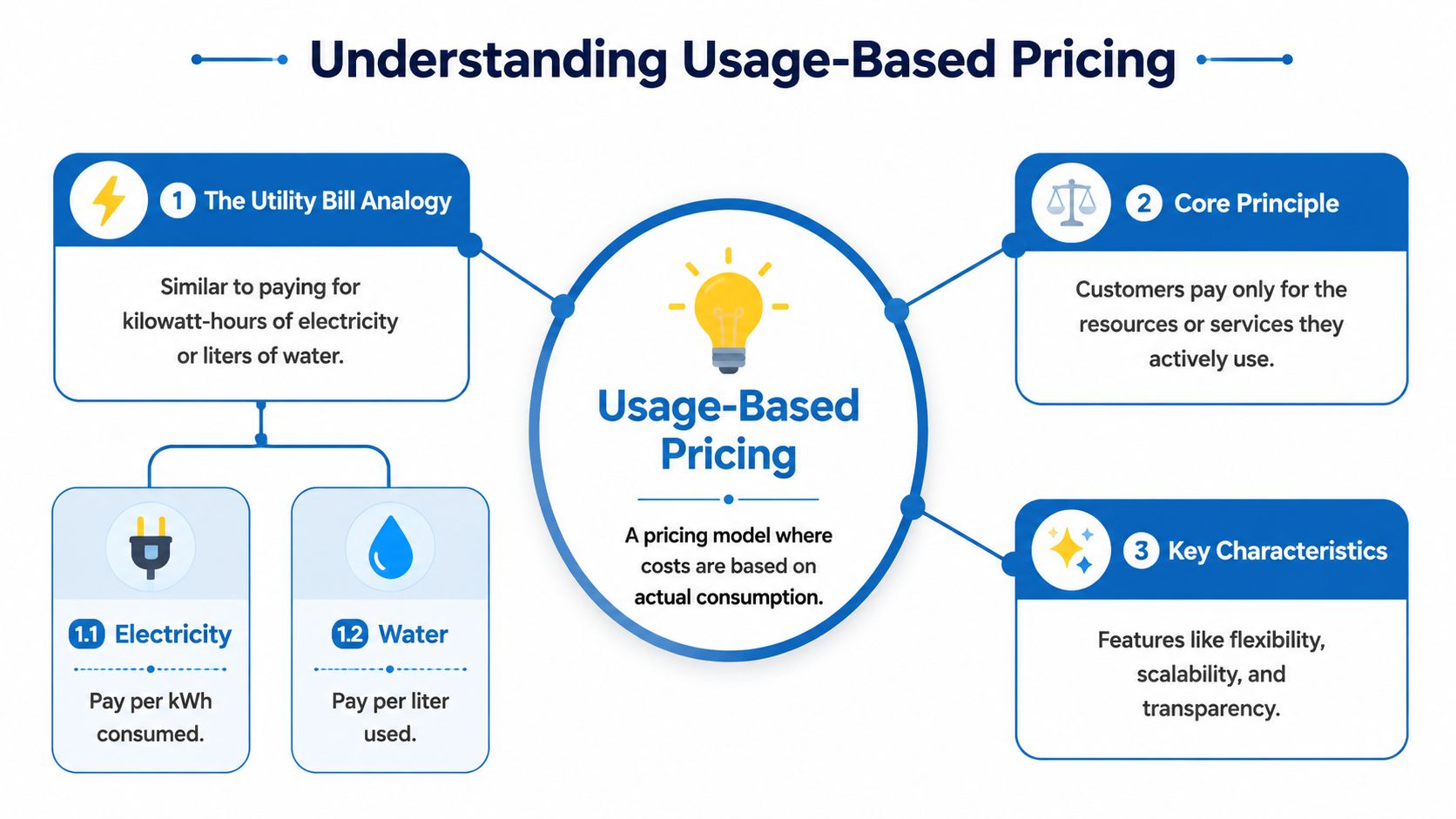
Think about your electric bill. You don't usually pay one fixed number that never changes regardless of usage. You're billed based on consumption. Use more power, pay more. Use less, pay less. Water works the same way in many places.
Usage based pricing applies that familiar utility logic to digital services.
The basic building blocks
There are three parts to understand.
The metric
This is the unit being measured. It might be gigabytes of data, minutes of calling, API calls, transactions processed, or another unit tied to service use.The meter
This is the tracking system. A provider records how much of that unit you consume during the billing period.The bill
Charges are calculated from the tracked usage, either at a per-unit rate, in tiers, or with a base amount plus additional usage charges.
A lot of confusion starts at step one. Customers often assume the measured unit is arbitrary. Good pricing avoids that. The pricing metric should line up with the value the customer receives, not just with an internal technical counter. Maxio's guidance on value-aligned usage metrics points to examples like API calls, gigabytes, tasks completed, or transaction volume because those units are easier to connect to customer outcomes.
This model already exists all around you
Usage based pricing isn't just a software trend. Zuora notes that it's used across cloud computing, utilities, and telecommunications, and that customers are often charged according to measurable units such as API calls, gigabytes of data, kilowatt hours, number of users, or transactions processed in its guide to usage-based pricing.
That makes the concept less exotic than it sounds. In many ways, it's just the digital version of a meter on the side of your house.
Why people still get tripped up
A utility bill analogy makes the model intuitive. Budgeting for it is another story. People are comfortable with variable electric or water bills because they've lived with them for years. Internet and voice buyers often expect a fixed monthly rate, so a variable bill can feel unfamiliar even when it's fair.
If you're trying to think through that uncertainty, it helps to review the basics of budgeting for variable costs. The planning mindset is different from managing a flat subscription.
Practical rule: If a customer can't quickly understand what is being measured, usage based pricing will feel risky even before the first invoice arrives.
Comparing Pricing Models Flat-Rate Hybrid and Usage-Based
Most customers don't choose between “good” and “bad” pricing. They choose between trade-offs. The main models each solve a different problem.
Flat-rate plans
Flat-rate pricing is the easiest to understand. You pay one recurring amount for the plan, and your bill stays largely stable from month to month.
That predictability helps families on a set monthly budget and businesses that need clean forecasting. It also reduces the need to constantly monitor consumption.
The downside is waste. Light users may pay for capacity they never touch. Heavy users may love the plan because someone else is effectively absorbing the cost of peak demand.
Pure usage-based plans
Pure usage-based pricing flips that equation. Your bill tracks your actual use more closely, which many customers see as fairer.
This model has become much more common in software. OpenView's research, cited by Chargebee, says 45% of SaaS companies reported using some form of usage based pricing in 2021, rising to three out of five SaaS companies by February 2023. Chargebee also cites a separate study finding 63% of SaaS businesses using some form of the model in its overview of usage-based pricing adoption. That shift matters because, as OpenView describes it, the model can lower the barrier to entry by letting customers start at a comparatively low cost and expand spending as usage grows.
For customers, the big advantage is alignment. For providers, revenue can scale with real usage instead of being locked to seat counts or one flat monthly fee.
The catch is volatility. A customer may like the fairness in theory and still dislike the uncertainty in practice.
Hybrid plans
Hybrid pricing tries to split the difference. It usually includes a predictable base charge plus usage-driven charges for extra consumption, overages, or high-cost features.
For many buyers, this feels more comfortable than going fully variable. There's a floor under the bill, but there's still flexibility when needs change.
A good example in communications is a voice or internet service with an included allowance and additional charges only when usage goes beyond that baseline. If you want to compare that mindset with a more traditional recurring model, this overview of flat-rate VoIP is useful.
Side-by-side view
| Model | Best fit for | Main advantage | Main concern |
|---|---|---|---|
| Flat-rate | Stable households, predictable offices | Easy budgeting | Paying for unused capacity |
| Pure usage-based | Variable usage patterns | Strong pay-for-what-you-use alignment | Bill volatility |
| Hybrid | Customers who want flexibility with a baseline | Balance of predictability and scalability | More pricing complexity |
How to choose without overthinking it
Use your own pattern, not your ideal pattern.
- Choose flat-rate if your main goal is a stable bill and you don't want to monitor usage.
- Choose usage-based if your consumption rises and falls a lot, and you're comfortable tracking it.
- Choose hybrid if you want a predictable base with room to grow during busy periods.
A pricing model can be perfectly fair and still feel stressful. Customers judge both the math and the monthly experience.
The Pros and Cons for Providers and Customers
The best way to evaluate usage based pricing is to separate the provider view from the customer view. What helps one side can create friction for the other.
What providers gain
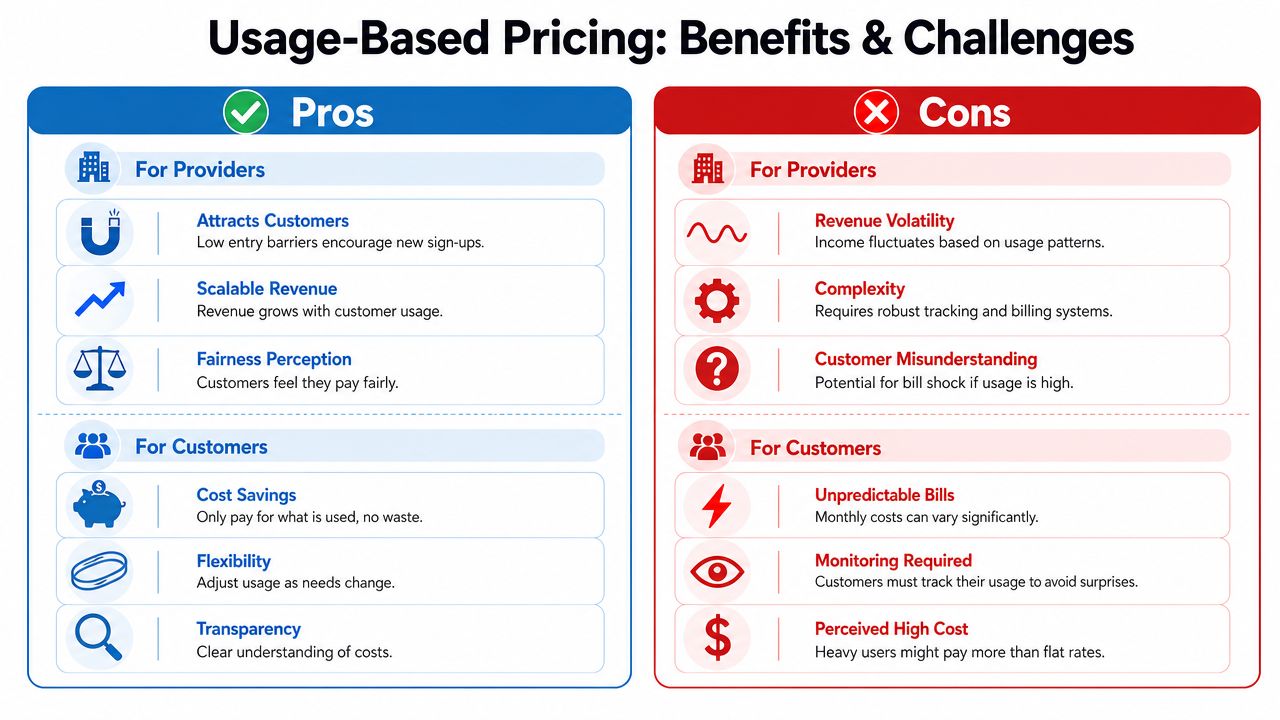
A provider can use usage based pricing to lower the entry barrier for new customers. Someone who hesitates at a large fixed contract may be willing to start smaller if spending grows with actual use.
It also helps align revenue with resource consumption. In services where bandwidth, storage, transactions, or call volume create real operating costs, variable pricing can reflect those costs more directly than a single monthly fee.
There's also a perception benefit when the model is explained well. Many customers do appreciate paying in proportion to what they consume.
What providers give up
The model is harder to run well. Stigg notes that a robust usage-based stack needs near-real-time metering, running totals, alerts, and spending caps because monthly-only invoicing can reveal budget overruns too late in its article on implementing usage-based pricing infrastructure. In other words, pricing becomes a data pipeline problem, not just a billing rule.
That means more operational complexity. Providers need accurate event capture, clear entitlements, and some form of automated limit enforcement.
Revenue can also become less predictable. When customer usage fluctuates, revenue forecasting gets harder.
Provider trade-off: flexibility can help win customers, but it demands stronger billing operations and more customer education.
What customers gain
For customers, the biggest upside is fairness. Light users don't feel like they're subsidizing heavy users. A family that streams less in one month or a business that has a slower season may appreciate seeing lower spend.
Flexibility also matters. If you're growing, hiring, opening locations, or handling seasonal demand, a usage-sensitive plan can expand with you without requiring a full plan redesign every time.
Some customers also like the transparency. If the unit is clear and the usage dashboard is readable, they can see exactly what is driving the bill.
What customers worry about
The main concern is bill shock. OpenMeter highlights communicating usage and managing costs as top pain points in its discussion of usage-based pricing challenges. That's the part many pricing pages under-explain.
Customers don't just want fairness. They want confidence. They want to know what a normal month looks like and what warning signs appear before a high bill lands.
Common worries include:
- Variable households: Streaming, gaming, and remote work don't happen in neat, even patterns.
- Busy business cycles: A surge in calls or data usage may be good for business and stressful for the budget at the same time.
- Monitoring fatigue: Some people don't want another dashboard to watch.
If a customer has to guess whether usage is “normal,” the provider has already created avoidable anxiety.
This is why churn in usage-based environments often starts as a communication problem before it becomes a pricing problem.
Usage-Based Models in the Real World
Many have already seen pieces of this model, even if they've never called it usage based pricing.

Home internet example
A household signs up for an internet plan that includes a certain level of monthly use. Most months, they stay within that range. During school breaks, holiday streaming, software downloads, and extra gaming push consumption much higher.
That's a usage-based element. Even if the plan starts with a base fee, the customer experience changes once additional use affects the bill.
Small business voice example
A small office uses VoIP for everyday calls. Then the business launches a seasonal sales push, hires temporary staff, and starts making more outbound and international calls.
If the voice service charges by minute for certain call types, or by storage for recordings and voicemail retention, usage is directly tied to the invoice. In that situation, planning enough bandwidth for VoIP is one part of the puzzle, but understanding how call activity maps to cost matters just as much.
Cloud and telecom example
Cloud platforms normalized this model for many businesses. You consume storage, compute, or bandwidth, and you pay according to usage. Telecom has long used similar ideas with data allowances, metered calling, and overage structures.
These examples matter because they show the model isn't experimental. It's already part of everyday infrastructure spending.
The familiar pattern
Across all these examples, the pattern stays the same:
- A measurable unit exists
- The provider tracks usage over time
- The bill changes when usage changes
That familiarity can help customers accept the model. It doesn't automatically make them comfortable with it. Comfort comes when they can see usage early, understand what's normal, and know what happens before they cross a threshold.
How a Good Provider Implements This Model
A customer-friendly usage based pricing model doesn't start with the invoice. It starts with design choices that make the invoice understandable before it arrives.
Pick a metric customers can recognize
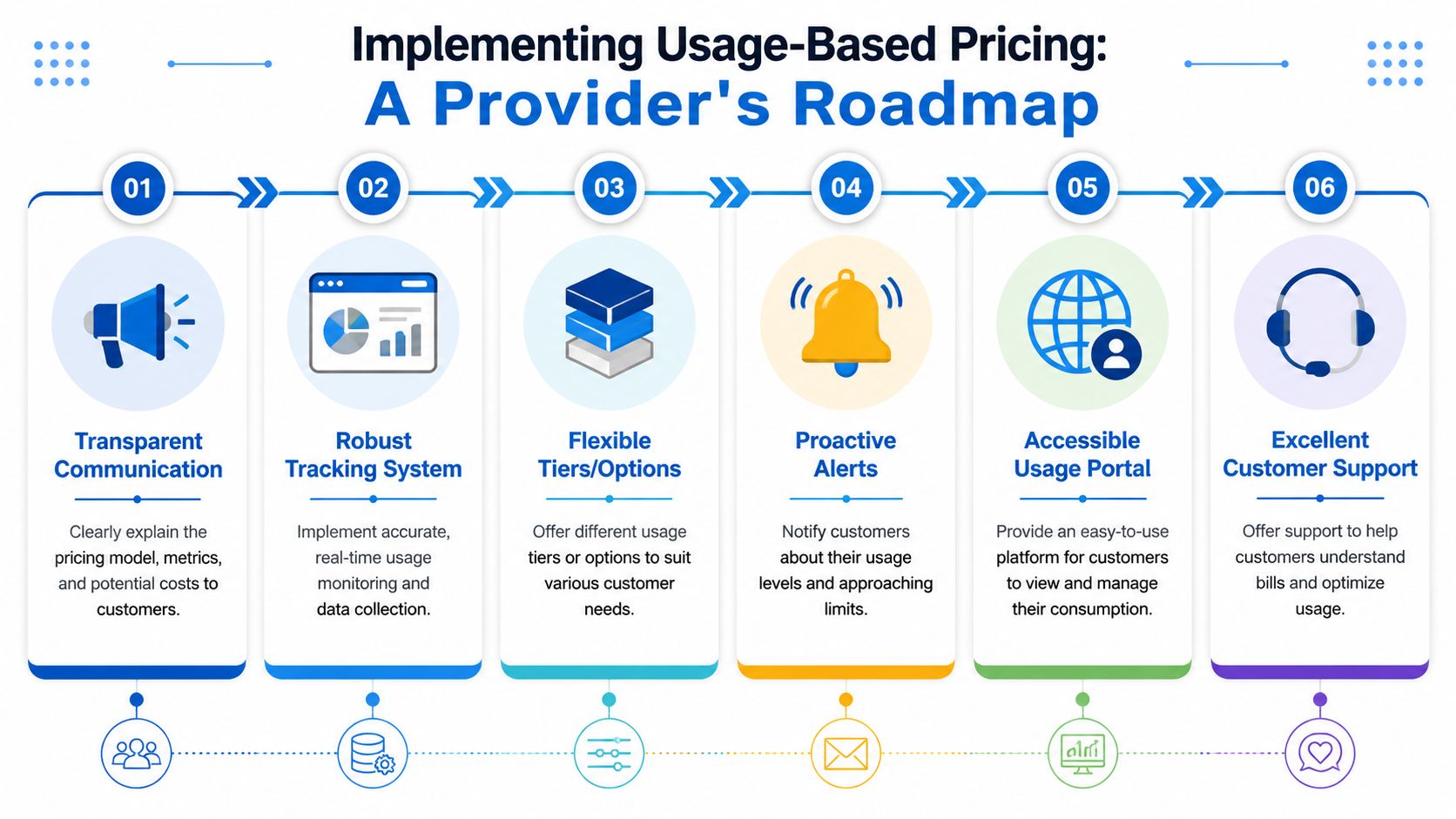
The best metric is one a customer can connect to their own behavior. Gigabytes, minutes, transactions, recordings, or users make more sense than obscure back-end counters.
If the meter doesn't reflect customer value, the price will feel arbitrary. Customers don't want to pay for internal complexity they can't see or influence.
Track usage during the month, not just after it
Monthly billing alone isn't enough. A good provider shows running usage before the invoice closes.
That visibility matters because people make decisions mid-cycle. A family may postpone large downloads. A business may adjust calling patterns, archive recordings, or upgrade a plan before charges pile up.
Use guardrails that reduce panic
Good providers don't treat alerts as a nice extra. They treat them as part of the product.
A strong setup includes:
- Usage alerts: Notifications when a customer reaches important thresholds.
- Spending caps: A way to prevent an open-ended bill.
- Clear overage rules: Customers should know whether service slows, stops, or continues at an added rate.
- Simple summaries: A dashboard should answer “What have I used?” and “What happens next?” quickly.
Explain the rules in plain language
Many rollouts fail. The provider may have accurate metering and still lose trust because the explanation is full of billing language instead of plain examples.
A better explanation sounds like this:
You've used most of your included amount for this month. If your current pattern continues, extra usage may add charges before the billing cycle ends.
That sentence is boring on purpose. Boring is good. Boring means clear.
Support matters more than people think
When a bill surprises someone, they don't want a policy lecture. They want a person or portal that helps them understand what happened and what to change next.
For business buyers, contract clarity also matters. A defined framework for uptime, responsibilities, and support response helps set expectations beyond pricing. That's one reason teams often review service level agreements alongside any variable billing terms.
One practical example is Premier Broadband, which offers internet and voice services as part of a broader connectivity stack. In any provider evaluation, the key question isn't whether the company offers fiber, VoIP, or managed services. It's whether usage visibility, billing clarity, and customer controls are built into the experience.
The churn prevention checklist
If you remember only one part of this article, make it this:
- Show the meter early
- Warn before thresholds
- Give customers a cap or control
- Use plain-language invoices
- Train support teams to explain usage calmly
Providers often assume churn comes from price alone. In usage-based models, churn often comes from surprise.
Frequently Asked Questions About Usage-Based Pricing
Is usage based pricing always cheaper
No. It depends on how much you use and how steady that usage is. Light or irregular users may save money. Heavy users may prefer a flat-rate plan or a hybrid plan with a predictable baseline.
How can I avoid bill shock
Use plans that offer dashboards, alerts, and some kind of spending control. If those tools aren't available, ask the provider how you'll know when usage is rising before the bill closes.
Is a flat-rate plan still better for families
Sometimes, yes. If your household wants a stable monthly number and doesn't want to monitor usage, flat-rate can be the simpler choice. If your usage swings a lot, a hybrid model may feel like a better middle ground.
Is usage based pricing only for software companies
No. The same pay-for-what-you-use idea appears in internet, telecom, utilities, and cloud services. The model works anywhere usage can be measured clearly.
What should I ask a provider before signing up
Ask five things: what unit is measured, how often usage updates, when alerts are sent, whether spending caps exist, and what happens after you reach a limit. Those answers tell you more than the headline rate.
If you're comparing internet or VoIP options and want a provider that explains service terms clearly, review the plans and support resources at Premier Broadband. The right fit comes from matching your real usage pattern with a plan structure you can understand and manage comfortably.