
The phone rings, and your screen lights up with 870. You hesitate for a beat because it could be a neighbor, a doctor's office, a school, a delivery update, or a call you'd rather not pick up at all.
That pause is exactly why the 870 area code matters. It's not just a prefix on a caller ID screen, it's a clue about where a number lives, how Arkansas phone service is organized, and why local calling now works differently than it did a few years ago. If you've ever wondered whether an 870 number means a call is nearby, whether the number is still tied to a place, or how to get one for a home or business, the answer is a little more practical than a map and a lot more useful than a list of cities. For a quick Arkansas overview, Premier Broadband's area code guide is a helpful companion.
Why the 870 Area Code Feels Different From Other Arkansas Numbers
A call comes in from 870, and the first question isn't always “where is this?” It's more often, “Do I know this person, or am I about to waste time on a robocall?” That hesitation is real because the number feels local without always feeling familiar.
Why the prefix matters
The 870 area code covers most of Arkansas outside the Little Rock core, so it reaches far more than one town or one county. It's the kind of code you may see on a clinic reminder in Jonesboro, a repair shop in Pine Bluff, or a family member's mobile phone in West Memphis, which is why it's such a broad signal in everyday life. The area code can tell you the call has an Arkansas connection, but it can't tell you whether the person is across town or using a voice app from somewhere else.
That's the key difference. People tend to treat area codes like a simple map pin, but 870 works more like a regional identity tag, one that often follows a person or business instead of the building they're standing in.
What this guide answers
This article breaks the topic into the parts people trip over, not just the parts that look tidy on a map. You'll see what 870 covers, how it came out of the old statewide system, why the 327 overlay changed dialing habits, and what it means if you want an 870 number for a home line, a mobile phone, or a business system.
Practical rule: an area code can suggest a region, but it doesn't guarantee who's calling, where they're standing, or how reliable the connection will be.
That distinction matters more now than it used to, because the code has become as much about dialing behavior as geography. Once that clicks, the rest of 870 starts to make a lot more sense.
Where the 870 Area Code Actually Covers
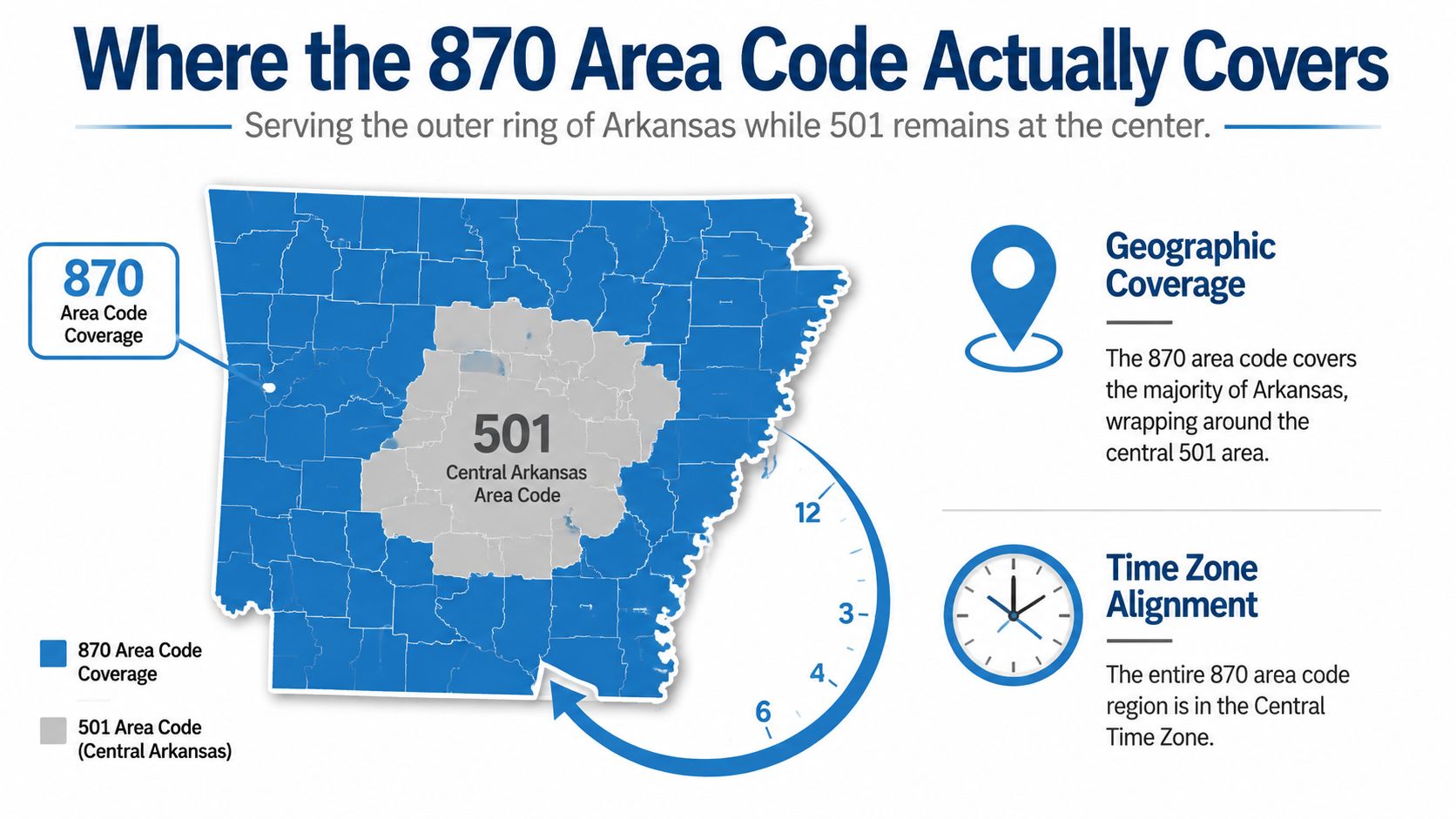
Think of Arkansas like a clock face with one busy center and a wider ring around it. 870 is that outer ring in the numbering plan, while 501 sits in the middle around Little Rock. The shape isn't a perfect circle, but the mental image works well, because 870 wraps around a large share of the state rather than sitting in one neat corner.
A simple way to place it on the map
The 870 area code serves the southern, eastern, and most of northern Arkansas. That includes communities such as Jonesboro, Pine Bluff, Texarkana, West Memphis, El Dorado, and Mountain Home, along with many smaller towns that don't always make it onto quick-reference maps. The easiest way to think about it is this, if you're not in the central Little Rock region, there's a strong chance you're in 870 territory.
The geography matters because people often ask about an area code as if it were a county boundary. It isn't. It's a phone numbering boundary, which can cut across places that feel connected by roads, school districts, or commuting patterns. That's why a resident can live in one part of a county and still see a different code than a neighbor a few miles away.
Time works the same way across the region
Arkansas communities in 870 follow the Central Time Zone, just like the rest of the state. That means the clock rules are the same, including daylight-saving changes, so you don't need to translate call times between parts of Arkansas the way you might between states.
For a broader look at the center of the state's numbering plan, this explanation of the 501 area code helps show why 870 exists around it.
The important part is that 327 now shares the same footprint, so a town's physical location no longer tells you the whole story. Geography still matters, but it's no longer the only thing that does.
How Arkansas Split From One Code to Many
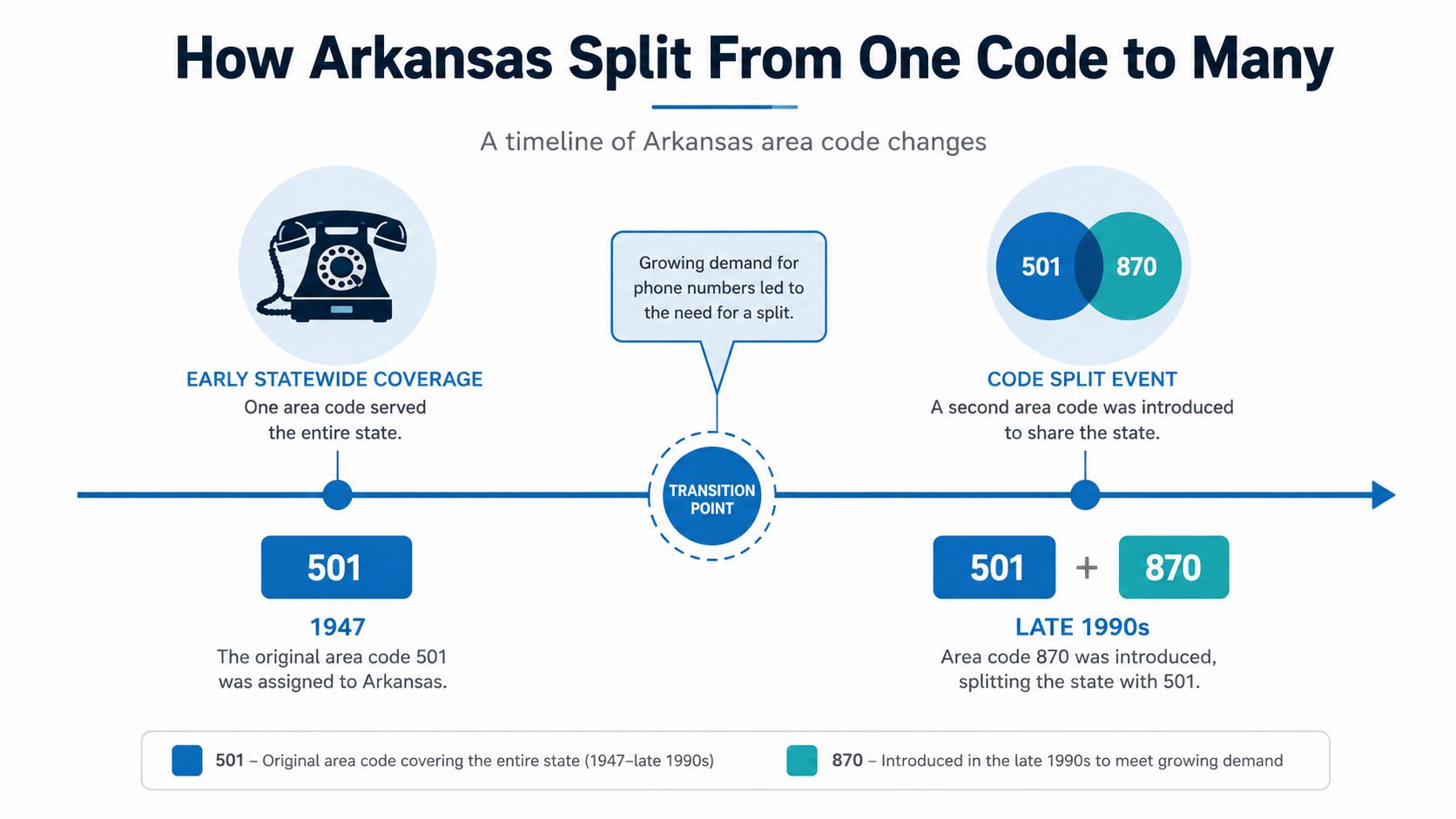
For decades, Arkansas had one simple arrangement, 501 covered the entire state beginning in 1947. That worked when phone service was smaller and less crowded. It stopped working when the number supply inside one code couldn't keep up with growing demand from homes, businesses, fax lines, and mobile devices.
Why the split happened
The split that created 870 took place on April 14, 1997, and it pulled most of the state out from under 501 while leaving 501 mainly for the Little Rock region. In numbering-plan terms, 870 was the 189th area code in service and one of 43 area codes introduced in 1997 (Area codes 870 and 327). That detail matters because it shows how fast North American numbering expanded in the 1990s, not just in Arkansas but across the system.
The reason behind the change is straightforward. One statewide code was no longer enough once more people, more businesses, and more devices needed unique numbers. The new code gave Arkansas room to grow without forcing every caller into the same cramped pool.
Rule of thumb: when a single area code starts running out of numbers, the fix is usually either a split or an overlay. Arkansas used both over time.
Why the history still matters
870's origin story is useful because it explains why the code feels so broad today. It wasn't created for one city or one corridor. It was created to relieve pressure across a huge part of the state, so the code naturally ended up attached to many communities at once.
That also explains why older residents sometimes remember the shift clearly. Their phone identity changed, but their address didn't. The code changed because the system around it changed, not because the towns themselves moved.
What the 327 Overlay and 10-Digit Dialing Change for You
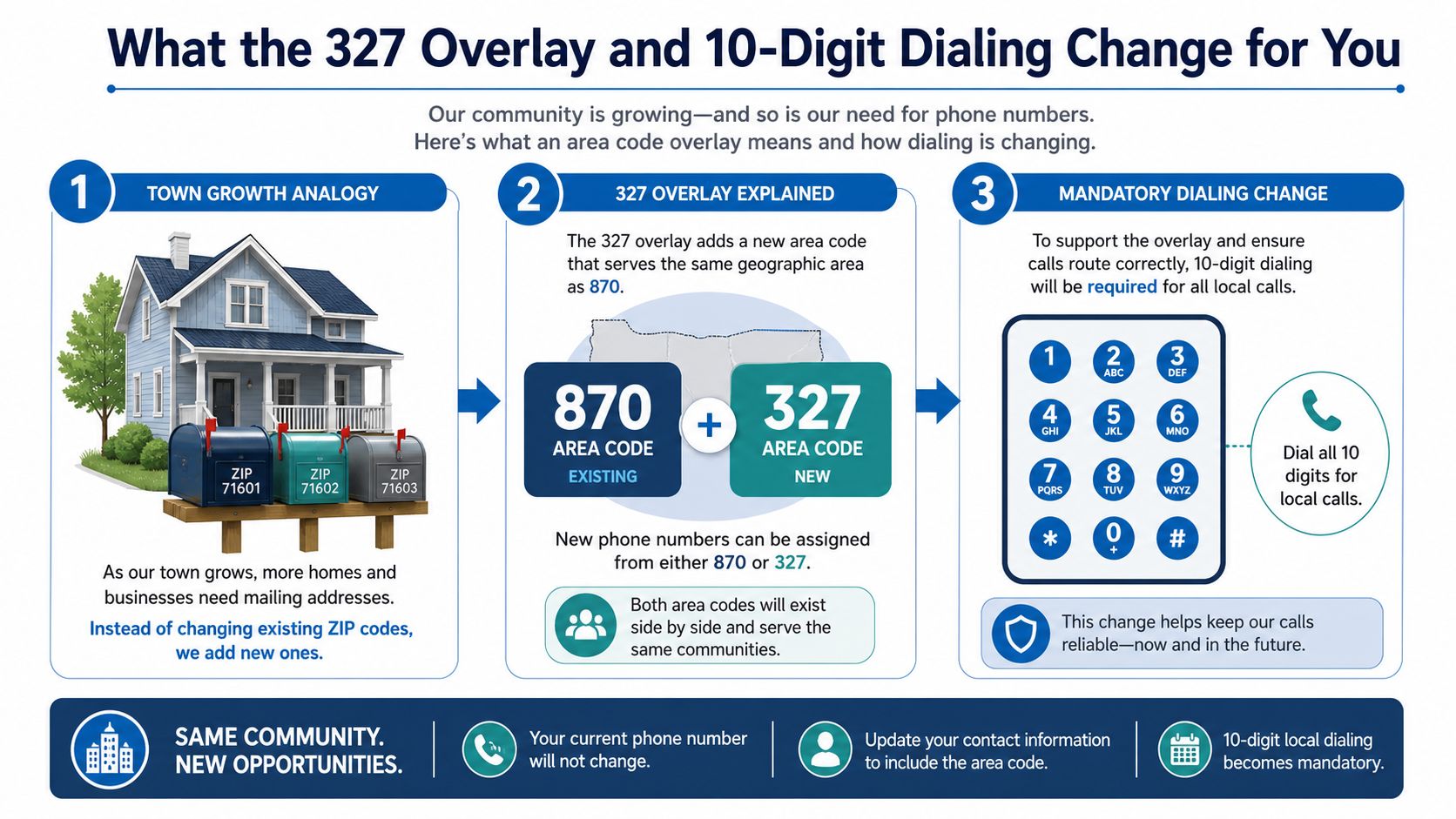
An overlay works like adding a second set of mailboxes on the same street. The street didn't move, the houses didn't move, but new addresses now come from two different number pools instead of one. That's what happened when 327 was layered onto the 870 region.
What changes in daily use
The practical result is simple, even if the setup sounds technical. Local calls now require 10-digit dialing, which means the area code plus the seven-digit number, even when you're calling next door. That rule has been mandatory in Arkansas's 870 and 327 region since the final change in January 2024 (New 870 Area Code in Arkansas).
That matters because a lot of older habits were built around seven digits. A stored contact from years ago, a speed-dial button, or a handwritten office list may still assume the old format. Once the overlay is in place, those shortcuts can stop working unless someone updates them.
What usually breaks first
Older systems are where the trouble tends to show up. Alarm panels, business phone trees, fax lines, auto-dialers, and saved contacts often depend on seven-digit patterns that no longer match how the network expects calls to be placed. The call may still be local, but the system handling it needs the full number to route it correctly.
If a family or business hasn't reviewed its phone setup in a while, this is the part worth checking first. A phone that works for casual calling can still trip over a list, a dialer, or a backup device that never got updated.
The big shift is mental as much as technical. 870 is no longer just “where is this call from?” It's also “how should I dial this number now?” That's the behavior change the overlay introduced, and it's already part of everyday calling across the region.
Landline, Mobile, and VoIP, What an 870 Number Can Actually Do
A local number used to mean a wire in a wall and a phone bolted to a desk. That idea is outdated now. An 870 number can sit on a traditional line, a mobile phone, or a VoIP system, and the caller may never know which one is underneath.
Three different kinds of phone identity
On a landline, an 870 number still looks and feels like the old model of phone service. The number is tied to a fixed location, although many carriers now move that service onto newer network plumbing as older copper systems age out. For households that still want a fixed line, it's mostly about basic reliability and familiarity.
On a mobile phone, the same number travels with the person. A resident can keep an 870 number while moving across town, switching carriers, or taking the phone on the road. The number still reads as local to Arkansas callers, even if the device isn't sitting in one place all day.
On VoIP, the number becomes even more flexible. It can ring on a desk phone, a laptop app, and a mobile app at the same time, which is why cloud phone systems have become so common for small offices and remote teams. What are VoIP phone numbers? is a useful primer if you want the nuts and bolts.
Why the plumbing matters less than the service
The big shift is that the number's location matters less than the service wrapped around it. A family might care about voicemail, call clarity, and whether the phone works during a storm. A business might care about forwarding, voicemail-to-email, and how calls land after hours.
A phone number is an address. The carrier, device, and app are the delivery trucks.
That's the right way to think about 870 now. The number tells people something about the region, but the true experience depends on the platform carrying it.
Why a Local 870 Number Does Not Always Mean Local Service Quality
A local number can feel reassuring, but it doesn't guarantee a strong connection. That's especially true across the rural and mountainous parts of the 870 region, where terrain and distance can make voice and broadband service harder to deliver consistently.
The number is not the network
Parts of the 870 footprint, including areas around the Ozark National Forest and portions of Newton and Madison counties, still face cell coverage dead zones even as cooperative and federal efforts continue to improve access (where is area code 870?). That matters because a caller ID with an 870 prefix can suggest “local,” while the actual connection may still be struggling behind the scenes.
That's why area code guides can be misleading when they stop at maps. The code is only a label. The underlying issue is the last mile, the part of the network that has to reach homes, farms, clinics, field crews, and small offices spread across rough terrain and long distances.
Where that shows up in real life
A telehealth visit needs a stable voice or video path. Remote learning needs dependable internet. Field operations need calls that complete when crews are out in the county. Small businesses need alarms, dispatch calls, and customer callbacks to go through the first time, not on the third try.
For teams trying to look local while staying reachable, local presence dialing is worth understanding, because the number on the screen is only one part of how a call is received. If the underlying connection drops, the local prefix doesn't help.
What to remember
A local 870 number can help people recognize you. It can't promise that the network under it is strong, redundant, or weather-resistant. That's why the smartest question isn't “Does this number look local?” It's “Will this service hold up when people use it?”
Getting, Porting, or Choosing an 870 Number for Home or Business
If you already have an 870 number, the easiest move is usually to keep it. Individuals often prefer not to hand over a familiar number they've used for years, and in many cases they don't have to.
How households usually handle it
When someone switches carriers, the existing number often gets ported to the new provider instead of being replaced. Porting keeps the identity people already know, which is especially useful for family lines, home offices, and long-time contacts who still save numbers in older phones. The timing depends on the account being in good standing and the provider's process, so it's worth checking the handoff carefully before making the switch.
If you're choosing a new setup, think about the kind of service you need. Some households only want a reliable voice line. Others want texting, voicemail, and a mobile app tied to the same identity.
What businesses should look for
Small businesses and remote workers often choose a hosted VoIP or cloud phone system because it can assign a new 870 number without waiting on a physical line. Those systems can also place the same number on a desk phone, a softphone, and a mobile app, which keeps the business reachable wherever the team happens to be. A provider that supports multi-line call handling, such as how CallZent handles multi-line calls, shows the kind of flexibility many small offices want from a modern phone setup.
A business should also look at the parts that matter in Arkansas day to day, uptime, fiber-backed internet, managed WiFi, and the ability to bundle voice with broadband. One example in the market is Premier Broadband, which offers VoIP phone service alongside fiber internet and business connectivity options. A setup like that can reduce the number of separate systems a small office has to manage.
The practical takeaway
The 327 overlay means either area code can show up on a new number, and that's normal. A new 870 number still signals a local Arkansas presence, while a ported number preserves the one you already have. The choice usually comes down to convenience, call features, and the quality of the network behind the number.
What is a DID number? is a useful next read if you want to understand how direct numbers are assigned inside a phone system.
Scam Patterns, Practical Tips, and Quick Answers About 870
Not every 870 call is bad, but scam callers do use local-looking numbers to get you to answer. That includes neighbor spoofing, one-ring tactics, and fake delivery or utility threats that try to create urgency before you think clearly.
Quick safety habits
- Let unknown numbers go to voicemail. If it matters, a real caller will usually leave a message.
- Verify through a known number. Call the company or person back using a number you already trust.
- Don't share personal details on an inbound call. If someone pressures you for passwords, account info, or payment, hang up and verify independently.
Fast answers people ask most
Does an 870 number always mean the caller is in Arkansas? No. It can indicate Arkansas, but the number may be used through mobile or VoIP service elsewhere.
Is 327 replacing 870? No. 327 overlays the same region, so both codes can exist side by side.
How long does it take to port a number? It depends on the provider and account status, but porting is often a routine handoff rather than a total reset.
If the number looks local but the request feels rushed, treat the urgency as the warning sign, not the area code.
The fastest way to remember 870 is this, it covers most of Arkansas outside Little Rock, it now lives alongside 327, and 10-digit dialing is the rule for the region.
If you need a dependable local number, fiber internet, or VoIP service that fits a home office or small business, Premier Broadband can help you compare options without sorting through phone jargon alone. Visit Premier Broadband to see how its internet and voice services can support a local Arkansas presence and everyday calling.