
At its simplest, business call recording is the process of capturing and storing your company’s phone conversations. Think of it like a football team reviewing game tape—they’re not just looking for mistakes, but also for winning plays they can repeat.
That's exactly what call recording does for your business. It lets you turn everyday conversations into a powerful asset, giving you the ability to pinpoint what works, fix what doesn't, and understand exactly what your customers need.
Why Business Call Recording Is a Strategic Tool
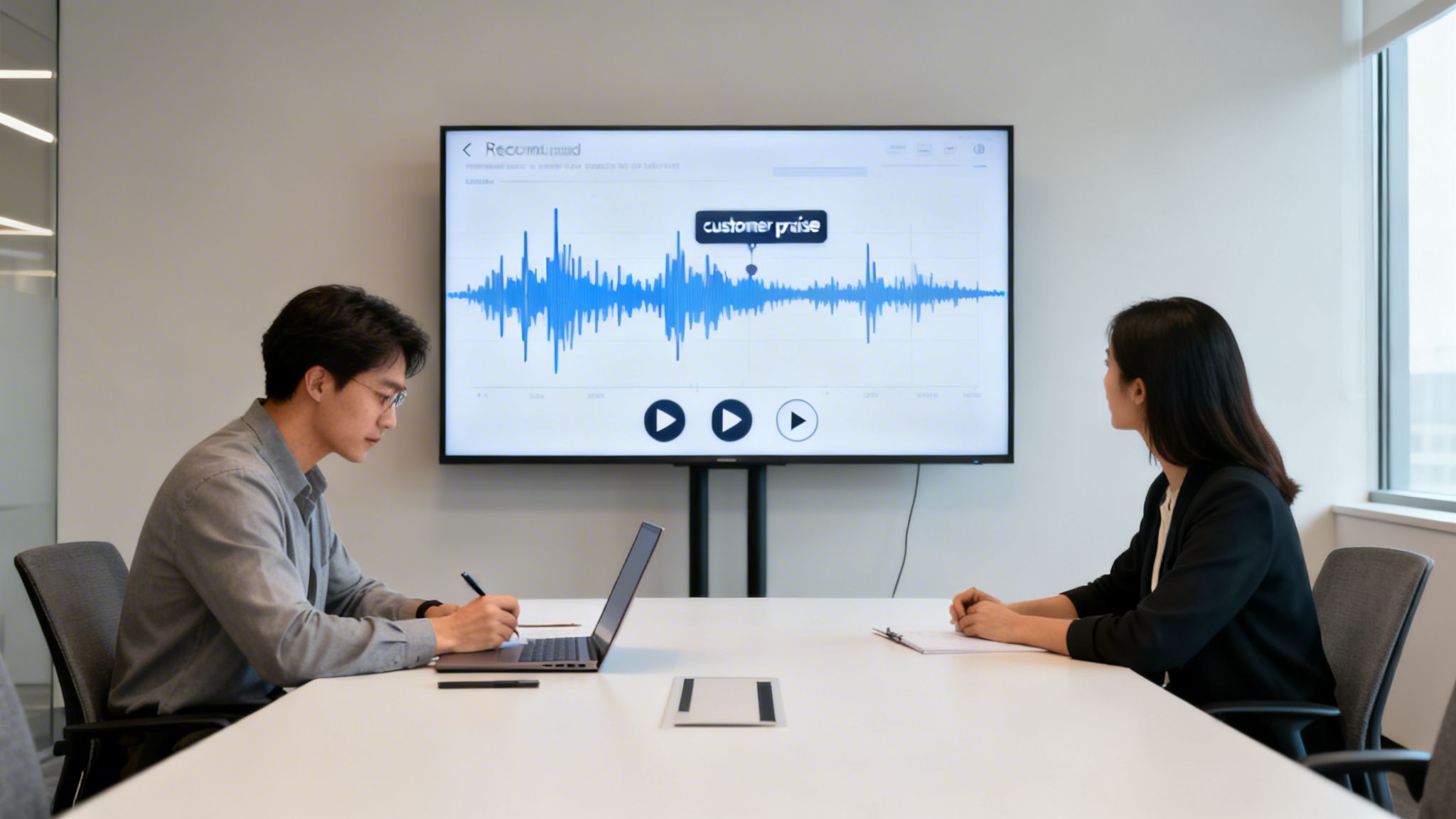
It wasn't long ago that call recording was a clunky, expensive technology reserved for massive call centers. It required dedicated servers and a whole lot of IT overhead. But thanks to modern VoIP phone systems, it's now an affordable and essential tool for businesses of every size, whether your team is in the office or working from home.
This accessibility has lit a fire under the market. The global call recording industry, valued at around $2.5 billion in 2025, is on track to hit $6.2 billion by 2033. This growth isn't just about technology; it’s driven by increasing compliance rules and the need for smarter, data-backed business decisions.
More Than Just a Recording
At its heart, business call recording creates a perfect, verifiable record of what was said during a phone call. It’s no longer just a "gotcha" tool for legal disputes. Today, it’s a proactive strategy for growth. When you capture the authentic voice of your customer, you unlock a goldmine of insights you can't get anywhere else.
By systematically reviewing what customers are actually saying, you can stop guessing what they want and start knowing what they need. This direct feedback is the key to improving your products, sharpening your service, and building real customer loyalty.
These recordings become the single source of truth for your entire organization. They help you train your team, protect your business, and ultimately, improve your bottom line.
A quick look at the core benefits shows just how impactful call recording can be across your entire operation.
Key Benefits of Business Call Recording at a Glance
| Benefit | Impact on Your Business |
|---|---|
| Improved Quality Assurance | Monitor and score calls to ensure a consistent, high-quality customer experience. |
| Enhanced Employee Training | Use real-world examples to coach new hires and upskill your existing team. |
| Faster Dispute Resolution | Settle "he said, she said" arguments instantly with an objective record of the conversation. |
| Solid Compliance & Liability Protection | Prove adherence to industry regulations and protect your business from legal risks. |
| Actionable Business Insights | Uncover customer pain points, product feedback, and sales opportunities hidden in conversations. |
These advantages demonstrate why call recording has become a non-negotiable tool for modern businesses looking to get ahead.
How Call Recording Works Across Your Business
The applications are incredibly practical and touch almost every department. Here are just a few examples:
- Employee Training: Let new hires listen to your top performers' calls. They'll learn effective communication skills and product details much faster than with a manual alone.
- Quality Assurance: Managers can easily check in on service quality, ensuring every customer gets the best experience you can offer.
- Dispute Resolution: A customer questions an order detail or a price quote? Pull up the recording. The conversation provides indisputable proof and resolves the issue in minutes.
- Compliance Adherence: For businesses in regulated fields like finance or healthcare, recordings prove that your team is following all required scripts and legal disclaimers.
Many of these features are seamlessly integrated into modern communication platforms like Unified Communications as a Service (UCaaS), which bring your voice, video, chat, and other tools together in one place.
Understanding Call Recording Laws and Compliance
When it comes to recording business calls, the legal side of things can seem like a minefield. But it really boils down to one simple idea: consent. Getting this right is critical, as different places have different rules about who needs to agree to be recorded.
The main thing you need to know is the difference between "one-party consent" and "two-party consent" laws. It’s a bit like the difference between you jotting down notes from a conversation for yourself versus creating an official transcript that everyone has to sign off on.
One-Party vs. Two-Party Consent
In states with one-party consent, you only need one person on the call to know it's being recorded. Since your business is one of the parties, your consent is all it takes. Most U.S. states use this rule, which makes recording your business calls pretty straightforward.
On the other hand, two-party consent states demand that every single person on the line knows about and agrees to the recording. This is often called "all-party consent" because it applies to conference calls, too. If you don't get everyone's permission in these states, you could be in serious legal trouble.
When your business deals with customers across state lines, the safest bet is to always follow the strictest rule. If your customer is in a two-party state like California or Florida, you need their consent—even if your business is in a one-party state.
This simple, proactive approach is the best way to steer clear of legal headaches and is a cornerstone of good regulatory compliance.
Staying Compliant with Simple Steps
You don’t need a law degree to stay compliant. It’s all about building clear, transparent habits. The easiest method is to use a clear, upfront disclosure at the start of every call.
A simple, automated message does the trick perfectly:
- "This call may be recorded for quality assurance and training purposes."
- "For our mutual protection, this conversation will be recorded."
When a customer continues the call after hearing that message, it's considered implied consent. This one small step protects your business and shows customers you're being upfront, which builds trust. And as technology evolves, you can keep things secure and compliant even with advanced tools like AI. For more on that, check out our guide on compliant frontline AI voice agents.
Beyond just consent, you also have industry-specific rules like PCI DSS (for payment card details) and HIPAA (for health information). These regulations add another layer, dictating how you have to store and protect sensitive data. A solid business call recording system, like the one included with Premier Broadband’s hosted VoIP, comes with the security features and access controls you need to meet these strict requirements without any extra hassle.
Choosing Between Cloud and On-Premise Recording
When you're ready to start recording business calls, one of the first big decisions you’ll make is where to keep the recordings. It really comes down to two main options: a traditional on-premise setup or a modern, cloud-based solution.
Think of it like storing your business documents. You could keep them all in a physical filing cabinet in your office, or you could use a secure cloud service. The right answer depends on your budget, IT capacity, and how you see your business growing.
Comparison of On-Premise vs. Cloud-Hosted Call Recording
Let's break down the key differences between these two approaches. The choice you make will directly impact your costs, maintenance workload, and overall flexibility.
| Feature | On-Premise Solution | Cloud-Hosted Solution (e.g., Premier Broadband VoIP) |
|---|---|---|
| Initial Cost | High capital expense for servers, storage, and software licenses. | Low to no upfront cost; included with a monthly subscription. |
| Maintenance | Requires a dedicated IT team for updates, security, and repairs. | All maintenance, security, and updates are handled by the provider. |
| Scalability | Difficult and expensive. Requires purchasing more hardware. | Effortless. Add or remove users with a few clicks. |
| Accessibility | Limited. Access is typically restricted to the physical office network. | Securely access recordings from anywhere with an internet connection. |
| Space | Requires physical space for servers and other bulky hardware. | Zero on-site footprint. Frees up valuable office space. |
For most businesses today, the agility and cost-effectiveness of a cloud-hosted system make it the clear winner. It removes the IT burden and lets you focus on what you do best.
The On-Premise Approach
An on-premise system means you buy, own, and maintain all the physical hardware yourself. Everything—servers, storage drives, and software—lives right there in your office.
This gives you direct physical control over your data, but that control comes with a hefty price tag. You're looking at a large upfront investment and the ongoing cost of an IT team to manage installation, handle updates, and patch security vulnerabilities. Scaling up means buying more expensive equipment, a process that is both slow and costly.
The Cloud-Hosted Advantage
Cloud-hosted recording, which is a core feature of modern VoIP phone systems, flips the script entirely. Instead of you managing servers, your call recordings are stored securely in the cloud by your service provider. This completely eliminates the need for expensive, bulky hardware in your office.
With a cloud solution, you shift from a major capital expense to a predictable monthly operating cost. The benefits are impossible to ignore:
- Lower Initial Costs: No need to purchase pricey servers or hardware.
- Effortless Scalability: Easily add or remove users as your team changes, only paying for what you use.
- Minimal Maintenance: Your provider takes care of all the updates, security, and upkeep behind the scenes.
- Remote Accessibility: Securely listen to and manage recordings from anywhere with an internet connection.
This flexibility is a huge reason why businesses are moving their communications to the cloud. North America leads this shift, accounting for a massive 39.5% of the global call recording market. While simple audio recording is still common, integrated VoIP recording is essential for supporting today's growing remote and hybrid teams. In fact, 58% of customers expect quick resolutions over the phone—a demand that is much easier to meet when you have call recordings for training and quality control.
Of course, no matter which system you choose, you have to be mindful of legal requirements. The flowchart below breaks down one of the most important aspects: consent.
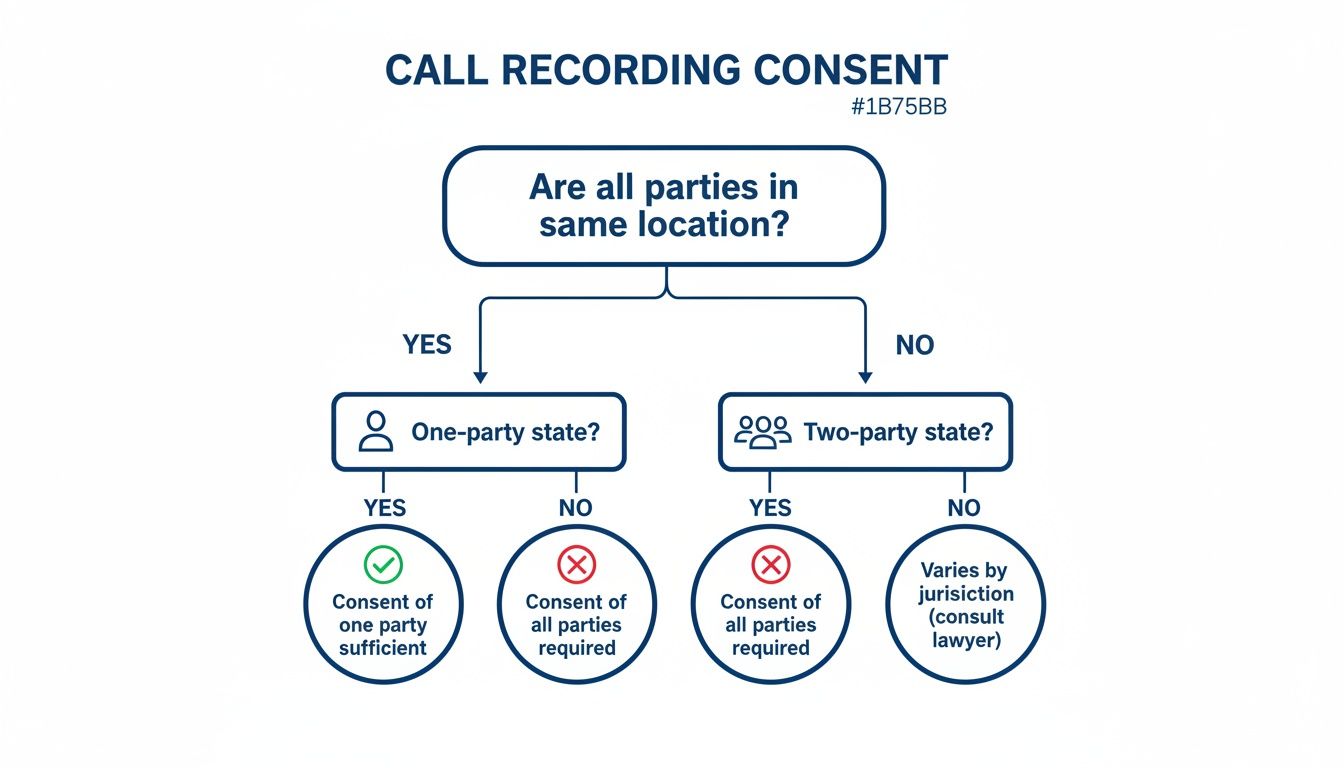
As you can see, consent rules can get complicated, especially when your calls cross state lines. Working with a knowledgeable provider who builds compliance tools into their cloud system can save you a lot of headaches. If you're new to this technology, you can learn more about how a cloud phone system works and see why it’s become the standard for modern businesses.
Turning Your Calls into Actionable Business Intelligence
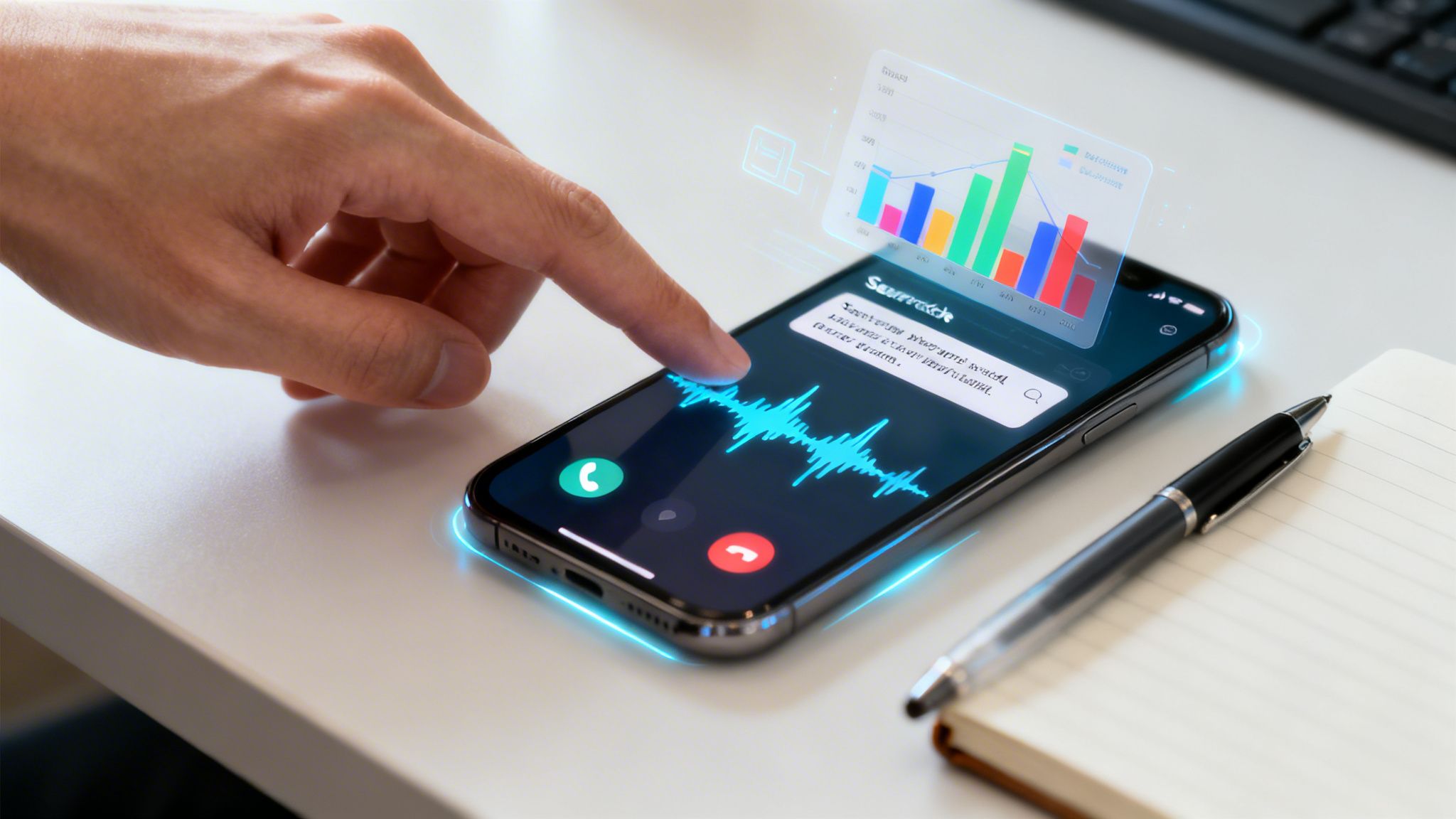
Modern business call recording is about so much more than just hitting 'record' and storing audio files. The real value comes from turning those conversations into a goldmine of strategic insights you can actually use.
Think of today's advanced systems less like an old tape recorder and more like an automated business analyst. It's as if you have someone listening to every call, ready to flag the most important information for you.
This is all possible thanks to AI-powered transcription and analytics. Imagine every single phone call being automatically turned into searchable text. Instantly, you could find every time a competitor is mentioned, spot a recurring customer complaint, or learn the exact words your top salesperson used to close their biggest deal.
From Raw Audio to Strategic Advantage
Without analytics, your call recordings are just a massive, disorganized library of sound files. It's a lot of data with no easy way to find what you're looking for.
But when you layer AI on top, you start to see patterns and trends that were completely hidden before. This is the key to shifting from putting out fires to building a proactive, forward-thinking strategy.
By analyzing call data, businesses can pinpoint the real reasons for customer frustration, see if marketing messages are landing, and even get a sneak peek at future trends based on what customers are saying today.
This gives you a direct line to the voice of your customer. You're no longer guessing what they think—you're hearing it firsthand. For companies wanting to really sharpen their sales process, exploring advanced methods like AI Call Analysis can provide a serious competitive advantage.
Practical Applications of Call Intelligence
Once you start turning audio into data, you open up a world of practical uses that can help almost every department. This is where a business call recording system really proves its worth.
Here are just a few examples of what you can do:
- Pinpoint Winning Sales Techniques: Automatically flag calls that ended in a sale. By looking at the transcripts, you can see the exact words, phrases, and objection-handling tactics your best agents use. Then, you can use those insights to train the whole team.
- Improve Your Products and Services: Use keyword spotting to track how often certain product features or pain points come up. If you see a spike in customers asking for a specific feature or complaining about a bug, you have concrete data to give your development team.
- Enhance the Customer Experience: Sentiment analysis can track customer emotions during a call, helping you identify moments of frustration or happiness. Managers can use this to coach agents on being more empathetic and better at solving problems, leading to happier customers.
When you have the right tools, you can uncover a wealth of information that’s currently locked away in your daily phone calls. Premier Broadband’s integrated VoIP platform, combined with our powerful call analytics, makes it easy to transform your phone system into a powerful source of business intelligence.
Best Practices for Managing Your Call Recordings
Flipping the switch on a business call recording system is a great start, but the real value comes from how you manage all that new data. To get the most out of your recordings (and avoid potential headaches), you need a solid game plan. Think of it like a library—without a good cataloging system, it’s just a room full of books. Your call recordings need clear rules to become a truly useful asset.
First things first: you need a data retention policy. This is just a formal set of rules that says how long you'll hang onto recorded calls before they're securely deleted. There’s no one-size-fits-all answer here. For coaching and training, you might only need calls from the last 30-90 days. But for legal reasons or industry compliance—especially in fields like finance—you could be required to keep records for several years.
A clear policy keeps you from drowning in a massive, expensive digital landfill of old calls. It also cuts down on your liability, ensuring you aren't holding onto sensitive customer data any longer than you absolutely have to.
Secure Access and Organization
Once you’ve decided how long to keep recordings, you need to control who can listen to them. Let's be honest, not everyone in your company needs to hear every single call. Putting strict access controls in place is non-negotiable for protecting customer privacy and your own business information.
Think of it like key cards in a secure building. A marketing manager might need access to glowing customer testimonials, a team lead needs to review their agents' calls for coaching, and your lawyer needs to pull specific recordings related to a dispute. Everyone gets a key, but it only opens the doors they need to go through.
This is often called the "principle of least privilege," and it’s a cornerstone of responsible data management. It simply means people should only have access to the data they need to do their jobs. It’s a simple concept that goes a long way in building trust with your customers and your team.
Making Your Recordings Searchable
What good is a recording if you can’t find it when you need it? This is where metadata—data about your data—becomes your best friend. Modern VoIP systems, like the ones from Premier Broadband, automatically tag every recording with critical details like:
- The date and time of the call
- How long the conversation lasted
- The phone numbers involved
- Which agent handled the call
With this information attached, you can sift through thousands of calls in seconds. Need to find every call a specific agent handled last Tuesday? No problem. Looking for a conversation you had with a customer three months ago? You can pull it up instantly. This turns a simple archive into a powerful, searchable database for quality assurance, training, and resolving issues fast.
These practices are more important than ever. After all, 73% of customers say they’ll switch brands if they don’t get a consistent experience. Analyzing your calls is one of the best ways to make sure you're delivering. You can learn even more by checking out the latest business phone system stats and trends.
Your Step-by-Step Plan to Get Started
Alright, ready to put business call recording to work for you? Getting started is more straightforward than you might think. Just follow these simple steps to find the right system and turn your daily phone calls into one of your most powerful business tools.
1. Figure Out Your “Why”
Before you look at any technology, ask yourself a simple question: Why do we need to record calls? Are you trying to coach up your sales team? Do you need to meet strict industry regulations? Or are you just tired of "he said, she said" disputes with customers?
Your main goal is the most important factor. A sales team needs features for training and quality checks. A medical or financial office, on the other hand, will be laser-focused on top-notch security and compliance. Nailing this down first ensures you don't overpay for bells and whistles you'll never use.
2. Pick Your Recording Solution
Now for the fun part—choosing the tech. As we've seen, a cloud-hosted VoIP system is the go-to choice for most businesses today. It gets rid of the need for clunky, expensive hardware in your office and rolls business call recording right into your phone service.
When you're looking at providers like Premier Broadband, you want a single, unified platform that gives you:
- Built-in call recording: No more headaches trying to make two separate systems talk to each other.
- Secure cloud storage: Keep your recordings safe while being able to access them from anywhere.
- Advanced analytics: Get the real story behind your calls with transcription and sentiment analysis.
- Effortless scalability: Find a system that grows right alongside your business, not one that holds you back.
An all-in-one platform just makes life easier. With a hosted VoIP solution, you get crystal-clear calls and powerful features without the mess of dealing with multiple companies and contracts.
3. Roll It Out and Train Your Team
Once you’ve got your new system, it's time to get your team on board. This is a critical step. Everyone needs to understand not just how to use the new tools, but also the legal and ethical rules for recording calls.
Make sure you provide clear training on how to get consent and who can access recordings. A smooth, compliant rollout starts with making sure your team is confident and well-informed from day one.
Frequently Asked Questions About Business Call Recording
Getting started with call recording can bring up a few common questions. We've put together some straight-to-the-point answers to clear things up and help you move forward.
Is It Legal to Record All Business Calls?
The short answer: it all comes down to consent. In the U.S., you'll run into two types of laws: "one-party consent," where just one person on the call (you) needs to know it's being recorded, and "two-party consent," where everyone involved has to agree.
Since you can't always know where your customers are calling from, the safest bet is to always act like it's a two-party state. The easiest way to cover your bases is with a simple, automated message at the start of the call, like, "This call may be recorded for quality purposes." It’s a simple step that provides consent and protects your business.
How Much Does Business Call Recording Cost?
The price tag really depends on how you set it up. Old-school, on-premise systems can be a huge upfront expense, requiring you to buy servers and software, not to mention the IT hours to maintain it all.
For most businesses today, a cloud-hosted VoIP solution is the smartest financial choice. Instead of a massive capital expense, call recording is just a built-in feature of your monthly phone plan. You get a predictable, low monthly fee and none of the maintenance headaches.
This makes powerful recording tools affordable and accessible for any business, big or small.
How Long Should We Keep Call Recordings?
There isn't a one-size-fits-all answer here—your retention policy should match why you're recording in the first place.
- For Employee Coaching: Holding onto recordings for 30 to 90 days is usually plenty of time to give feedback and spot training needs.
- For Dispute Resolution: You might want to keep recordings for six months to a year, which should cover you through a typical sales or project cycle.
- For Legal Compliance: If you're in a regulated field like finance or healthcare, you could be legally required to store recordings for several years.
Setting up a clear data retention policy is key. It ensures you have the recordings you need without holding onto sensitive data any longer than necessary.
Ready to transform your business communications with a secure, all-in-one solution? Premier Broadband offers crystal-clear VoIP phone systems with built-in call recording and advanced analytics. Simplify your operations and unlock valuable insights with a single, trusted partner.