
So, what exactly is a managed network security solution? Think of it as hiring a team of digital bodyguards for your business. Instead of trying to manage firewalls, monitor for threats, and respond to incidents all on your own, you hand over the keys to a specialized third-party provider. They take full responsibility for your security, offering 24/7 protection and proactive defense.
This completely shifts how you handle security. It stops being a major internal cost and operational headache, and instead becomes a predictable, managed service.
Shifting from DIY Defense to Expert Protection
Imagine your business is a fortress. You could try to build the walls, hire the guards, and install the surveillance cameras yourself. But keeping up with every new threat and tactic would quickly become a full-time, expensive job. This is the challenge of a do-it-yourself (DIY) security strategy—it demands constant attention, deep expertise, and a big investment in technology and people.
Managed network security offers a much better way. It’s like bringing in an elite security firm to protect that fortress for you. You don’t have to buy, configure, or monitor all the complex tools yourself. You just partner with a provider who handles everything.
What This Partnership Includes
This isn't just about installing some software and calling it a day. It’s a full-service partnership that typically covers:
- Continuous Monitoring: Experts are watching your network around the clock, actively hunting for anything suspicious before it turns into a real problem.
- Proactive Threat Management: Your provider keeps all your defenses updated to block the latest viruses, malware, and cyberattack methods as they emerge.
- Incident Response: If a threat does get through, the managed team jumps into action immediately to contain and neutralize it, keeping any potential damage to a minimum.
- Expert Access: You get a direct line to a team of cybersecurity pros whose only job is to protect businesses like yours.
With this model, you get to offload the immense technical and operational weight of cybersecurity. To get a better feel for this, it helps to see how a broader range of managed IT services for small business work to control costs and boost efficiency. The idea is the same: let the experts handle the specialized stuff so you can focus on running your business.
By outsourcing, you transform security from a reactive, in-house burden into a proactive, expert-managed strategy. It's about gaining peace of mind and enterprise-grade protection without the enterprise-grade price tag.
More and more businesses are making this switch. The global market for these services was valued at USD 82.89 billion in 2025 and is expected to rocket to USD 167.37 billion by 2034. This explosive growth, tracked by firms like Precedence Research, is fueled by rising cyber threats and the sheer complexity of today's digital world. It’s a clear sign that business owners recognize the incredible value of specialized security management.
The Core Components of Your Security Fortress
To really get what makes managed network security so powerful, you have to look under the hood. A provider doesn’t just install one piece of software and call it a day. Instead, they build a multi-layered digital fortress where every single component has a critical job to do.
Think of it less like a single wall and more like a medieval castle, complete with gatekeepers, watchtowers, and secret passages all working in harmony. Each layer is specifically designed to stop different kinds of threats, creating a defense that’s tough, smart, and resilient. When an expert team manages it all, these tools weave together into a seamless security blanket that covers your entire operation.
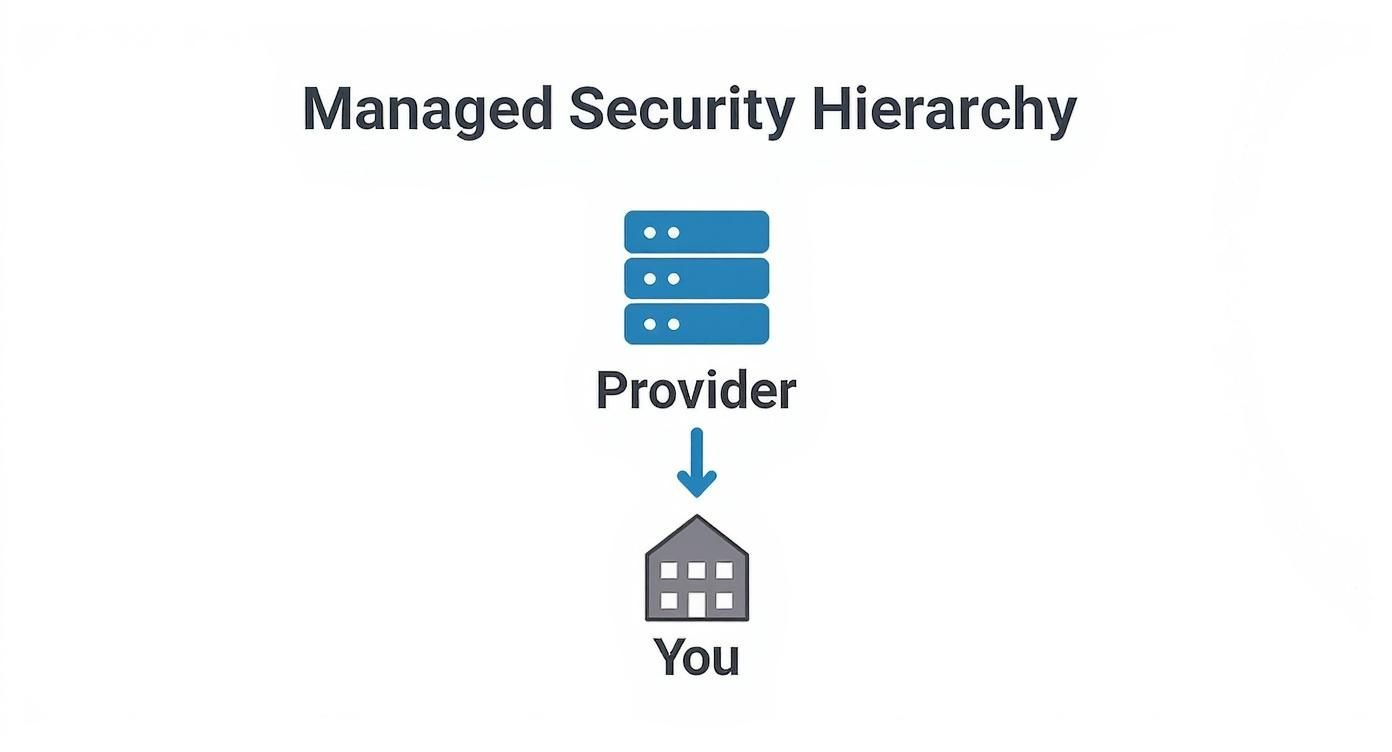
This diagram shows the basic relationship: the provider handles all the complex, heavy lifting so your business gets the benefits of top-tier security.
Let's break down the key players that make up this modern fortress.
At a Glance: Key Components of Managed Network Security
This table gives you a quick rundown of the essential technologies in a managed security solution. It shows what each tool does and what kind of trouble it’s designed to stop.
| Component | Primary Function | Protects Against |
|---|---|---|
| Firewall | Acts as a digital bouncer, inspecting and filtering all incoming and outgoing network traffic based on strict security rules. | Unauthorized access, malicious traffic, and basic cyberattacks from the outside. |
| SD-WAN | Intelligently routes network traffic over the most efficient and secure path, optimizing performance for cloud apps and remote work. | Inefficient data flow, poor connection quality, and security gaps in distributed networks. |
| IDS/IPS | Monitors network activity for suspicious patterns (IDS) and actively blocks detected threats in real-time (IPS). | Sophisticated malware, hacking attempts, and policy violations that get past the firewall. |
| VPN | Creates a secure, encrypted "tunnel" over the public internet for remote users to connect safely to the business network. | Eavesdropping, data interception, and man-in-the-middle attacks on public Wi-Fi. |
| Endpoint Security | Protects individual devices (laptops, servers, phones) from malware, ransomware, and other direct threats on the device itself. | Viruses, ransomware, phishing attacks, and exploits targeting user devices. |
Each of these components is a powerful tool on its own, but their real strength comes from working together as a unified system.
The Gatekeepers: Firewalls and SD-WAN
Standing guard at the very edge of your network are the gatekeepers. Their job is to control everything that comes in and goes out.
The most fundamental of these is the firewall. A firewall is basically your network's bouncer. It inspects every bit of data trying to get in or out and blocks anything that doesn’t follow the strict security rules your provider sets. It’s your first line of defense.
But today's networks are more complex. With people working from home and apps running in the cloud, data needs to travel securely and efficiently. That’s where Software-Defined Wide Area Networking (SD-WAN) steps in. Think of SD-WAN as a smart traffic cop for your network, automatically picking the best and safest route for your data. It keeps performance high and security tight for all your connections.
The Watchful Guards: IDS and IPS
While a firewall blocks known threats at the gate, you also need guards patrolling the walls, looking for anything suspicious. That's the job of Intrusion Detection Systems (IDS) and Intrusion Prevention Systems (IPS).
An IDS constantly watches your network traffic for patterns that suggest a cyberattack is happening. If it sees something, it sends an alert right away.
An IPS takes it a step further. It doesn't just spot a threat—it actively steps in to block it on the spot. It’s the guard who not only sounds the alarm but tackles the intruder before they can do any damage.
These systems are vital for catching clever attacks that might sneak past the firewall. A key part of making this work is solid security configuration management, which ensures every piece of your defense is tuned perfectly.
The Secure Tunnels and Personal Armor
Your fortress isn't just one building; it includes remote workers and devices connecting from all over. To protect them, you need two more crucial components.
Virtual Private Networks (VPNs) create a secure, encrypted tunnel over the public internet. When an employee connects through a VPN, all their data is scrambled, making it unreadable to anyone trying to snoop. This is absolutely essential for protecting sensitive info when your team is working from anywhere but the office.
Finally, Endpoint Security is like personal armor for every single device on your network—laptops, servers, and smartphones. It shields these devices from malware, ransomware, and other direct attacks. This is a critical final layer because one compromised laptop can give an attacker a way into your entire network.
By combining all these components, a managed security provider builds a powerful, layered defense. You can learn more about how these layers come together by exploring strategies for protecting your network. They handle all the configuration, updates, and monitoring, giving you complete protection without the headache.
Managed Security vs. In-House: The Critical Differences
Deciding whether to outsource your security or build an in-house team is one of the biggest technology decisions your business will face. It’s a choice that goes way beyond a simple pros-and-cons list. It directly impacts your budget, your team's focus, and how well you can stand up against cyber threats.
The whole decision really comes down to a few key trade-offs. You're weighing the predictable, subscription-based costs of a managed service against the huge upfront investment and surprisingly high ongoing expenses of an internal team. At the same time, you're comparing the headache of finding and keeping cybersecurity talent against the instant access a provider gives you.
The True Cost of Security Ownership
The most obvious difference is how you pay for it all. With a managed network security solution, your costs are neatly bundled into a predictable monthly or annual fee. This simple move turns a massive capital expense (CapEx) into a much more manageable operating expense (OpEx), which makes budgeting a whole lot easier.
On the other hand, the in-house approach comes with a long—and often underestimated—list of expenses. The initial purchase is just the tip of the iceberg.
- Upfront Costs: This includes buying expensive hardware like firewalls and servers, plus shelling out for software licenses that can easily run into the thousands.
- Operational Costs: You’ve got to factor in ongoing maintenance, software renewals, hardware replacements, and the electricity to keep everything humming 24/7.
- Hidden Costs: And don't forget about training your team to keep their skills sharp, plus the emergency costs that pop up when something inevitably goes wrong.
When you add it all up, the total cost of ownership for an in-house team is almost always higher and far less predictable than the straightforward fee from a managed provider.
The Expertise Gap: A Team vs. a Department
Beyond the money, there's the huge challenge of finding the right people. Building a capable in-house security team isn't as simple as hiring one "IT security person." Real cybersecurity demands a whole range of specialized skills.
A single in-house hire can't be an expert in everything. A managed security provider gives you immediate access to an entire department of specialists—from threat hunters and compliance experts to incident responders—for a fraction of the cost of hiring them yourself.
To get the same level of expertise as a managed security provider, a business would have to hire a whole crew of professionals, including:
- A Security Analyst to watch over alerts and dig into potential threats.
- A Network Engineer to manage the firewalls, VPNs, and other gear.
- A Compliance Specialist to make sure you're meeting industry rules like HIPAA or PCI-DSS.
- An Incident Responder who knows exactly what to do the moment a breach happens.
Hiring, training, and retaining this kind of talent is incredibly tough and expensive, especially for small and medium-sized businesses. This is a huge reason why the network security market is expanding so quickly. The market is on track to hit USD 30.49 billion in 2025 and is forecasted to reach USD 79.29 billion by 2033, driven by businesses looking for this kind of specialized expertise without the overhead. You can find out more about the growth drivers in the network security market to see why so many are making the switch.
Strategic Focus: Shifting from Firefighting to Growth
Maybe the most valuable benefit of outsourcing is the strategic edge it gives you. When your internal IT team is bogged down with managing security, they spend their days reacting to alerts, patching systems, and putting out fires. This constant defensive work leaves very little time for proactive projects that can actually move the business forward.
Partnering with a managed security provider frees your team from that burden. They’re no longer tied down by the constant pressure of security monitoring and can finally focus on initiatives that drive real growth. Instead of trying to figure out a firewall rule, they can be rolling out a new CRM, improving your cloud setup, or building tools to make everyone more productive.
This simple shift turns your IT department from a cost center into a strategic asset. You’re not just buying security; you're buying focus. You’re empowering your best people to work on what truly matters—innovating and growing your business—while the experts handle the complex, ever-changing world of cybersecurity.
How to Choose the Right Managed Security Partner

Picking a partner for your managed network security is a big deal. It's about more than just finding the lowest price. You’re handing over the digital keys to your business, so you need to be sure you're making the right call.
A great partner feels like a natural extension of your own team. The wrong one? They can cause more headaches than they solve. To pick a winner, you need to look past the sales pitch and get down to what really matters: their commitments, their skills, and how they’ll support you down the road.
Scrutinize the Service Level Agreement
The Service Level Agreement (SLA) is where the promises get put in writing. It’s the single most important document to review, so don’t just skim it. This is the contract that defines exactly what you can expect.
Look for specific, measurable numbers. Vague promises won’t help you when something goes wrong.
- Guaranteed Uptime: How much of the time will their services be up and running? You want to see figures like 99.9% or higher.
- Response Times: When an alert pops up, how fast will they jump on it? This needs to be broken down by how serious the issue is. A critical threat should get a response in minutes, not hours.
- Resolution Times: Once they respond, how long will it take to actually fix the problem? This shows you how efficient their team really is.
If an SLA doesn’t have clear numbers attached, consider it a major red flag. It should be a concrete guarantee of the service you’re paying for.
Verify Technical Expertise and Certifications
You wouldn't hire an accountant without checking their credentials, right? The same goes for the team protecting your network. Don't be shy about asking for proof of their technical skills.
A solid provider will be upfront about their team's qualifications and the technology they use. Look for industry-standard certifications like:
- CISSP (Certified Information Systems Security Professional)
- CompTIA Security+
- CEH (Certified Ethical Hacker)
- Vendor-specific certifications (like from Cisco or Palo Alto)
A provider's certifications are more than just badges. They're proof that the team is committed to best practices and truly understands the tools needed to keep your business safe. It shows they’re serious about staying sharp in a field where the threats are always changing.
Also, ask what’s in their toolkit. Do they use industry-leading security platforms? The quality of their tech is a direct reflection of the quality of protection you'll get.
Ensure Scalability and Future-Proofing
Your business is going to grow, and your security needs to be able to keep up. A solution that’s perfect today might hold you back in a couple of years.
Be open about your plans for the future. Ask potential partners how their managed network security solutions handle adding new office locations, more remote workers, or new cloud software. The best partners offer flexible services that can scale with you.
This is exactly why services like Premier Broadband's Managed Network Edge are so valuable—they’re built to manage your network securely as your organization gets bigger. Choosing a partner who can grow with you means you’re making a smart investment for the long haul.
Real-World Scenarios Where Managed Security Excels
It's one thing to talk about benefits on paper, but the real value of managed network security shines brightest when you see it tackle everyday business challenges. Let's look at a few stories where handing over the security reins wasn't just a smart move—it was the perfect solution.
These examples show how a managed approach solves specific headaches, from juggling multiple locations to navigating strict industry rules. Each one maps a clear path from a pressing problem to a secure, efficient, and stress-free operation.
Securing a Growing Retail Chain
Picture a small retail chain with five bustling storefronts. The owner is a pro at managing inventory and keeping customers happy, but cybersecurity isn't on their radar. Every store has point-of-sale (POS) systems handling credit cards and guest Wi-Fi for shoppers, creating a huge target for attackers with no dedicated IT staff to watch over it.
The owner was facing a few tough questions:
- Consistency: How could they guarantee the same security rules were being followed at all five stores?
- Compliance: They had to meet PCI DSS standards for credit card data—a complex and intimidating job.
- Expertise: Who would spot a threat or jump into action if a POS system was breached?
A managed security provider came in with a unified plan. They set up managed firewalls at each store, carefully separating the guest Wi-Fi from the critical POS network. They also brought in 24/7 monitoring and threat detection, giving the owner top-tier security without adding a single IT person to the payroll. The outcome? Full compliance, safe transactions, and total peace of mind.
Protecting Patient Data in a Healthcare Clinic
Now, think about a busy healthcare clinic. Their entire world revolves around patient care, but they're also sitting on a mountain of protected health information (PHI). This puts them under the strict microscope of the Health Insurance Portability and Accountability Act (HIPAA). A data breach isn't just a tech issue; it's a legal nightmare with crippling fines.
The clinic's small IT team was great at fixing printers but didn't have the specialized skills for HIPAA-compliant security. They were worried about access controls, data encryption, and performing the required risk assessments.
By teaming up with a managed security provider that specialized in healthcare, the clinic offloaded that entire burden. The provider put tight access controls in place, managed data encryption, and handled the regular security audits, providing the detailed reports needed to prove HIPAA compliance.
For any organization handling sensitive data, a managed security service is more than just convenient—it’s a critical part of managing risk. It brings in the specialized expertise needed to handle complex rules and protect what matters most.
This move let the clinic staff get back to focusing on patients, knowing their data was locked down and their legal obligations were covered. It's a common story in other regulated fields, too. In fact, the banking, financial services, and insurance sector is projected to make up 31% of the managed security services market. You can explore more insights about the managed security services market on Research Nester to see how various industries are benefiting.
Enabling a Secure Hybrid Workforce
Finally, imagine a modern tech company with employees logging in from home, the office, coffee shops—you name it. This flexibility is fantastic for morale, but it's a huge security headache. How do you keep company data safe when it's being accessed from dozens of different networks and personal devices?
Their biggest challenge was keeping security consistent for every employee, no matter where they were. The old office firewall just wasn't cutting it anymore. They needed a way to secure every connection back to their network and shield every laptop from threats found on public Wi-Fi.
A managed network security solution was the answer, using a combination of VPNs and endpoint security. The provider rolled out a secure VPN for all remote employees, creating an encrypted tunnel for all company traffic. They also installed and monitored advanced protection on every company laptop to block malware and phishing attacks. You can dive into our guide on network diagnostic utilities to learn about the tools that keep these connections running smoothly. This integrated strategy gave the company full visibility and control, keeping its hybrid team both productive and secure.
Common Questions About Managed Network Security
Diving into managed network security is a big step, and it's natural to have questions. It’s a smart move to get all the facts before you commit. We've gathered the most common questions we hear from business owners and IT managers, and we're here to give you straightforward answers so you can move forward with confidence.
Think of this as your final briefing before you lock down your business's security. We'll cover everything from cost and setup to how a new security partner will gel with your current team.
How Much Do Managed Security Services Typically Cost?
This is usually the first question on everyone's mind, and the honest answer is: it really depends. There's no one-size-fits-all price tag for managed network security because every business is different. The cost typically boils down to a few key factors.
- Scope of Services: Are you looking for basic firewall management and monitoring? Or do you need a full-blown security suite with 24/7 threat hunting, endpoint protection for every device, and detailed compliance reporting? The more you need, the more it will cost.
- Number of Users and Devices: The more endpoints you have—laptops, servers, phones—the larger your digital footprint is. Protecting a team of 10 is different from protecting a team of 100.
- Network Complexity: A single-office setup will have a different price point than a business with multiple locations, remote workers, and cloud services all interconnected.
- Compliance Requirements: If your business needs to meet strict regulations like HIPAA or PCI DSS, you'll require specialized services and reporting, which can impact the overall cost.
While you'll always need a custom quote, the real value is shifting from unpredictable, lump-sum capital expenses to a steady, predictable monthly operational cost. Instead of getting hit with a surprise bill for new hardware or an emergency fix, you get a clear, budgeted line item that covers everything.
What Is the Onboarding Process Like?
Getting started with a managed security provider should be a smooth, structured process. A good partner won't just flip a switch and walk away; they'll work closely with you to make the transition seamless.
Generally, the process unfolds in a few key stages:
- Discovery and Assessment: First, the provider gets to know your network inside and out. They'll perform an audit to understand your current setup, spot potential weak points, and get clear on your security goals.
- Solution Design: Using what they learned, they'll craft a security plan built just for you. This is the blueprint that maps out what tools they'll use and how everything will be configured to protect your business.
- Deployment and Integration: Next, their team puts the plan into action, deploying the necessary hardware and software. This is done carefully to cause as little disruption to your daily operations as possible.
- Tuning and Optimization: Once everything is live, there's a fine-tuning period. The security team monitors network traffic, adjusts rules, and makes sure the system is running perfectly to catch real threats without creating false alarms.
The whole point of a great onboarding experience is to make your new security provider feel like a natural extension of your team right from the start. It’s a partnership built to create a security foundation that helps your business, not hinders it.
Throughout it all, communication is everything. Your provider should keep you in the loop every step of the way, making sure you know what's happening and why.
Can a Managed Service Work With My Existing IT Team?
Absolutely. In fact, this is one of the most effective ways to use managed network security solutions. Bringing in a managed security provider isn't about replacing your in-house IT team—it's about empowering them.
Think of it like this: your internal IT team knows your business like the back of their hand. They're the experts at keeping daily operations running smoothly, helping users, and pushing new technology projects forward. A managed security provider is a team of specialists—like cybersecurity detectives—who live and breathe threat protection.
When they work together, something powerful happens:
- Your IT Team: Is freed from the constant stress of chasing security alerts and can finally focus on strategic projects that help grow the business.
- The Managed Provider: Handles the 24/7 monitoring, threat analysis, and incident response, bringing a level of expertise that’s tough and expensive to build in-house.
Your provider becomes a trusted advisor, giving your IT staff valuable insights while handling the heavy lifting of security. This cooperative approach lets each team play to its strengths, making your entire organization stronger and more secure.
Ready to stop worrying about your network's security and get back to focusing on what you do best? The team at Premier Broadband is here to help. We offer comprehensive managed network security solutions designed to protect your business from every angle, giving you enterprise-grade protection with the personalized service you deserve. Learn more about our managed network solutions and secure your business today.