

Your front desk is helping a customer, your salesperson is on another call, and a new prospect hears ringing with no answer. That's the moment many small businesses realize a single phone line isn't a phone system.
A multi-line phone setup fixes that problem by letting your business handle more than one call at once. It can make a two-person team sound organized, keep callers from hitting a busy signal, and route people to the right person without the usual chaos. It also changes how your staff works day to day. Fewer interruptions. Fewer handwritten message slips. Fewer missed chances to answer when someone is ready to buy.
The part many articles skip is the part that matters most with modern systems. If your phone service runs over the internet, your calling experience depends on your network. Good VoIP on weak internet feels unreliable. Good VoIP on a strong fiber connection feels simple.
What Is a Multi-Line Phone and Why Does It Matter
A multi-line phone system isn't just a desk phone with extra buttons. It's the ability for one device or one business phone setup to handle two or more simultaneous calls while also letting people place callers on hold, transfer calls, and manage extensions, as described by 8×8's explanation of multi-line phone systems.
That definition matters because many owners still picture a multi line phone as old office hardware. The underlying principle is capacity. If one employee is helping a customer, another person can still answer a new call. If a caller needs billing, the first staff member can transfer them instead of asking them to hang up and dial again.
What this looks like in a small business
Take a moving company on a busy weekday. One customer wants a quote, another wants to reschedule, and a crew leader is calling in from the road. With one line, somebody waits. With a multi-line setup, those conversations can move at the same time.
That's why niche operations often look for purpose-built resources such as phone solutions for independent movers. The details differ by industry, but the core need is the same. Keep calls flowing without making customers feel ignored.
Practical rule: If two people in your business ever need to answer or manage calls at the same time, you're already in multi-line territory.
Why it matters beyond call volume
The benefit isn't only handling more calls. It's giving callers a smoother path.
A good system can:
- Reduce bottlenecks by letting staff place one caller on hold while helping another
- Support teamwork through internal extensions and transfers
- Create a more polished experience so callers reach sales, service, or billing without confusion
- Adapt to different devices so calls can be managed from a desk phone, laptop, or mobile app depending on the provider
If you've heard the term “cloud phone system” and wondered whether that's just another name for internet calling, Premier Broadband's overview of what a cloud phone system is is a useful plain-English starting point.
For most small businesses, the value is simple. A multi line phone helps you answer like a real office, even if your team is small.
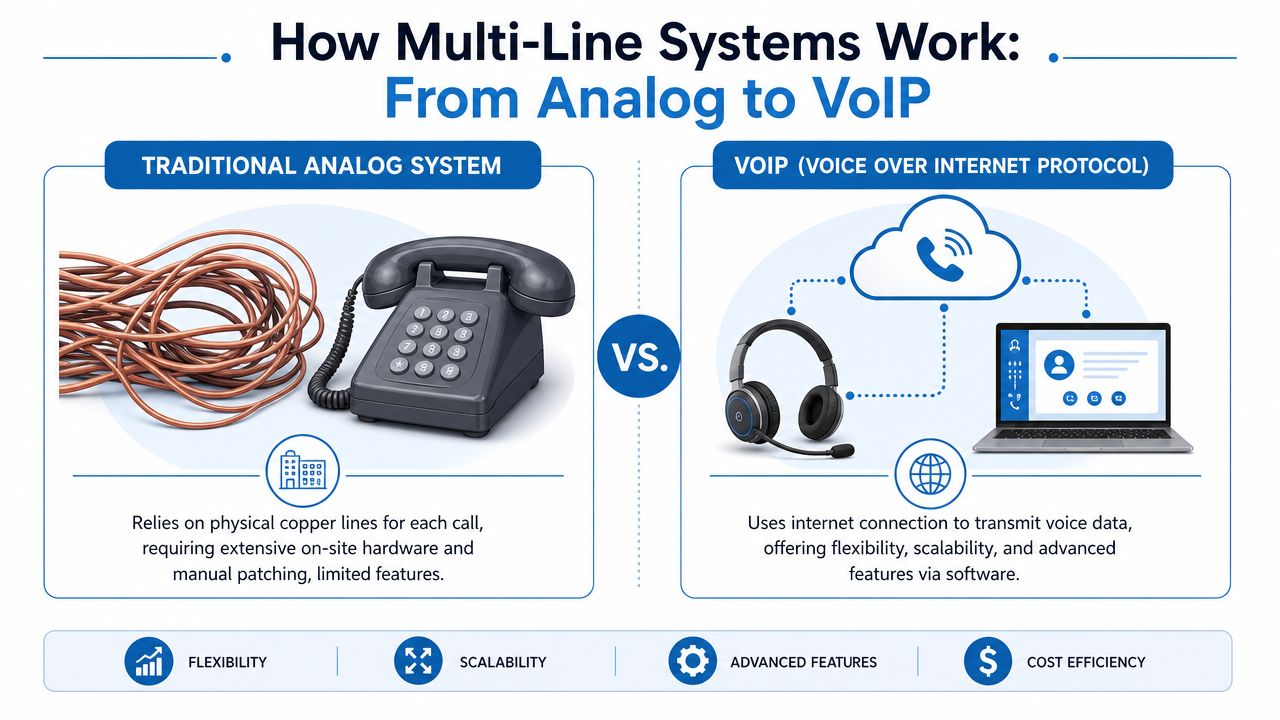
How Multi-Line Systems Work From Analog to VoIP
The easiest way to understand modern phone systems is to compare them to transportation. Traditional analog lines were the older work trucks. They got the job done, but every capability depended on physical equipment. On-premise PBX systems were more advanced, like a well-built fleet with its own garage and mechanic. VoIP is closer to a modern connected vehicle. More flexible, easier to manage, and less tied to what's sitting in one room.
Traditional analog systems
By the mid-20th century, the standard business phone used a dedicated multi-line setup with physical line buttons, letting users handle two or more simultaneous calls over the copper-based POTS network, according to the history of the telephone in the United States.
If you've seen an old office phone with several lit line buttons, that's the model many people still picture. Each line was tied to physical phone service coming into the building. It worked, but scaling often meant more wiring, more hardware, and more limits.
If you want a simple refresher on the public switched telephone network behind those older systems, FaxZen's guide to PSTN helps connect the old language to the modern alternatives.
On-premise PBX
A PBX is the office traffic director. It functions as a telephone operator in a box. Staff pick up, place calls, transfer them, and reach extensions through a central system installed on site.
For some businesses, that setup still makes sense. But it usually means more dependence on local hardware, more setup complexity, and more responsibility for maintenance. If the box in the office has a problem, your phones may have a problem.
Hosted VoIP
VoIP stands for Voice over Internet Protocol. Instead of sending calls through dedicated copper lines, it sends voice over your internet connection.
That shift changes almost everything:
| System type | How calls travel | What the business manages | Typical limitation |
|---|---|---|---|
| Analog | Physical copper lines | Line hardware and wiring | Expansion depends on physical lines |
| On-premise PBX | Local switchbox plus phone service | Hardware, maintenance, office setup | More equipment to support |
| Hosted VoIP | Internet connection and cloud platform | Devices, settings, and network quality | Performance depends on internet reliability |
A hosted model is why many businesses no longer need a room full of phone equipment. Staff can use desk phones, computer apps, or mobile apps while the provider manages the calling platform in the cloud. If you want the technical basics in plain language, Premier Broadband's article on how VoIP phone systems work is a good companion read.
Older systems were limited by what was physically installed in the building. VoIP is limited much more by how well your network supports voice traffic.
That last point is the one owners often miss. With VoIP, your phone system doesn't stop being a phone system. It becomes part of your network.
Essential Features Every Business Needs
A modern multi-line setup should do more than let two people talk at once. It should remove friction for callers and staff.
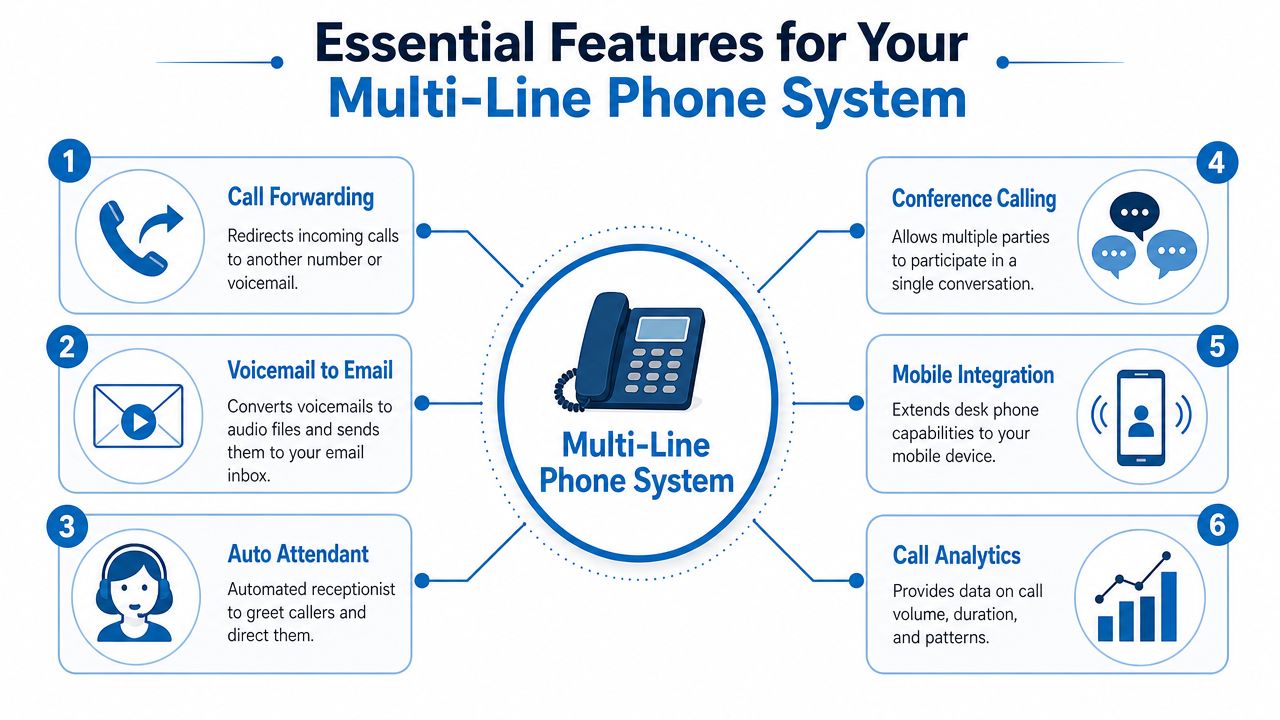
Modern cloud-managed platforms can include features such as auto-attendants, audio conferencing, and call recording, as noted in Allo's overview of multi-line phone systems. The trick is knowing which features solve real business problems and which ones only sound impressive on a brochure.
The features that pull their weight
Auto-attendant
This is your digital receptionist. Callers hear a greeting and choose where to go. For a small business, that means you can sound organized even when nobody is sitting at a front desk.Call forwarding
If someone isn't at their desk, the call can ring a mobile device or another extension. That matters for field teams, hybrid staff, and owners who still wear several hats.Voicemail to email
Instead of checking a phone mailbox over and over, staff receive voicemail in their inbox. That makes follow-up easier, especially when they're already living in email.
A quick visual can help if you're comparing feature names and trying to remember what each one does.
Features that help teams work faster
Some tools don't change how the caller feels right away, but they change how smoothly your team responds.
- Conference calling keeps multiple people in one conversation without separate dial-outs.
- Call recording can help with training, handoff review, and confirming what was promised on a call.
- Mobile integration lets your business number follow you instead of forcing you to use a personal cell number.
- Call analytics helps managers spot patterns such as peak hours or missed-call windows without guessing.
A small business doesn't need every advanced feature. It needs the few that remove the most friction in the daily rush.
Match features to real situations
Here's a simple way to put it:
| Business problem | Useful feature | Why it helps |
|---|---|---|
| Calls ring unanswered during lunch | Auto-attendant | Callers still reach the right menu or mailbox |
| Owner is away from the office | Call forwarding | Important calls still get answered |
| Team forgets to check voicemail | Voicemail to email | Messages show up where staff already work |
| Two staff members need to brief a customer together | Conference calling | Everyone joins one call |
| New hires need examples of good call handling | Call recording | Managers can coach with real conversations |
When owners ask whether they need a “fancy” phone system, this is usually the better question: which features prevent missed calls, slow handoffs, and customer confusion?
Choosing Your System Key Buying and Setup Considerations
Buying a multi line phone system is partly about phones and mostly about fit. The right choice depends on how your team answers calls, where they work, and whether your internet can carry voice traffic cleanly.
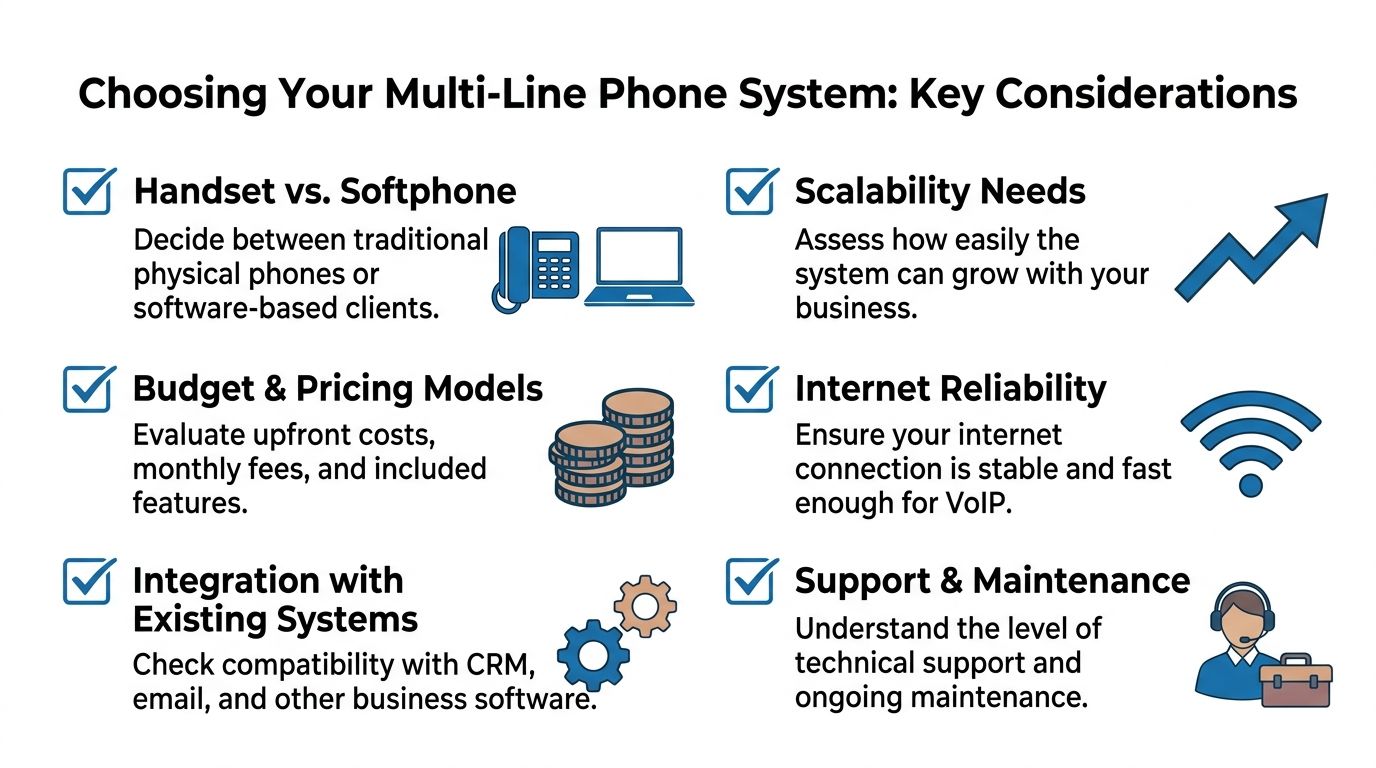
Start with line capacity and devices
According to Sunco's multi-line phone system guide, entry-level business systems typically support 2 to 4 lines, while higher-end systems can support 6 to 12+ lines. The same source notes that a single high-quality voice call needs about 100 kbit/s of bandwidth.
Those numbers are useful, but don't stop at them. Ask two practical questions:
- How many people may need to answer or place calls at the same time?
- Will they use desk phones, laptop apps, or mobile apps?
A front office may prefer handsets. A mobile team may be happier with softphones. Many businesses use both.
If you're weighing configurations, Premier Broadband's page on multi phone lines for business gives a straightforward look at how these setups are commonly used.
The buying factors owners often overlook
Here are the decision points that matter most:
Number portability
If your current phone number is already on business cards, trucks, and Google listings, ask whether you can keep it. Most owners don't want the disruption of changing numbers.Scalability
Don't buy only for today. Buy for the next employee, next location, or seasonal rush.Support model
Find out who helps when a desk phone won't register, calls sound choppy, or an auto-attendant needs updating.
QoS is not optional
This is the critical point. QoS, or Quality of Service, is how a network prioritizes voice traffic so calls don't compete badly with everything else happening online.
If someone in the office starts a large upload while another person is on a customer call, the network has to decide what gets priority. Without good network management, voice can break up, delay, or sound robotic.
If your phones run on VoIP, your internet connection is part of the phone system. Treat it that way when you shop.
This is why fiber quality matters so much. A feature-rich VoIP platform can still feel poor if the underlying connection is unstable, congested, or badly managed. When owners compare providers, they should compare the network just as carefully as the phone features.
The Premier Broadband Advantage Hosted VoIP and Fiber
The strongest case for hosted VoIP isn't just feature count. It's what happens when cloud calling and strong internet are treated as one decision instead of two separate purchases.
Why cloud scale changes the conversation
One of the biggest gaps in old vs new phone discussions is concurrency. Modern cloud-based SIP phones can hold “a dozen or more” incoming calls, while traditional systems often top out at 3 to 4 lines per device. The same verified data notes a projected 72% of small businesses migrating to cloud VoIP in 2025 to 2026 for scalability, and that this depends on a stable internet connection capable of handling voice and data at the same time.
For a small business owner, that changes the question from “How many buttons are on the phone?” to “How many conversations can my team realistically manage without my system getting in the way?”
Why the network matters as much as the phone platform
Hosted VoIP works best when the internet side is engineered for business use. Fiber is especially relevant because stable, symmetrical connectivity supports the back-and-forth nature of voice traffic much better than a connection that performs well only on downloads.
That's where a bundled approach can make sense. Premier Broadband's fiber internet for small business is one example of pairing internet capacity with the kind of cloud voice setup businesses use for extensions, hunt groups, transfers, and mobile calling. The practical advantage isn't marketing language. It's fewer finger-pointing moments between separate vendors when call quality drops.
A simpler way to judge a provider
When you talk to any hosted VoIP provider, ask these questions:
- Who is responsible for call quality troubleshooting? If the phone vendor blames the internet vendor and the internet vendor blames the phone vendor, you're in the middle.
- How is voice traffic prioritized? You want a clear answer, not vague reassurance.
- What happens during busy periods? Calls shouldn't fall apart because staff are also using video meetings, file transfers, or cloud apps.
The broader lesson is simple. A modern multi line phone system can be flexible, professional, and easy to manage. But only if the network underneath it is ready for the job.
Frequently Asked Questions About Multi-Line Phones
Can I keep my existing business phone number
Usually, yes. Many businesses port their existing number to a new provider so customers don't have to learn a new one.
Ask about the porting process before you sign up. The important details are timing, temporary forwarding during the transition, and whether all numbers on your current account can move.
Do I need a desk phone or can I use an app
You can often do either, depending on the provider. Some teams prefer desk phones at reception or in shared office areas. Others use softphone apps on computers and smartphones.
A mixed setup is common. Front desk staff may want a physical handset, while remote employees use the same business number through an app.
What happens if the internet goes out
This is one of the smartest questions to ask. Because hosted VoIP relies on internet connectivity, an outage can affect calling unless your setup includes failover options such as forwarding to mobile devices or alternate answering rules.
Ask providers how calls are handled if your office connection is interrupted. The answer should be operational, not theoretical.
When evaluating resilience, don't just ask whether outages are rare. Ask what your callers experience if one happens.
Is a multi-line system only for larger companies
No. Small businesses often benefit the most because a few missed calls can hurt more when your team is lean.
A two-person office, a contractor with office staff, a clinic, or a retail shop can all use a multi-line setup to avoid bottlenecks and route callers more professionally.
How secure is a VoIP phone system
Security depends on the provider and the network behind it. Good setups use secure account access, managed devices where appropriate, and properly configured network policies.
This is another reason the internet side matters. If voice runs over your data network, phone security and network security are connected.
Will call quality be as good as a traditional line
It can be excellent, but quality depends heavily on connection stability and voice prioritization. That's why network design matters more than many buyers expect.
If your business depends on phone conversations, test under real conditions. Make calls while people are also using your normal business tools.
How many lines do I actually need
Start with simultaneous demand, not headcount alone. If one person answers sales, another handles service, and a third occasionally takes overflow, you need enough capacity for those moments, not just average usage.
A good provider can help map your call flow. The goal is to avoid buying too little and creating the same bottleneck you were trying to fix.
If your business is weighing internet-based phone service, Premier Broadband is worth a look for businesses that want fiber connectivity and hosted voice from one provider. That combination can make setup simpler, especially when call quality, network reliability, and day-to-day support all need to work together.