

When you hear "VoIP," think of it as a cloud phone system that runs your calls over the internet. For a small business, this switch means saving a ton of money compared to old-school landlines while getting your hands on features that make you look like a major league player. It’s a strategic move that equips your team with professional tools like auto-attendants and mobile apps, giving you the flexibility you need to grow.
Why Modern Businesses Are Moving to VoIP

Switching your phone system might sound like a huge project, but it’s much simpler than most people think. A traditional phone system is like a clunky desktop computer from ten years ago—it does one job from one location, and that's it. A modern VoIP solution, on the other hand, is like a cloud-synced laptop: it works anywhere, on any device, and is always up to date.
VoIP, which is short for Voice over Internet Protocol, is just a fancy way of saying your phone calls travel over your internet connection instead of those ancient copper wires. For a small business, this isn't just a technical tweak; it's a completely different way of operating.
Unlocking Big Business Capabilities
This one change gives you powerful communication features that used to be only for large corporations with deep pockets. It also prepares your business for the reality of remote and hybrid work, making sure your team stays connected and productive no matter where they are.
VoIP immediately makes your customer interactions feel more professional. By putting these systems in place, small businesses can:
- Establish a Professional Image: Features like an auto-attendant and custom on-hold music make your business sound polished and credible right from the start.
- Enable True Mobility: Your team can make and take calls from their business number using their own cell phones or laptops, keeping work and personal separate.
- Boost Productivity: Smart features like voicemail-to-email and integrations with other software cut down on the small administrative tasks that eat up the day.
More Than Just a Phone System
At its heart, VoIP is the starting point for a smarter, more connected communications strategy. It's often the first step into the world of Unified Communications as a Service (UCaaS), which brings together voice, video, chat, and file sharing all in one place. If you're curious, you can learn more about what UCaaS is and how it can pull all your business communications together.
Adopting a VoIP solution is all about getting a competitive edge. It lets a small business project the image and efficiency of a much larger company, which builds customer trust and makes you more agile—all without the big-company price tag.
To really see the difference, it’s helpful to check out a definitive guide to phone answering for small businesses that details the exact problems VoIP was built to solve. This guide will walk you through making this smart, cost-effective move smoothly, so your business is ready for whatever comes next.
The Tangible Benefits of Switching to VoIP
Okay, let's get past the tech talk. The real reason small businesses are flocking to VoIP is the immediate, real-world impact it has on their daily operations. This isn't just about getting a new phone system; it's a strategic move that pays off in three big ways: serious cost savings, an instant professional upgrade, and game-changing flexibility.
The most obvious win is how much money you'll save. Traditional landline contracts are notorious for high monthly fees, long-term commitments, and services you don't even need. VoIP cuts out all that expensive physical wiring and equipment by using the internet connection you're already paying for.
That simple shift makes a huge difference to your bottom line. When you ditch those old-school phone lines, you’ll see your communication expenses drop right away.
Unlock Significant Cost Savings
Thinking about calling internationally? The savings get even bigger. Old phone companies charge a fortune for calls outside the country. With VoIP, those calls are just data zipping over the internet, which makes them incredibly cheap.
Here's what the numbers show: businesses that move from landlines to VoIP can slash local calling costs by up to 40%. Even better, they can cut international calling costs by a staggering 90%. And for a new business just starting out, avoiding that clunky on-premise PBX hardware can lower initial setup costs by up to 90%. You can explore more VoIP statistics and see the impact for yourself.
It’s not just about cheaper calls, either. VoIP simplifies your expenses by running your voice and data through one single network. That means one bill to manage and less hardware to maintain, which is why VoIP is one of the smartest voip solutions for small businesses looking to get costs under control.
Before we dive deeper, let's quickly compare the old way with the new way. It really puts the differences in perspective.
Traditional Phone Lines vs Modern VoIP Solutions
| Feature | Traditional Phone System | Modern VoIP Solution |
|---|---|---|
| Setup Cost | High (PBX hardware, wiring) | Low (uses existing internet) |
| Monthly Bill | High, fixed per-line fees | Low, flexible user-based plans |
| Calling Costs | Expensive long-distance/international | Inexpensive or included in plan |
| Features | Basic (caller ID, voicemail) | Advanced (auto-attendant, mobile app) |
| Scalability | Difficult, requires new hardware | Easy, add/remove users online |
| Location | Tied to a physical office desk | Anywhere with an internet connection |
| Maintenance | Requires on-site technicians | Managed in the cloud, automatic updates |
As you can see, it’s a night-and-day difference. VoIP isn't just a phone system; it’s a modern communication tool built for today's business needs.
Project a Professional Image Instantly
How your business sounds to a new customer is just as important as how your website looks. A great VoIP system gives a one-person shop the tools to sound like a Fortune 500 company, leveling the playing field instantly.
Features that used to cost a fortune are now built right in:
- Auto-Attendant: Think of this as your virtual receptionist. It greets callers with a professional menu ("Press 1 for Sales, Press 2 for Support"), making sure every call gets to the right place and giving you that "big business" feel.
- Custom On-Hold Music: Don't leave callers listening to dead air. Use the wait time to play music or share a promotional message that keeps them engaged.
- Big Business Phone Number: Grab a toll-free 800 number or a local number that builds trust and makes it easy for customers to remember you.
These features work together to create a polished and reliable experience from the moment a customer calls, building the confidence you need to win their business.
Gain Unmatched Operational Flexibility
Business doesn't stop when you leave the office, and your phone system shouldn't either. VoIP frees your communications from a physical desk, letting your team stay connected and productive from literally anywhere.
With VoIP, your business number follows you, not the phone. Your team can make and take calls on their company line using whatever device is most convenient.
- Desktop App: A simple headset turns any laptop or computer into a complete business phone.
- Mobile App: Your team can use their smartphones for work calls, keeping their personal and business numbers completely separate.
- IP Desk Phone: Still love the feel of a traditional desk phone? No problem. Modern IP phones plug straight into your internet connection and work seamlessly.
This means you can take that critical sales call from your home office or have a technician solve a customer issue while on the road. You’ll never miss an opportunity because someone was away from their desk again. This is the kind of mobility that boosts productivity and helps your team find a better work-life balance.
Must-Have Features in a Business VoIP System
When you start digging into different voip solutions for small businesses, the long list of features can make your head spin. To cut through the noise, it helps to focus on the tools that actually solve day-to-day problems for your business. Think of it less like a technical manual and more like a simple checklist for making your company run smoother.
Let's skip the jargon and talk about what these features really do for you. These are the non-negotiables that turn a basic phone line into a powerful business asset, helping you sound more professional and serve your customers better.
Your 24/7 Virtual Receptionist
The first and most powerful feature is the Auto-Attendant. This isn’t some clunky robotic menu; it's your tireless virtual receptionist, making sure every caller gets a great first impression, day or night.
Imagine a customer calls after hours. Instead of the phone ringing endlessly or hitting a generic voicemail, they’re met with a polished, professional menu: "Thanks for calling! For sales, press one. For support, press two."
An auto-attendant solves a few problems right away:
- Professionalism: It instantly makes your small business sound bigger and more buttoned-up.
- Efficiency: Callers get routed to the right person or department without you lifting a finger.
- Customer Experience: It gives callers immediate answers to common questions, like business hours.
This one feature ensures no call goes unanswered and every customer feels acknowledged.
Tools for Productivity and Mobility
A modern VoIP system should do more than just answer calls—it should help your team get work done from anywhere. This is where mobility features and smart tools come into play, turning your phone system into a true productivity hub.
Voicemail-to-Email is a perfect example. Forget dialing in to check messages. This feature sends an audio file of the voicemail right to your email inbox, often with a text transcription. You can quickly scan messages, prioritize callbacks, and forward key info to your team without ever picking up a phone.
Just as crucial are Mobile & Desktop Apps, sometimes called softphones. These apps turn any device—your laptop, your cell phone, a tablet—into your business phone.
This flexibility is a huge reason why nearly 59% of small businesses see productivity jump after switching to cloud communications. When your team can take a business call on their laptop at home or their smartphone on the road, your business never misses a beat.
Features for Quality and Insight
Great communication isn't just about picking up the phone; it's about understanding and improving how you talk to customers. That's where Call Recording and CRM integrations come in.
Call Recording is an incredible tool for quality control and training. If you have a sales or support team, reviewing calls helps you see what’s working and what isn't. It also creates a clear record of conversations, which can be a lifesaver for resolving disputes or confirming important details.
CRM (Customer Relationship Management) Integration is another game-changer. When your phone system talks to your CRM, an incoming call can instantly pop up the caller's entire history on your screen. Your team can greet them by name and see their past orders or support tickets right away. It turns a simple phone call into a personal, high-value interaction that impresses clients every time.
Choosing the right features is all about impact. By prioritizing tools like an auto-attendant, mobile apps, call recording, and CRM integration, you’re not just saving money—you’re actively growing your business.
On-Premise vs. Hosted VoIP: Making the Right Choice
When you’re looking at VoIP solutions for your business, one of the first big decisions is whether to go with an on-premise system or a hosted one. Getting this right from the start is the key to avoiding a ton of unnecessary costs and headaches down the road.
Think of it like this: an on-premise VoIP system is like buying and maintaining your own server in the office closet. You own all the hardware—the box is called a PBX (Private Branch Exchange)—and that means you’re on the hook for everything. We're talking a big upfront investment, finding space for it, and paying an IT pro to install, manage, and secure it.
While this setup gives you total control, it also leaves you with total responsibility. For most small businesses, it’s just too expensive and complicated. That's time and money you could be putting back into growing your company.
Hosted VoIP: The Modern, Smarter Way
Now, contrast that with hosted VoIP. This is more like using a cloud service you already know, like Google Workspace or Microsoft 365. You don't own any clunky hardware. Instead, a provider like Premier Broadband handles everything for you in their secure data centers. They manage all the technology, software updates, and security patches behind the scenes.
You just pay a simple, predictable monthly fee for each person on your team. This shifts your phone system from a major capital expense to a manageable operating cost, letting you focus on what you do best—running your business. To get a better feel for this, you can check out our guide on what a cloud phone system is.
For a small business, hosted VoIP is almost always the clear winner. It gets rid of the big upfront investment, scales up or down as your team changes, and guarantees you always have the latest tech and security without you ever having to lift a finger.
The massive shift to remote and hybrid work has only made this choice easier. Teams today need to stay connected whether they’re at the office, at home, or on the move, and hosted VoIP is built for that exact flexibility. In fact, remote work has been a huge driver for VoIP, with around 43% of companies saying it was the direct reason they made the switch.
A Quick Side-by-Side Comparison
To make the decision crystal clear, let’s break down the key differences. This really shows why hosted VoIP has become the go-to standard for small businesses.
| Feature | On-Premise VoIP | Hosted VoIP |
|---|---|---|
| Initial Cost | High: Requires buying expensive PBX hardware. | Low: No major hardware purchase needed. |
| Maintenance | Your Responsibility: You handle all updates and fixes. | Provider's Responsibility: All maintenance is included. |
| Scalability | Difficult: Adding new users requires new hardware. | Easy: Add or remove users online in minutes. |
| Expertise | IT Staff Required: Needs in-house or contracted experts. | None Required: The provider manages everything. |
| Remote Work | Complex: Can be difficult to configure for remote users. | Built-in: Works seamlessly from any location. |
| Predictability | Variable Costs: Unexpected repairs can be costly. | Fixed Costs: A predictable monthly subscription fee. |
At the end of the day, the hosted model just makes more sense for a small business. It gives you the powerful communication tools of a large enterprise without the enterprise-level price tag or headaches, freeing you up to compete without getting bogged down by technology.
A 7-Step Plan for a Seamless VoIP Transition
Switching your business phone system might feel like a huge project, but with a solid plan, it's just a simple, step-by-step process. We've put together an actionable checklist to break the whole thing down into seven easy stages. This takes all the guesswork out of the equation and sets you up for a smooth, successful launch.
Following a clear path is how you avoid common headaches like unexpected downtime or bad call quality. Each step here builds on the last, taking you from your first assessment all the way to a full-blown implementation and beyond.
1. Assess Your Network Readiness
First things first: you have to make sure your internet connection is up to the task of handling high-quality voice traffic. Think of VoIP calls like high-performance sports cars—they need a smooth, wide-open highway to really perform. A weak or spotty connection will just lead to choppy audio, dropped calls, and headaches for your team and customers.
The two most critical factors are bandwidth (how much data you can send) and latency (how fast it gets there). Low latency is especially crucial for clear business calls. You can run a quick check to see where your network stands. We suggest using a specialized VoIP bandwidth test to get a truly accurate read. This will tell you straight up if your connection is ready to go or if you need an upgrade first.
2. Audit Your Communication Needs
Next up, take a good, hard look at how your team actually communicates. This isn't just about phones; it's about your entire daily workflow. Ask yourself some key questions to get a clear picture of what you really need.
- How many of your employees need a phone line?
- Do you have people working from home or traveling a lot?
- What are your busiest call times during the day or week?
- Are there must-have features, like an auto-attendant or call recording, that would solve current problems?
- Does your phone system need to connect with other software you use, like a CRM?
Answering these helps you pick a plan that’s a perfect fit. You won't end up paying for features you don’t need or missing out on tools that could really make a difference.
3. Choose the Right Provider and Plan
Once your needs are crystal clear, it's time to check out providers. You're looking for a partner who not only has the features you need but also has a rock-solid reputation for reliability and great customer support. The right provider will feel more like an extension of your own team.
The infographic below breaks down the main choice you'll make: a cloud-based (hosted) system versus a self-managed (on-premise) one.
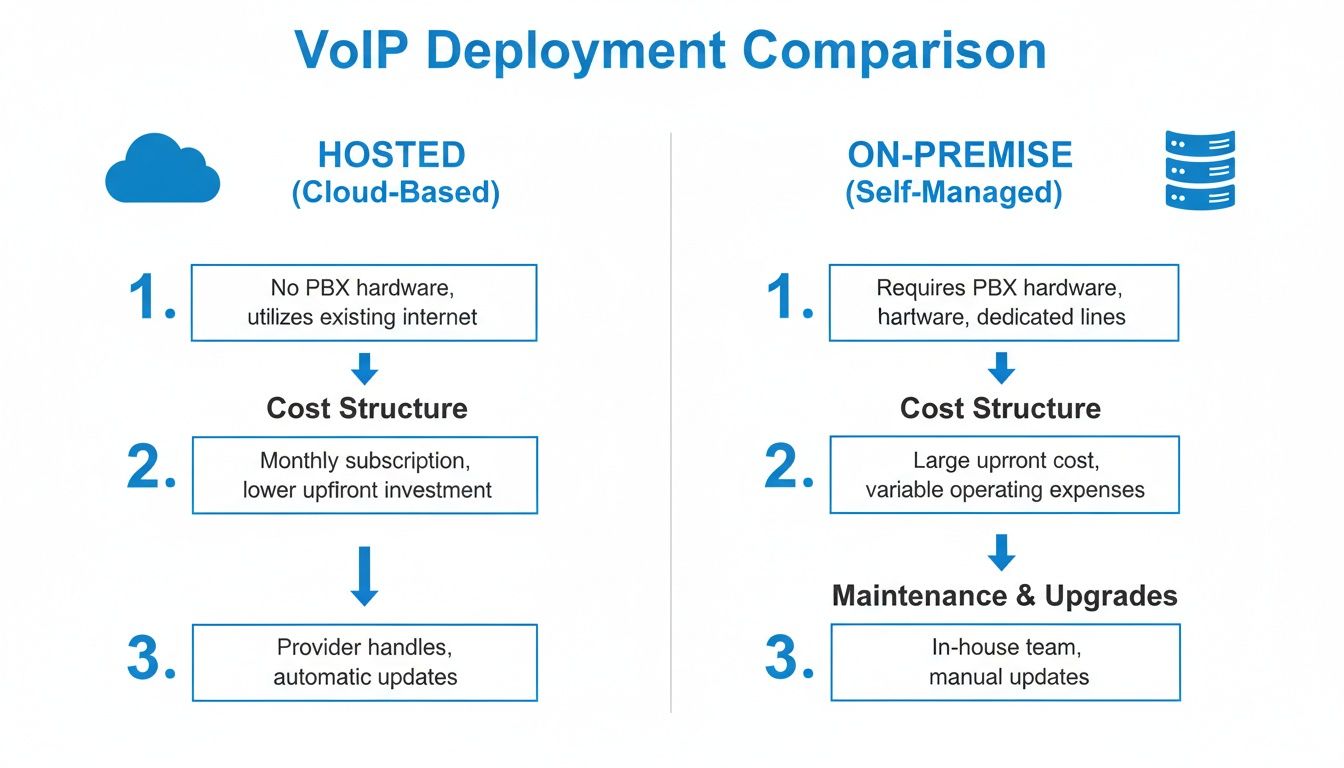
As you can see, most small businesses go with a hosted solution. It gets rid of the hassle of buying and maintaining a bunch of expensive hardware.
4. Plan Your Number Porting
Yes, you can absolutely keep your current business phone number! The process is called "number porting," and your new provider will handle all the technical stuff for you.
There is one golden rule here: do not cancel your old phone service until the port is 100% complete. If you cancel too early, you could lose your number for good. Your new VoIP provider will give you an exact date for the switch.
5. Design Your Call Flows
This is the fun part where you get to customize the system for a great customer experience. Map out exactly how you want incoming calls to be handled.
Should they go to an auto-attendant first ("Press 1 for Sales…")? Should they ring a whole group of people at once? What happens if nobody answers? Figuring this out ahead of time makes every caller's experience professional and efficient.
6. Train Your Team for Success
A new VoIP system is only as good as the people using it. Make sure to schedule a training session for your team before the official go-live date.
Walk everyone through the basics: making and transferring calls, using the mobile app, and setting up voicemail. A little time spent on training now ensures everyone is confident from day one and gets the most out of the new tools.
A well-planned transition isn't just about technology; it's about people. Ensuring your team is comfortable and proficient with the new system is the single biggest factor in a successful rollout.
7. Go Live and Monitor Performance
On launch day, the switch will happen. Your provider should be on standby to help with any immediate questions or issues. For the first few days, keep a close eye on call quality and ask your team for feedback.
If you're ready to make the move, a good VoIP systems installation guide can offer extra hands-on help. Following this structured plan guarantees your transition is not just seamless, but a strategic success for your business.
Why Your Internet Is the Foundation for Great Calls
Here's a simple truth about VoIP: its success hinges entirely on the quality of your internet connection.
Think of it like this: your VoIP calls are high-performance race cars, and your internet is the highway they drive on. If that highway is a bumpy, congested back road, you’re in for a frustrating ride full of choppy audio, annoying delays, and dropped calls. But a fast, stable connection is a wide-open superhighway, ensuring every word arrives instantly in crystal-clear quality.
Without that solid foundation, even the best voip solutions for small businesses will fall flat.
This isn't some experimental new tech; it's a proven global standard. The VoIP market is already valued at over $160 billion worldwide and is projected to blast past $349 billion by 2034. A huge part of that growth comes from businesses just like yours, with over 60% of SMEs now using VoIP for their communications. It’s clear that VoIP is a trusted, go-to solution for modern businesses.
Understanding Key Internet Metrics
To make sure your calls are flawless, you need to know what makes an internet connection good for VoIP. A few key performance metrics directly impact how professional you sound on every call.
-
Bandwidth: This is the size of your internet "highway." More bandwidth means more data—like voice and video—can travel at once without causing a traffic jam.
-
Latency: This is the time it takes for data to travel from your office to the person you're talking to. For real-time conversations, low latency is critical to avoid those awkward pauses and people talking over each other.
-
Jitter: This measures how consistently your data flows. High jitter is like an unpredictable driver on the road, causing bits of voice data to arrive out of order. The result? Garbled or robotic-sounding audio.
A true business-grade connection actively manages all three, making sure your voice traffic always gets top priority on the data highway.
The Critical Role of Symmetrical Speeds
For VoIP, one metric stands above all others: symmetrical speeds. This simply means your upload speed is just as fast as your download speed. Most residential internet plans give you fast downloads but crawl when it comes to uploads, and that's a huge problem for any two-way communication.
A phone or video call is a constant two-way street of data. You are simultaneously sending (uploading) and receiving (downloading) voice data. If your upload speed can't keep up, your voice will sound choppy to the other person, even if you can hear them perfectly.
This is exactly where fiber internet shines as the undisputed champion for business communication. A dedicated fiber internet connection for your small business provides the powerful symmetrical speeds and low latency you need for flawless calls, seamless video conferences, and quick file transfers, keeping your operations running smoothly and professionally.
Frequently Asked Questions About Business VoIP
Switching your phone system is a big decision, so it's natural to have a few questions. We’ve put together clear, direct answers to the things business owners ask us the most. Think of this as the final check-in to give you the confidence to make the move.
From keeping your number to keeping your calls secure, let's cover the essentials.
Can I Keep My Existing Business Phone Number?
Yes, absolutely. The process is called "number porting," and it’s a standard, reliable part of setting up VoIP service. Your new provider will handle the entire transfer for you, moving your number over from your old phone company.
Here’s the most important rule: do not cancel your current phone service until the porting process is 100% complete. If you cancel too early, you could lose your number for good. A quality provider will manage the timeline to make sure there's zero downtime for your business.
What Kind of Internet Speed Do I Really Need?
This might surprise you, but VoIP quality is less about raw speed and more about a stable and reliable connection. That's exactly why a business-grade fiber internet connection is the gold standard for VoIP.
Fiber gives you low latency and symmetrical speeds (meaning your upload speed is as fast as your download speed), which is critical for clear, two-way conversations. It prevents annoying issues like jitter and lag, ensuring your calls sound crystal-clear even when your team is busy with other online tasks.
Your phone system is a critical business tool—its performance is a direct reflection of your professionalism. Investing in a stable, business-grade internet connection is the single most important thing you can do to guarantee a great VoIP experience.
Is a VoIP Phone System Secure for Business?
It certainly is. Modern VoIP platforms are built with security as a top priority. Good providers use strong encryption—like TLS and SRTP—to scramble your call data as it travels over the internet, protecting your conversations from anyone trying to listen in.
With a hosted VoIP solution, you get an extra layer of security. The provider’s expert team manages all the security patches, network monitoring, and threat detection around the clock. This takes a huge security burden off your plate.
Do I Have to Buy Special New Phones?
Not always. One of the best things about VoIP is how flexible it is. You have a few options, and you don't always need to buy new hardware.
- Softphones: These are apps that turn any computer or smartphone into a full-featured business phone. Just plug in a headset and you're ready to go.
- IP Phones: If you and your team prefer a traditional desk phone, you can get modern IP phones that plug straight into your internet connection instead of a phone jack.
- Adapters: In some cases, a simple adapter can connect your current analog phones to your new VoIP service.
Many providers, including us, offer affordable options to rent or buy phones that come pre-configured and ready to use. We make the hardware part simple.
Ready to upgrade to a phone system that saves you money and gives your team the tools they need to succeed? Premier Broadband delivers crystal-clear hosted VoIP solutions built on our 100% fiber network. Get a quote today and discover just how easy it is to modernize your business communications.