
Think of your business phone service like your favorite streaming service. You don't need a massive DVD collection taking up space in a closet; you just connect to the internet and get everything you need on demand. That’s a cloud phone system in a nutshell. It ditches the old hardware and delivers a modern, flexible phone service right over your internet connection.
The Modern Shift Away from Traditional Hardware
For years, business phones meant one thing: a tangled mess of wires in a closet connected to a big, clunky box called a PBX (Private Branch Exchange). This on-premise system was a major headache. It cost a fortune to buy, was a nightmare to maintain, and offered zero flexibility. Want to add a new employee? You had to call a technician to physically run new lines, a slow and expensive process.
A cloud phone system flips that entire model on its head. It takes the "brain" of your phone system—that PBX—and moves it into highly secure, off-site data centers managed by a provider like us. Your team then connects to this powerful system using your existing internet connection, not old-fashioned copper phone lines. This is why you'll often hear it called hosted VoIP (Voice over Internet Protocol).
This isn't just a minor upgrade; it's a completely new way of thinking about business communication. It unlocks a level of freedom and power that was unimaginable with the old hardware, turning your phone service into a true communications hub.
What This Means for Your Business
By moving your phone system to the cloud, you get immediate benefits that outdated hardware simply can't match. The whole system is built for the way businesses work today, where being quick and adaptable is everything.
This shift is more than just a passing trend. The global market for cloud telephony is set to explode from USD 26.69 billion in 2025 to USD 42.60 billion by 2030. That's a clear signal that businesses everywhere are ditching their old systems for something better. You can read the full research on cloud telephony market growth to see just how fast this change is happening.
To make things simple, here's a quick breakdown of what a cloud phone system is all about.
| Cloud Phone System at a Glance | |
|---|---|
| Concept | Simple Explanation |
| Architecture | Your phone system's "brain" lives in a secure data center, not your office. |
| Connection | Calls are made and received over your high-speed internet line. |
| Hardware | No bulky on-site PBX server needed. Just phones and your internet router. |
| Management | Everything is controlled through a simple online web portal or app. |
| Billing Model | A predictable, flat monthly fee per user, just like a subscription. |
Essentially, a cloud phone system gives you:
- Location Independence: Your business number is no longer chained to a desk. Employees can make and take calls from a physical desk phone, a software-based phone on their laptop, or a mobile app, keeping them connected wherever they work.
- Predictable Costs: Instead of a massive upfront cost for hardware, you pay a simple monthly fee for each user. This makes budgeting a breeze and is much easier to manage than a large capital expense.
- Effortless Scalability: Need to add five new team members for a busy season? It takes just a few clicks in your online portal. If things slow down, scaling back is just as simple, so you're only ever paying for what you actually use.
A cloud phone system liberates your business from the chains of physical hardware. It transforms your communication platform into a powerful, flexible tool that fuels growth, supports remote work, and improves customer conversations—all without the IT headaches.
How a Cloud Phone System Actually Works
To really get what a cloud phone system is, it helps to pop the hood and see what makes it all tick. The secret sauce is a technology called Voice over Internet Protocol (VoIP). The simplest way to think about VoIP is as a digital translator for your voice.
When you speak into your phone, VoIP takes those sound waves and instantly converts them into tiny digital packets of data. These packets are then zipped securely across the internet, a lot like how you’d send an email or load a website. This is a huge change from old-school landlines, which needed dedicated copper wires to carry your voice as a clunky analog signal.
This picture helps visualize the path your call takes—starting in your office, traveling through the internet, and connecting to all sorts of devices.
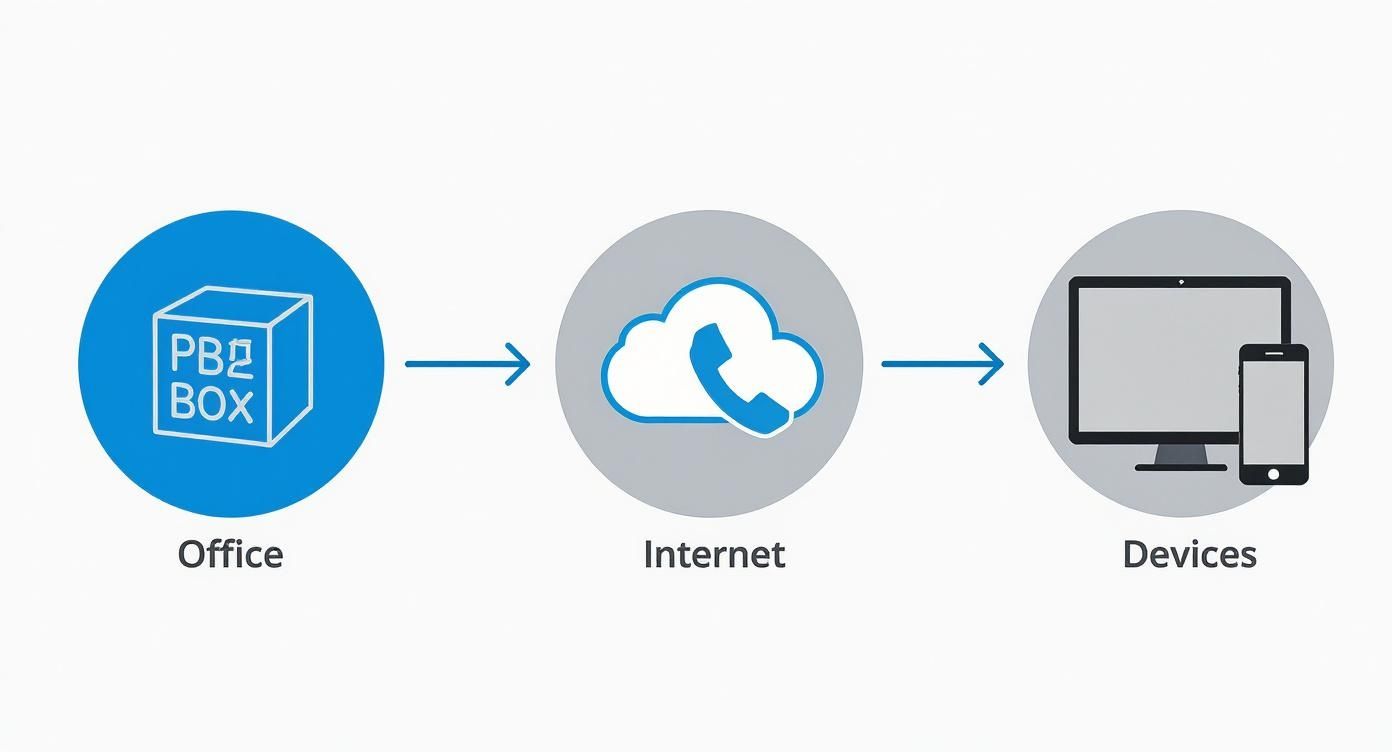
What this shows is how the provider's data center does all the heavy lifting, not some dusty box in your server closet.
The Journey of a Digital Phone Call
The moment you dial a number—whether from a desk phone, a laptop app, or your smartphone—the call begins its digital journey. Those little data packets containing your voice travel from your device, through your local network, and out to the internet over your broadband connection.
This is exactly why a solid, stable internet connection is so critical, especially one powered by fiber optics. A high-quality connection from a provider like Premier Broadband makes sure those data packets arrive quickly and in the right order. The result? Crystal-clear call quality with no frustrating delays. Any lag or choppiness you hear on a bad connection is usually because those packets are getting lost or slowed down along the way.
From there, the packets race to your cloud phone system provider's secure data centers. These high-tech facilities are the heart of the whole operation.
The Brain of the Operation: The Hosted PBX
Inside the provider's data center, powerful software known as a hosted PBX gets to work. It reads the destination address on your voice data packets and smartly routes them to the right person, all in a fraction of a second.
This system figures out the best path for the call, whether it's going to:
- Another user on the same cloud system: The call is routed directly over the internet to their device.
- A traditional landline or mobile number: The call is smoothly handed off to the Public Switched Telephone Network (PSTN)—the classic phone network we’ve all used for decades.
This handoff between the modern VoIP world and the traditional phone network is managed by something called SIP trunking. Think of it as a digital bridge connecting the two. For a deeper dive on this, you can learn more about how SIP trunks work in our guide.
Ultimately, the hosted PBX is the command center that handles everything, from routing calls with an auto-attendant to sending voicemail transcriptions to your email. Because this "brain" lives in the cloud, your provider handles all the updates and adds new features automatically. Your system always stays current without you ever lifting a finger.
Traditional PBX vs Modern Cloud Phone Systems
To really appreciate what a modern cloud phone system brings to the table, it helps to look at what it replaced: the old-school on-premise PBX. For decades, that bulky box in the server closet was the only way for a business to handle calls. But as the world moved online, its limitations became impossible to ignore. The difference isn't just about technology; it's a completely different way of thinking about cost, flexibility, and features.
Let's draw a clear line in the sand. One approach is stuck in the past, tied down by physical hardware and rigid rules. The other is built for how we work today, offering an agility that legacy systems just can't touch.
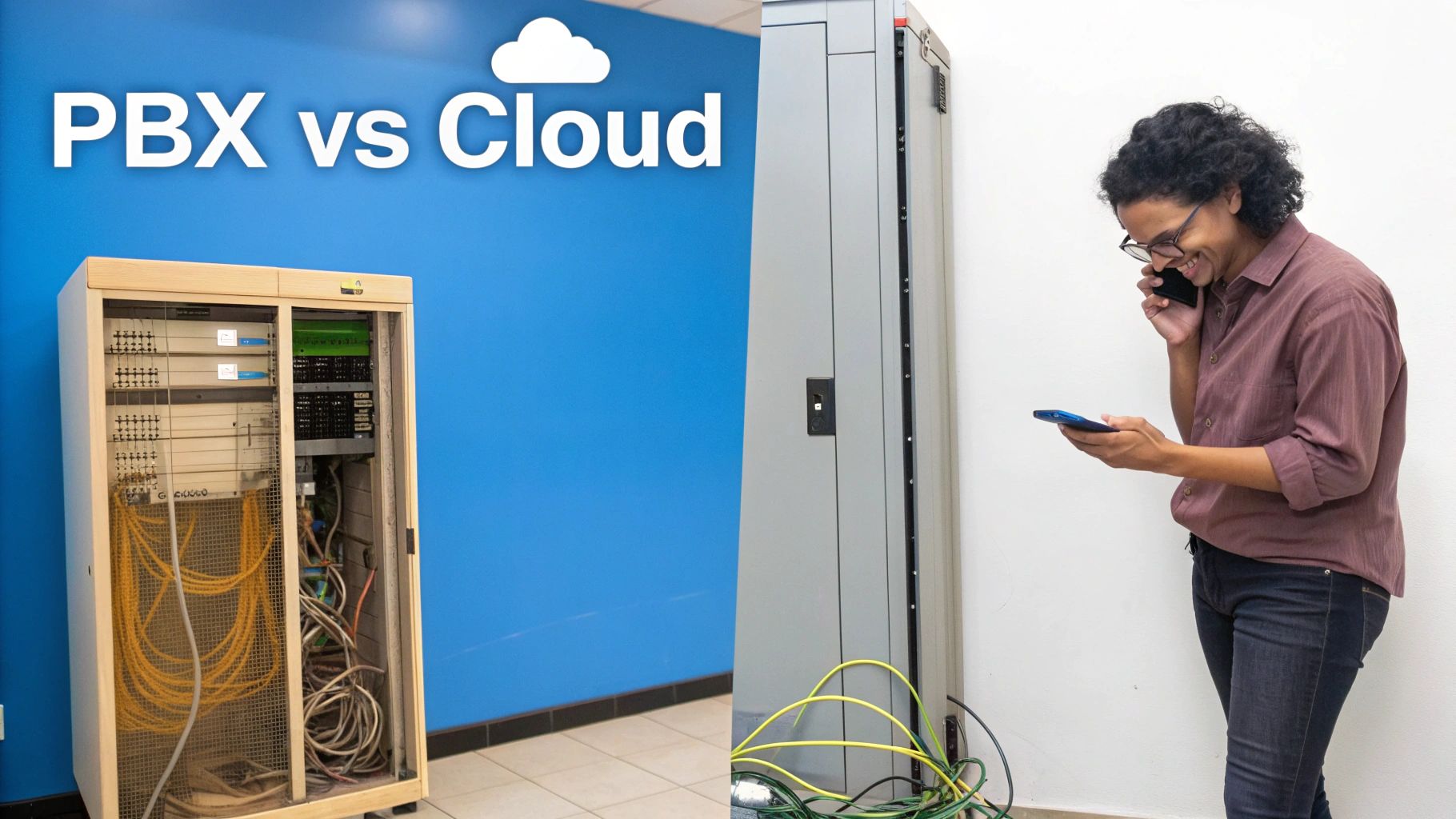
To really break down the differences, a side-by-side comparison is the best way to see how these two systems stack up in the real world.
On-Premise PBX vs. Cloud Phone System Feature Comparison
| Feature | Traditional On-Premise PBX | Modern Cloud Phone System |
|---|---|---|
| Initial Cost | High upfront capital expense for hardware, installation, and licensing. | Low to zero upfront cost. Pay-as-you-go subscription model. |
| Scalability | Slow and expensive. Requires technician visits and new hardware to add lines. | Instant. Add or remove users in minutes through an online portal. |
| Maintenance | Your responsibility. You handle all repairs, updates, and security. | Handled by the provider. Updates and security are automatic. |
| Remote Work | Not designed for it. Tied to the physical office location. | Built for it. Access your full phone system from anywhere on any device. |
| Features | Basic calling features are standard. Advanced tools cost extra. | Rich feature set included (Auto-Attendant, Mobile Apps, Voicemail-to-Email). |
| Reliability | Dependent on your office power and internet. A single point of failure. | High uptime with geo-redundant data centers. Calls can be rerouted automatically. |
As you can see, the shift from PBX to the cloud is about more than just getting rid of a closet full of wires. It’s about creating a more resilient, cost-effective, and agile communications hub for your business.
Cost Structure and Investment
The first thing most businesses notice is the price tag. With a traditional PBX, you're looking at a huge upfront capital expenditure. You have to buy the main server unit, all the desk phones, and pay for the wiring, which can easily run into thousands of dollars before you even make your first call.
And it doesn't stop there. You're also on the hook for ongoing costs like professional installation, recurring maintenance contracts, and surprise bills whenever a technician has to come out for a repair or an upgrade.
A cloud phone system flips that model on its head. Instead of a massive one-time payment, you pay a predictable, flat monthly fee per user. This operational expense (OpEx) model is much friendlier to your budget and keeps your cash free for growing other parts of your business. All the maintenance, security, and updates are handled by the provider behind the scenes—no extra charge.
Scalability and Business Agility
Businesses are always changing. You hire new people, you might have a slow season, or you pivot to a new service. A traditional PBX is famously bad at keeping up. Adding a new employee means calling a technician, paying them to run new physical phone lines, and manually configuring the hardware. It's slow, disruptive, and costs money every time.
This is where a cloud system just makes sense. Need to add a new salesperson for a seasonal rush? You can add a new user through a web browser in about five minutes. If you need to scale back down, it’s just as easy.
A cloud system scales with you, not against you. It gives you the freedom to adapt to business changes instantly, so you only ever pay for what you actually use.
This kind of flexibility is a game-changer for growing businesses. You can expand your team or even open a new office without the headache and expense of a massive phone system overhaul.
Feature Set and Capabilities
An on-premise PBX will give you the basics: call holding, transferring, and voicemail. But if you want anything more advanced, get ready to pay for expensive add-on hardware modules or complicated software licenses. Trying to connect it to modern tools like your CRM is often a non-starter.
Modern cloud phone systems, on the other hand, come loaded with powerful features right out of the box, all included in your monthly plan. These aren't just gimmicks; they're tools designed to make your team more productive.
- Auto-Attendant: Your virtual receptionist that professionally greets callers and sends them to the right person or department, 24/7.
- Ring Groups: Rings a whole team's phones at once, so the first available person can grab the call. No more missed opportunities.
- Voicemail-to-Email: Sends voicemail recordings and transcriptions straight to your inbox, so you can check messages from anywhere.
- Mobile and Desktop Apps: Turns any smartphone or computer into your business phone, making remote work completely seamless.
Maintenance and Remote Work Readiness
With a traditional PBX, you are the IT department. When it breaks, it’s your problem. You're responsible for maintaining the hardware, installing updates, and patching security holes. It's a huge time sink. Worse, a PBX chains your communications to one physical building, making it a terrible fit for today’s remote and hybrid teams.
A cloud phone system provider takes all of that off your plate. They manage the servers, guarantee the uptime, and roll out new features and security patches automatically. This frees up you and your team to focus on your actual business.
Most importantly, because the system lives in the cloud, it's ready for remote work by design. An employee working from home in another state has the exact same features and access as someone sitting at headquarters. That unified experience is essential for keeping modern, distributed teams connected.
Key Features That Drive Business Growth
A cloud phone system is so much more than a replacement for that old landline on your desk. It’s a powerful engine for productivity and a complete toolkit for smarter, more efficient operations. The features that come packed in aren't just bells and whistles; they’re practical tools built to solve real business challenges, improve customer interactions, and help your team get more done.
Moving past a simple dial tone means unlocking a whole suite of capabilities that can completely change how you communicate. These systems are designed to handle routine tasks automatically, give you valuable insights into your operations, and keep your team connected, no matter where they are.
Core Productivity and Automation Tools
At its heart, a cloud phone system takes the manual work that slows your team down and puts it on autopilot. This automation ensures you maintain a professional image and handle every call efficiently, freeing up your staff to focus on what really matters—like growing the business—instead of just playing switchboard operator.
Here are a few key automation features you'll find:
- Auto-Attendant: Think of this as your virtual receptionist. It greets every caller with a professional, custom menu ("Press 1 for Sales, Press 2 for Support") and gets them to the right person or department instantly, 24/7, without anyone having to lift a finger.
- Ring Groups: This simple but incredibly effective tool rings multiple phones at once, like everyone on your sales team. The first person available can answer, which drastically cuts down on missed opportunities and long hold times for your customers.
- Visual Voicemail & Voicemail-to-Email: No more dialing in to check your messages. Voicemails are automatically transcribed into text and sent right to your email inbox. You can scan messages, prioritize callbacks, and share information without ever picking up the phone.
These features work together to create a smooth, professional experience for your customers while making your team's day-to-day work a whole lot easier.
Fostering Collaboration with Unified Communications
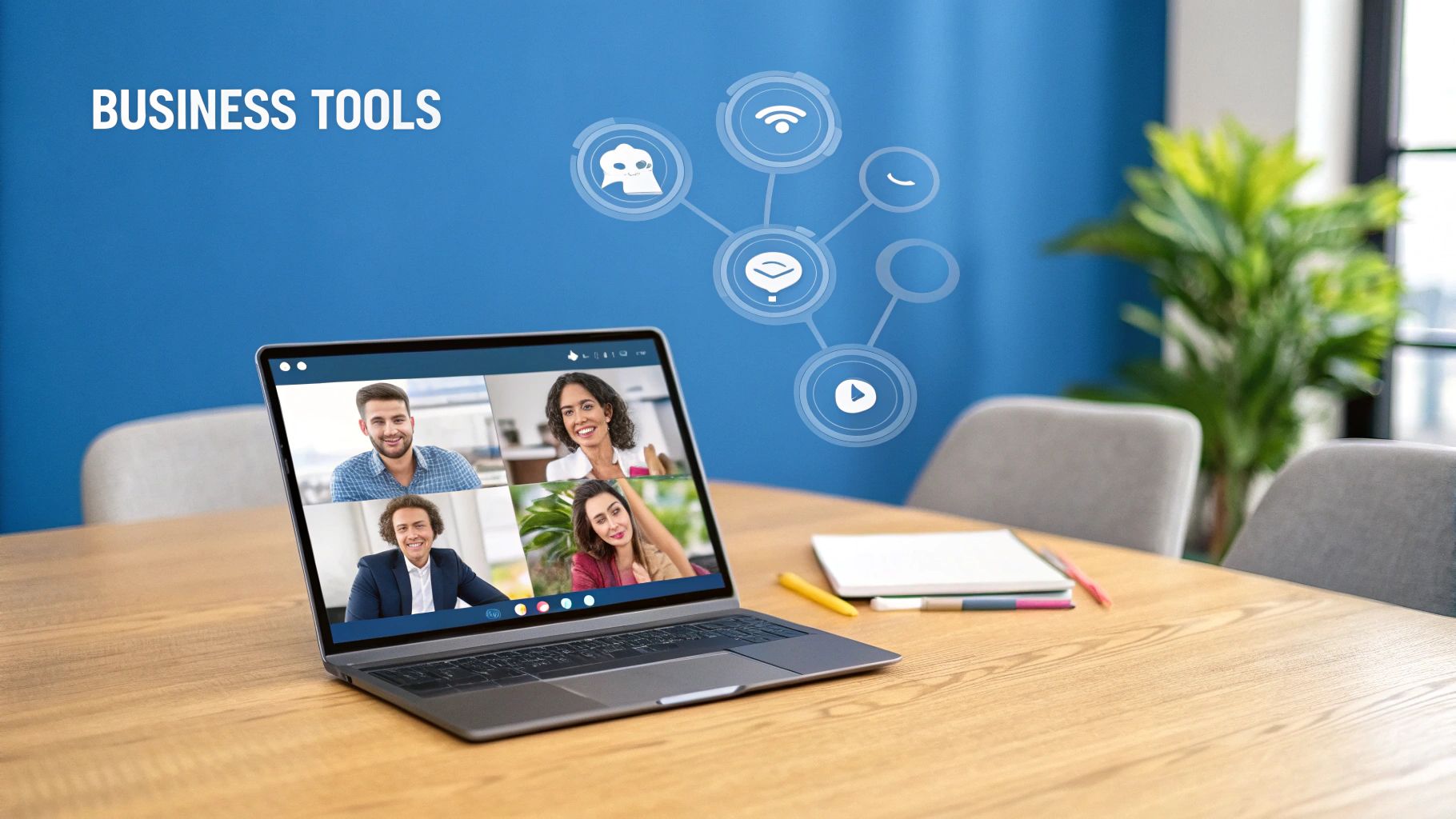
Modern business happens everywhere, not just in a single office. A cloud phone system often serves as the foundation for what’s known as Unified Communications as a Service (UCaaS). It’s a fancy term for bringing all of your communication channels—voice, video, and messaging—into one simple, cohesive application.
You can learn more about how this all connects in our detailed guide on what UCaaS is and how it benefits businesses.
UCaaS integrates essential tools like:
- Video Conferencing: Host team meetings, client presentations, or virtual training sessions with built-in video, screen sharing, and recording capabilities.
- Team Messaging: Create dedicated chat channels for specific projects or departments. It’s perfect for asking quick questions, sharing files, and collaborating in real-time without clogging up your email inbox.
- Presence Status: See at a glance if a coworker is available, on a call, or in a meeting. This way, you know the best way to reach them without interrupting their workflow.
By breaking down communication silos, these unified features ensure that your team can collaborate effectively, whether they are in the next cubicle or working from home offices across the country.
Driving Growth with Data and Integrations
Here's where things get really interesting. Perhaps the most powerful part of a cloud phone system is its ability to turn your communication data into real business insights. Instead of just making and taking calls, you can analyze them to improve team performance and boost customer satisfaction.
Advanced systems give you access to analytics dashboards that track key metrics like call volume, wait times, and call duration. Even better, you can integrate your phone system with other business tools, like your Customer Relationship Management (CRM) software. Imagine a customer calls, and their entire history instantly pops up on your agent's screen—that’s the kind of personalized service that builds loyalty.
These capabilities are where the true ROI of a cloud system becomes clear. For instance, cloud-based contact centers reduce call handling costs by an average of 15% while creating new revenue streams. As technology evolves, so do the possibilities. To see what's on the horizon, it's worth exploring how AI in telephony is being integrated into these platforms. This shift turns your phone system from a simple utility into a strategic asset for growth.
Is a Cloud Phone System Right for Your Business?
Choosing a new phone system isn't a one-size-fits-all decision. The best system is one that solves the real-world problems your business runs into every day. By looking at a few common business scenarios, you can get a feel for how cloud phone technology adapts to different needs, helping companies of all sizes work smarter.
A cloud phone system is a game-changer for certain types of businesses. Let's dig into a few profiles and see where yours might fit.
The Growing Small Business
For a small business trying to compete with bigger companies, perception is everything. A cloud phone system gives you that polished, professional image without the huge price tag or the need for a dedicated IT team. You get instant access to features like an auto-attendant to greet and route callers, plus a business number that rings right on your cell phone so you never miss a client call.
This kind of setup lets you grow on your own terms. Need to add a new employee? Forget scheduling a costly technician. You can add a new line yourself in just a few minutes through a simple online portal. That kind of agility is exactly what you need to manage growth without draining your budget. If you're looking for a place to start, checking out the top VoIP services for small businesses is a great first step.
The Modern Remote or Hybrid Company
With teams spread out across different cities and home offices, just keeping everyone connected can be a challenge. A cloud phone system completely removes those geographical barriers, creating a single, unified communications hub for everyone. An employee working from another state gets the exact same features as someone at headquarters, using the same business number from their laptop or a mobile app.
A cloud phone system ensures communication continuity for distributed teams. It enables users to make and receive calls from any internet-connected device, which is a key strategic advantage in modern work environments.
This unified platform makes your entire operation more agile. Team members can transfer calls, hop on conference bridges, and work together just as if they were all in the same room. For a deeper dive on this flexibility, you can discover key insights about the cloud telephony market and see how it’s shaping remote work.
The Customer-Centric Business
If your success depends on providing amazing customer service, a cloud phone system gives you the tools to make every single interaction better. Features like call recording let you review conversations for quality control and training, helping your team hit a high standard every time.
You also get powerful analytics dashboards that offer deep insights into your call patterns. You can track key metrics like:
- Call Volume: Figure out your busiest hours so you always have enough staff on hand.
- Wait Times: Find the bottlenecks that might be frustrating your customers.
- Call Duration: Analyze how long conversations are taking to boost efficiency and spot complex issues.
Using this data, you can stop just reacting to problems and start being proactive. These tools give you a crystal-clear picture of the customer experience, arming you with the information to make smart decisions that build loyalty and keep people happy. Your phone system becomes more than just a utility—it becomes a core part of building strong customer relationships.
Making the Switch to a Cloud Phone System
Moving your business phone service to the cloud might feel like a big project, but with the right partner, it's a surprisingly straightforward process. A good plan is all it takes to ensure a smooth switch with zero downtime, helping your team get comfortable with the new system right away.
It all starts with a simple discovery phase. This is where we work with you to understand exactly what your business needs. How many people need a phone line? Which features are must-haves for your day-to-day operations? This first step makes sure the solution is the perfect fit from the very beginning.
Next, a quick check of your network confirms your internet connection is ready to handle crystal-clear calls. A stable, high-speed connection is the bedrock of a great VoIP experience, which is why a fiber-optic network is the ideal foundation for reliability.
Planning a Seamless Transition
Once we know what you need and have confirmed your network is good to go, the real planning starts. We map out a detailed implementation strategy to make the switch feel completely seamless for you and your customers. This plan covers everything from creating user accounts to setting up key features like your auto-attendant and call routing.
A huge piece of this puzzle is number porting. This is simply the process of moving your existing business phone numbers over to the new cloud system.
Don’t worry—you won't lose your numbers. A carefully managed porting process means your customers will never even know a change was made, so there's no disruption to your business. You get to keep the numbers your clients already know and trust.
Throughout this stage, we handle all the technical details behind the scenes. We coordinate the number porting, set up the system to your exact needs, and make sure everything is prepped and ready for a smooth launch day.
Onboarding and Empowering Your Team
With the technical side handled, the final step is getting your team comfortable and confident using their new tools. Great onboarding and training are key to getting the most out of your investment. This is more than just showing people how to answer a call; it’s about unlocking powerful new tools like the mobile app, visual voicemail, and easy conference calling.
A great provider will offer plenty of training resources, such as:
- Live Training Sessions: Guided walkthroughs for your entire team.
- On-Demand Guides: Easy-to-find documents and video tutorials.
- Dedicated Support: A direct line to experts who can help with any questions.
This hands-on support ensures everyone is ready to take full advantage of the system's features from day one. Sometimes, router settings can interfere with VoIP traffic, but a good provider can help pinpoint and fix these issues. To get ahead of potential roadblocks, you can learn more about common network configurations like what SIP ALG is and why it matters for top-notch call quality.
Frequently Asked Questions About Cloud Phone Systems
Switching up your business communications is a big move, and it’s natural to have questions. Getting a handle on security, reliability, and the nuts and bolts of the process is key to feeling good about your decision. Let's tackle some of the most common questions we hear from business owners looking into a cloud phone system.
This isn't just about plugging in new phones; it’s a modern way of operating built to solve the headaches of old, hardware-based systems.
Is a Cloud Phone System Secure?
Absolutely. Security is a huge deal for any business, and good cloud phone providers build their platforms with serious protection from the ground up.
Your calls and data are shielded with multiple layers of security, including:
- Data Encryption: Your voice data is scrambled as it travels over the internet, making it totally unreadable to anyone who might try to listen in.
- Secure Data Centers: The provider’s servers are kept in high-security facilities with both physical guards and digital safeguards, including 24/7 monitoring.
- Compliance Standards: Many providers meet strict industry compliance standards, so you can be confident your communications and customer data are handled the right way.
What Happens If My Internet Goes Down?
This is one of the most important questions, and modern cloud systems are built for exactly this scenario. Unlike an old landline that just goes dead, a cloud phone system has smart failover features to make sure you never miss an important call.
Your business doesn’t stop when the internet blinks. With automatic call forwarding, all incoming calls can be instantly rerouted to cell phones or another location, keeping you in business.
Even if your local office loses its connection, your customers won't know the difference. Your auto-attendant will keep answering, and your team can take calls right on their mobile devices using the system's app. You'll maintain a professional image, no matter what.
Can I Keep My Current Business Phone Number?
Yes, you definitely can. The process of moving your existing phone number from your old provider to the new cloud service is called number porting. It's a standard, simple procedure, and your new provider will handle all the technical work for you.
This is a huge relief for most businesses. You get to keep the number your customers already have saved, so there's no need to reprint business cards, update your website, or change your advertising. The switch is managed to be completely seamless with zero downtime.
How Is a Cloud Phone System Priced?
One of the best parts is the simple and predictable pricing. Instead of a huge upfront cost for bulky hardware, a cloud phone system works on a subscription basis. You pay a flat, predictable monthly fee for each user. This single price typically includes all the features, ongoing maintenance, automatic software updates, and customer support, so you won’t get hit with surprise bills.
Ready to bring your communications into the modern era with a system that's secure, reliable, and ready to grow with you? The team at Premier Broadband can set you up with a hosted VoIP solution powered by our 100% fiber network, giving your business the crystal-clear connection it deserves. Explore our business voice solutions today.