
Think of managed network services as handing over the keys to your network to a team of experts. They take complete responsibility for your internet's performance, security, and day-to-day reliability. It’s the difference between a DIY project and a fully supported, professional service.
Basically, it's like having a dedicated tech crew for your digital life, making sure everything runs perfectly 24/7.
Your Network on Autopilot
Let's use an analogy. Imagine your internet connection is a high-performance car. With a standard internet plan, you own the car, but you’re also the full-time mechanic. You're on the hook for every tune-up, security check, and roadside repair—which is a huge hassle when you just want to drive. That's an unmanaged network in a nutshell; you handle everything from slow speeds to fighting off security threats.
Managed network services flips that script entirely. Instead of being the mechanic, you hire a professional pit crew. This team—your managed service provider—takes total ownership of keeping your network in peak condition.
They're always on the lookout for problems before they affect you, running routine maintenance to keep things fast, and building a strong security shield around your connection. This frees you up to focus on what actually matters, whether that’s running your business, nailing a remote presentation, or just enjoying a glitch-free smart home.
From Hands-On Headaches to Hands-Off Peace of Mind
The real difference comes down to responsibility and expertise. With a typical unmanaged network, the burden of upkeep and security lands squarely on your shoulders. You’re usually stuck reacting to problems—like a dropped video call or a network slowdown—after they’ve already caused a headache.
A managed service, on the other hand, is proactive by design. Experts use powerful tools to watch over your network around the clock, catching issues before you even notice them. This model is a game-changer for businesses that need to understand their options, like exploring a Managed Network Edge to boost their business internet performance.
By outsourcing your network management, you get access to specialized knowledge and enterprise-grade tech that would be incredibly expensive and difficult to manage on your own. It's a strategic move from constantly putting out fires to future-proofing your connectivity.
Unmanaged vs Managed Networks at a Glance
The value really clicks when you see the two approaches side-by-side. One requires constant technical know-how and vigilance, while the other delivers reliability as a hands-off service.
| Feature | Standard (Unmanaged) Network | Managed Network Services |
|---|---|---|
| Responsibility | You're responsible for all setup, maintenance, and troubleshooting. | The provider manages all the technical details for you. |
| Security | You must configure and update your own firewall and security. | Proactive, expert-managed security is built-in. |
| Monitoring | Reactive; you only know there's a problem when something breaks. | Proactive; 24/7 monitoring spots issues before they impact you. |
| Support | Standard customer support, usually just for outages. | Dedicated technical support for performance and optimization. |
| Cost | Lower monthly fee, but you risk unexpected troubleshooting costs. | A predictable monthly fee that covers all management and support. |
This shift allows you to stop treating your network like another complex system you have to manage and start seeing it as the dependable utility it should be.
A Look Under the Hood: The Core Components of a Managed Network
To really get what managed network services are all about, you have to look past the surface. It's more than just a "hassle-free" connection. These services are built on a few key pillars that all work together to keep your digital life—at home or at the office—running like a well-oiled machine.
The best way to think about it is choosing between being your own IT expert or hiring a dedicated, professional crew.
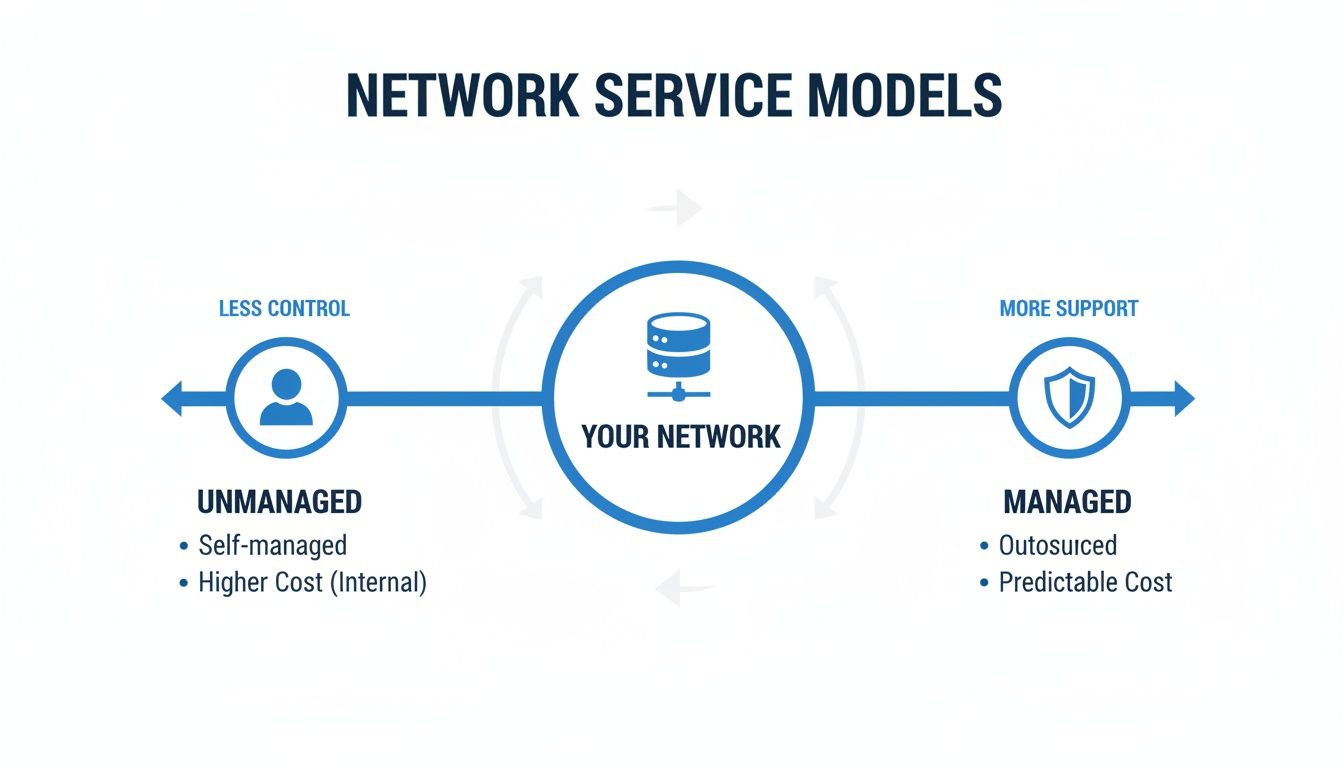
As you can see, the managed approach puts a professional provider in the driver's seat, which leads to more predictable costs, better performance, and much stronger security.
Proactive Monitoring: The 24/7 Watchtower
The foundation of any managed service is 24/7 proactive monitoring. This isn't about sitting around and waiting for something to break; it's about spotting trouble on the horizon and stopping it before it ever reaches you. Think of it as a watchtower, always staffed, always vigilant.
Your provider uses sophisticated tools to keep a constant eye on your network's health. They’re looking for performance dips, weird traffic patterns, or signs that a piece of hardware is about to give up.
When an issue pops up—often long before you'd ever notice a lag—an alert is triggered automatically. This lets technicians jump in and fix the problem, turning what could have been a total outage into a minor blip that you never even felt.
Comprehensive Management: The Expert Maintenance Crew
If monitoring is the watchtower, then comprehensive management is the hands-on maintenance crew. This team handles all the behind-the-scenes work that keeps your network running at its best—the kind of stuff that’s easy to forget about in a DIY setup.
This management layer covers:
- Device Management: Your provider takes care of all the network gear—routers, switches, access points, you name it. They make sure everything is configured perfectly to work together.
- Performance Optimization: The team is always analyzing traffic and performance data to find and eliminate bottlenecks. This ensures you’re consistently getting the speed and stability you pay for.
- Preventative Maintenance: This means regularly updating firmware, applying security patches, and running health checks to head off future problems before they start.
Robust Security: Your Digital Fortress
Today, you can't separate network management from network security. A huge piece of the puzzle is building a digital fortress around your connection to shield you from the endless list of online threats.
This goes way beyond a simple firewall. A managed service provider (MSP) deploys and manages a whole suite of security tools that work in tandem to keep your data locked down tight.
A provider's security services are much more than basic antivirus. They often include advanced threat detection, intrusion prevention, and content filtering that can block malicious websites before they even have a chance to load.
This integrated defense is non-negotiable for modern connectivity. To see how it all comes together, you can learn more about specific managed network security solutions that protect businesses and homes. This proactive security is one of the biggest wins you get over a standard internet plan.
Advanced Tools: The Smart Navigation System
Finally, many managed network services bring powerful technologies to the table that used to be reserved for giant corporations. One of the most important is Software-Defined Wide Area Networking (SD-WAN).
Think of SD-WAN like a smart navigation app—like Waze or Google Maps—but for your internet traffic. If a business has multiple internet connections, say fiber and a 4G LTE backup, SD-WAN intelligently analyzes all the available routes in real-time.
It then automatically sends your data over the fastest, most reliable path at that very moment. If your main fiber line gets a little congested, SD-WAN will seamlessly move your critical video conference or VoIP call over to the backup line without you ever noticing a hiccup. It delivers a level of reliability that’s almost impossible to achieve on your own.
How Managed Networks Benefit Your Home and Business
Knowing what a managed network is helps, but seeing what it can do for you is what really matters. Whether you're steering a growing company or just trying to keep a busy, device-filled home online, the benefits go way beyond a simple speed boost. It's about getting back your time and gaining some much-needed peace of mind.

For any business, a managed network is more than a utility—it's a real strategic asset. Think about it: instead of your IT team spending all day chasing down glitches and putting out fires, they could be working on projects that actually move your business forward. That shift from just reacting to problems to proactively preventing them is a total game-changer.
Advantages for the Modern Business
In business, downtime isn't just an annoyance; it's lost money. Managed services are built to keep you up and running, providing a solid, secure, and flexible foundation for everything your company does.
Here’s what that looks like in practice:
- Fewer Operational Headaches: Handing over network management means you’re offloading all the complicated, tedious tasks—monitoring, updates, security—to a team of experts. This frees up your own people to focus on what they do best.
- A Stronger Security Posture: Cyber threats are always changing, but a managed service gives you a multi-layered defense. Your provider sets up and manages top-tier firewalls, threat detection, and content filtering, dramatically lowering your risk of a data breach.
- Predictable IT Costs: Say goodbye to surprise bills for emergency fixes or new equipment. With a managed network, you pay a flat monthly fee, making it much easier to budget and avoid the financial shocks that come with managing IT yourself.
- Scalability on Demand: As your business expands, your network needs to keep up. A managed provider can scale your services, add new locations, or boost your bandwidth in a snap, without you having to shell out for new hardware or staff.
More and more businesses are catching on. The global managed network services market hit around USD 75.69 billion this year and is on track to more than double. Small and medium-sized businesses are a huge part of that growth, turning to managed services to slash their upfront and ongoing expenses.
Peace of Mind for the Connected Home
These benefits aren't just for the office. With remote work, online classes, and a house full of smart gadgets, a reliable home network is non-negotiable. A managed service delivers that same professional-grade stability and security right to your front door.
For a homeowner, a managed network is like having your own IT expert on call 24/7. It makes sure your home office is as reliable as your corporate one and that your family’s private data stays private.
A huge part of this is beefing up your digital defenses. Following critical network security best practices is something an expert team handles for you, protecting everything from your bank details to your family photos.
For your daily life, this means no more choppy video calls during an important meeting, no more buffering halfway through movie night, and a stable connection that keeps every smart speaker, security camera, and gaming console online. At the end of the day, it’s about making sure your digital life just works—securely and reliably—without you needing a degree in IT.
Seeing Managed Networks in Action
The technical specs are one thing, but seeing how a managed network solves real-world problems is where it all clicks. The true power of this approach really shines when you step away from the theory and look at real situations where expert management saves the day.
Let’s walk through a few scenarios. These stories show how a managed network is so much more than just an internet connection—it’s a complete solution that makes life easier.
The Growing Business and the Instant Expansion
Meet Sarah. She owns a successful local retail shop and is finally ready to open a second location across town. In the old days, this would have been a massive headache. Think ordering new internet lines, hiring IT guys to set everything up, and then spending weeks trying to get the two stores to talk to each other.
With a managed network service, her experience is night and day. She makes one call to her provider, who uses an SD-WAN solution to bring the new branch online fast.
Instead of a drawn-out, complicated project, her new store is connected to the main office’s systems in just a couple of days. The provider handles all the tricky configuration, making sure both locations can securely share inventory and sales data from the moment the doors open. Sarah gets to focus on training her new team, not untangling cables.
The Remote Executive and the Flawless Presentation
Now, let's look at David, a senior executive working from home. He’s about to give a career-defining presentation to the board of directors over a video call. A choppy connection or a frozen screen isn’t just annoying—it could seriously damage his credibility.
His standard home internet was always a bit shaky during busy hours, and that’s a risk he just couldn’t take. By switching to a managed home network, David gets a connection that’s actively fine-tuned for what he needs.
His provider’s system automatically prioritizes his video conference, guaranteeing it has the bandwidth it needs to run smoothly. The 24/7 monitoring even caught and fixed a small ISP issue in his neighborhood hours before his meeting started—a problem he never even noticed. When it was showtime, David delivered his presentation perfectly, without a single glitch.
This is a perfect example of how these services tackle common remote work issues. We actually dive deeper into this in our guide on how Managed Network Edge instantly solves these issues.
The Modern Smart Home That Just Works
Finally, think about the Miller family. Their house is packed with connected gadgets: smart cameras, voice assistants, streaming TVs, and gaming consoles. On their old network, something was always on the fritz. The security camera feed would lag, a smart speaker would drop its connection, or online gaming was a frustrating mess.
The moment they upgraded to a managed network service, the difference was huge. Their provider set up the Wi-Fi to kill any dead zones and intelligently manage all the traffic from their dozens of devices.
Here’s what changed for them:
- Rock-Solid Security: Their smart home is no longer a soft target for hackers. The provider manages a powerful firewall and keeps an eye out for any threats.
- Seamless Entertainment: The kids can play online games with zero lag while their parents stream a 4K movie in the living room, all without a hint of buffering.
- Reliable Automation: All their smart devices—from the doorbell to the lights—stay connected and work instantly, every time.
In every one of these stories, the real hero isn't a piece of equipment. It’s the expert service working behind the scenes. Managed network services deliver the stability and performance that let you focus on what you need to do, knowing your connection has your back.
How To Choose The Right Managed Network Provider
Knowing you need a managed network is one thing; finding the right partner to deliver it is the real challenge. This isn't just about picking an internet plan. It's a major decision that directly impacts your network's performance, your security, and your ability to grow. You have to look past the monthly price and figure out what you're truly getting for your money.
Not all providers are created equal. The best ones act like an extension of your own team, bringing expertise and technology that perfectly match your needs, whether it’s for a busy home office or a sprawling multi-site business. Making the right choice now lays a solid digital foundation for years to come.
Evaluate The Core Infrastructure
The quality of any managed service starts with the physical network it runs on. A provider’s core infrastructure is what dictates the speed, reliability, and future-readiness of your connection. Before you even think about signing a contract, you need to ask some direct questions about their tech.
Is their network built on 100% fiber, or is it a patchwork of older, less reliable copper or coaxial lines? Fiber-optic networks give you symmetrical upload and download speeds, which is a game-changer for everything from video calls to cloud backups. A modern, fiber-first infrastructure isn't just a nice-to-have; it's the bare minimum for a quality managed service.
Scrutinize The Security Suite
Let's be honest—a huge reason to get a managed network is for better security. This is one area where you absolutely cannot afford to cut corners. A trustworthy provider will be upfront and transparent about the layers of security they use to keep you safe from online threats.
Your checklist should include:
- Firewall Management: Do they provide and manage a business-grade firewall, or is that left up to you?
- Threat Monitoring: Is there 24/7 active threat detection and prevention to stop attacks before they ever reach your network?
- Content Filtering: Can they block harmful or inappropriate websites at the network level, protecting every single device connected to it?
- Data Center Security: A top-tier provider will also be able to explain their approach to layered security for data centers, since that's where their core services operate from.
A provider's security shouldn't be a vague promise on a website. It needs to be a clear, comprehensive suite of tools and services that build a digital fortress around your connection—all managed by their experts.
Assess Support And Responsiveness
When something eventually goes wrong—and it will—the quality of your provider's support team is what matters most. You need a partner who is easy to reach, knowledgeable, and available when you're in a jam. Don't settle for a generic customer service line that just takes messages about outages.
Look for a provider offering 24/7/365 technical support staffed by actual network experts. Dig into reviews and ask potential providers about their average response times and how they handle complex problems. This is the team you’ll count on to keep you online, so make sure they’re up to the task.
Look For An Integrated Ecosystem
Finally, think about the huge advantage of choosing a provider that offers a whole ecosystem of services. Juggling different vendors for your internet, security, and phone systems can become a logistical nightmare fast. A single provider that integrates all of these simplifies everything from your monthly bill to getting support. Our guide on finding the best business internet providers dives deeper into this strategy.
An integrated platform means one phone number to call and one team that understands your entire setup from top to bottom. This unified approach doesn't just cut down on complexity; it ensures all your services work together seamlessly, boosting both performance and security. Choosing a partner who can offer an all-in-one solution is a smart way to streamline your operations and get some much-needed peace of mind.
Frequently Asked Questions About Managed Networks
Making the switch to a managed network is a big decision, and it’s smart to have questions. This isn't your standard internet plan—it’s a completely different approach focused on proactive management, serious security, and having experts in your corner. We’ve put together some straightforward answers to the most common questions we hear to help you feel confident.
These answers will clear up the details and show you how a managed service solves real-world frustrations for homes and businesses alike. Let's get into it.
Are Managed Network Services Only For Large Companies?
That’s one of the biggest myths out there. While big companies absolutely depend on managed services, the benefits are just as valuable for small businesses, remote workers, and even modern smart homes. Think about it—reliability, security, and expert support are things everyone needs.
For a small business, a managed network is like having your own IT department for a fraction of the cost. You get access to a team of pros who handle all the technical headaches, letting you compete with bigger players by having the same rock-solid stability and security.
For your home, it’s about getting a professional-grade setup for a world that demands it. Your connection stays secure, reliable, and optimized for everything from critical work-from-home tasks to high-demand gaming and streaming.
How Does A Managed Service Improve My Network Security?
A managed network service flips your security from reactive to proactive. With a typical internet plan, security is all on you. You have to remember to update your router, figure out firewall rules, and spot threats—usually after the damage is done.
A managed service provider (MSP) takes all that off your plate. Here’s how:
- Continuous Threat Monitoring: Experts use advanced tools to keep an eye on your network 24/7, stopping threats before they ever become a problem.
- Professional Firewall Management: Your provider sets up and manages a business-grade firewall, blocking malicious traffic from getting anywhere near your devices.
- Automatic Security Patching: They make sure all your network gear gets critical security updates the moment they’re released, closing security gaps that hackers love to exploit.
- Content Filtering: Many services can block access to sketchy websites and filter out harmful content, adding another layer of defense for everyone connected.
Think of it this way: you can buy a lock for your door, or you can hire a dedicated security team to watch your property around the clock. The level of protection is in a different league entirely.
What Is The Difference Between Managed Wi-Fi And A Full Managed Network?
Great question. It helps to think of managed Wi-Fi as just one piece of a bigger puzzle. Its main job is to make sure your wireless signal is strong and stable everywhere you need it, whether that’s an office or your home. The provider plans the layout, manages the access points, and kills any dead zones.
A full managed network service, on the other hand, is the entire puzzle. It's a complete solution covering your whole network from top to bottom.
| Service Component | Managed Wi-Fi | Full Managed Network Service |
|---|---|---|
| Scope | Focuses only on the wireless network (Wi-Fi). | Covers the entire network, from the internet line to all devices. |
| Hardware Covered | Wireless Access Points. | Routers, Switches, Firewalls, Modems, and Access Points. |
| Primary Goal | To provide strong, reliable wireless coverage. | To ensure total network performance, security, and stability. |
| Best For | Venues needing excellent guest Wi-Fi (e.g., cafes). | Businesses and homes needing comprehensive connectivity. |
While managed Wi-Fi is good, a full managed network makes sure every part of your system works together perfectly, keeping both your wired and wireless devices secure and performing at their best.
Do I Lose Control Over My Network With A Managed Service?
Not at all. You actually gain more convenience without giving up the control you need for everyday things. The point isn’t to lock you out; it’s to free you from the complex, time-consuming technical tasks that are better left to the pros.
Most quality providers give you a simple mobile app or online portal. This dashboard gives you easy control over what matters most. For instance, you can typically:
- Change your Wi-Fi name and password.
- Set up a secure guest network for visitors.
- Manage parental controls and content filters.
- See which devices are connected to your network.
While you handle the simple stuff, your provider takes care of the heavy lifting in the background—security updates, performance tuning, and troubleshooting. It’s truly the best of both worlds: easy daily control with expert management behind the scenes.
Ready to experience the peace of mind that comes with a professionally managed network? Premier Broadband offers a complete suite of solutions, from 100% fiber internet to our comprehensive Managed Network Edge services, designed to keep your home and business securely connected. Learn more and simplify your network today.