

Let's cut right to it. SIP calling is simply a way to make and receive phone calls using your internet connection, completely bypassing the old-school phone lines.
Think of SIP as the digital traffic controller for all your online conversations. It's the technology that sets up, manages, and ends everything from a quick voice call to a multi-person video meeting.
The Foundation of Modern Voice Communication
SIP stands for Session Initiation Protocol. While that might sound a little technical, it's the engine running under the hood of most modern Voice over IP (VoIP) services. Instead of relying on aging copper wires, SIP uses your internet connection to create a "session" between you and whoever you're calling.
It’s a lot like a host at a restaurant. When you call someone, SIP is the one that checks if they're available, "rings" their phone to get their attention, and then sets the rules for the conversation. Once that connection is made, your actual voice can travel back and forth online. To get a better feel for the whole process, you can learn more about how VoIP phones work in our detailed guide.
More Than Just Phone Calls
While we mostly talk about SIP for voice calls, it's incredibly flexible. It's the same fundamental technology that handles:
- Video Conferencing: Kicking off a video call with your team.
- Instant Messaging: Setting up a real-time text chat.
- Unified Communications: Pulling voice, video, and messaging together into one seamless platform.
This adaptability makes SIP calling perfect for just about anyone—from a solo remote worker who needs reliable, clear calls to a growing business ready to overhaul its entire communication system.
By shifting calls from physical lines to the internet, SIP gets around the high costs and rigid limitations of traditional phone service. It’s a flexible, scalable, and feature-rich way to communicate that just makes more sense today.
The Key Takeaway
When people ask, "what is SIP calling?", they're really asking about the powerful protocol that makes modern internet communication possible. It's what makes your VoIP phone ring, your video meetings connect, and your business phone system just work.
This isn't just about replacing your landline. It’s a complete upgrade that saves money, adds powerful new features, and gives you a level of flexibility that traditional phone services can't come close to matching.
How a SIP Call Works Behind the Scenes
So, what’s really going on when you make a SIP call? Let's break it down.
Think of it like making a reservation at a restaurant. You don't just show up and start cooking; there's a clear process to make sure you get a table and your food arrives correctly. A SIP call follows a similar, structured path, managed by two key protocols working together.
SIP Signaling: The Digital Handshake
First up is the Session Initiation Protocol (SIP). In our restaurant analogy, SIP is the host who takes your reservation. Its job is to handle all the signals needed to start, change, or end your call.
When you dial a number, your phone (called a User Agent Client or UAC) sends out a request. Here’s how that "conversation" goes:
- INVITE: Your phone sends an "INVITE" message to the person you're trying to reach. This is like asking the host, "Is a table for two available?"
- Ringing & OK: The other person's phone starts to ring and sends back a "Ringing" signal. When they answer, their phone sends an "OK" message to confirm they're ready to talk. The reservation is confirmed!
- ACK: Your phone sends a final "ACK" (Acknowledge) message, completing the digital handshake.
Only after this back-and-forth is complete can the actual talking begin. This process makes sure both ends of the line are ready and establishes the technical rules for the call, like which audio codecs to use.
This diagram shows how that signal travels from a phone, through the internet, to the device on the other end.
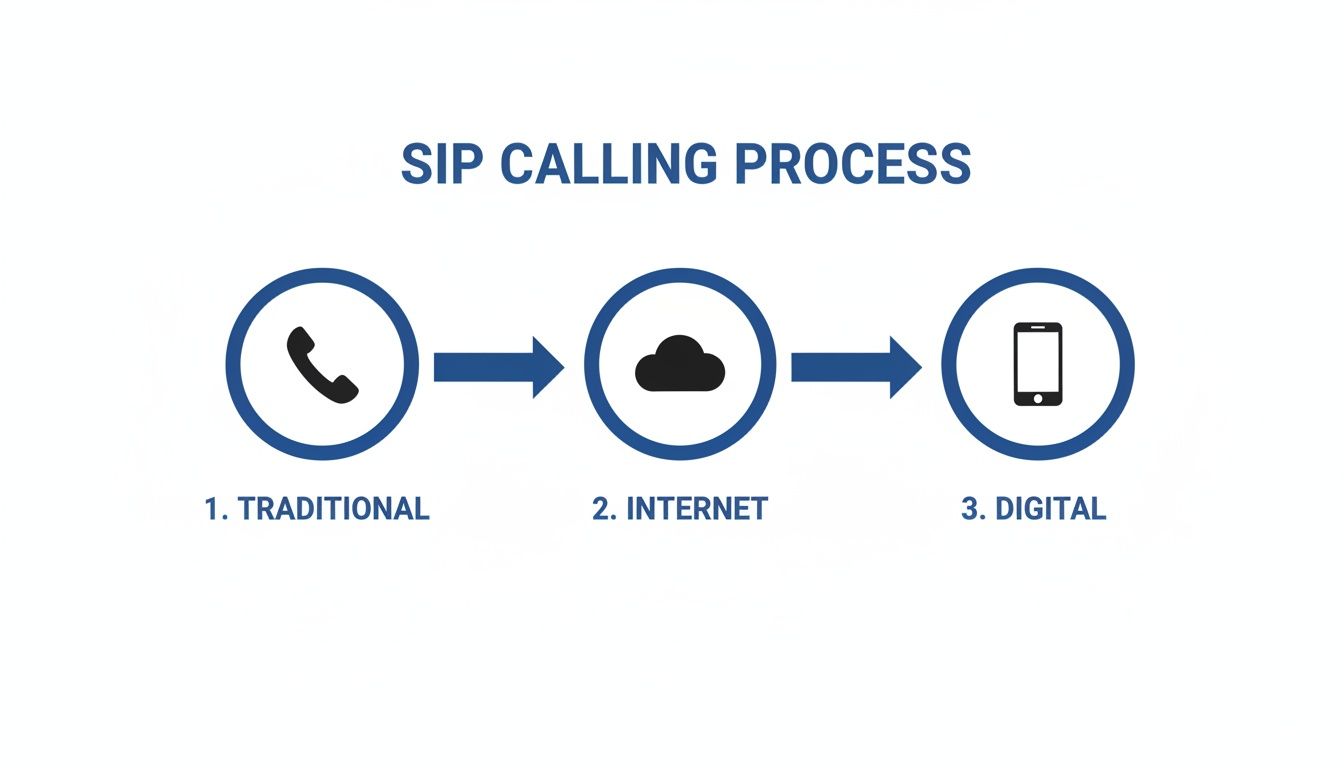
It’s a perfect illustration of how the internet acts as the bridge, turning a simple call into a digital exchange.
RTP: The Media Delivery
Once SIP sets the table, another protocol called the Real-time Transport Protocol (RTP) jumps in. If SIP is the host, think of RTP as the efficient waitstaff bringing your food to the table.
RTP’s only job is to take your voice, chop it into small digital packets, and ship them across the internet. It ensures those packets arrive in the right order and on time, which is what prevents your conversations from sounding jumbled, delayed, or garbled.
To put it simply: SIP handles the control of the call (the setup and teardown), while RTP handles the content of the call (the actual voice data). This teamwork makes the whole system incredibly efficient.
For businesses wanting to adopt this tech, knowing how these pieces fit together is the first step. To see how this applies on a larger scale, you can explore the details of how SIP trunks work to connect an entire office phone system to the internet. This basic knowledge helps demystify how SIP calling delivers such clear, reliable communication using your internet connection.
Key Features and Powerful Benefits of Using SIP
Knowing the "how" of SIP calling is great, but the real magic happens when you see what it can do for you. Moving your phone service to the internet isn't just a technical swap; it’s a genuine upgrade for your home or business, unlocking serious savings, flexibility, and features you just can't get with old-school phone lines.
The first thing most people notice is the cost savings. SIP calls run over your existing internet connection, which means you can ditch those expensive, dedicated phone lines and the hefty monthly bills that come with them. This is a huge deal for anyone making long-distance or international calls, where the costs can plummet.
This shift is why the whole VoIP industry, which is powered by SIP, is taking off. Businesses are leaving their clunky PBX systems behind for something better. The global VoIP market hit $132.2 billion in 2024 and is projected to skyrocket to $349.1 billion by 2034.
Unmatched Scalability and Flexibility
Beyond saving money, SIP gives you incredible freedom to grow. Think about adding a new phone line for a new hire or a whole new department. With a traditional system, you’d be calling a technician and waiting days for an installation.
With SIP, adding or removing lines is something you can do yourself in minutes through an online portal. This lets your phone system scale up or down right alongside your business, so you’re never paying for more than you actually need.
SIP calling decouples your phone number from a physical location. You can make and receive calls from your business number on a desk phone at the office, a softphone app on your laptop at home, or your smartphone while traveling.
Advanced Features That Empower Communication
This is where SIP really leaves traditional phone systems in the dust. You get a whole toolkit of professional features that make communication easier and more efficient. It’s not just a dial tone—it’s a full communication platform.
Some of the most popular features include:
- Unified Communications (UC): Bring your voice calls, video meetings, and instant messaging all together on one platform. No more jumping between different apps.
- Enhanced Mobility: Your business number goes wherever you go. You can take important calls on your cell, your laptop, or your desk phone without missing a beat.
- Voicemail-to-Email: Get your voicemails sent right to your email inbox, often with a text transcription. It's so much easier to manage messages on the go.
- Auto-Attendant: Set up a professional virtual receptionist to greet callers and route them to the right person or department, giving your business a polished feel 24/7.
A great example of where this technology is headed is the advanced AI phone agent technology that’s changing customer service. These smart systems use SIP to answer common questions, route calls, and provide round-the-clock support, freeing up your team to handle the more complex stuff. At the end of the day, SIP provides the foundation for a smarter, more connected, and more affordable way to communicate.
SIP Calling vs. Traditional Phone Lines and VoIP
To really get why SIP calling is such a big deal, it helps to put it side-by-side with the old-school technology it’s replacing and other terms it gets mixed up with. Once you see the differences, it becomes crystal clear why so many homes and businesses are making the jump.
At its core, the biggest difference is how the call gets from point A to point B. Traditional phone lines, the kind that run on the Public Switched Telephone Network (PSTN), use a massive physical network of copper wires to send your voice as an analog signal. It’s a reliable but one-trick-pony system that hasn't changed much in over a century.
SIP calling, on the other hand, uses your internet connection. It turns your voice into digital data, packs it up, and sends it over the web. This is way more efficient and unlocks a ton of features that just aren’t possible with an old analog line.
So, Is It VoIP or SIP?
People often use "VoIP" and "SIP" like they're the same thing, which can be confusing. Let's clear that up.
Think of it like this: VoIP (Voice over Internet Protocol) is the general idea of making phone calls over the internet. SIP (Session Initiation Protocol) is the specific technology—the set of rules—that actually makes it happen.
In simple terms, SIP is the engine that powers the VoIP car. While there are other ways to make internet calls, SIP is the standard that pretty much everyone uses to set up and manage calls online. So when you’re talking about SIP calling, you’re talking about the most powerful and popular way to do VoIP.
Hosted VoIP vs. SIP Trunking: What’s the Difference?
When businesses look at moving to internet-based phones, they usually run into two main options. The right one for you really depends on what kind of phone system you have now (if any) and what you want to accomplish.
-
Hosted VoIP: This is your all-in-one, cloud-based phone system. A provider like Premier Broadband handles everything for you—the servers, the software, all the technical stuff. You just plug in your phones and start making calls. It's the perfect fit for a business that wants a modern, feature-packed phone system without buying or managing any complicated hardware.
-
SIP Trunking: This is for businesses that already have a phone system in the building (often called a PBX) and like it, but want to stop paying for old, expensive landlines. A SIP trunk is a digital connection that replaces those copper lines, bridging your existing PBX to the internet for cheaper, more flexible calling.
SIP Calling vs Traditional Landlines vs Hosted VoIP
To pull it all together, this table breaks down the key differences between the old way of doing things and the new, internet-powered options. It’s a quick guide to understanding the technology, costs, and features you can expect from each.
| Feature | SIP Calling | Traditional Landline (PSTN) | Hosted VoIP |
|---|---|---|---|
| Technology | Digital data over the internet | Analog signals over copper wires | Fully cloud-based digital system |
| Hardware | Your existing PBX + SIP Trunk | On-site PBX and physical lines | IP Phones or software only |
| Scalability | Easy; add channels as needed | Slow; requires new line installation | Instant; add or remove users online |
| Cost | Low per-channel fees, reduced call rates | High line rental + per-minute charges | Predictable per-user monthly fee |
| Features | Depends on your PBX | Basic (Caller ID, Voicemail) | Advanced (Auto Attendant, Call Recording) |
| Mobility | Limited to your office PBX | Tied to a physical location | Use your number anywhere on any device |
As you can see, whether you're connecting your existing equipment with SIP trunking or moving entirely to a cloud system with Hosted VoIP, the benefits over traditional phone lines are huge. You get more features, greater flexibility, and significant cost savings—all by using the internet connection you already have.
What You Need to Get Started with SIP Calling
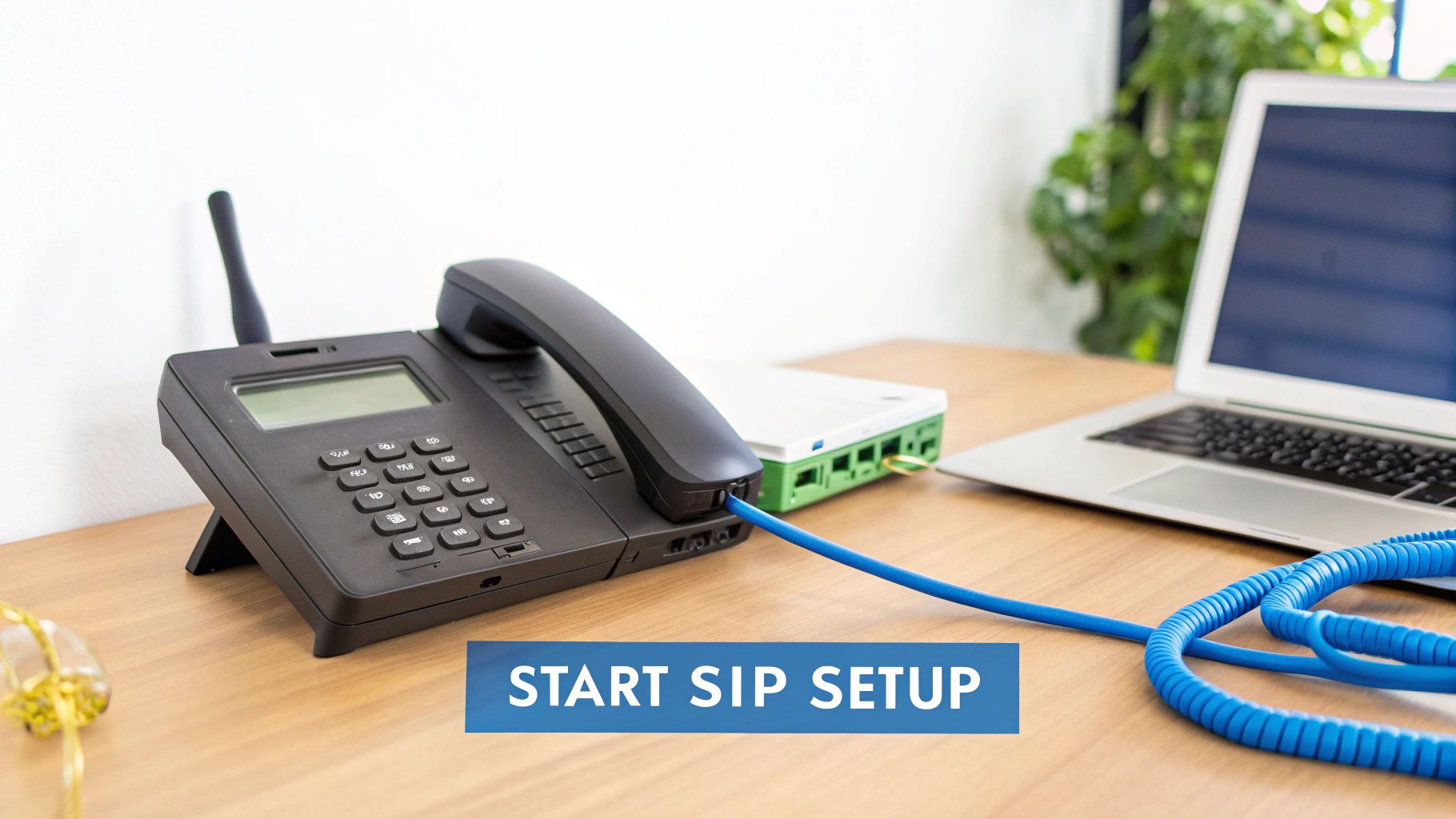
Ready to make the switch to a more modern, flexible phone service? Getting started with SIP calling is probably easier than you think. It really just comes down to three key things working together to bring your phone calls online.
First things first, you need a stable, high-speed internet connection. This is the foundation of everything. Since SIP calls are sent over the internet, your connection quality directly affects your voice quality. For those crystal-clear, lag-free conversations, a fiber internet connection is the best you can get. It gives you the equal upload and download speeds you need for perfect communication every time.
Choosing Your SIP Device
Next up, you'll need a device that can "speak" the SIP language. You’ve got more options here than you might realize, with choices that fit any budget or work style.
- VoIP Desk Phones: These look just like the office phones you're used to, but they plug straight into your internet network instead of a phone jack. They’re built for amazing audio quality and have all the familiar features.
- Softphone Applications: A "softphone" is just an app you can install on your computer or smartphone. It instantly turns that device into a fully featured business phone, which is perfect for working from home or on the go.
- Analog Telephone Adapters (ATA): Still attached to your old analog phone? No problem. An ATA is a small gadget that acts as a translator, connecting your traditional phone to your internet router so it can work with SIP.
The move to SIP calling has exploded alongside the rise of remote and hybrid work. By 2025, the global VoIP market is expected to top $160 billion. Even more telling, mobile VoIP is projected to leap from $49.2 billion in 2021 to a staggering $327.5 billion by 2031. It's a clear signal of where communication is headed. Read more about the future of VoIP and SIP technology.
Finding a SIP Service Provider
Finally, you need a SIP service provider. This is the company that connects your internet calls to the regular phone network, gives you a phone number, and manages your account. Think of them as your new phone company, but one that operates over the internet.
For businesses, finding a provider that offers a managed solution is a huge advantage. They can handle all the setup, bundling your internet, voice, and security into one simple package.
Once you have these three pieces in place, setting everything up is usually a breeze. You plug in your device, punch in the account details your provider gives you, and you're ready to make calls.
Making sure you have enough bandwidth is key to a great experience. You can easily test your internet connection with our VoIP bandwidth test to see if you're ready to go.
Choosing the Right Provider for Reliable Service
All the powerful features we've talked about with SIP calling really boil down to one thing: the quality of your internet connection.
If your network is slow or unreliable, you're going to get choppy audio, dropped calls, and a whole lot of frustration. That's why picking the right provider is the single most important decision you'll make when you switch to a modern phone system.
For the best, clearest calls, you need a network that was built from the ground up for real-time traffic like voice and video. A 100% fiber network is the gold standard here. It gives you symmetrical upload and download speeds, which is just a fancy way of saying your voice goes out just as clearly as your caller's voice comes in.
The Power of a Managed Solution
For businesses, the right provider is more than just an internet line; they're a partner. A managed service provider can simplify your life by bundling everything you need—internet, voice, and even security—into one easy-to-manage package.
Instead of trying to get separate vendors to play nicely together, a managed solution ensures all your systems work together perfectly from day one.
The key takeaway is that the best technology requires a strong foundation. Choosing a provider that offers both a powerful network and comprehensive support ensures your move to SIP calling is seamless, effective, and reliable from day one.
The market for SIP trunking is growing fast, and for good reason. It was valued at USD 10.2 billion in 2024 and is expected to hit USD 17.24 billion by 2031. You can see the market growth for yourself. This just shows how important it is to find a stable, long-term partner you can count on.
Ultimately, your provider is what makes or breaks your experience. By choosing a fiber connection and looking into bundled services, you can unlock everything SIP has to offer. To see what a top-tier connection looks like, check out our guide on finding the best internet and telephone service for your home or business.
Got Questions About SIP Calling? We've Got Answers.
Let's wrap up with a few of the most common questions people have when they're first looking into SIP calling. These quick answers will clear up any lingering confusion and help you see just how simple it is to upgrade.
Is SIP Calling Secure?
Yes, it absolutely can be. Reputable providers go to great lengths to protect your conversations, using powerful encryption to secure both the call signals and the audio itself.
This is done with security protocols like Transport Layer Security (TLS) and Secure Real-time Transport Protocol (SRTP). Think of them as a private, armored tunnel for your phone call. When you combine that with a secure network from your provider, you get layers of protection that make SIP a very safe choice for both home and business.
Do I Need Special Equipment?
Not always, and that's one of the best parts about it. While a dedicated VoIP desk phone will usually give you the best possible call quality, you have other great options.
You can easily make and take calls using:
- A softphone app on your computer or smartphone.
- Your good old analog phone plugged into an Analog Telephone Adapter (ATA).
This flexibility means SIP calling can fit almost any setup or budget, whether you’re working from the office or on the go.
Can I Keep My Existing Phone Number?
You sure can. In most places, you can bring your current phone number with you when you switch to a SIP or VoIP service.
The official term for this is Local Number Portability (LNP). It allows you to get all the benefits and savings of modern phone technology without the headache of telling everyone your number has changed. It's a smooth, seamless transition for your family, friends, and customers.
Ready to experience the clarity and savings of a modern phone service? Premier Broadband provides crystal-clear VoIP phone solutions powered by our 100% fiber network. Explore our voice and internet plans today!