

You've got a Spanish number in front of you, you're ready to call, and then the hesitation kicks in. Do you need to drop a digit, add a zero, use 011, or just tap +34 and hope for the best?
That confusion is normal. Spain is easy to call once you understand the number structure, but callers often get tripped up by one detail: the Spanish number itself. If you get that part right, the rest is straightforward. If you get it wrong, the call often fails even though the number “looks” correct.
The Three Simple Parts of a Call to Spain
Every international call to Spain has three parts. It functions similarly to a mailing address. You need the route out of your country, the destination country, and the full local destination number.
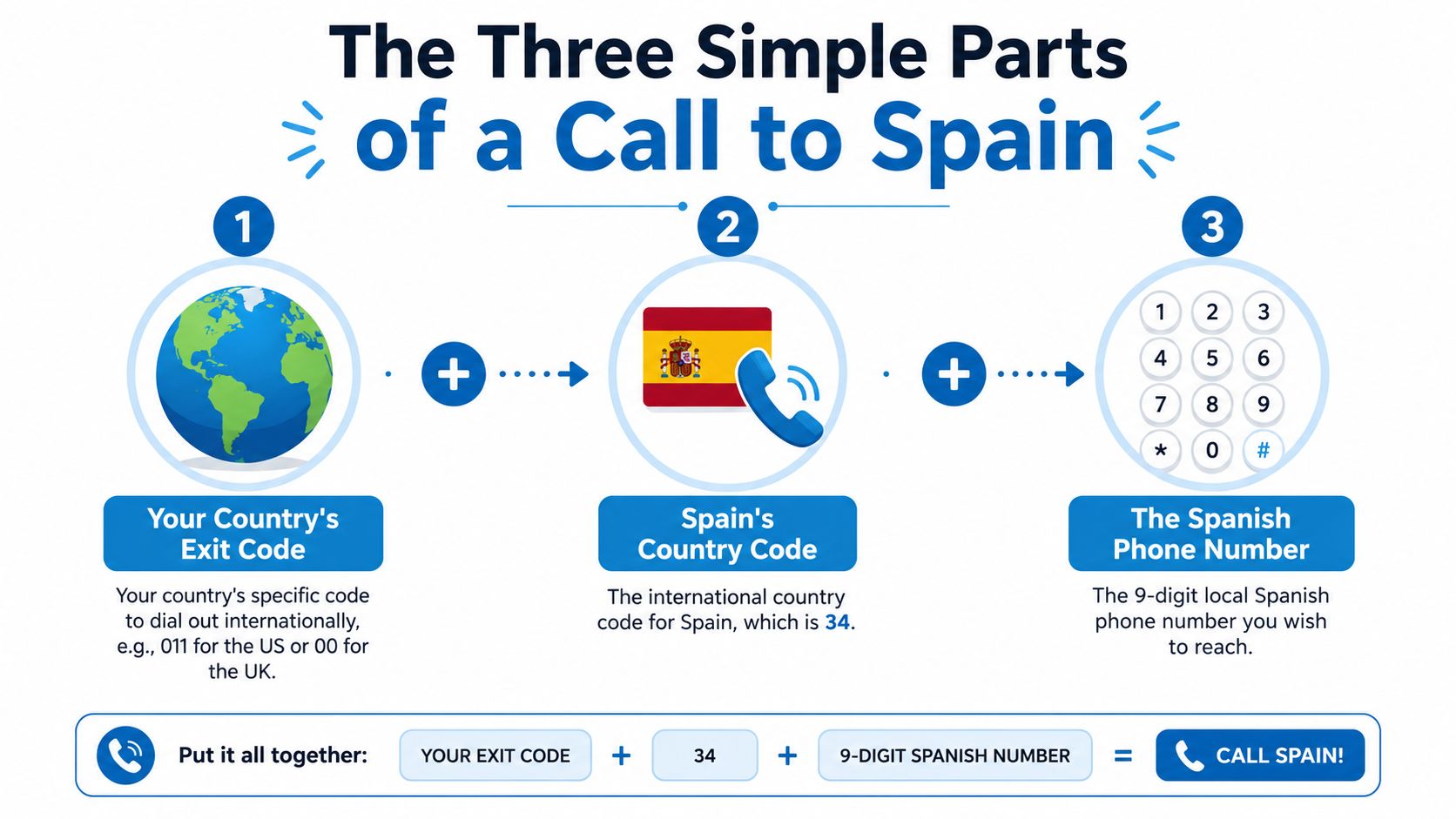
Your exit code
The exit code tells your carrier you're making an international call. It depends on where you're calling from.
If you're in the United States, that code is 011. In much of Europe, including the UK when dialing internationally in the usual landline format, it's 00.
Spain's country code
Spain uses +34 for international calls. That's the country code recognized globally, and it's the part that tells the network your call belongs in Spain. Zadarma notes that Spain uses the universal country code +34, established by the ITU, and that using the + symbol on mobile devices is standard on 99% of modern smartphones, helping reduce call setup errors by about 40% since implementation (Zadarma on Spain country code and plus dialing).
Practical rule: On a mobile, use +34 whenever you can. It's cleaner and usually safer than manually entering your country's exit code.
The full Spanish number
This is the part that causes the most mistakes. A Spanish number is a full 9-digit number. You don't strip off the front part just because it looks like an area code.
So if someone gives you a Madrid number beginning with 91, or a Barcelona number beginning with 93, those digits stay in place when you call from abroad. They are part of the number you dial.
A simple format looks like this:
- Exit code or +
- 34
- Full 9-digit Spanish number
For mobile users, that usually means your simplest format is:
+34 [full 9-digit Spanish number]
If you're trying to learn how to call in Spain without second-guessing yourself, this is the foundation that matters most. Don't overcomplicate it. Start with your international access, add 34, then enter the complete Spanish number exactly as given.
Dialing Examples from the US UK and Mobile
Knowing the structure is one thing. Typing it correctly is another. Small mistakes break international calls fast, especially when people add extra digits out of habit.
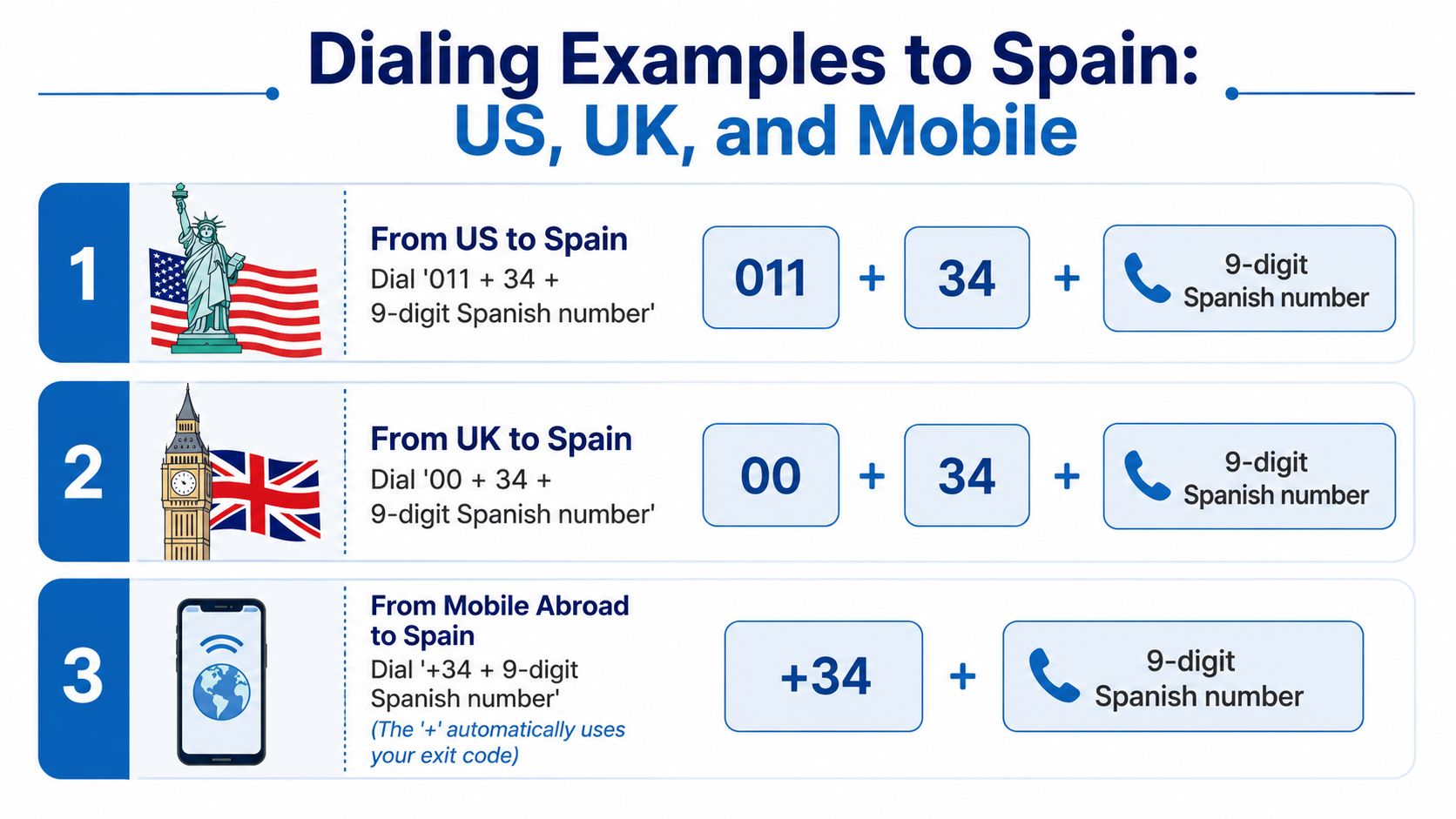
From the US
If you're calling from a US landline or a carrier that expects a traditional international sequence, the format is:
011 + 34 + 9-digit Spanish number
Premier Broadband's dialing guide states that the mandatory US format is 011 + 34 + 9-digit local number, and using the mobile + format can reduce user error by 60% compared with manual landline entry (calling Spain from the USA).
Here are clean examples:
011 34 91 XXX XXXX
011 34 93 XXX XXXX
011 34 6XX XXX XXX
The biggest US mistake is adding a 1 before 34. That's a domestic long-distance habit, not an international one. Don't do it.
From the UK or much of Europe
For a standard landline-style international call from the UK or many European countries, use:
00 + 34 + 9-digit Spanish number
Examples:
00 34 91 XXX XXXX
00 34 93 XXX XXXX
00 34 7XX XXX XXX
This works well when you're using a desk phone, hotel phone, or older system that doesn't handle the plus sign cleanly.
From any mobile phone
On a mobile, the easiest format is:
+34 91 XXX XXXX
+34 93 XXX XXXX
+34 6XX XXX XXX
The plus sign handles the exit code for you. That's why I usually tell people to stop trying to memorize country-specific exit prefixes if they're using a smartphone. Save the number in international format and tap it.
If you're calling a Spanish office and then need to reach a person inside that company, it helps to understand managing calls with extensions before you dial.
A quick copy check before you place the call
Use this short checklist:
- US landline format: Start with 011
- UK or EU landline format: Start with 00
- Mobile format: Start with +
- Spain code: Always 34
- Spanish number: Enter all 9 digits
That last point matters more than people think. If the number you copied only has eight digits after +34, or you removed the front digits because they “looked like an area code,” you've likely created the problem yourself.
Is It a Landline or a Mobile Number
A lot of guides tell you to dial Spain using the country code and move on. That's not enough. If you want to understand how to call in Spain properly, you need to recognize what kind of number you're holding.
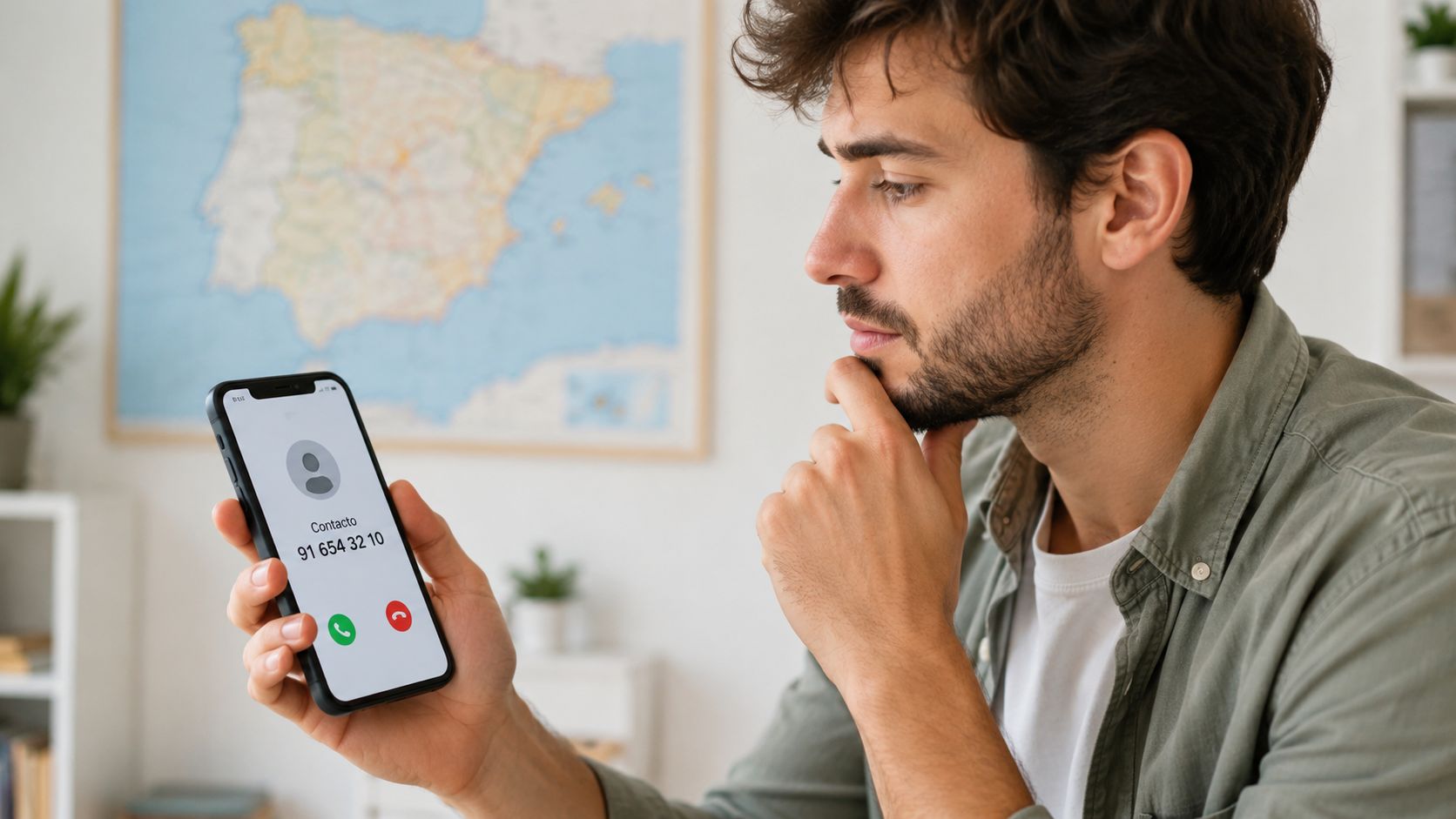
The first digit tells you a lot
Spanish numbers are structured in a way that's easy to read once you know the rule:
- Mobile numbers start with 6 or 7
- Landlines start with 8 or 9
That means a number beginning with 91 is a landline. A number beginning with 93 is also a landline. A number beginning with 6 is a mobile.
According to 8×8's summary of Spanish numbering, based on CNMC rules, all Spanish numbers are 9 digits with no separate trunk prefix, and the regional prefix must always be included (Spanish number structure and VoIP number basics).
Madrid and Barcelona aren't optional prefixes
This is the mistake I see most often. People look at 91 for Madrid or 93 for Barcelona and assume those digits are optional area codes that can be added or removed depending on where they're calling from.
They are not optional in this context. They are part of the full number.
A Spanish number should be treated as one complete 9-digit unit. Don't split it into “area code” and “main number” the way you might in other countries.
Here's how to read common examples:
| Number start | Type | What it means |
|---|---|---|
| 91 | Landline | Madrid fixed line |
| 93 | Landline | Barcelona fixed line |
| 6XX | Mobile | Spanish mobile |
| 7XX | Mobile | Spanish mobile |
Why this matters beyond connection
This isn't only about making the call go through. It also helps you choose the right calling method.
Some services price calls differently for mobiles and landlines. If you know a number starts with 6 or 7, you can expect it to be routed as a mobile destination. If it starts with 8 or 9, you're usually dealing with a fixed line.
That makes a real difference when you're comparing app-based calling, VoIP plans, and carrier rates.
Save Money with VoIP and Wi-Fi Calling
If you call Spain occasionally, your mobile carrier might be good enough. If you call regularly, especially landlines, carrier pricing gets expensive fast.

A 2025 study cited by MyTello found that 68% of US and UK expats in Spain waste more than €120 annually on overpriced international calls by not using VoIP. The same source notes that services like Skype can offer landline calls from €0.02/min, compared with carrier rates that can exceed €0.50/min (VoIP savings for calls to Spain).
What works well
If both people use the same app, app-to-app calling is usually the easiest low-cost option. WhatsApp is common. Skype, Google Voice, and similar tools are useful when you need to reach an actual phone number, not just another app account.
For business users or remote workers, dedicated VoIP is usually the cleaner setup. If you want a quick primer on the terminology and trade-offs, this overview of business VoIP explained is a useful reference.
A practical decision guide:
- Calling family on WhatsApp: Best when both people use the app and have data or Wi-Fi
- Calling a Spanish landline: Better through a VoIP service that supports direct number dialing
- Calling clients or teams often: Better through a structured VoIP setup with voicemail, caller ID, and device flexibility
- Calling from weak mobile coverage: Wi-Fi Calling can help if your carrier supports it reliably
What usually doesn't work well
Traditional carrier international add-ons sound convenient, but they're often poor value if your usage changes month to month. Hotel phones are another trap. They may require an outside-line prefix before you even start the international sequence, and pricing is often opaque.
Wi-Fi Calling also isn't magic. It works best on stable broadband. If your connection is weak, you may still get lag, clipping, or failed setup.
For people comparing options side by side, a dedicated low-cost VoIP service tends to make more sense than paying standard international carrier rates every time you need to reach Spain.
Here's a useful walkthrough on modern calling options:
My practical recommendation
Use this order of preference:
- App-to-app call if the other person uses the same platform.
- VoIP or Wi-Fi Calling if you need to call a Spanish landline or mobile directly.
- Carrier international dialing only if it's occasional and your plan pricing is reasonable.
That order keeps costs down without making the process harder.
Troubleshooting Common Issues and Essential Numbers
When a call to Spain fails, it's often assumed the number was typed incorrectly. Often, that isn't the actual issue.
Talk360 reports that 78% of failed international calls stem from plan restrictions, such as international calling not being enabled, while 22% of unanswered calls come from time zone misalignment (international call troubleshooting and timing).
Run this checklist first
- Check your plan: International dialing may be blocked by default.
- Confirm the number format: Use the full Spanish number exactly as provided.
- Try mobile plus format: If your landline sequence fails, test the number with +34 on a smartphone.
- Check local phone system rules: Hotels and office PBX systems sometimes require an outside-line digit first.
- Review router settings if you use VoIP: Issues such as SIP interference can come from network behavior, which is why this guide to what SIP ALG is and why it matters is worth knowing.
Call failures and unanswered calls are different problems. One is routing. The other is timing.
Essential number to know in Spain
If you're physically in Spain and need emergency help, the key number is:
- 112 for emergency services
If you're outside Spain, use the emergency number for your own location instead of trying to call Spanish emergency services from abroad.
The simplest way to avoid most issues is still the same. Use the complete 9-digit Spanish number, use +34 on mobile whenever possible, and verify that your provider allows international calls before you start troubleshooting anything more technical.
If you make international calls often, especially for work or family, it's worth looking at a setup built for it. Premier Broadband offers fiber internet and VoIP phone solutions that fit homes, remote workers, and businesses that need dependable calling without the usual carrier hassle.