
Trying to find affordable home internet plans can feel like you’re searching for a needle in a haystack. But it doesn't have to be so complicated. The best plan for your home isn't just the one with the lowest price tag; it's the one that gives you the speed you actually need at a fair price—without any surprise fees popping up on your bill.
What Affordable Home Internet Really Means
Let's get one thing straight: 'affordable' internet isn't just about finding the cheapest deal online. True affordability is about getting solid performance for your money. You shouldn't have to overpay for crazy-fast speeds you'll never use, but you also don't want a connection that buffers every time you try to watch a movie. It's all about finding that perfect balance of cost, performance, and honesty from your provider.
Think of it like buying a car. You wouldn't just pick the cheapest one on the lot. You'd find one that fits your family, gets good gas mileage, and won't break down next week. It's time to apply that same thinking to your internet plan. Stop hunting for the 'cheapest' and start looking for the 'smartest' plan for your home. This simple shift will save you a ton of headaches later on.
The Three Pillars of Internet Value
To find a plan that’s genuinely a good deal, you need to check every offer against three basic rules. Get these down, and you'll be able to spot true value from a mile away.
- Fair Monthly Cost: The price you see should be the price you pay. It should match the service you're getting without being packed with short-term gimmicks that disappear after a month or two.
- Reliable Speed: Your plan has to be fast enough for everything you do online, whether that's streaming, hopping on video calls, or just browsing. No one has time for constant lag.
- Transparent Pricing: There should be zero surprises on your bill. A good provider is upfront about costs for things like equipment rental, installation, and any data limits.
It's not just us saying this—making internet affordable is a global priority. The Broadband Commission for Sustainable Development has a goal for entry-level internet to cost less than 2% of a country's monthly Gross National Income per capita. It just goes to show how important accessible, fairly-priced internet really is.
At the end of the day, an affordable plan gives you peace of mind. It just works, fitting right into your budget and your daily life without a fuss. Before you even start looking at numbers, it's a good idea to know what different services offer so you can effectively compare home internet plans. That way, you’ll know if you're looking at a great deal or just clever marketing.
Matching Your Internet Speed to Your Real Life
Internet providers love to talk a big game about gigabit speeds, promising an unbelievable online experience. But how much of that horsepower do you actually need under the hood? Picking the right internet speed is less about buying the fastest plan on the market and more about matching performance to your real, day-to-day life.
Think of it like buying a car. A Formula 1 race car is an incredible piece of engineering, but it’s not exactly practical—or affordable—for the morning school run. In the same way, paying for a supercharged internet plan when you just need to check emails and stream some Netflix is like taking a rocket ship to the grocery store. It’s expensive overkill.
The real key to finding an affordable home internet plan is to get honest about your own usage. A single person who streams Netflix after work has completely different needs than a family of five with online gamers, remote workers, and a house full of smart devices all running at once.
Getting this right means balancing three key things: the monthly cost, the speed you genuinely need, and the fine print in the contract.
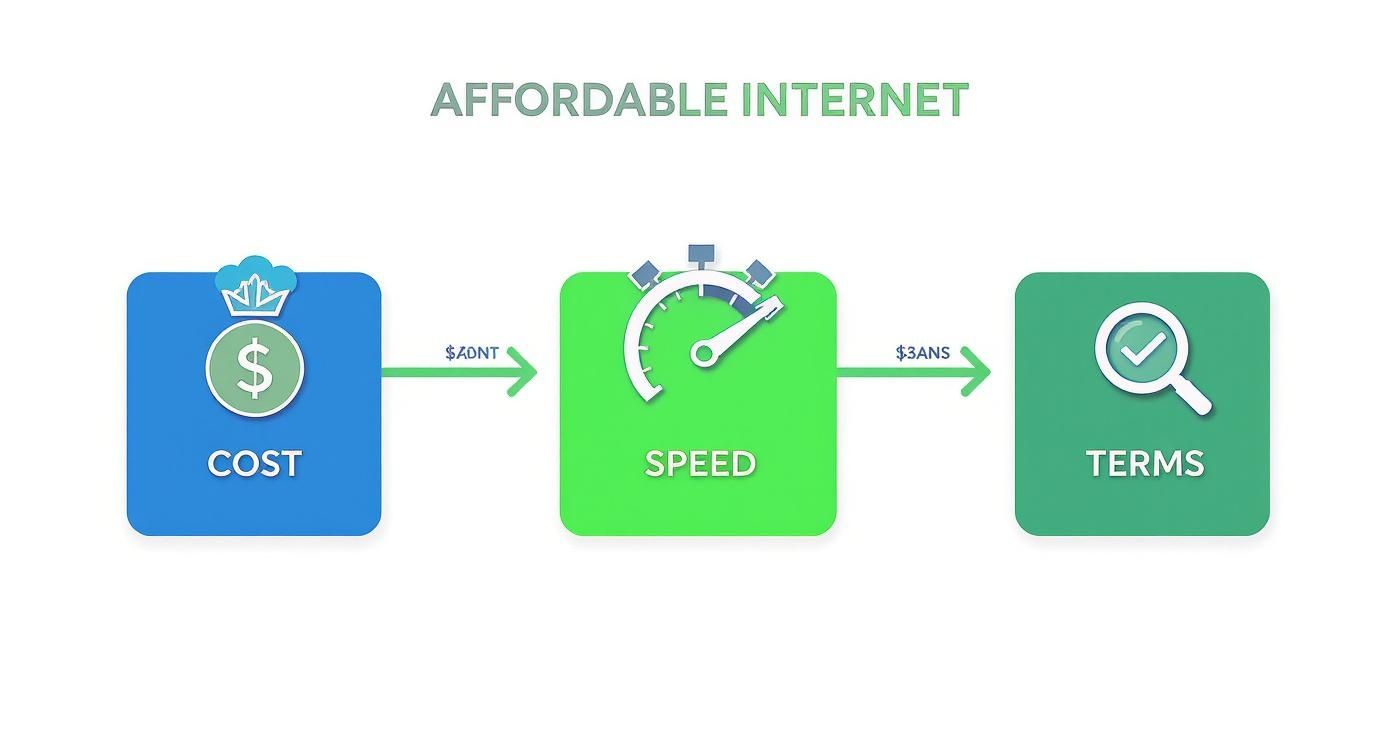
When you find a plan that hits the sweet spot between these three factors, you've found true value.
Recommended Internet Speeds for Your Household
To help you pinpoint your ideal speed, we put together this quick guide. See which profile sounds most like your home to avoid the common trap of overpaying for bandwidth you'll never use.
| Household Profile | Common Activities | Recommended Speed | Example Premier Broadband Plan |
|---|---|---|---|
| The Solo Streamer or Light User | HD streaming, social media, online shopping, checking email | 50-100 Mbps | Essentials 200 Mbps |
| The Work-From-Home Pro | Video conferencing, cloud apps, large file uploads & downloads | 100-300 Mbps (Symmetrical) | Streamer 400 Mbps |
| The Connected Family or Power Users | Multiple 4K streams, competitive gaming, smart home devices | 300-500+ Mbps | Family 1 Gig |
This table should give you a solid starting point for figuring out what you really need, ensuring you get a plan that works without breaking the budget.
Decoding Your Household Needs
Let’s dig a little deeper into these profiles to see what makes them tick.
The Solo Streamer Or Light User
This is your typical one or two-person household. The internet is mostly for entertainment and staying connected—browsing social media, checking emails, streaming music, and watching videos in HD on a laptop or TV.
- Common Activities: Streaming Netflix or YouTube, online shopping, light social media use.
- Speed Recommendation: 50-100 Mbps is plenty of juice for a smooth, buffer-free experience without paying for excess capacity.
The Work-From-Home Pro
When your home doubles as your office, your internet needs a promotion. You’re constantly on video calls, uploading large files, and relying on cloud-based apps to get your job done. Here, upload speed is just as critical as download speed. A weak upload is what makes you freeze on a Zoom call or watch a progress bar crawl for an hour when sending a big presentation.
For a deep dive into why this is so important, check out our guide on what is a good upload speed. It breaks down how strong uploads create a seamless remote work setup.
The Connected Family Or Power Users
Welcome to the modern, multi-device household. Picture it: someone’s on a work video call in the office, a teenager is in an intense online gaming match in their room, and two others are streaming 4K movies on different TVs. On top of all that, your smart security cameras, thermostat, and speakers are constantly connected.
- Multiple Simultaneous Streams: Numerous devices are all pulling data from your network at the very same time.
- High-Bandwidth Activities: 4K streaming and competitive online gaming are bandwidth hogs.
- Speed Recommendation: You'll want a plan with 300-500 Mbps or more to keep everyone online and happy, without any lag or interruptions.
Exposing the Hidden Fees That Inflate Your Bill
That amazing promotional price you see splashed across an advertisement? It’s designed to grab your attention, but it rarely tells the whole story. The trip from that advertised price to your actual monthly bill is often full of costly surprises in the form of hidden fees.
Internet providers have become masters at tacking on small, confusing charges that can easily inflate your bill by 20% or more. Suddenly, that "affordable" plan is anything but.
These extra costs aren't just an accident; they’re a core part of the business model for many big-name providers. By luring you in with a low price, they make up the difference with a laundry list of mandatory fees, hoping you won't notice or question them. This is where a little bit of knowledge goes a long way.

Unmasking the Most Common Culprits
To keep your wallet safe, you have to know what you're looking for. These sneaky charges often hide in plain sight on your bill, disguised with official-sounding names. Let's pull back the curtain on the ones you’ll see most often.
- Equipment Rental Fees: This is the classic. Providers charge you a monthly fee, often $10 to $15, just to use their modem and router. That can add up to $180 a year for equipment you’ll never even own.
- Broadcast TV or Regional Sports Fees: If you bundle internet with TV, watch out. These are costs passed on from broadcasters, but they show up as separate, non-negotiable line items that jack up the advertised bundle price.
- Network Enhancement or Maintenance Fees: This is one of the vaguest charges out there. They claim it helps improve their network, but it’s really just another way to raise your bill without changing the advertised price.
- Administrative or Regulatory Cost Recovery Fees: These sound official, but they are often just fees created by the provider to cover their own internal business costs—not government-mandated taxes.
The real problem with these fees is the lack of honesty. A truly affordable home internet plan is one where the price you see is the price you pay, no magnifying glass required.
Your Action Plan to Fight Back
The good news? You don't have to just accept these charges. With a few smart moves, you can seriously reduce or even get rid of some of these extra costs. It all starts with questioning every single line item on your bill.
Tactics for a Lower Bill
First, go after that equipment rental fee. For a one-time cost, you can usually buy your own modem and router. Just make sure the model you pick is compatible with your provider’s service—their website should have a list of approved devices. The upfront cost typically pays for itself in about a year.
Next, always ask for a self-installation kit. Many companies charge a one-time fee of $50 to $100 for a technician to come to your home. A self-install kit is almost always free and comes with simple, step-by-step instructions.
Finally, keep a close eye on your data usage. Some providers still enforce data caps and hit you with punishing overage fees if you go over your monthly limit. If you stream, game, or work from home, look for a provider that offers unlimited data from the get-go.
Choosing a provider like Premier Broadband helps you sidestep these games entirely. With our commitment to clear, transparent pricing, you get a bill that’s predictable and fair every single month—no hidden fees, ever.
Finding Discounts and Programs to Cut Your Cost
Beyond simply picking the right speed plan, tapping into special assistance programs and discounts is one of the smartest ways to get affordable home internet. Too many people pay the full sticker price without realizing they might qualify for major savings from federal programs or the provider itself.
These programs are all about making sure essential internet access isn't a luxury. Think of it as a financial toolkit—if you meet the criteria, you can unlock resources that seriously lower your monthly bill. A few minutes of research could easily save you hundreds of dollars a year.
Government Assistance for Internet Bills
Often, the biggest savings come from government programs designed to close the digital divide. These initiatives give you a monthly credit that gets applied right to your internet bill, making high-quality service a reality for low-income households.
The most well-known program was the Affordable Connectivity Program (ACP). While this specific program is no longer accepting new applications, its impact was huge. Many providers, including Premier Broadband, have created plans based on this model to help eligible customers get connected for little to no cost.
While federal internet subsidies might change over time, the need for affordable access isn't going away. Providers and states are always looking for new ways to support households, so it pays to stay informed about local and company-specific assistance.
Knowing how these programs work is the first step. For more details on program specifics and how you might qualify for similar initiatives, you can learn more about Premier Broadband’s commitment to the Affordable Connectivity Program. Staying in the loop ensures you're ready to take advantage of any help that becomes available.
Uncovering Provider-Specific Discounts
Separate from federal aid, most internet service providers (ISPs) offer their own discounts for certain groups of people. These deals aren't always advertised on the front page, so you might just have to ask.
Providers offer these special rates to support different parts of the community, recognizing that students, seniors, and military members often have unique financial situations.
Here are a few common groups that often qualify for a special rate:
- Seniors: Many ISPs have reduced-price plans for older adults, particularly those on a fixed income.
- Students: If you're in college, you can often get a discount just by showing a valid student ID or school email address.
- Military and Veterans: As a thank you for their service, many providers give exclusive monthly discounts to active-duty military, reservists, veterans, and their families.
- Low-Income Families: Some companies run their own low-income internet programs completely separate from government aid, offering basic service for a very low monthly fee.
The golden rule is to always ask. When you call a provider, make it a point to ask about any discounts that might apply to you. You'd be surprised what a simple question can unlock.
How to Apply and Get Your Savings
Getting set up with these programs is usually pretty simple. For government assistance, you typically verify your eligibility through a national system by showing proof of income or that you're part of another federal program like SNAP or Medicaid.
For provider-specific discounts, it's even easier. You'll just need to show proof of your status, like a student ID or military service record. To find even more ways to cut costs, you can check out these proven tips to reduce your monthly bills across all your household services.
Don't let a simple application stand between you and big savings. The little bit of effort is more than worth it.
Negotiation and Bundling Strategies That Work
Finding a great internet plan is just the start. The price you see on the website isn't always set in stone. If you want to lock in the absolute best deal, you have to be willing to take the driver's seat. Two of the most powerful tools in your toolkit are good old-fashioned negotiation and smart bundling.
Don't be intimidated by the idea of negotiating with a big company. It's way simpler than you might think. Internet providers really want to keep you as a customer, and they often have loyalty discounts or unadvertised promotions ready for people who just take the time to ask. It's not about being pushy; it's about showing them you know your options.
How to Negotiate Your Internet Bill
When you call, your main goal is to get transferred to the customer retention department. These are the folks who have the real power to offer you a better deal to stop you from leaving. A little prep work goes a long way. Before you even pick up the phone, do a quick search for what competitors are offering for similar speeds in your area.
Ready to call? Just follow these simple steps:
- Be Polite and Prepared: Start by letting the representative know you're looking over your budget and the internet bill is a bit higher than you'd like.
- Mention Competitor Offers: Calmly bring up the deals you found. Try saying something like, “I see another company is offering a 300 Mbps plan for $20 less a month. I’d really rather stay with you guys, but that’s a tough savings to pass up. Is there anything you can do to match that price?”
- Ask for Loyalty Discounts: Be direct and ask if there are any loyalty discounts or new customer promotions they can apply to your account. Sometimes, a better rate is just a few clicks away for them.
- Be Willing to Walk Away: If they can't make it work, thank them for their time and mention you'll need to think about your options. This can often trigger one last, better offer.
The good news is that the market is on your side. Broadband prices across the U.S. have been dropping relative to the speeds you get. In fact, real prices for the most popular internet plans fell by 8.7% in just one year, while even the super-fast gigabit plans saw prices dip by 6.2%. You can dig into the numbers yourself by checking out USTelecom's comprehensive pricing data. This gives you real leverage.
The Smart Way to Bundle Services
In the old days, bundling meant getting stuck with a landline you never touched and a cable TV package full of channels you never watched. Not anymore. Today, bundling is all about flexibility and getting real savings on services you’ll actually use. It’s as simple as combining your internet with other digital services from the same provider to unlock a lower total price.
Think of it like a value meal for your digital life. Buying everything separately adds up, but grouping them together gives you a sweet built-in discount.
Modern bundling puts you in control. Instead of forcing you into a rigid package, it allows you to combine services that fit your lifestyle, like pairing high-speed fiber internet with a flexible streaming TV solution or a reliable VoIP home phone.
Modern Bundles That Create Real Value
Look for providers who offer modern, useful services that actually go well with your internet connection. This is the key to making sure you're not just paying for fluff to get a discount.
- Internet + VoIP Phone: If a home phone is still part of your setup, bundling it with internet is a no-brainer. VoIP (Voice over Internet Protocol) gives you crystal-clear calls and cool features for way less than a traditional landline.
- Internet + Streaming TV Packages: Ditch the rigid cable contract. Innovative providers like Premier Broadband have partnered with services like MyBundle.TV. This lets you combine your internet with a streaming package you build yourself, so you can watch your favorite shows and save up to 50% compared to old-school cable.
When you pair direct negotiation with smart bundling, you take full control of your internet costs. These strategies help you get beyond the advertised rate and find a truly affordable home internet plan that provides real value, month after month.
So, How Does Premier Broadband Deliver Real Value?
Figuring out what makes a great internet deal—speed, surprise fees, discounts—is the first part of the puzzle. Now, let’s look at how Premier Broadband pulls it all together. We focus on giving you total value, not just a cheap price that disappears after a few months. Finding a truly affordable plan means finding a partner you can trust for quality, honesty, and real savings.
It’s about more than just your monthly payment. It's about the entire experience. Value is a connection that just works, pricing you can actually understand, and perks that make your life online easier. We think great internet should be like any other utility—so reliable you forget it’s even there.
It All Starts with a Better Network
The heart of any internet service is the technology it runs on. Old-school cable and DSL use networks originally built for TV or phone calls. Premier Broadband is different—we’re built on a 100% fiber-optic network. This isn’t just a small step up; it’s a completely different (and better) way to get you online.
Think of it like this: cable is an old, winding country road that gets jammed during rush hour, slowing everyone down. Fiber is a brand-new superhighway with a dedicated lane just for your data. You get consistent, lightning-fast speeds, day or night. That’s how we can offer symmetrical speeds (uploads as fast as downloads), which is a game-changer for video calls, gaming, and working from home. Learn more about the top reasons to choose Premier Broadband.
Straightforward Pricing and Smart Ways to Save
A great network doesn’t mean much if your bill is filled with confusing charges. We keep it simple with transparent, all-in pricing. We got rid of the sneaky fees that other providers use to pad your bill. The price you see is the price you pay.
Here’s how we build value into every single plan:
- No Hidden Fees: You won't find any mystery "network maintenance" fees or other nonsense on our bills.
- Support for Assistance Programs: We’re committed to making sure everyone can get connected and fully support government programs that help lower costs for eligible families.
- Smart Bundling Options: We help you save without trapping you in bloated, old-fashioned TV packages you don't want.
It's amazing to see how much internet costs around the world. In countries that have invested heavily in fiber and competition, the prices can be incredibly low. Take Israel, for example, where you can get 1 GB of data for as little as $0.02. That's what happens when you have a modern, competitive market. You can see how different countries compare on worldwide data pricing.
Bundles That Actually Help You
We think bundling should add real value, not just more services you’ll never use. That’s why we do it differently. Instead of a one-size-fits-all cable package, we give you flexible options that work with your internet service to save you money.
Our partnership with MyBundle.TV is the perfect example. It lets you cut the cord your way. You can build a streaming package with only the channels you actually watch, which can save you up to 50% compared to a traditional cable bill. Add in our reliable VoIP phone service, and you have a complete, affordable setup for your home.
At Premier Broadband, our goal is simple: deliver more than just an internet connection. We deliver lasting value built on performance, honesty, and genuine savings.
Frequently Asked Questions
Shopping for home internet can feel like a maze. We get it. Here are the most common questions we hear, with straightforward answers to help you feel confident about your choice.
Is Fiber Internet Really That Much Better?
In a word, yes. For most homes, the upgrade to fiber is a night-and-day difference. Fiber optic internet delivers symmetrical speeds, which is a fancy way of saying your uploads are just as fast as your downloads. This is huge for anyone who works from home, joins video calls, plays online games, or sends big files. No more frustrating lag.
On top of that, fiber is just more reliable. It’s far less likely to slow down when everyone in the neighborhood logs on in the evening. You get the speed you pay for, consistently.
Can I Save Money By Buying My Own Equipment?
You absolutely can. While you’ll have an upfront cost to buy a compatible modem and router, you can stop paying the $10 to $15 per month rental fee that most providers charge.
Over a year, that adds up to $120 to $180 in your pocket. The gear usually pays for itself in about a year, and after that, it's pure savings. Just make sure to check your provider’s website for a list of approved devices before you buy.
What Should I Do If My Internet Bill Suddenly Increases?
A surprise price hike almost always means your introductory or promotional rate has expired. The first thing you should do is call your internet provider. When you get a representative, ask to be transferred to the customer retention department—that’s where they have the power to make deals.
Politely explain that the new price is more than you budgeted for and ask if they have any new promotions or loyalty discounts available. If you've seen offers from competitors, mentioning them shows you’ve done your homework. More often than not, they’ll find a way to offer you a better rate to keep you from switching.
Tired of the games and ready for straightforward pricing and real value? Check out Premier Broadband’s fiber internet plans and get the speed you need without the hidden costs. Learn more about our plans today.