
Here’s the thing: the difference between fiber and cable internet boils down to the materials they’re made from. Fiber sends data as pulses of light through super-thin glass strands, which gives you incredible, symmetrical speeds. Cable, on the other hand, uses older copper coaxial wires and electrical signals, leading to slower, asymmetrical performance.
Deciding between them really depends on what you need. Are you looking for a connection that’s built for the future? Or is cable's wider availability good enough for now?
The Core Difference Between Fiber and Cable Internet
When you’re weighing fiber vs. cable, you’re not just choosing an internet plan—you’re choosing between two completely different technologies. Think of it like a brand-new superhighway versus an old county road. Both will get you to your destination, but one is designed for much higher speeds and way less traffic.
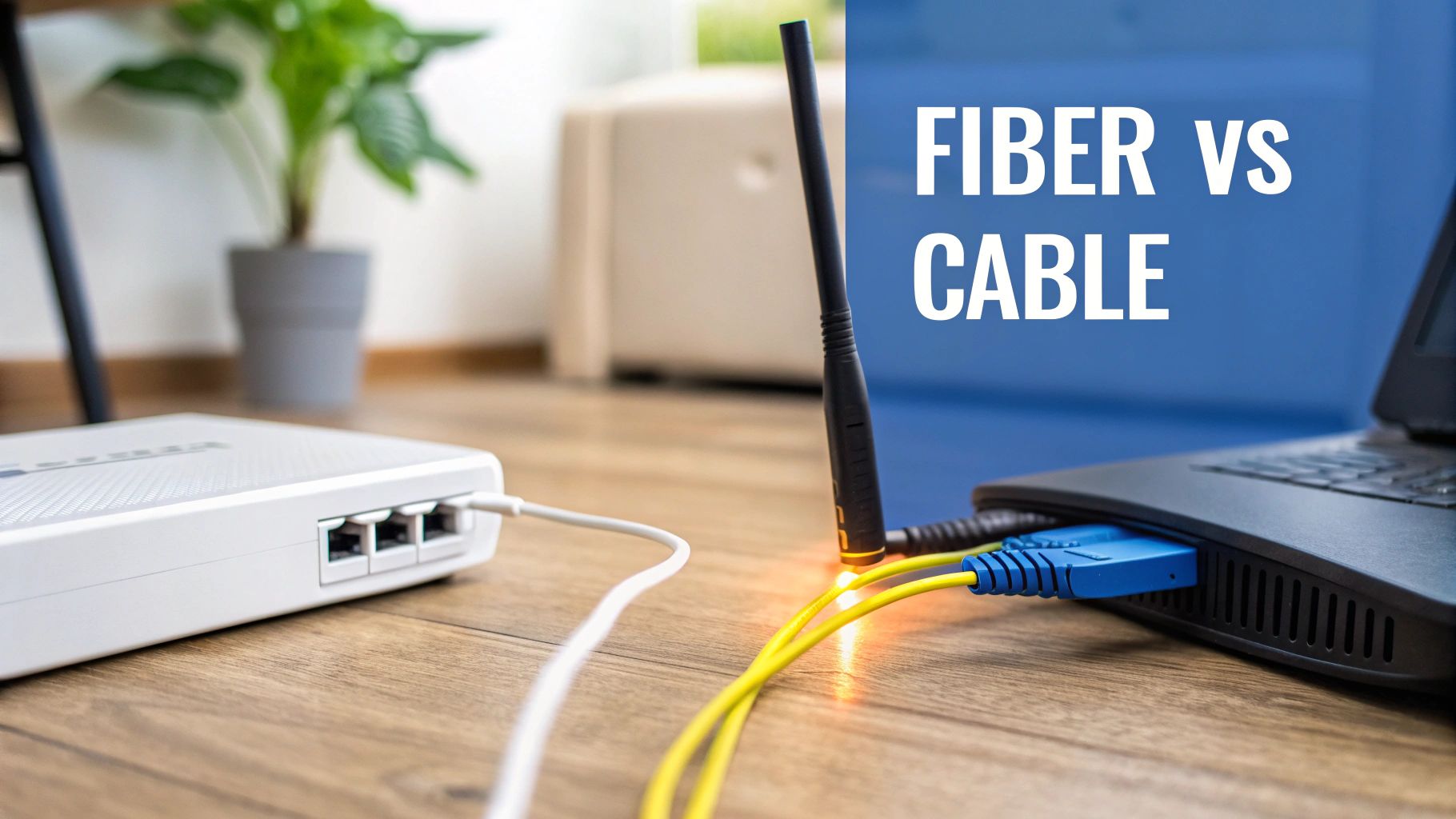
Cable internet runs on the same coaxial network that was originally built for TV. It works by sending data as electrical signals, which is a decent method but has its limits. Because you’re sharing that connection with everyone else in your neighborhood, you’ll probably notice things bog down during peak hours—like evenings when everyone is trying to stream at once.
Fiber-optic internet is a whole different ballgame. It uses tiny glass fibers to transmit data as beams of light. This is a much faster and more reliable way to move information, which is why fiber can offer symmetrical speeds. That means your upload speeds are just as fast as your downloads, something cable just can’t match. To see exactly how this works, check out our guide on what is fiber-to-the-home.
Technology and Performance At a Glance
The way data is transmitted directly affects your day-to-day experience, from glitch-free video calls to competitive online gaming. Fiber's glass strands are also much more resilient against bad weather or electrical interference, making the connection far more stable than old-school copper cables.
Key Takeaway: Fiber internet is built from the ground up purely for data, delivering consistent, top-tier speeds. Cable uses older infrastructure that has to split its bandwidth between TV and internet, which often means slower uploads and frustrating slowdowns when everyone is online.
Here’s a quick rundown of how the two technologies stack up. If you're a business owner, you might also find this an ultimate business comparison of fiber optic vs cable internet helpful for a deeper dive.
Fiber vs Cable a Quick Comparison
Let's break down the essential differences at a glance.
| Feature | Fiber Internet | Cable Internet |
|---|---|---|
| Technology | Light signals via glass strands | Electrical signals via coaxial cable |
| Download Speed | Up to 2 Gbps and beyond | Typically 50 Mbps – 1 Gbps |
| Upload Speed | Symmetrical (matches download) | Asymmetrical (much slower) |
| Reliability | High; immune to interference | Moderate; prone to congestion |
| Latency | Very Low | Low to Moderate |
As you can see, fiber optic technology is engineered for superior performance across the board, from raw speed to connection stability.
How Symmetrical Uploads Define the Speed Debate
When most people talk about internet speed, they're usually just looking at one number: download speed. And sure, that’s important for watching Netflix or scrolling through websites. But that's only half the story. The real game-changer in the fiber versus cable debate is symmetrical speed, a feature you only get with fiber that completely changes how you use the internet.
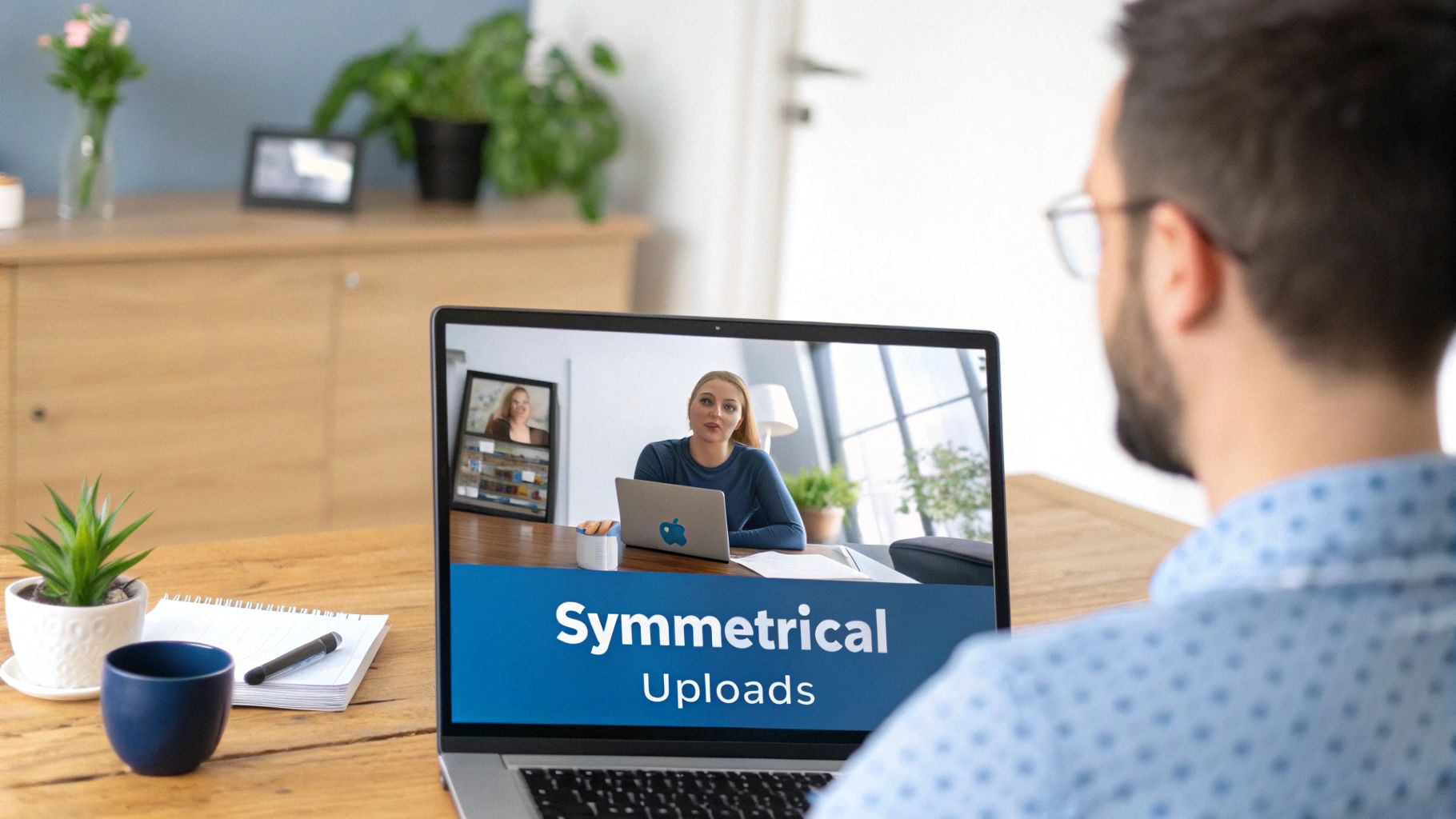
Simply put, symmetrical speeds mean your upload and download speeds match. A 1 Gig fiber plan from Premier Broadband gives you 1,000 Mbps for downloading and 1,000 Mbps for uploading. This balance is everything, because so much of what we do online is a two-way conversation.
Cable internet, on the other hand, is built on older coaxial technology that runs on asymmetrical speeds. It's designed to give you fast downloads but often leaves you with an upload speed that's just a tiny fraction of that—sometimes only 1/10th of your download speed. For a lot of what we do today, that creates a serious bottleneck.
The Real-World Impact of Asymmetrical Cable Speeds
Picture this: you're on a big video conference call for work. With a cable connection, you can see your coworkers in perfect HD. But when it's your turn to talk, your video freezes, gets pixelated, or drops out completely.
That's your upload speed failing you. Your connection is struggling to send your video feed back out to the server in real-time. It just can't handle the demand, leading to those awkward, frustrating interruptions.
Here are a few other places where slow cable uploads cause headaches:
- Remote Work: Trying to send a large presentation to your team's cloud drive takes forever, holding everyone up.
- Online Gaming: Your character lags at the worst possible moment because your actions aren't getting to the game server fast enough, even if your download speed is blazing fast.
- Content Creation: Uploading a high-res video to YouTube or streaming on Twitch becomes painfully slow, or worse, forces you into a low-quality broadcast that viewers won't stick around for.
For anyone creating content or streaming live, symmetrical uploads are absolutely essential for a smooth, professional-looking broadcast. If you're looking to get into streaming, make sure your internet is ready for it. For tips on getting everything set up, check out a comprehensive guide to setting up your stream.
Why Fiber Delivers Effortless Symmetrical Performance
Fiber optic technology was built from the ground up for massive, two-way data transfer. By sending data as pulses of light through glass strands, it has an incredible capacity that doesn't need to favor one direction over the other.
This advantage makes everyday online tasks feel seamless. That same work video call on a fiber connection is crystal-clear both ways. Backing up your family photos to the cloud is done in minutes, not hours.
The Creator's Advantage: If you create, share, or collaborate online, symmetrical fiber isn't just a nice-to-have—it's a necessity. It breaks through the digital ceiling that cable's upload limits create, letting you produce and share content as fast as you can think of it.
The difference in performance isn't small; it's massive. A 2025 Ookla report showed that the median upload speed for top cable providers was just 64.40 Mbps. In stark contrast, leading fiber providers delivered a median upload speed of 595.75 Mbps—that's more than nine times faster.
Knowing what makes for a solid upload capability is the key to choosing the right internet. For a full breakdown, you can learn more by reading our guide that answers the question, "what is a good upload speed?"
Ultimately, the choice between fiber internet vs cable comes down to how you actually use the internet. If you only ever consume content, cable might be enough. But if you participate, create, and collaborate online, symmetrical fiber is the only technology that can truly keep up.
Why Consistency Matters More Than Speed: Reliability, Latency, and Congestion
Raw speed numbers grab headlines, but what really defines a great internet connection is consistency. The day-to-day experience comes down to three things: reliability, latency, and network congestion. This is where the old-school technology behind cable internet just can't keep up with modern fiber.
Fiber's design gives it a huge advantage right out of the gate. Data travels as beams of light through glass strands, making it almost untouchable by the common issues that cause cable connections to drop or slow down.
This means you get a stable, predictable connection you can actually depend on. The little things that degrade a cable signal just don't register on a fiber network.
Understanding Connection Reliability
True reliability isn't just about avoiding a total outage. It's about knowing your connection will be there for an important video call or when you’re about to win a game. The physical difference between copper and glass is what makes this possible.
- Electromagnetic Interference: Cable's copper wires can get scrambled by interference from power lines or even large home appliances. This is a common cause of random slowdowns and fuzzy signals. Fiber is made of glass, so it's completely immune.
- Weather and Environment: Fiber optic lines are built tough. They stand up to extreme temperatures, moisture, and nasty weather. Cable's copper infrastructure is far more fragile and prone to damage during a storm or a cold snap.
- Signal Degradation: The electrical signal in a copper cable weakens over distance, needing amplifiers to keep it going. Light traveling through fiber can go for miles with almost no loss in quality, giving you a much stronger signal at home.
The Critical Role of Latency
You've probably heard gamers talk about "ping." That's latency—the time it takes for data to get from your computer to a server and back. It's measured in milliseconds (ms), but even a tiny delay feels like a huge lag in real-time activities.
Because light travels so incredibly fast, fiber optics deliver ultra-low latency. The signal is faster and more direct than the electrical pulses traveling through a copper wire, which makes your connection feel instantly responsive. For a competitive gamer, this is everything. A low ping means your actions happen immediately, giving you a real advantage over opponents stuck on laggy cable connections.
Gaming and Real-Time Interaction: High latency is the enemy of any real-time application. For a gamer, it's the difference between winning and losing. For a remote worker, it's the awkward delay in a video call that makes conversation feel disjointed and unnatural. Fiber's low-latency performance eliminates this digital lag.
If you're dealing with frustrating delays on your current connection, it's worth figuring out why. Our guide on how to fix high latency can help you troubleshoot.
How Network Congestion Tanks Your Speed
Ever notice your internet slows to a crawl in the evening? That's network congestion, and it's the single biggest headache for cable users. Cable networks are built on a shared loop. You and dozens of your neighbors are all pulling from the same main pipeline. Think of it as a one-lane road with everyone trying to merge at 5 PM.
During peak hours—evenings and weekends—everyone is online streaming, gaming, and working. That shared bandwidth gets stretched thin, and your speeds plummet. That 300 Mbps plan you pay for can suddenly feel like a dial-up connection right when you need it most.
Fiber solves this completely. Most fiber-to-the-home networks give you a dedicated line straight from the main hub to your house. Your bandwidth is yours alone.
Let's look at how this plays out in the real world.
| Scenario | Cable Internet (Shared Loop) | Fiber Internet (Dedicated Line) |
|---|---|---|
| A Weeknight at 8 PM | A family tries streaming a 4K movie, but it keeps buffering because the whole neighborhood is online, bogging down the network. | The same family streams their 4K movie instantly, with zero buffering. Their speed isn't affected by what their neighbors are doing. |
| Remote Work Video Call | A professional's video call freezes up right after school lets out, as all the neighborhood kids jump on to play games. | The professional enjoys a crystal-clear, stable video call all day long, ensuring they can communicate without interruptions. |
This dedicated connection guarantees your performance stays fast and consistent, no matter what time it is or how many people are online nearby. When you're comparing fiber internet vs cable, this freedom from rush-hour traffic is one of fiber's most powerful advantages for any modern home.
Comparing Availability and Regional Access
When you’re weighing fiber vs. cable, speed and performance are huge, but it all comes down to one simple question: can you even get it at your house? For years, this is where cable had the upper hand. It’s a direct result of providers using the same coaxial lines that have delivered cable TV for decades.
For millions of homes, cable is just the default option. This massive, pre-existing network made it easy for providers to start offering internet service without the incredible cost of laying brand new lines.
This head start gave cable a huge chunk of the market. While fiber is a far better technology, its rollout means building an entirely new network from the scratch—a slow, expensive process.
Why Cable Is So Common
Cable's widespread availability is a matter of legacy. Since the groundwork was already in place, providers could connect a huge number of homes quickly. This created a big gap in availability, especially between cities and rural areas.
As of 2025, cable internet reaches roughly 85% of U.S. households and holds the largest market share at around 47%. To put it in perspective, only 8% of people in urban areas can't get cable, but a massive 53% of rural residents still lack access. You can dive deeper into these numbers with some recent broadband statistics. This often makes cable the only high-speed game in town for many communities.
But that's changing fast. Serious investment in fiber networks is closing this gap, with providers like Premier Broadband leading the way to bring future-proof connections to more and more neighborhoods.
The Installation Process: A Clear Divide
The difference in technology also creates a very different installation experience. Getting hooked up with cable is usually pretty simple, while fiber requires a more hands-on, professional setup.
- Cable Installation: Most providers just mail you a self-install kit. You get a modem, plug it into the coaxial jack on your wall, and follow a few instructions. If your home is already wired, it’s quick and easy.
- Fiber Installation: This process is handled by a professional technician. Because it’s a brand-new connection, they have to physically run a dedicated fiber optic line from the street right to your home. They’ll install an Optical Network Terminal (ONT) inside, which turns the light signals into a standard Ethernet connection for your router.
While the professional fiber setup requires a scheduled appointment, it guarantees your connection is perfectly optimized for the best possible performance right from the start. It’s a one-and-done process that gives you a dedicated, modern line built just for internet.
Key Insight: Cable's easy installation is a byproduct of using old TV technology. Fiber's professional setup is an investment in a modern, dedicated connection that ensures top-tier performance and reliability for years to come.
How to Check for Fiber in Your Area
The most important step you can take is to find out what’s actually available at your address. Don't just assume you're stuck with cable because it's always been that way—fiber networks are expanding every day.
Most providers, including Premier Broadband, have a simple online availability checker. Just type in your street address, and you’ll instantly see which plans are available. It’s the fastest way to confirm if our 100% fiber network has reached you yet. Making the switch isn’t just an upgrade; it’s moving to a truly modern internet experience, free from the limits of old, shared cable lines.
Which Internet Type Best Fits Your Lifestyle
Picking between fiber and cable isn't just about the tech specs; it’s a lifestyle choice. The right internet depends entirely on how you use it. Instead of just listing features, let's break down some real-world situations to see which one really meets your needs.
Of course, this all starts with what’s even available where you live. Cable’s older network is pretty much everywhere, but fiber's cutting-edge infrastructure is still expanding.
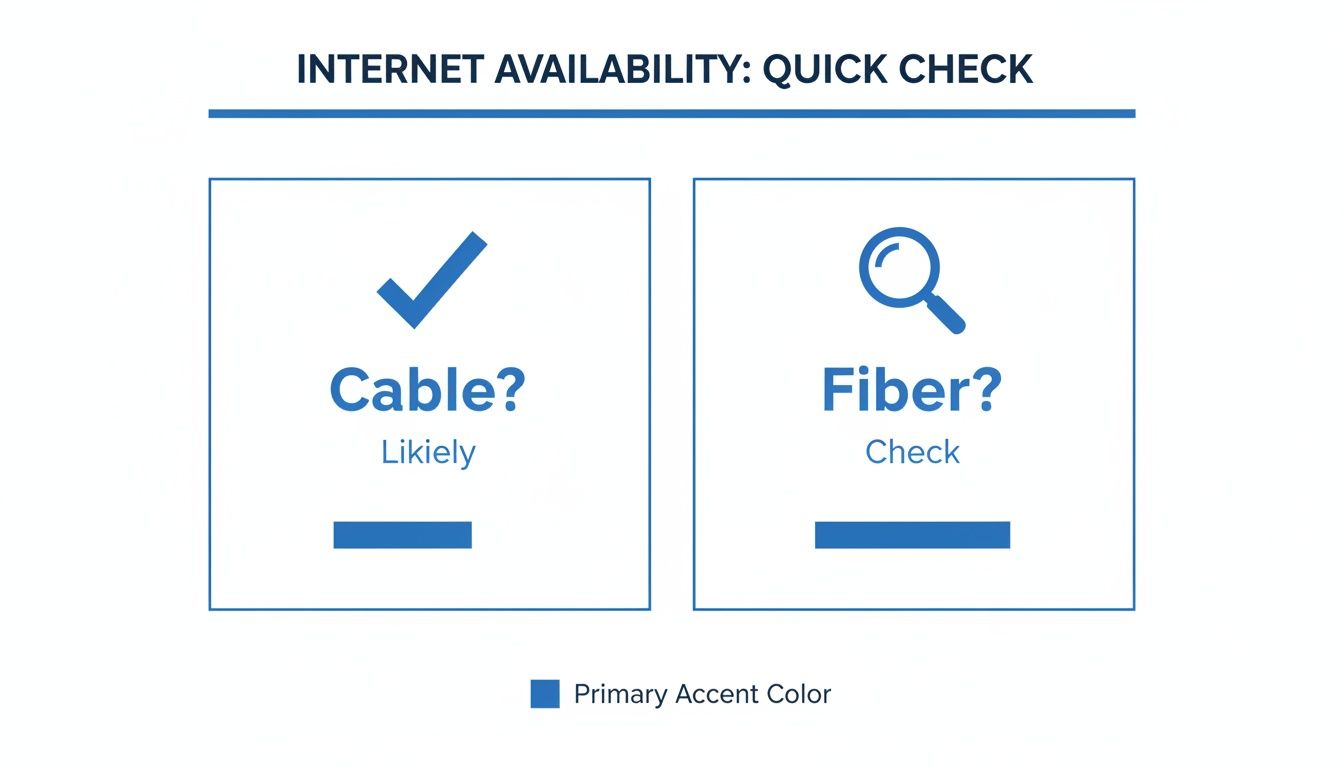
This graphic really shows the first step in the process. Cable is often the go-to, but you owe it to yourself to see if you can get fiber for a truly premium experience.
The Remote Worker and Content Creator
If you work from home or create any kind of digital content, upload speed is everything. It's not just about downloading—it's about sending huge amounts of data out. Think of professionals on constant video calls, designers syncing massive project files, or streamers broadcasting live.
On cable internet, these tasks can grind to a halt. Its design is asymmetrical, meaning it prioritizes download speeds and leaves you with a tiny fraction of that for uploads. The result? Grainy video calls, cloud backups that take forever, and choppy, low-quality live streams.
Fiber internet, with its symmetrical speeds, completely solves this. A 1 Gig plan means you get 1,000 Mbps for downloads and 1,000 Mbps for uploads. That kind of power makes sending big files feel instantaneous and keeps your video stream looking sharp and professional.
The Bottom Line: For anyone working remotely or creating content, fiber isn’t just an upgrade—it's a necessity. The symmetrical performance of Premier Broadband's 100% fiber network delivers the reliable power you need to get things done without frustration.
The Competitive Gamer
When a split-second decision can mean winning or losing, latency is king. For serious gamers, a low "ping" is way more important than sheer download numbers. Latency is that tiny delay between your action and the game's response, and a high-latency connection is a surefire way to lose.
Cable’s older copper wiring and shared network setup can cause unstable latency. When everyone in the neighborhood gets online in the evening, your ping can spike, leading to game-ruining lag that makes competitive play impossible.
This is where fiber optic tech has a huge advantage. Data travels at the speed of light over a dedicated line, giving you ultra-low and rock-solid latency. That near-instant response time lets you react faster than your opponents who are stuck on a congested cable connection. In the fiber internet vs cable battle for gaming, fiber is the undisputed champion.
The 4K Streaming Household
In most homes today, you'll find multiple devices streaming HD content at once. Someone's watching a 4K movie, another person is on a video call, and the kids are on YouTube—all at the same time. This puts a serious strain on your internet connection.
A cable connection often chokes under this pressure due to network congestion. You’re sharing your bandwidth with the whole neighborhood, so your speeds can drop dramatically during the evening "internet rush hour." That’s why your 4K movie suddenly starts buffering just as it gets to the good part.
Fiber's dedicated line fixes this completely. Your bandwidth is yours alone, so it doesn't matter what your neighbors are doing. You get consistent, blazing-fast speeds 24/7, allowing multiple 4K streams, video calls, and downloads to run perfectly without a hitch. If this sounds like your house, you can easily compare home internet plans to find the perfect speed for your family.
Making the Switch: Is Fiber Internet Worth the Upgrade?
When you’re looking at fiber internet vs. cable, it’s about more than just a speed boost. You’re really deciding on the digital foundation for your home. While your old cable internet might seem okay for surfing the web, its outdated technology has a performance ceiling that most modern families are already bumping up against.
Fiber optic technology, on the other hand, was built from the ground up for how we use the internet today—and how we'll use it tomorrow. It’s not just faster; it delivers a fundamentally better, smoother online experience. This all comes down to a few key advantages that older cable networks just can't match.
A Connection Built for the Future
For today's connected home, some things just aren't negotiable. Fiber blows cable out of the water by delivering:
- Symmetrical Speeds: Your uploads are just as fast as your downloads. This gets rid of the frustrating lag when you’re on video calls, playing games online, or backing up important files to the cloud.
- Lower Latency: A more responsive connection means what you do in a game or on a video call happens almost instantly. No more of those annoying delays you get with cable.
- Superior Reliability: Fiber's glass strands aren't affected by the electrical interference and neighborhood network slowdowns that often plague shared cable lines. You get consistent performance, day or night.
These all work together to give you a seamless, frustration-free connection. You can have multiple 4K streams going, handle heavy-duty remote work, and enjoy competitive gaming all at the same time, without your internet even breaking a sweat.
Fiber isn't just an upgrade; it's a completely different standard of internet. You're moving from a shared, congested network to your own dedicated, high-capacity digital pipeline built for modern life.
While cable might be more widely available for now, the performance gap between it and fiber is huge, and it's only getting wider. For any household with growing digital demands—from working at home and online classes to streaming and smart home devices—the case for fiber is a strong one. It’s the only connection that gives you the power, stability, and future-readiness you need to keep up.
If you're ready for an internet that works as hard as you do, the next logical step is to check out Premier Broadband’s 100% fiber network.
Questions We Hear All the Time About Fiber vs. Cable
When you're trying to sort out the fiber internet vs cable debate, a few questions always seem to pop up about the cost, the gear, and what works with what. Here are some straight answers to the most common things we get asked.
Is Fiber Internet More Expensive Than Cable?
While cable companies might catch your eye with a low introductory price, fiber almost always gives you more bang for your buck. For about the same monthly cost, a fiber plan will give you much faster symmetrical speeds and way more reliability.
Plus, cable plans often have nasty surprises like data caps or big price jumps after the promo period ends. With fiber, what you see is what you get, making it the better value for how we use the internet today.
Key Insight: When you look at the actual performance you get for every dollar—especially with those equal upload and download speeds—fiber is hands-down the smarter, more cost-effective choice.
Do I Need New Equipment to Switch to Fiber Internet?
Yes, making the switch to fiber means we'll need to do a professional installation with some new equipment. Our technician will install an Optical Network Terminal (ONT), which is the box that turns the light signals from our fiber optic line into an internet connection your devices can use.
It’s a different piece of technology from a cable modem, which has to translate signals from an old-school coaxial cable. The ONT is your direct link to the pure fiber network.
Can I Use My Existing WiFi Router with Fiber Internet?
Most of the time, yes, your current WiFi router will work with a new fiber connection. But—and this is a big but—your old router could be the weak link holding back your speed.
To really get the full power of the gigabit speeds fiber can deliver, we strongly recommend a newer router that supports Wi-Fi 6. An older router just wasn't built to handle that kind of performance, and you'll be leaving a lot of the speed you're paying for on the table.
Ready to stop dealing with sluggish uploads and a crowded network? Premier Broadband runs on a 100% fiber network built for how you live and work today. Check your availability and see what a real internet connection feels like.